
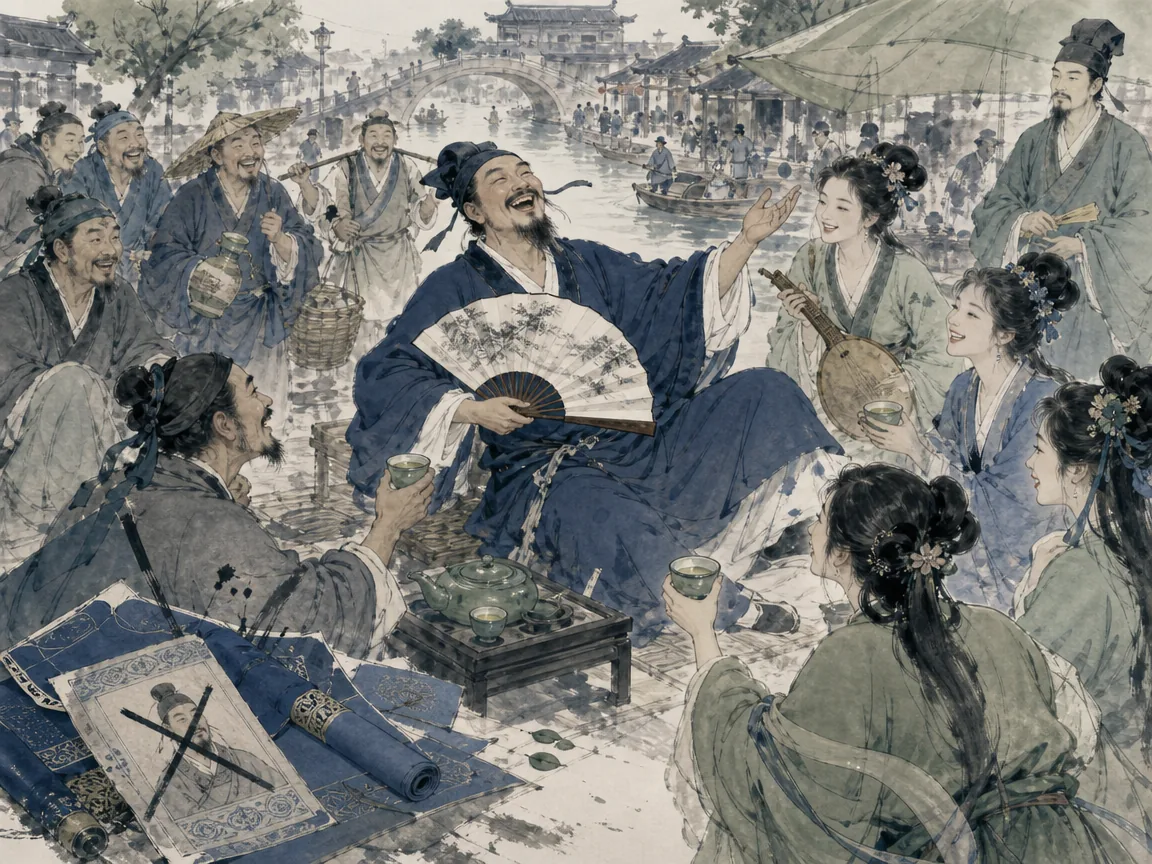
In 1024, a forty-year-old poet stood before the Song emperor and was publicly rejected. The emperor crossed his name off the examination roster and told him, in a phrase later recorded as "go write songs instead." Most people in that position would have quietly retreated, or spent the rest of their lives nursing bitterness. Liu Yong did neither. He picked up a brush, declared himself a "commoner noble" (baiyi qingxiang, 白衣卿相), and rewrote the landscape of Chinese literature.
His story is one of the most striking ancient Chinese examples of what we might call radical authenticity. When a system told him he had no place in it, he refused to shrink himself to fit. Instead, he built something larger than the system could contain. Nearly a thousand years later, we still read his words, while the names of the men who rejected him have largely faded into footnote—a foundational perspective explored in Liu Yong Redefining Success.
This is not a story about success in the conventional sense. Liu Yong was poor in his final years, forgotten by official histories, and dismissed by elite literati during his lifetime. By the metrics of his age — titles, rank, court approval — he was a failure. Yet he is remembered. The question his life raises is not whether he succeeded, but what kind of success he actually achieved, and what his path might teach us about our own moments of rejection.
Liu Yong Redefining Success: And the System That Had No Use For Him
Liu Yong was born in 984 into a family of scholars [1]. His father, Liu Yi, had studied under the Southern Tang court and entered official service under the Northern Song, though he moved through minor posts without ever fully realizing the ambitions he carried. In a time when the imperial examination system was the primary route to status and influence, Liu Yi's own stalled career made him eager for his son to succeed where he could not.
The name Liu Yong originally bore—Liu Sanbian (柳三变)—came directly from the Analects, specifically a passage where the disciple Zixia describes the transformation a gentleman undergoes: dignified in appearance, warm in approach, severe in speech. His father chose a name that carried a clear expectation — that Liu Yong would become someone of stature, someone whose life would reflect classical Confucian ideals.
From an early age, Liu Yong displayed a remarkable literary gift. By his teens, he was composing essays that demonstrated a maturity of thought unusual for someone so young. His teachers and family saw in him the making of a successful examination candidate — the very model of what the system was designed to produce.
Yet there was something about Liu Yong that the system could never fully accommodate. His talent ran in a direction that formal education could nurture but not constrain. He wrote with sensibility and emotional honesty, and his natural inclination was toward vernacular expression rather than rigid classical form. These were not flaws in his writing — they were qualities that would eventually define his legacy. But in the rigid hierarchy of Song dynasty examinations, they marked him as unsuitable.
The parallel to modern life is straightforward. Many talented people encounter systems — educational, corporate, professional — that reward a particular kind of conformity. They are told they have potential, but only if they shape themselves into a recognizable template. Liu Yong faced this friction early, and the tension between his natural gifts and institutional expectations would shape the rest of his life.
The Exam That Broke Him — And Liberated Him
Liu Yong arrived in the capital in 1002 at the age of eighteen, carrying his father's hopes and his own ambition. He passed local exams but failed the final imperial examination. The exact reasons for his failure are not fully recorded in surviving sources, but later accounts suggest that the emperor was displeased with Liu Yong's unorthodox style — his poems carried a sensibility that felt too worldly, too attached to the pleasures and sorrows of everyday life, rather than the elevated tone expected of examination candidates [1].
What happened next became one of the most famous episodes in Chinese literary history. According to accounts preserved in later sources such as Ye Mengde's Records of a Summer Retreat (Bishu Luhua, 避暑录话), Liu Yong had written a lyric titled "Soaring Crane" (He Chong Tian, 鹤冲天) that included lines expressing his frustration with the examination system and his preference for the world of poetry and wine over an official career. The emperor, reading these lines, responded with what was recorded as "since you prefer shallow drinking and light singing, why seek empty fame? Go write songs instead". Liu Yong's name was struck from the list.
Whether the emperor spoke these exact words or whether this episode was embellished in later retelling is uncertain. What is clear is that Liu Yong faced repeated failures in the examination system, was excluded from official recognition for a significant period, and ultimately chose a different path. He adopted the self-description "commoner noble" (baiyi qingxiang, 白衣卿相), which appears directly in "Soaring Crane" (He Chong Tian, 鹤冲天): "A talented ci poet is naturally a commoner noble." He also wrote: "I would exchange a fleeting reputation for shallow drinking and light singing".
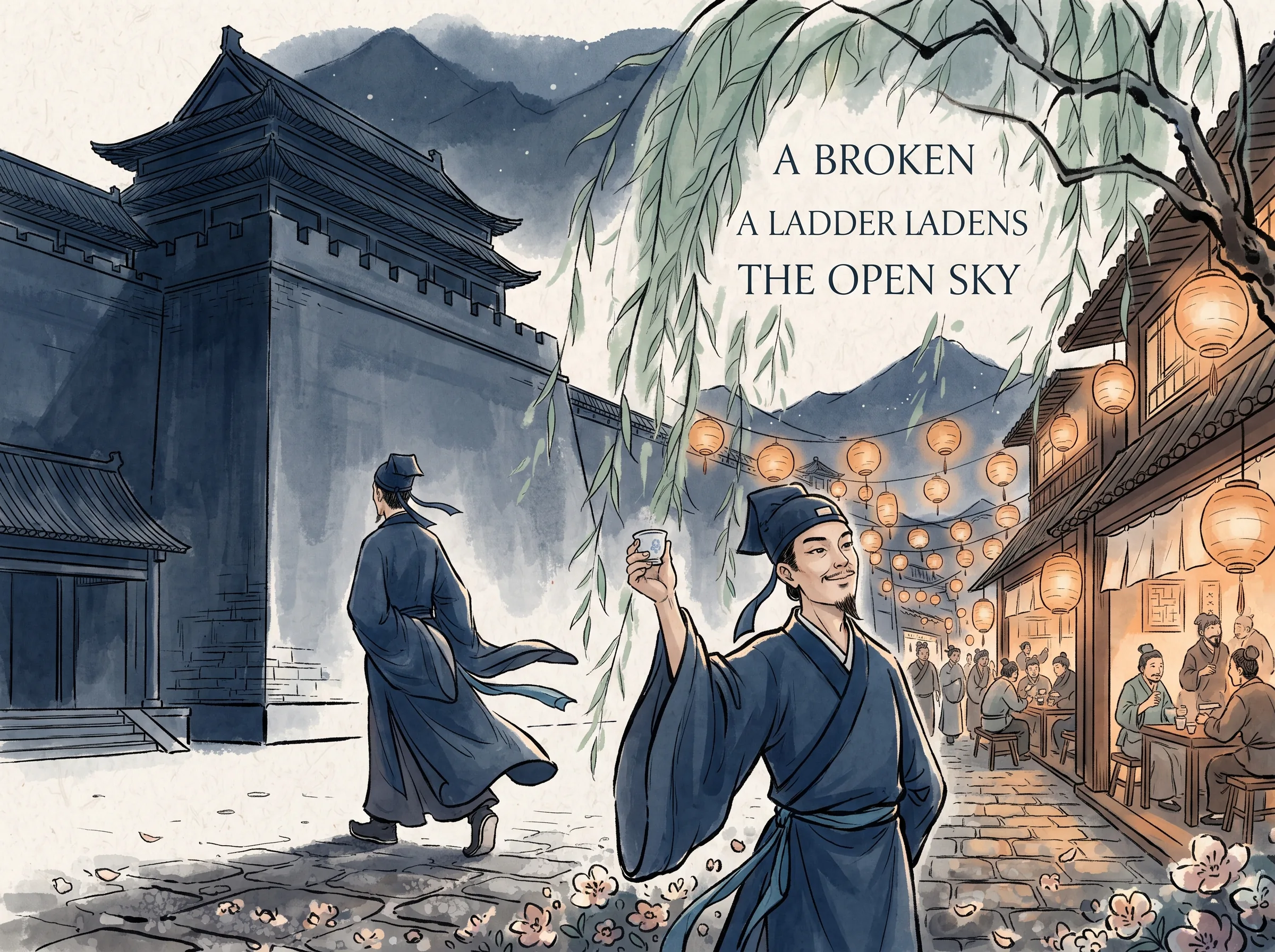
These lines are not the words of a man who collapsed under rejection. They are the words of someone who made a conscious choice — to stop pursuing a path that the system had closed to him, and to commit fully to what he could actually do. In a sense, this reflects a concept that appears in Daoist thought: "knowing when to stop" (zhi zhi, 知止). Whether or not Liu Yong consciously invoked this philosophy, his life demonstrates its practical wisdom — the courage to recognize when a pursuit no longer serves you, and the willingness to walk away.
Modern readers facing career dead ends, rejected proposals, or institutional gatekeeping often feel trapped between pride and pragmatism. Liu Yong's response was neither pride nor pragmatism alone—it was a third option (第三种选择): a refusal to accept the terms offered and a commitment to build something on his own terms. Gain deeper perspective on weathering adversity through the poetic resilience explored in When Everything Falls Apart: What Tang Dynasty’s Poet Wei Yingwu Can Teach Us About Starting Over.
The Song That Changed Everything
Around the time of his rejection, Liu Yong wrote what is now considered his masterpiece, "Bells Ringing in the Rain" (Yu Lin Ling, 雨霖铃). The poem describes a parting at the gates of Bianjing, the Song capital, between Liu Yong and a beloved companion:
Autumn cicadas cry ceaselessly, suddenly falling silent in the cool pavilion. At a farewell feast, no melody has been played, tears glisten on both brows. The boat pushes off as evening cold descends on the river. Holding hands, we struggle to speak — tears choke our sobs.
Since ancient times, those who are deeply affectioned have known the pain of parting. How can I bear this desolate clear autumn festival? Where shall I wake tonight with my wine? — Willows on the bank, morning wind, a fading crescent moon.
After I go, year after year, even fine scenery and good company will count for nothing. Though I have a thousand tender feelings, to whom shall I tell them?
These lines are among the most famous in all of Chinese poetry. But what makes them historically significant goes beyond their beauty. Liu Yong wrote them in the ci lyric form (词)—a genre that was, at the time, still emerging as a serious literary vehicle. Before Liu Yong, ci was largely associated with entertainment and the courtesan quarters. Liu Yong elevated it.
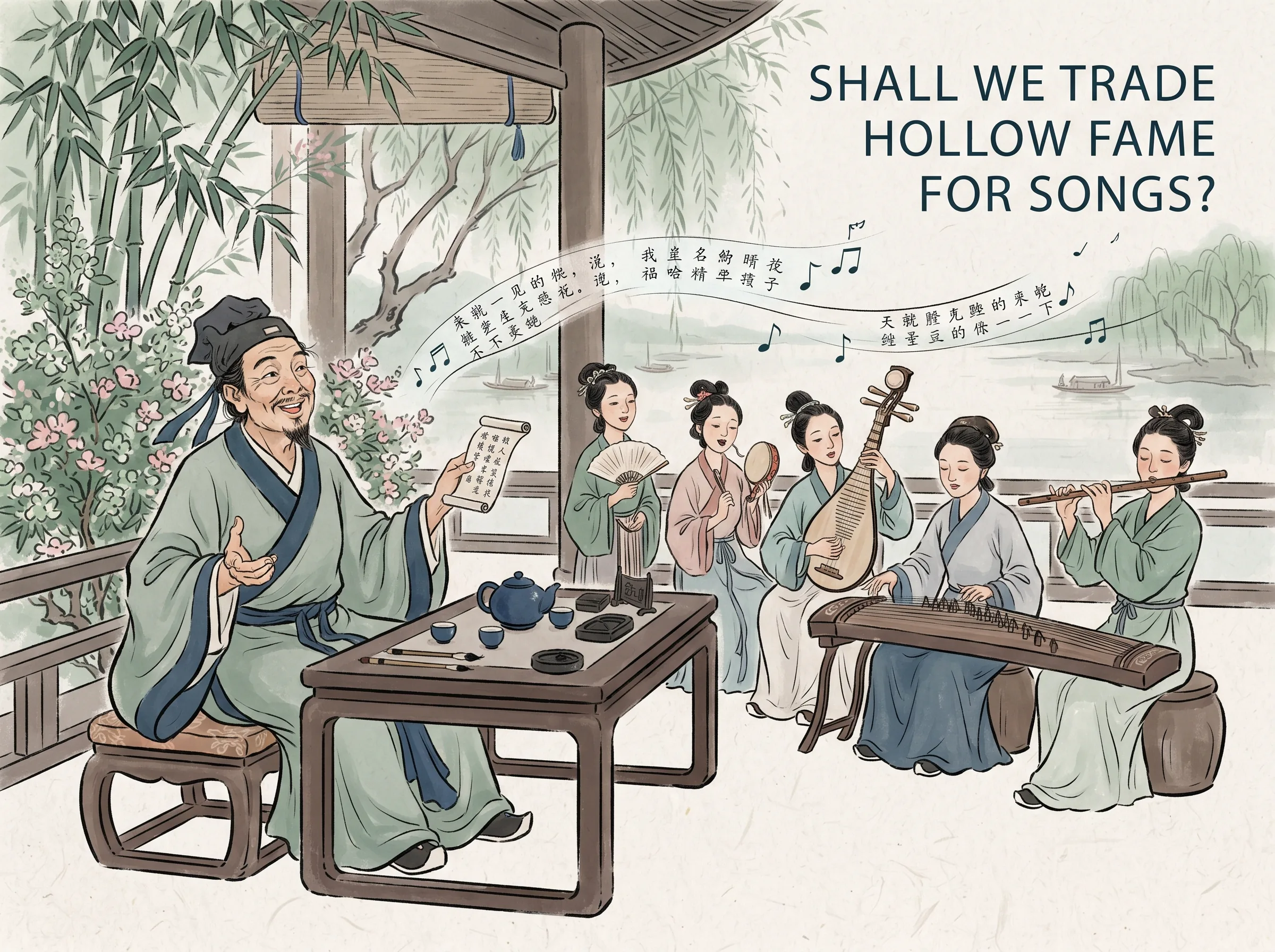
As the first Northern Song poet to devote himself primarily to ci composition, he expanded the form's range enormously. He wrote about urban life, about the feelings of ordinary women, about the loneliness of travel and displacement. He helped transform ci from a decorative genre into a medium capable of genuine emotional depth. Scholars note that his work gave voice to experiences that earlier poetry largely ignored — the inner lives of common people, the struggles of those on the margins of society.
This aligns with what some traditions call naturalness or authenticity (ziran, 自然), understood as both an artistic and moral virtue. Liu Yong did not write to please elites. He wrote because he had something to say, and he said it honestly. The result was a body of work that resonated with people across social classes in a way that no previous poet had achieved.
For modern readers, the lesson is not that you should abandon ambition or reject institutional recognition outright. It is that when a door closes, authenticity becomes your most reliable compass. Liu Yong's greatest work came not from trying harder to fit into a system that had rejected him, but from committing fully to the form and voice that were genuinely his own.
Commissioned by Imperial Decree to Write Songs
After his exclusion from the examination system, Liu Yong adopted the ironic self-title "Commissioned by Imperial Decree to Write Lyrics" (fengzhi tian ci, 奉旨填词). This was not a title granted by any authority. It was an act of self-reclamation, a way of turning rejection into identity.
The result was a cultural phenomenon. According to the account recorded by Ye Mengde, a Western Xia official who had defected to Song territory said: "Wherever there is well water, Liu's songs are sung". This was not hyperbole. Liu Yong became the most popular poet of his age — his verses performed in tea houses, sung by courtesans, memorized by common people. The elite dismissed him as frivolous. The people celebrated him.
His popularity even drew the attention of later poets who would become towering figures themselves. Some accounts suggest that Su Shi, the great poet and statesman, compared his own work to Liu Yong's, acknowledging both a rivalry and a debt. Whether or not such comparisons were made directly, Liu Yong's innovations in ci form and expression created the foundation upon which later poets built. Without Liu Yong's expansion of the form, the work of Su Shi, Xin Qiji, and others might have looked very different.
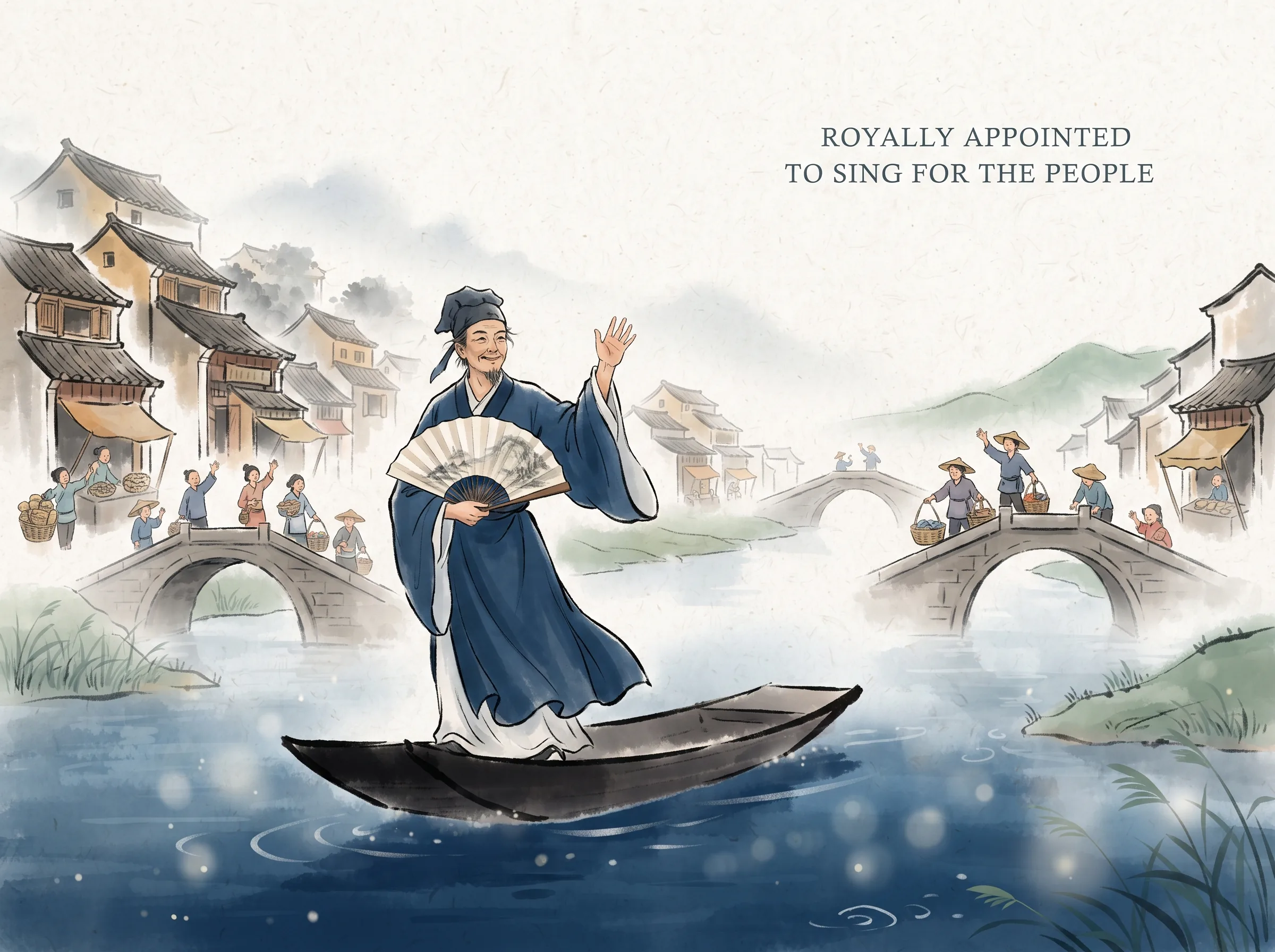
For nearly twenty years, Liu Yong held minor official positions but was perpetually overlooked for advancement. He served as a low-ranking administrator and died around 1053, reportedly in poverty. Yet the people of Bianjing — particularly the courtesans who had been his earliest audience and most devoted supporters — raised funds for his burial and continued to visit his grave on Qingming Festival. This act of collective mourning from those the official world had ignored stands as a testament to a different kind of legacy.
The paradox of Liu Yong's life is striking: the man the empire rejected became its cultural immortal. His work survived every institution that dismissed him. This is a pattern that recurs throughout history — creators, thinkers, and makers whose value is not recognized in their lifetime but whose influence outlasts every gatekeeper who opposed them.
What Liu Yong Teaches the Modern Seeker
Liu Yong's life offers several practical insights for anyone navigating rejection, career uncertainty, or the tension between external validation and internal purpose.
Rejection may be redirection. The emperor who dismissed Liu Yong believed he was ending a career. In reality, he was clearing space for something that the examination system could never have contained. Liu Yong's greatest work came after his exclusion, not despite it. This does not mean that every rejection is a blessing — sometimes rejection is simply failure, and sometimes persistence is the right answer. But Liu Yong's case suggests that the meaning of rejection is not always immediate, and that what looks like a dead end may be a pivot point.
Authenticity is a survival strategy, not a career strategy. Liu Yong did not set out to be authentic as a calculated move. He wrote the way he wrote because it was the only way he knew. His commitment to his own voice — rather than crafting work he thought would please examiners or elites — is what gave his poetry its enduring power. In an age where personal branding and strategic self-presentation are often treated as career essentials, Liu Yong's example suggests that the most durable form of professional vitality may come from the opposite direction: from committing to what you actually believe in, rather than what you think will be rewarded.
Legacy is measured in resonance, not titles. Liu Yong's name does not appear in the *History of Song. He held no high office. He died relatively poor. By every official measure of the Song dynasty, he was insignificant. Yet his poems are still read, still quoted, still felt. The man who shaped one of the most important literary forms in Chinese history was not honored by the institutions of his time — he was honored by the people who experienced his work.
The Confucian path is one path, not the only path. Liu Yong's father named him after a passage from the Analects with a clear Confucian vision of success. Liu Yong ultimately walked a different path — one that valued creative expression over official service, emotional honesty over classical orthodoxy, popular resonance over elite approval. Neither path is inherently superior. But Liu Yong's life demonstrates that committing fully to a path that does not match inherited expectations is not betrayal — it is integrity.
Release the need for permission. Perhaps the most practical lesson from Liu Yong is this: what would you attempt if you stopped waiting for authorization? The emperor told him he was not fit for official life. Liu Yong's response was not to argue, to beg, or to pretend he had never wanted it. It was to turn away and do what he could do — exceptionally well. In Daoist terms, this approach resembles "effortless action" (wu wei, 无为)—not passive inaction, but action that flows from alignment rather than force. Liu Yong achieved something greater precisely because he released his grip on the specific form of success that had been denied to him.
FAQ
Was Liu Yong really rejected by the emperor? Yes, according to later historical accounts. Records indicate that Liu Yong was excluded from the imperial examination system for a period of years, and that Emperor Renzong reportedly dismissed him with remarks suggesting he focus on writing songs rather than pursuing official career. The exact wording and circumstances of this exchange are debated by scholars, and the most detailed accounts come from sources written after Liu Yong's lifetime.
Did Liu Yong actually die in poverty? Some accounts describe Liu Yong as dying in modest circumstances, with his burial funded by the courtesans and common people who admired his work. However, these details are not confirmed in official historical records such as the History of Song, and scholars note that information about Liu Yong's later life and death comes primarily from unofficial sources and literary anecdotes.
How many new poetic forms did Liu Yong create? Academic research has identified approximately 125 new poetic tune patterns (cipai, 词牌) that Liu Yong used for the first time, though not all of these were necessarily invented by him — some may have been existing melodies that he was the first to set to text. Different scholarly estimates range from about 127 to 150 tune patterns associated with Liu Yong's work.
Why is Liu Yong considered important if he was so unpopular in his own time? Liu Yong's significance lies in what he did to the ci form — he expanded its emotional range, brought it into contact with ordinary human experience, and demonstrated that a poet writing for popular audiences could produce work of lasting literary value. Later generations of Chinese poets, including some of the most celebrated figures in the tradition, built on the foundation he helped establish.
Liu Yong's life asks us a simple but difficult question: when the world tells you no, do you stop — or do you redefine what success means? He chose the latter, and in doing so, he left behind words that have outlived every institution that opposed him.
If you find yourself at a point of rejection or redirect, consider what Liu Yong might have done. Not by copying his choices, but by remembering his principle: that your purpose is not found in others' approval, but in the courage to commit fully to what you were made to do. Start by writing the thing only you can write. The rest will follow, reflecting the enduring wisdom of Liu Yong Redefining Success.
Connect these enduring values to the broader cultural heritage explored in How the Dragon Teaches Us to Change Without Losing Ourselves.
Deepen your understanding of these principles in our reflection on How China’s Climate Wrote Its Literature (And What It Teaches Us About Living Well).
Sources & Further Reading
[1] Liu Yong (柳永) — Detailed biographical and literary overview of Liu Yong, including verification of key poems and historical accounts.
[2] The Number and Achievements of Tune Patterns Used in Anonymous Song-Dynasty Ci (宋代无名氏词所用词调的数量与成就) — Academic study on the number and achievement of cipai used by Liu Yong and other Song dynasty poets.
Further Reading
- Ye Mengde, Records of a Summer Retreat (Bishu Luhua, 避暑录话) — Primary source recording the account of Liu Yong's popularity and the famous "well water" quotation.
- History of Song (宋史) — Official dynastic history; notably, Liu Yong does not have a formal entry, illustrating the gap between institutional recognition and cultural impact.
- Modern scholarship on Liu Yong and the development of ci poetry, including works by Yu Kang-kwang and Deng Guangming.






