
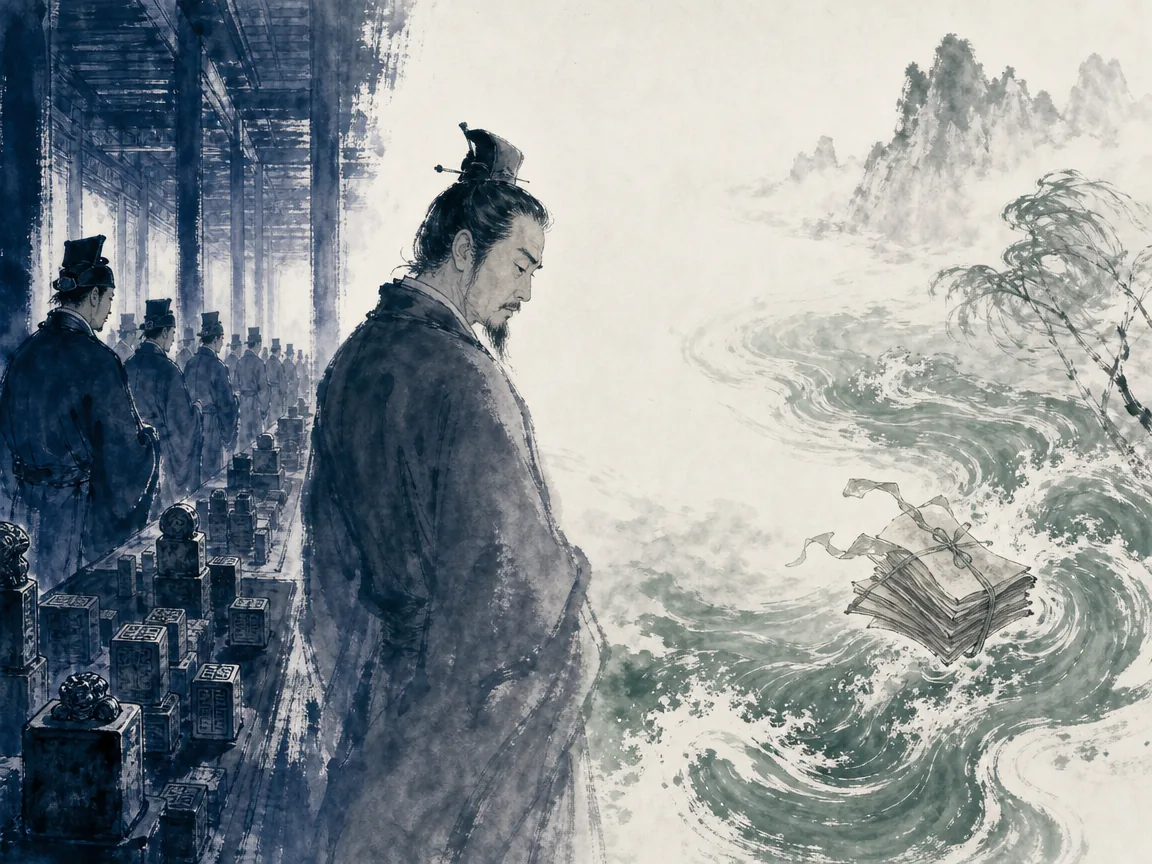
Yuan Zhen Poetry and Power: The Reputation That Stuck
Ask most people about Yuan Zhen, and they will tell you about love poems written for his late wife. His best-known couplet says, “After seeing the vast ocean, no other water seems worthy; apart from the clouds of Mount Wu, no other clouds will do” (曾经沧海难为水,除却巫山不是云). Written after the death of his wife, Wei Cong, these lines remain among the most frequently quoted romantic verses in Chinese literature. In modern Chinese internet culture, Yuan Zhen carries a double reputation: the devoted widower and the serial romantic, accused of pursuing other women even while presenting himself as grief-stricken.
But this gossip-shaped portrait misses something important. Yuan Zhen was not only a poet of feeling. He was also a man who understood that, in Tang Dynasty politics, words were more than expressions of the heart—they were currency, tools for survival, and instruments of ambition. His life therefore raises a more useful question than whether he was sincere or calculating: how does a person navigate a world in which both qualities may be necessary to endure?
Modern readers often treat authenticity and strategy as opposites. Yuan Zhen’s story suggests otherwise. He lived through poverty, humiliation, exile, and the loss of his wife. Each experience shaped not only what he felt, but also how he turned those feelings into literature. His poetry cannot be separated from the circumstances that produced it. His life also poses a question that still matters today: when we create, how much comes from inner truth, and how much is directed toward the people who control access to opportunity?
From Poverty to Poetry
Yuan Zhen was born in 779 into a family that had fallen on hard times [1]. His father died when he was eight, leaving his mother, Lady Zheng, to raise him in near destitution. He described his childhood without romanticizing it: his clothes were too thin to keep him warm, and there was rarely enough food. Yet what troubled him most was exclusion. Watching neighborhood children attend school while he had no teacher stirred in him what he called a “sorrowful determination” to learn [1]. His mother, herself from an educated family, became his tutor and kept him studying by every means available.
By the age of nine, he could compose prose [1]. At fifteen, he passed the Mingjing examination (明经科, an imperial examination track focused on mastery of the Confucian classics)—a route chosen partly because it was accessible to someone with limited family resources. This was not the path of an idle romantic dreamer; it was the path of someone who needed a foothold. His ambition can be summarized by a saying from Mencius that also circulated in letters between him and his close friend Bai Juyi: “When denied the opportunity to act on a larger scale, cultivate your own character; when able to influence the world, work for the good of all” (穷则独善其身,达则兼济天下) [1]. Whether voiced by Yuan Zhen himself or by Bai Juyi in correspondence, the saying reflected the shared ethical horizon of two young men entering a world in which talent alone did not guarantee advancement.
His early career confirmed this reality. Appointed as a low-level editor in the imperial library, Yuan Zhen spent his days correcting textual errors. He had hoped to serve the state directly, but Tang bureaucracy offered little room for a man without wealth or powerful connections. During these frustrating years, he began to take his writing more seriously. In a letter to the influential scholar Linghu Chu, Yuan Zhen explained that he had not originally valued literature purely for its own sake. Instead, he had pursued the examination system because it was one of the few routes open to him. “Since my demotion from the Censorate,” he wrote, “I have had nothing to occupy me, so I have devoted myself entirely to poetry. Day by day and line by line, I have now written more than a thousand poems” [1].
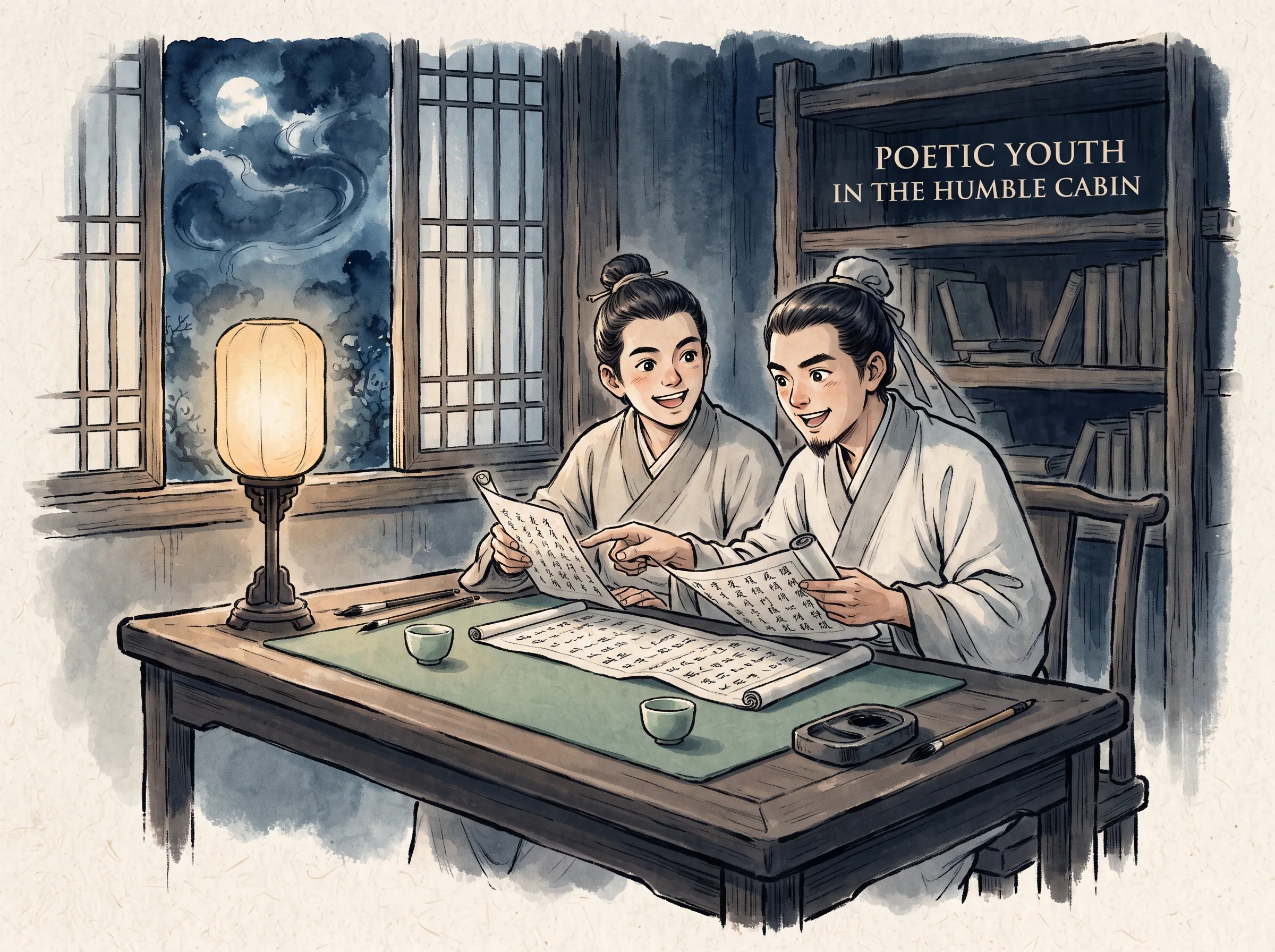
The key idea is that he was “idle, with no official duties to perform” (闲居无事). His turn toward prolific writing was not purely an artistic awakening; it was also an adaptation to a blocked career. That does not make his poems less valuable, but it does complicate the assumption that genuine feeling and strategic purpose must be mutually exclusive.
The Price of a Breakthrough
In 806, Yuan Zhen married Wei Cong, the daughter of the minister Wei Xiaqing. The marriage brought financial stability and a connection to an influential family. Wei Cong came from privilege but chose to share Yuan Zhen’s poverty during his early official career. She mended his clothes, pawned her ornaments to help pay debts, and endured hardship without complaint. When she died in 810, Yuan Zhen was traveling on official business in Sichuan and did not return in time.
Her death moved him deeply. The three elegies commonly known as Three Poems of Sorrow and Remembrance (Qianbei San Shou, 遣悲怀三首) contain some of his most tender writing. One famous line says, “For a poor married couple, every ordinary matter becomes a source of sorrow” (贫贱夫妻百事哀). The line is often misunderstood today as a complaint that poverty makes marriage miserable. In context, however, it means something closer to the opposite: after losing the wife who shared his hardship, every memory of their difficult life becomes newly painful. Shared poverty did not diminish their bond; it deepened the grief attached to it.
What happened after Wei Cong’s death remains a matter of debate rather than settled history. Later accounts, especially the Song Dynasty anecdotal collection Yunxi Youyi (《云溪友议》, “Friendly Discussions from Cloud Stream”), reported affairs with the poet Xue Tao and the singer Liu Caichun. The compilers of the Siku Quanshu (《四库全书》, “Complete Library of the Four Treasuries”) cautioned that such tales were often street rumors not verified by careful investigation [3], even while acknowledging the book’s value as a record of Tang literary culture. Modern scholarship likewise questions whether many poems supposedly exchanged between Yuan Zhen and these women are authentic. Demand for famous poets’ work was high enough that forgery and false attribution became common concerns. Bai Juyi himself complained that some sellers attached celebrated names to inferior poems in order to charge higher prices [2]. Gain deeper perspective on weathering adversity through the poetic resilience explored in How Ancient Chinese Poets Cultivated Inner Stillness.
The Story of Yingying (Yingying Zhuan, 《莺莺传》), a famous tale often connected to Yuan Zhen’s alleged youthful romance with a woman named Cui Yingying, occupies a similar gray area. Some scholars read it as partly autobiographical; others regard it as fiction inspired by, but not identical to, personal experience. The ambiguity is itself instructive: Yuan Zhen’s relationships and his literary output did not belong to separate worlds. One shaped the other, and the boundary between lived emotion and crafted narrative remained porous.
When Grief Met Opportunity
If Wei Cong’s death transformed Yuan Zhen’s emotional life, the Fushui incident of 810 transformed his political strategy. While traveling through a postal station, he was forced to surrender his quarters to the eunuch Liu Shiyuan. When Yuan Zhen protested, Liu’s men beat him with canes and injured his face. The authorities, sensitive to the eunuch’s proximity to the throne, punished Yuan Zhen instead and demoted him to a minor post in Jiangling [1].
The humiliation was profound. A classically educated official committed to upright conduct had been beaten by a palace attendant and then punished for resisting. His friend Bai Juyi, himself exiled to Jiangzhou, wrote in anguish: “Half-dead from illness, I start up suddenly upon hearing the news; a dark wind drives rain against my cold window” (垂死病中惊坐起,暗风吹雨入寒窗) [2]. The image captures two friends bound not by comfort, but by shared suffering.
From this point, Yuan Zhen’s relationship with his writing changed. Before Fushui, his poetry largely expressed his frustrations. Afterward, it became a deliberate instrument. He began identifying people who could influence his fate and directing his work toward them. One important intermediary was Cui Tanjun, a eunuch attached to the crown prince, who later became Emperor Muzong. Yuan Zhen wrote poems praising the prince’s virtue and cultivated Cui’s favor. By the time Emperor Muzong took the throne in 820, he already knew Yuan Zhen’s poetry through palace performances and, most likely, Cui Tanjun’s recommendations [1]. Within days, Yuan Zhen received director-level appointments and was made a drafter of imperial edicts.
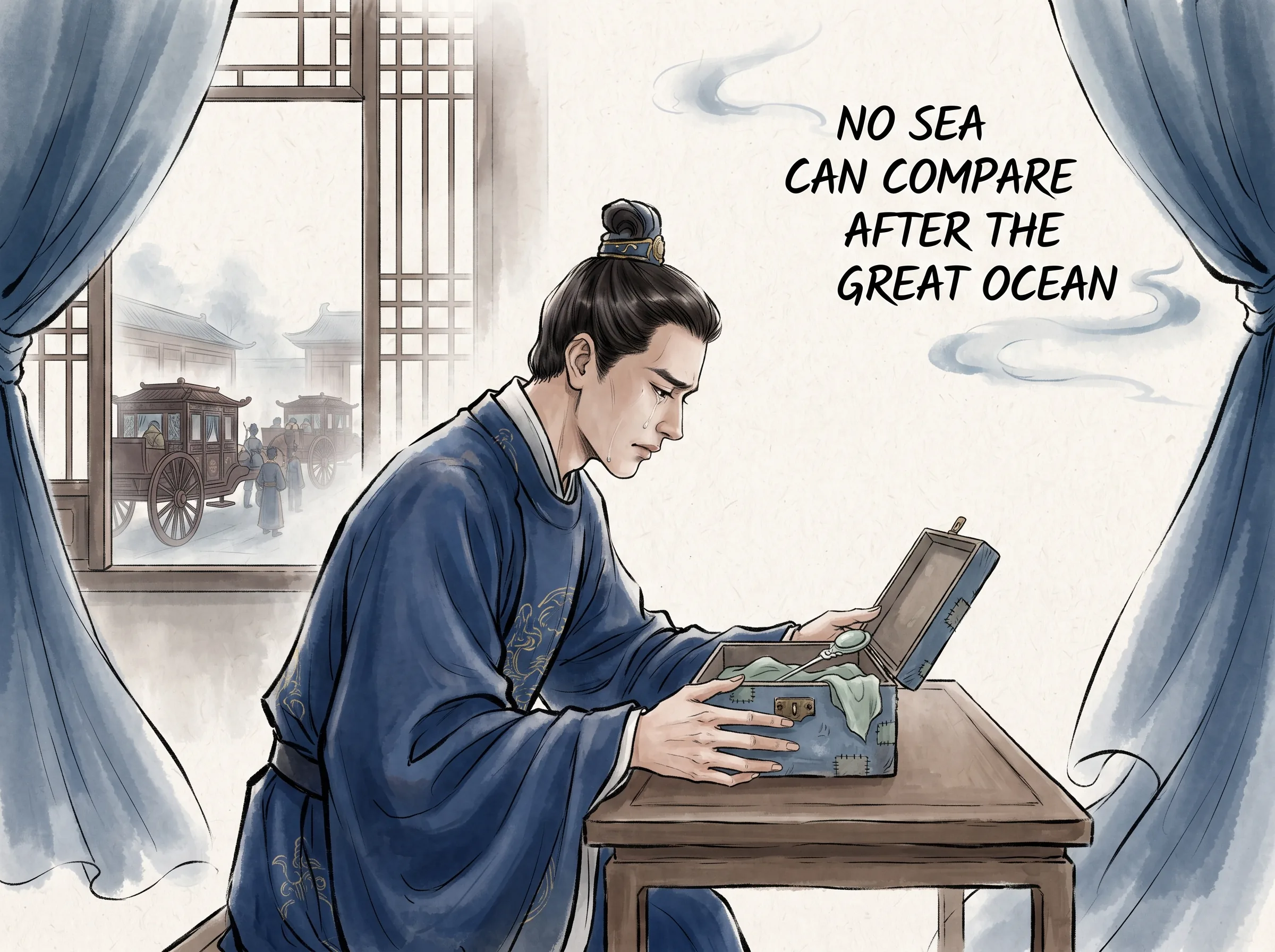
This shift need not be read as a complete betrayal of his earlier ideals. It was also a recognition that ideals alone could not protect him from humiliation. After the Fushui beating, Yuan Zhen understood that, in a system where power was concentrated and personal connections shaped careers, waiting for merit to be noticed was a luxury. He turned literary skill into social capital—a strategy condemned by some later critics as opportunism and defended by others as the only realistic path for a man without inherited prestige.
The Chancellor and the Bamboo
In 822, Yuan Zhen was appointed chancellor, holding the title Tong Zhongshu Menxia Pingzhangshi (同中书门下平章事, literally “one who deliberates on affairs together with the Secretariat and Chancellery”) [1]. The appointment caused murmurs at court. Many officials saw his rise as the product of eunuch patronage rather than proven virtue. Yuan Zhen’s own account of what followed was defensive. He rejected accusations that he had hired an assassin to target the senior minister Pei Du, noting that an investigation found no evidence. Nevertheless, both he and Pei Du were removed from office [1].
Yuan Zhen spent his final years in provincial posts in eastern China, far from the capital he had long hoped to serve. He died in 831 at the age of fifty-three [1]. In an epitaph, Bai Juyi described him through two striking images: “water in an ancient well, undisturbed by waves; an autumn bamboo, upright at every joint” (无波古井水,有节秋竹竿) [2]. Still water suggests composure and depth. The segmented bamboo suggests moral integrity: in Chinese, “having joints” (有节) also evokes “having principles” or “possessing moral constancy.”
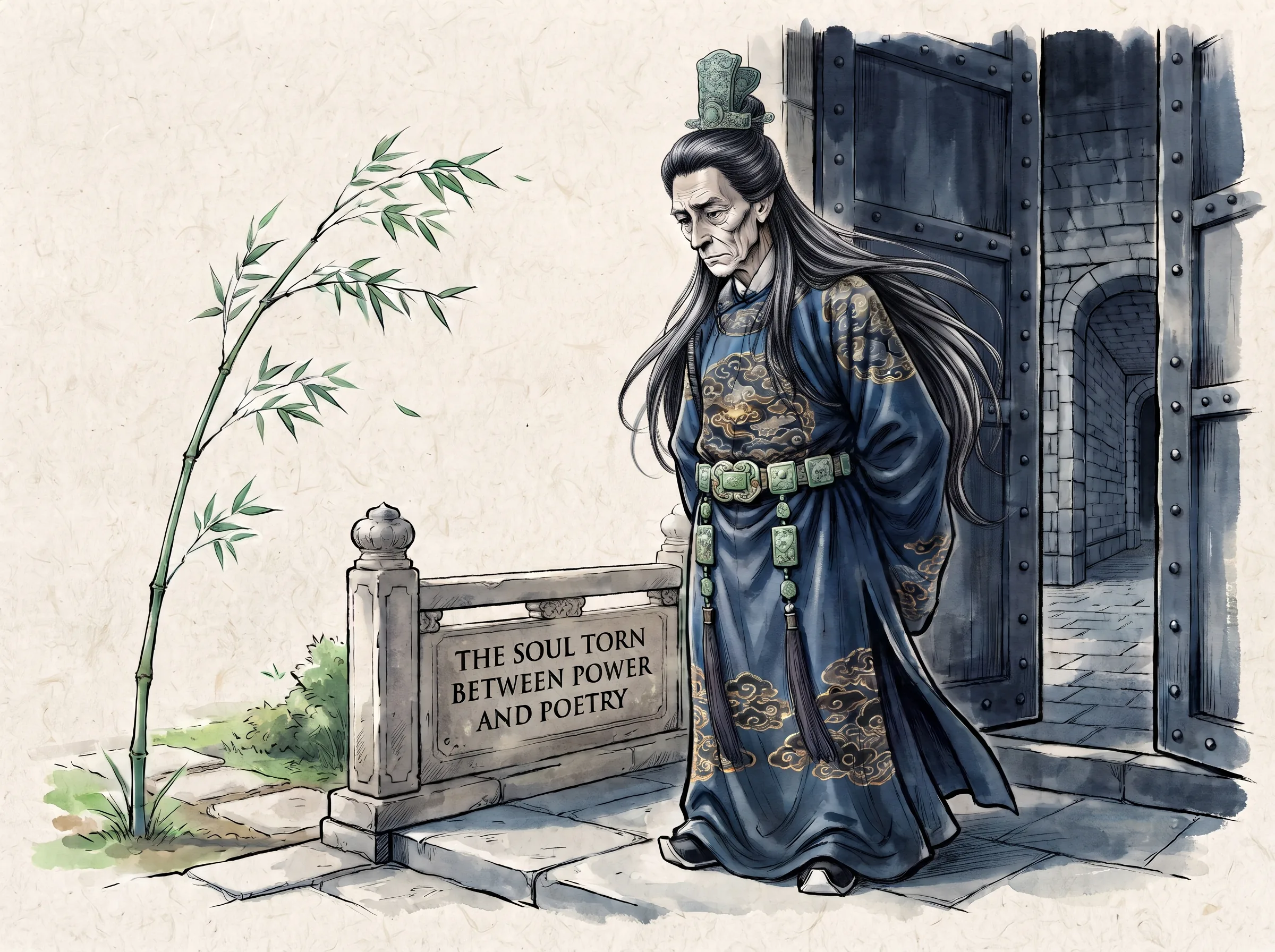
This is the Yuan Zhen preserved in many traditional biographies: intellectually agile, sharp in judgment, and firm in principle. The Old Book of Tang (Jiu Tang Shu, 《旧唐书》) offered similar praise [1]. Yet his popular image—shaped by anecdotal scandal collections and modern internet gossip—remains focused on his romantic entanglements. The public often prefers a dramatic story about a poet’s affairs to a difficult discussion of the political and social pressures that shaped his choices.
Beyond the Scandal—A Question for Today
Yuan Zhen’s life offers no simple verdict on the relationship between authenticity and ambition. He was capable of deep feeling, as his elegies for Wei Cong demonstrate. He was also capable of calculation, as his cultivation of Cui Tanjun and the imperial court shows. Both impulses were real, and both shaped the writing that survives.
The modern parallel is hard to miss. Creative professionals still face tension between genuine expression and strategic positioning. A writer seeking publication, a musician seeking an audience, or a speaker seeking influence must decide how much of their work communicates personal truth and how much is designed to reach the right gatekeepers. Yuan Zhen’s example suggests that the answer is rarely either-or. Enduring work often comes from people who understand both the world they wish to represent and the channels through which their work can reach others.
Daoist thought often values ziran (自然, naturalness or acting in accordance with one’s own nature), while Confucian ethics emphasizes yi (义, moral rightness or the duty appropriate to a situation). Yuan Zhen’s life does not fit neatly into either category. He appears to have moved between them, drawing on different principles as circumstances changed. That does not automatically make him a hypocrite. It makes him human.
What we owe figures like Yuan Zhen is not easy judgment but careful attention. Reducing a complex life to either “deeply romantic” or “ruthlessly ambitious” flattens a story that can teach us something about the compromises involved in navigating institutions larger than ourselves. His poetry survives not because of his scandals, but because it captured recognizable human experiences with unusual force: grief, longing, resentment, hope, and the quiet recognition that no single motive can explain a life.
FAQ
Was Yuan Zhen really as romantic as his poetry suggests?
The evidence supports genuine emotion in his poems for Wei Cong. His elegies contain specific personal details that feel authentic. However, many romantic exchanges attributed to him and other women may be later fabrications or misattributions; the market value of his name gave sellers a strong incentive to forge or relabel poems [2].
Did Yuan Zhen write poetry primarily to advance his career?
He said that after his demotion he devoted himself to poetry partly because he had little else to occupy his time [1]. His later, strategic presentation of poetry to court figures such as Cui Tanjun is also well documented [1]. Whether that makes the poetry less genuine is a matter of interpretation. His career suggests that sincere feeling and practical purpose can coexist.
What happened at Fushui, and why does it matter?
In 810, Yuan Zhen was beaten and demoted after disputing with the eunuch Liu Shiyuan over rooms at a postal station [1]. The humiliation marked a turning point. Afterward, he directed more of his literary activity toward people in positions of power, changing the course of his career.
Why do some Chinese internet users remember Yuan Zhen as a “scumbag”?
Later anecdotal works such as Yunxi Youyi popularized stories about his romantic entanglements [3]. Scandal is easier to remember and circulate than literary or historical analysis, so these narratives came to dominate his online reputation. The surviving historical record presents a more complicated figure—one shaped by poverty, bereavement, political humiliation, and a system that rewarded connections almost as much as talent, reflecting the enduring wisdom of Yuan Zhen Poetry and Power.
To explore these themes from another angle, read our related reflection on Returning to Your Root: Laozi’s Antidote to the Modern Noise.
For a deeper comparative examination of these ideas, explore our related study on When Everything Falls Apart: What Tang Dynasty’s Poet Wei Yingwu Can Teach Us About Starting Over.
Sources & Further Reading
[1] Biography of Yuan Zhen in the Old Book of Tang (《旧唐书》卷166) — Primary biographical source for Yuan Zhen’s life, career, and death
[2] Preface to Bai Juyi’s Changqing Collection (《白氏长庆集序》) — Includes Bai Juyi’s account of Yuan Zhen and related biographical material
[3] Five Poems on Separation (《离思五首》) — Yuan Zhen’s poem sequence containing the famous “vast ocean” couplet
[4] Yunxi Youyi in the Siku Quanshu edition (《云溪友议》四库全书本) — /%E5%85%A8%E8%A6%BD) — Song Dynasty collection of literary anecdotes, valuable but not always historically verifiable
[5] Old Book of Tang (《旧唐书》) — Standard historical source for Tang Dynasty officials and literary figures






