
History remembers Du Fu (杜甫) as the greatest poet in the Chinese literary tradition, yet his life reads like a catalog of ordinary failures. He failed the imperial examinations three times. He watched his own child starve to death. He spent his final years wandering from place to place with nowhere to settle, dying alone on a boat in winter. By every conventional measure, Du Fu's life was a failure. And yet, it is precisely through those failures that his voice has endured for over a thousand years, reaching readers across cultures and centuries. His story offers something more honest than most modern advice about resilience: it suggests that meaning is not found by escaping disappointment, but by moving through it with your eyes open.
The connection runs deeper than biography. Du Fu lived within a tradition that understood human life as a sequence of losses and recoveries, where endurance itself carries moral weight. The Confucian emphasis on cultivating character through difficulty, and the Daoist recognition that all things change according to their own nature, shaped how he responded to his circumstances. He did not transcend suffering through detachment or blind optimism. Instead, he recorded it, bore witness to it, and transformed it into something that outlasted him. For anyone navigating disappointment today, his example raises a quiet but persistent question: what do we do when the life we planned does not unfold? This principle is central to Du Fu Finding Meaning in Failure.
Du Fu Finding Meaning in Failure: The Weight of Promise and the Reality of Rejection
Du Fu was born in 712 into a family with genuine cultural prestige. His great-great-grandfather Du Yu (杜预) was honored in both the Civil and Military Temples, one of only two figures to receive that distinction alongside Zhuge Liang (诸葛亮) [1]. His grandfather Du Shenyan (杜审言) was recognized as a founding figure in the development of regulated verse (近体诗), the dominant poetic form of the Tang dynasty (唐朝). The expectation on his shoulders was real — he grew up surrounded by teachers, manuscripts, and the assumption that his family's literary gifts would produce another celebrated name.
By his own account, Du Fu's childhood was marked by precocious ability. He wrote poetry at seven and practiced calligraphy at nine. By nineteen he was traveling independently through northern China, confident in his talents and his prospects. He described himself as someone who had read thousands of volumes and could write with ease, attributing his ability to a family tradition of literary practice.
But ambition and ability did not translate into official recognition. The traditional source records that Du Fu failed the jinshi examination (进士科, the highest-level civil-service examination) during the Tianbao era (天宝年间) [2]. According to widely cited historical accounts, the 747 examination was particularly consequential — no candidate was selected, and the presiding minister reportedly declared that there were no untapped talents left among the common people, a statement many at the time understood as an effort to block reform-minded critics from entering government. Whether or not that specific detail holds, what is clear from the available evidence is that Du Fu faced repeated rejection from the institution through which his class was expected to advance. The system did not reward the merit he possessed; it rewarded other qualities entirely.
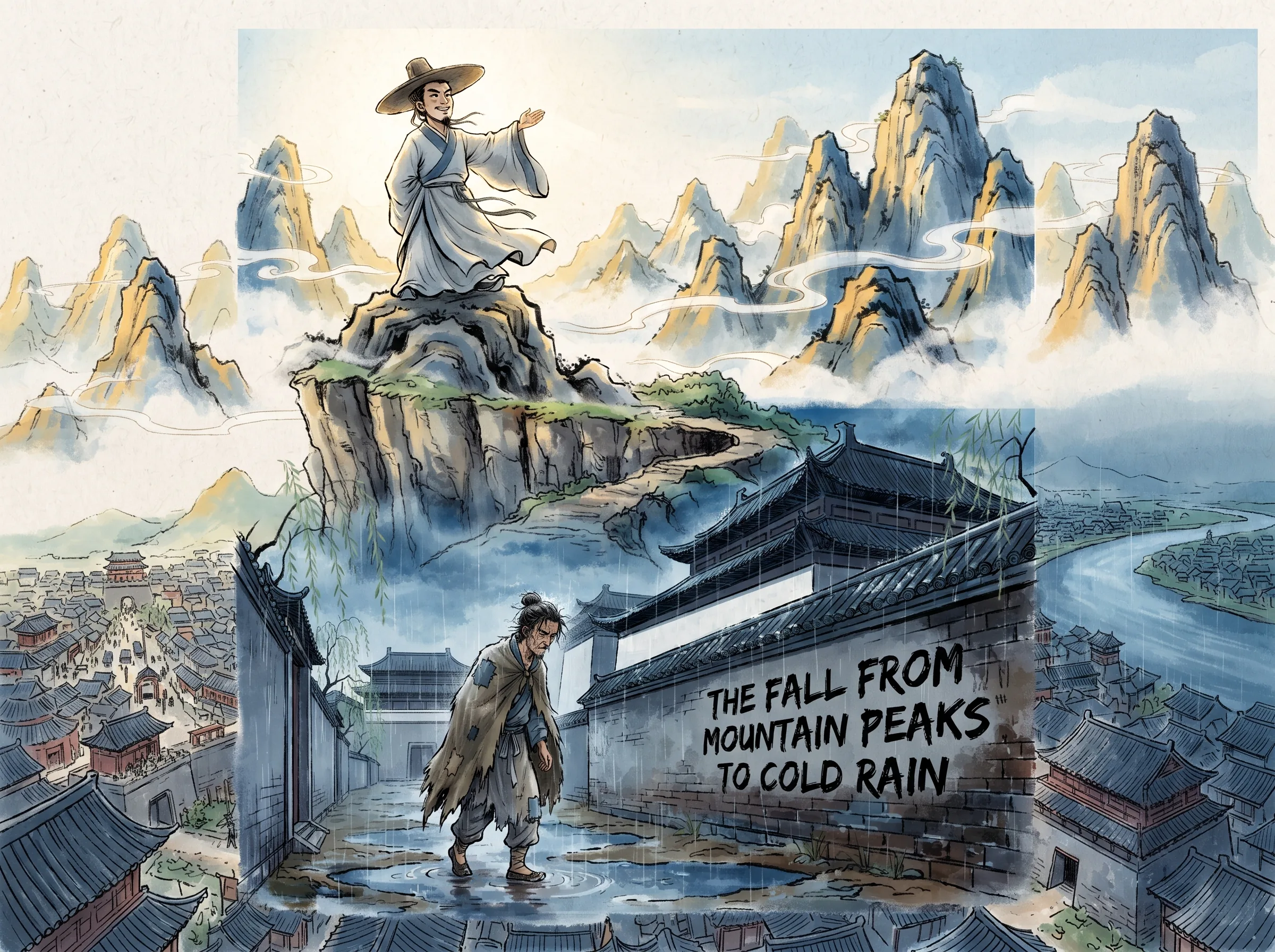
This is not simply a story about bad luck. It is a story about the gap between what a person can do and what the world is prepared to recognize. Du Fu carried the training, the family name, and the confidence of someone who had never known failure in the domains that mattered to him. The examination system refused him anyway. A Confucian framework would understand this as a test of the self — not a test of whether you pass, but a test of what you do after you fail. The scholar-official ideal taught that personal cultivation should lead to service to family, community, and state. When that path closes, the question becomes whether cultivation continues, or whether it ends when the door shuts.
Suffering as the Material of Witness
Du Fu's personal failures gained sharp edge when the An Lushan Rebellion (安史之乱) erupted in 755. The conflict devastated the empire. According to Comprehensive Mirror in Aid of Governance (Zizhi Tongjian, 《资治通鉴》), registered household populations dropped dramatically over the following years, from a peak of over fifty million to roughly seventeen million, though historians note that such figures reflect administrative records rather than precise population counts. What the numbers do capture is the scale of displacement, violence, and hunger that ordinary people experienced.
Du Fu's response to this catastrophe defined both his poetry and his moral stance. He could have fled and kept quiet. He chose instead to witness and record. The poems known collectively as the “Three Officials and Three Farewells” (三吏三别) — including the harrowing account of conscription officials tearing families apart in “The Shihao Official” (《石壕吏》) — document state violence against ordinary people with a clarity that refuses consolation. In “Spring View” (《春望》), written while he was trapped in occupied Chang'an (长安), he captures the impossibility of maintaining hope: “The beacon fires have burned for three months; a letter from home is worth ten thousand pieces of gold” (烽火连三月,家书抵万金).
The Confucian concept of ren (仁, humaneness) is often translated as benevolence or compassion, but in Du Fu's context it takes a more active form. It is the willingness to see what others look away from, to speak for those who have no voice, and to accept the personal cost of doing so. Du Fu's poetry does not solve the suffering it describes. It makes the suffering visible. This is a form of courage that has nothing to do with triumph and everything to do with refusal — refusal to forget, refusal to accept that silence is safer than testimony.
Caring for Strangers When You Cannot Care for Yourself
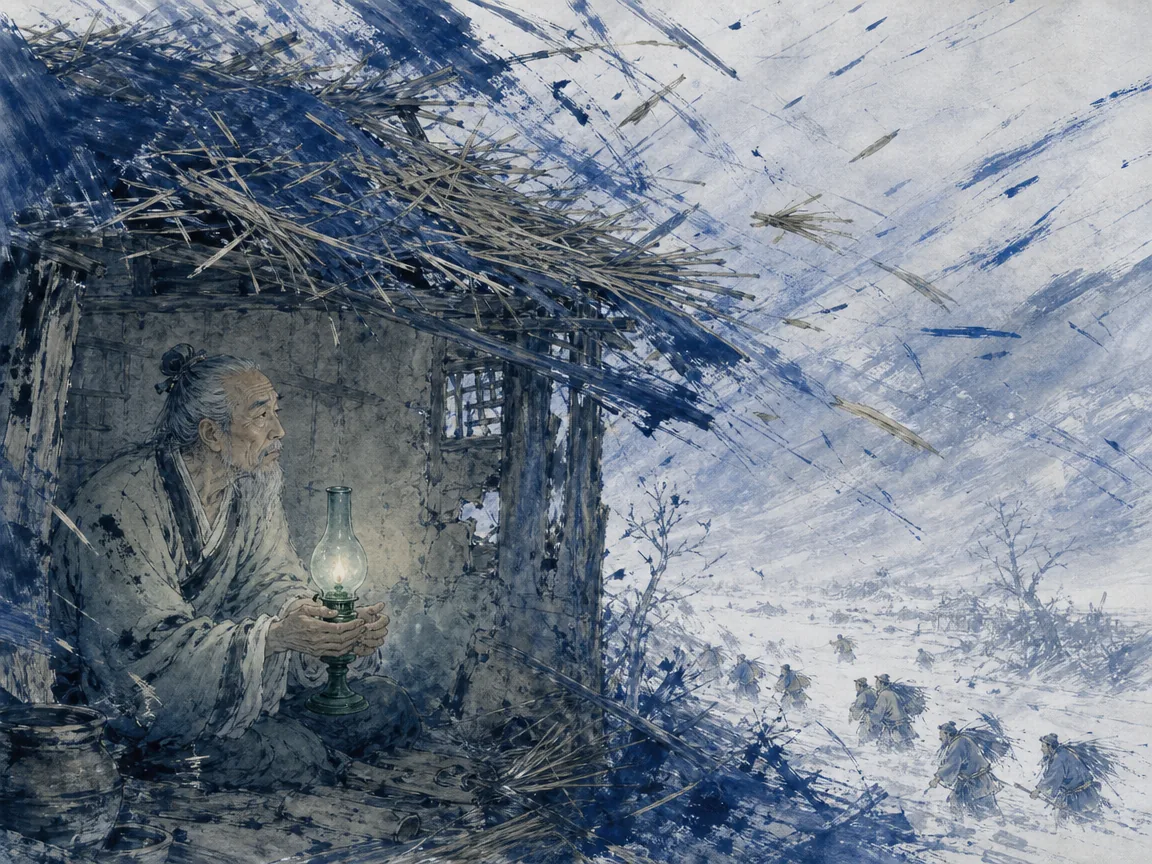
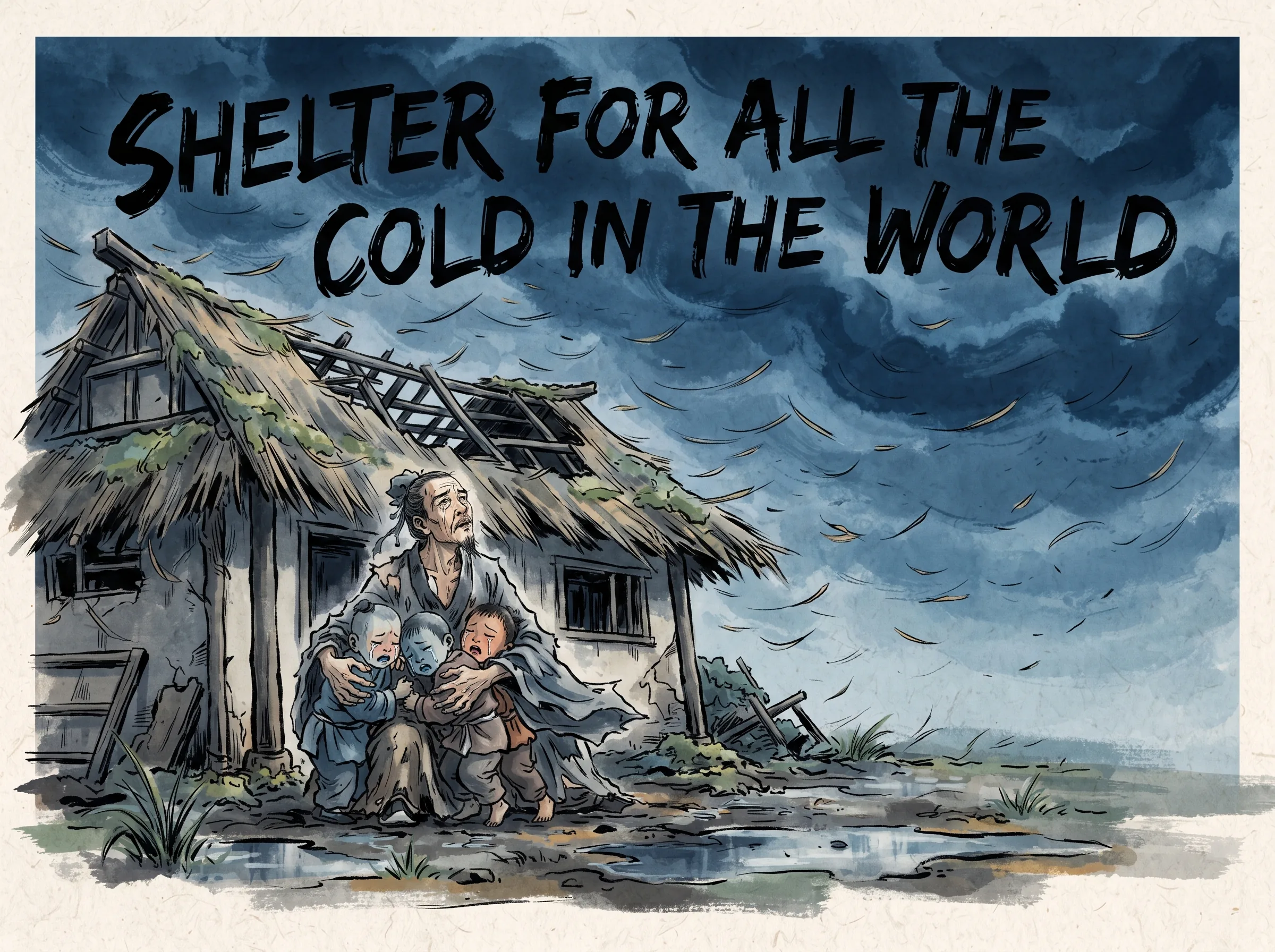
Perhaps the most striking feature of Du Fu's character is the width of his concern. In one of his best-known poems, “Song of My Thatched Cottage Ruined by the Autumn Wind” (《茅屋为秋风所破歌》), he describes a storm that tears the thatch from his roof, leaving his family exposed to rain and cold [3]. The immediate situation is desperate. And yet the poem does not stay there. It moves outward:
How can I secure a mansion of ten thousand rooms, to shelter all the learned men of the world and fill their hearts with joy? (安得广厦千万间,大庇天下寒士俱欢颜?)
He wrote this poem while his own roof was blown away, his family was cold, and there was nothing he could do to change any of it [3]. This is not inspirational poster language. It is the observation of a man who has nothing to lose in expressing what he wishes were true.
Du Fu's compassion extended beyond poetry into his decisions about public service. According to the historical record, he refused an appointment as magistrate of a county because the role required him to perform the humiliating rituals of serving superiors — a position he found degrading to his sense of dignity. He chose poverty over compromise, even though poverty was already his reality.
The emotional cost of this constancy was steep. During the rebellion, Du Fu wrote of finding his infant child dead from starvation in his own home, and he described the moment with raw grief: "Entering the house, I heard wailing; my youngest child had already died of hunger". He could do nothing to prevent it. He could write about it, but writing did not feed the child. The tension between caring for the world and being unable to care for those closest to him is perhaps the most human aspect of Du Fu's story, and also the most painful.
Modern readers experience a recognizable version of this tension in the phenomenon of compassion fatigue — the exhaustion that comes from wanting to help and being unable to. Du Fu lived it at full intensity for decades. His example suggests that compassion is not a resource that must be carefully rationed to be sustainable, but a commitment that defines who a person is, regardless of whether it changes outcomes.
Acceptance Without Resignation
In the final years of his life, Du Fu settled temporarily in Kuizhou (夔州), where he produced over four hundred poems in roughly two years — nearly a third of all his surviving work. Among them is “Climbing High” (《登高》), a poem that has been praised by later literary critics as the finest seven-character regulated verse (七言律诗) in the Chinese tradition. The poem opens with an image of vast, inevitable motion:
Endless falling leaves rustle down; endlessly the Yangtze rolls on. (无边落木萧萧下,不尽长江滚滚来。)
This is not a poem about giving up. It is a poem about seeing clearly — recognizing that change is constant, that life moves forward whether we are ready or not, and that there is a kind of dignity in acknowledging what is rather than clinging to what was. The Daoist tradition speaks of shunying ziran (顺应自然, “following the natural course”) not as a call to indifference, but as a call to stop fighting reality and to act from a clearer understanding of it.
Du Fu's late poems carry this quality. They do not resolve his suffering. They hold it honestly, without ornament, and in that honesty there is a form of peace. When he writes of walking alone on a high terrace, old and ill, watching the seasons turn, he is not performing optimism. He is stating what is true. That statement itself becomes a kind of achievement.
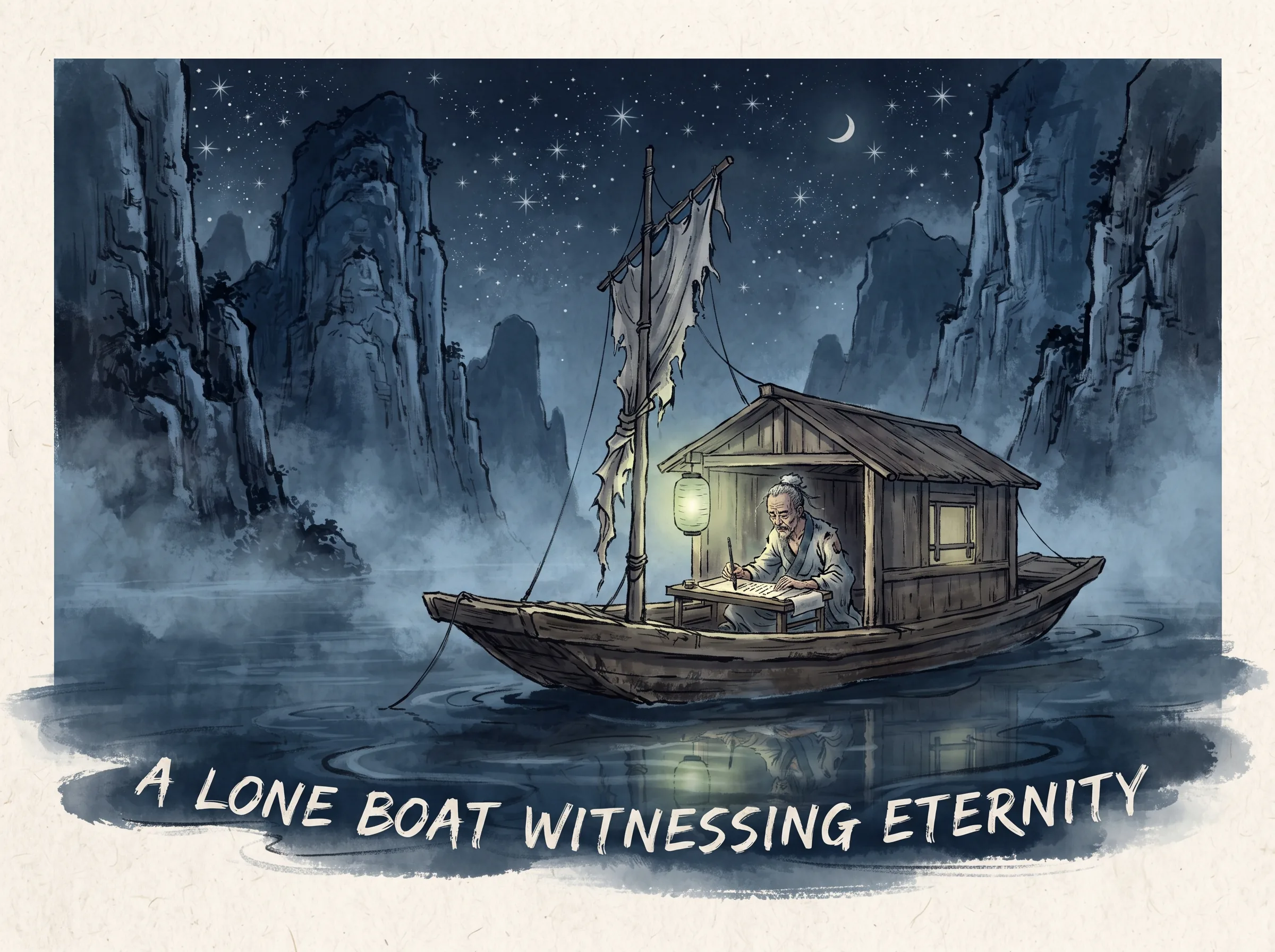
Du Fu died in 770 aboard a boat, according to the epitaph written by Yuan Zhen (元稹): “He ended his days as a transient resident, and was temporarily interred at Yueyang (岳阳)” [4]. Yuan Zhen recorded that Du Fu was fifty-nine years old when he died [4]. It would be more than forty years before his grandson Du Siye (杜嗣业) fulfilled the wish to move his remains to permanent burial, a task Yuan Zhen described as difficult given the family's poverty [4]. The man who had cared about strangers all his life died without the means to be properly buried. His grandson, decades later, completed what he could.
Finding Your Own Continuation
Du Fu's life offers several practical lessons for anyone facing disappointment that feels absolute:
Keep a record. Du Fu's greatest gift to us was not his optimism but his honesty. He wrote down what he saw and felt without softening the edges. Keeping a journal, writing, or simply naming what is happening — these are ways of refusing to let experience disappear unexamined.
Find your people. Du Fu's friendship with Li Bai, though brief, sustained him through years that followed. The bond between them produced some of the most moving poems in the Chinese tradition. Community and mutual support are not luxuries during hard times; they are essential. This mutual steadfastness in the face of political adversity mirrors another legendary Tang resilience story; discover how hardship forged an unbending voice in How 23 Years of Exile Made the Poet Who Wouldn’t Bend.
Expand your circle of care slowly. Du Fu's movement from personal grief to concern for strangers was not instant. It was gradual, and it coexisted with his own pain. Small acts of attention — to a neighbor, to a cause, to the people around you — can be a way of staying connected to something larger without requiring yourself to solve everything.
Continue the work, however imperfectly. Du Fu did not stop writing because his life was failing. He wrote more. The work does not need to be perfect or even good by external standards. It needs to be done. For a complementary perspective on meeting historical decline and impermanence with equanimity, see our study on When All Good Things Fade: What a Prosperous Poet Teaches Us About Letting Go.
Frequently Asked Questions
Was Du Fu really unsuccessful in his official career? Yes. The historical record confirms that he failed the imperial examinations and spent much of his life in low-ranking or unstable positions, never achieving the scholarly-official status his family background and training had prepared him for [2].
What caused the dramatic population decline during the An Lushan Rebellion? The conflict triggered widespread death, displacement, and breakdown of administrative record-keeping. Census figures from the period show a sharp decline, though historians note these numbers reflect registered households rather than exact population counts.
Did Du Fu die in poverty? Yes. According to Yuan Zhen's epitaph, he died on a boat as a transient resident with no permanent home or sufficient resources for a proper burial [4]. His grandson would not be able to relocate his remains for over forty years [4].
Is “Climbing High” (《登高》) considered his greatest poem? Later literary critics, particularly the Ming dynasty scholar Hu Yinglin (胡应麟), have praised it as one of the finest seven-character regulated verses in Chinese literary history. This is a critical consensus, not a claim made by Du Fu himself.
Conclusion
Du Fu's life was marked by failures that would have ended most people's stories: professional rejection, personal loss, poverty, displacement, and death far from home. Yet he produced a body of work that continues to move readers across cultures and centuries. The lesson is not that suffering produces greatness — Du Fu's suffering did not make him great, and not everyone who suffers becomes a poet. The lesson is that meaning can be found within suffering, not by escaping it, but by meeting it with attention, courage, and the willingness to keep going.
If you are navigating disappointment that feels permanent, consider what Du Fu's example offers: the permission to grieve, the obligation to bear witness, the importance of community, and the conviction that the work — however unfinished — still matters. The next step does not require a grand resolution. It requires only the next honest action, reflecting the enduring wisdom of Du Fu Finding Meaning in Failure.
Du Fu died aboard a small river boat, an enduring witness to displacement and longing; for a wider philosophical reflection on finding rootedness in an unstable world, see Why Do We Only Truly Find ‘Home’ After Leaving It? What Chinese Philosophy Can Teach Us About Rootedness in a Mobile World.
Sources & Further Reading
[1] Epitaph for Lady Du of Jingzhao, Mistress of Wannian County in the Tang Dynasty (《唐故萬年縣君京兆杜氏墓碑》) — Wikisource
[2] Old Book of Tang: Biography of Du Fu (《旧唐书·杜甫传》) — Gushiwen.cn
[3] “Song of My Thatched Cottage Ruined by the Autumn Wind” (《茅屋為秋風所破歌》) — Wikisource
[4] Epitaph and Preface for Lord Du, Formerly a Member of the Ministry of Works in the Tang Dynasty (《唐故工部员外郎杜君墓系铭》) — Wikisource
[5] Comprehensive Mirror in Aid of Governance (Zizhi Tongjian, 《资治通鉴》) — cited in Bilibili transcript for population figures during the An Lushan Rebellion






