
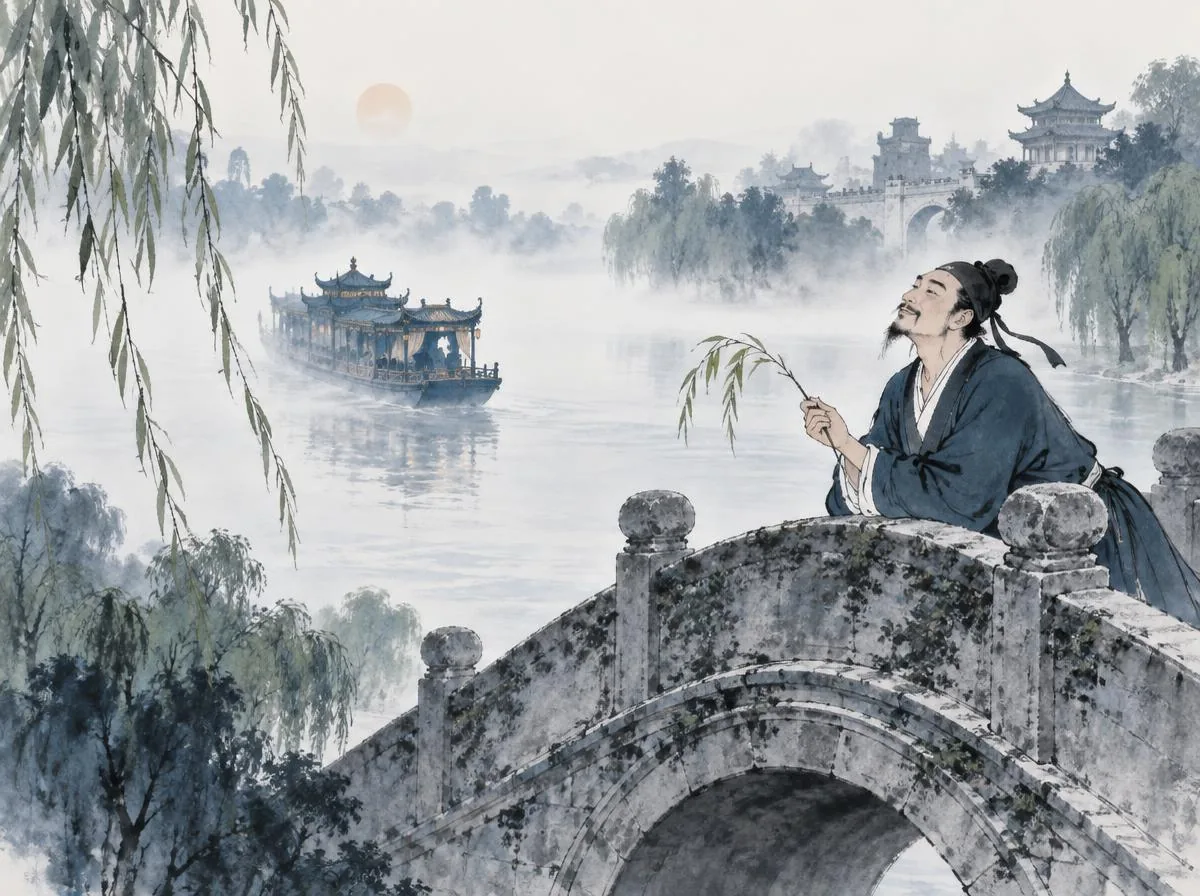
He is remembered for a line that sounds like hedonism: Ten years — a single dream in Yangzhou. For over a thousand years, readers have painted Du Mu (杜牧, 803–852) as a pleasure-seeking Romantic, a Tang dynasty dandy whose greatest achievement was writing beautiful poetry about beautiful women. But this portrait misses something essential. Beneath the reputation for indulgence lies a man who faced political rejection, personal loss, and the slow collapse of the empire he loved — and who found, in moments of deliberate release, a way to survive without breaking.
Du Mu was, by most measures, a genius who never got his due. He came from one of the most prestigious families in Chang'an, studied military strategy alongside the Confucian classics, and by twenty-six had passed the imperial examinations with distinction. He wrote thirteen commentaries on The Art of War (Sunzi Bingfa, 《孙子兵法》) — a feat that drew comparison to Cao Cao's own annotations — and later offered strategic advice that would shape real military campaigns against the rebel warlord Wang Keng of Zelo. Yet the factional struggles of his era, particularly the bitter rivalry between the Niu and Li cliques, kept him on the margins of real power. His ambition had nowhere to go but inward—a foundational perspective explored in Du Mu Yangzhou Years Daoist Lesson.
What happened next has often been misread. Between 833 and 835, Du Mu served in the Huainan military government (淮南节度使府) under Governor Niu Sengru, based in Yangzhou — then the wealthiest, most cosmopolitan city in China. This period produced some of his most famous poems, including verses about courtesans, moonlit bridges, and youthful romance. Later, looking back, he would write that the past ten years felt like a single dream. Scholars note that this "ten years" does not refer to a decade spent in Yangzhou but to the span of time since those events — a poetic compression of memory and regret. What it does reveal, however, is how Du Mu transformed political disappointment and personal sorrow into something enduring: art, clarity, and a quiet kind of freedom.
Du Mu Yangzhou Years Daoist Lesson: The Prodigy Who Saw the Empire Fading
Du Mu was born into a world that was already looking backward. The Tang dynasty, once the apex of Chinese civilization, was now grappling with regional warlords, court factionalism, and economic strain. His family embodied the old elite: his grandfather Du You (杜佑) had served as chancellor and compiled the Tongdian (《通典》), the first comprehensive history of Chinese institutions. His father and uncles also held office. As one Tang-era saying put it, the Du and Wei families of southern Chang'an were "so lofty they nearly touched the sky" [1].
Yet Du Mu's own trajectory was marked by a recurring pattern: talent recognized but never fully utilized. He excelled in the imperial examinations in 828, placing fifth — a remarkable achievement at twenty-six. Contemporary accounts suggest he was already known for his striking appearance and flamboyant manner. But his real passion lay elsewhere. Alongside his literary studies, he devoured military texts, particularly The Art of War. His thirteen annotations on Sunzi demonstrated a strategic mind that rivaled any of his predecessors.
This duality — poet and strategist — was not unusual in Tang intellectual culture, but Du Mu's combination was exceptional. He wrote policy memorials on border defense and rebellion suppression, and decades later, Sima Guang would include his military analyses in the Zizhi Tongjian (《资治通鉴》), a compilation curated specifically for imperial instruction [2]. Few literary giants of his era received such recognition from a historian whose standards excluded even Li Bai and Du Fu.
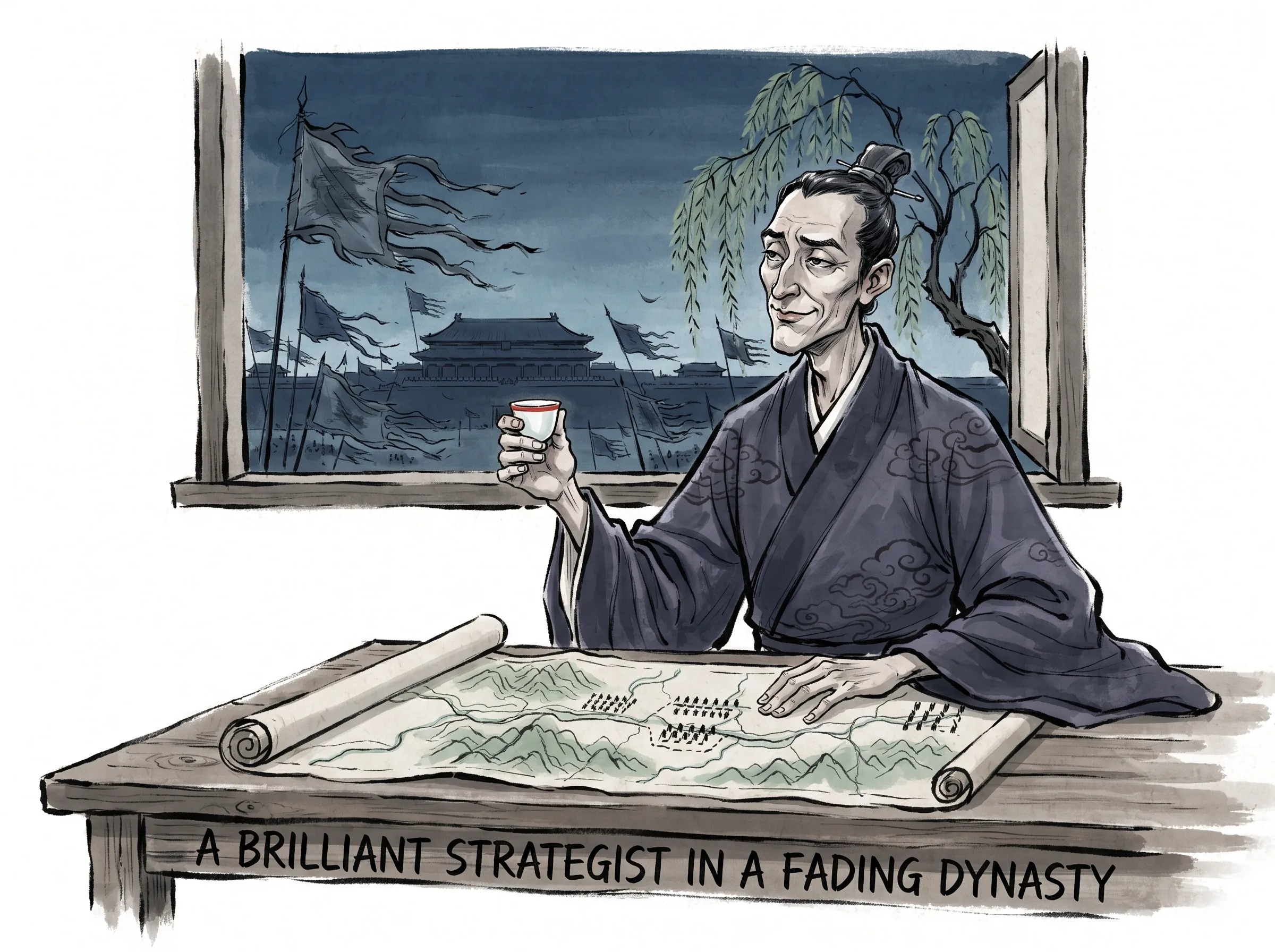
The problem was timing. The political landscape of the 830s and 840s was dominated by the Niu-Li factional strife (牛李党争), a bitter struggle for influence between two groups of elite officials. Du Mu's association with Niu Sengru — the governor who invited him to Yangzhou — placed him firmly in one camp. When his faction fell from favor, Du Mu's prospects dwindled. His strategic insights had no audience. His ambition had no outlet.
Modern readers facing similar dynamics — high achievement met with systemic blockage, talent unrecognized by the structures meant to reward it — may find Du Mu's early career resonant. The frustration is not of failure but of misalignment: a capable person navigating a system that values loyalty over insight, faction over merit.
Yangzhou: Memory, Poetry, and the Space Between
Yangzhou was, in the ninth century, the commercial capital of China. Situated at the intersection of the Grand Canal and the Yangtze River, it was a city of merchants, entertainers, scholars, and officials — a place where wealth and culture flowed together. For Du Mu, it became a stage for both public service and private expression.
His tenure in the Huainan military government (淮南节度使府) lasted approximately two years, from 833 to 835 [1]. Yet in his later poem Qian Huai ("Banishing Thoughts," 《遣怀》), he wrote:
"Ten years — a single dream in Yangzhou. / All I've won is a reputation for fickleness in the pleasure quarters."
(Shinian yi jue Yangzhou meng, yingde qinglou boqing ming; 十年一觉扬州梦,赢得青楼薄幸名。)
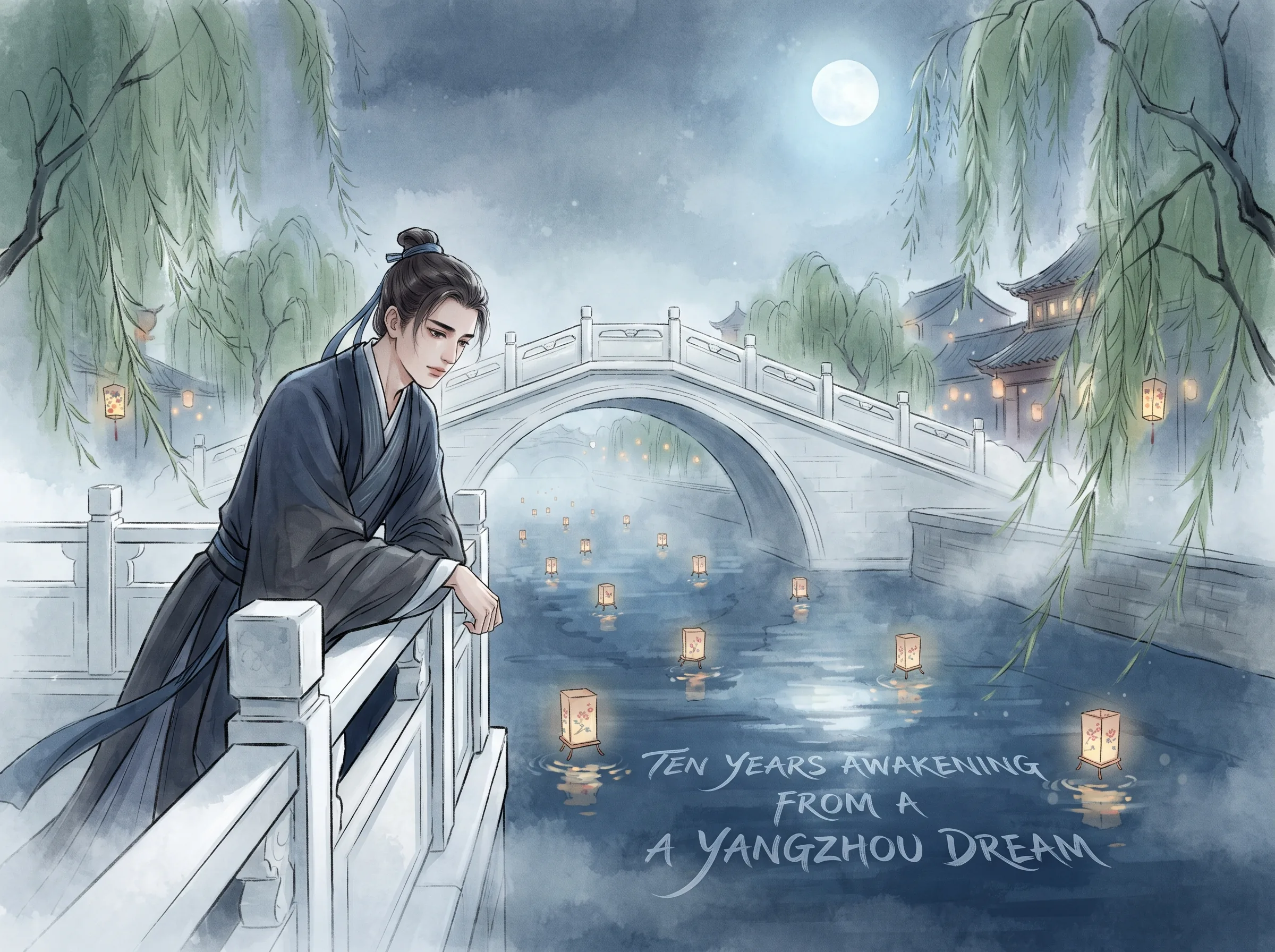
Scholars caution that the "ten years" here is not a factual claim about duration but a poetic measure — the approximate time elapsed since those experiences, compressed into a single evocative phrase [1]. The poem itself acknowledges political frustration as the underlying current: the indulgence described on the surface masks a bitter depression beneath the apparent splendor (fanhua, 繁华) [1].
This tension — between outward appearance and inner reality — is where Du Mu's story becomes philosophically interesting. Traditional Daoist thought offers a framework for understanding it. The Zhuangzi describes zuo wang (坐忘, "sitting and forgetting") as a practice of releasing attachment to the physical self and the calculating mind, opening space for direct alignment with the Way. While we cannot attribute a specific term like "fasting and forgetting" (zhāi wàng, 斋忘) to classical Daoist texts — that appears to be a modern conflation of mind-fasting (xīnzhāi, 心斋) and sitting-in-oblivion (zuòwàng, 坐忘) — the underlying idea is clear: sometimes the path forward requires stepping out of the performance of ambition.
Du Mu's years in Yangzhou can be read through this lens. His poetry, his friendships, his engagement with music and conversation — these were not merely escapist distractions. They were forms of cultivation, ways of preserving a inner life when the outer world offered no viable channel for it. The Daoist insight here is subtle: non-striving (wu wei, 无为) does not mean doing nothing. It means acting in alignment with what is actually possible, rather than exhausting oneself against what is not. Gain deeper perspective on weathering adversity through the poetic resilience explored in Why the Best Comes After the Fall: Cao Zhi’s Paradox of Failure and Genius.
One well-known anecdote illustrates this dynamic. When Du Mu prepared to leave Yangzhou, Governor Niu Sengru hosted a farewell banquet and privately warned him about excessive indulgence. Du Mu insisted he was disciplined. Niu then produced a cache of secret reports documenting every visit Du Mu had made to entertainment establishments — compiled, apparently, by Niu's own guards. Whether or not every detail of this story is historical, it captures a recognizable truth: Du Mu's public persona as a man of pleasure coexisted with a private awareness of its costs.
Love, Loss, and the Poetry That Survived
Among the figures who appear in Du Mu's Yangzhou poetry, one name stands out: Zhang Haohao (张好好). According to the preface he wrote for his poem Zhang Haohao Shi ("Poem for Zhang Haohao," 《张好好诗》), she entered the official register of entertainers at age thirteen and was later taken as a concubine by Shen Shushi, an official connected to Du Mu's former patron Shen Chuanshi. Six years after their first meeting in Jiangxi, Du Mu encountered her again in Luoyang, where she was working alone (duzi, 独自) in a wine shop.
The encounter moved him to write a lengthy narrative poem and, remarkably, to copy it out in his own handwriting. This manuscript, now held in the Palace Museum in Beijing, is widely regarded by scholars as one of the most important surviving examples of Tang dynasty calligraphy. Whether it is accurately described as his "only surviving handwritten work" depends on scholarly consensus that continues to evolve [verification note].
The emotional core of the Zhang Hao Hao Shi is straightforward: a man witnesses the passing of someone he once admired, sees how time and circumstance have altered her fate, and responds not with judgment or despair but with a clear, unsentimental account. One line from her own earlier poem — quoted within Du Mu's text — captures the reversal of fortune: "How could I have known our meeting would end in sorrow? / From now on, who will share my life?".
What makes this episode relevant to modern readers is not the romantic detail but the question it raises about how we process loss. Du Mu did not suppress his grief. He did not dramatize it into self-pity. He translated it into form — into structured verse, into controlled brushwork. In the Chinese tradition, this aligns with a Confucian understanding of qing (情, genuine feeling) channeled through li (礼, cultivated expression). Emotion is not the enemy of wisdom; unprocessed emotion is.
For people today who face breakups, professional disappointments, or the slow distancing of friends and colleagues, Du Mu's approach offers a model: allow the feeling to move through you, but give it shape. The shape need not be a poem. It might be a letter you do not send, a conversation you finally have, or simply the disciplined act of naming what happened without flattening it into cliché.
Acceptance in Later Years: The Huangzhou Period
After his Yangzhou years, Du Mu's career followed an uneven path. He served as a censor in the capital, but the factional politics that had marginalised him earlier continued to shape his options. In 842, he was appointed prefect (cishi, 刺史) of Huangzhou — a provincial posting that some later accounts framed as a kind of exile [2]. Whether this was punitive demotion or simply the normal rotation of Tang officials remains a matter of interpretation.
What is clear is that Du Mu governed Huangzhou with competence and integrity. Historical records note that he wrote to the powerful minister Li Deyu offering strategic analysis on the Zelo rebellion, and Li Deyu "made considerable use of Du Mu's suggestions" [2]. This was the same Li Deyu who belonged to the opposing faction — a detail that underscores how Du Mu's reputation for strategic insight transcended partisan lines.
During his three years in Huangzhou, Du Mu produced some of his most widely read poems, including Red Cliff (Chibi, 《赤壁》) and, according to tradition, Pure Brightness (Qingming, 《清明》). The authorship of Qingming is disputed: some scholars note that the poem does not appear in Du Mu's collected works or in the Quantangshi, while others point to its presence in early Song compilations and its alignment with his known themes [3]. The debate remains open, and for readers approaching the poem, the question of authorship may matter less than the question it raises — one that Du Mu's life consistently returns to: How do we face impermanence?
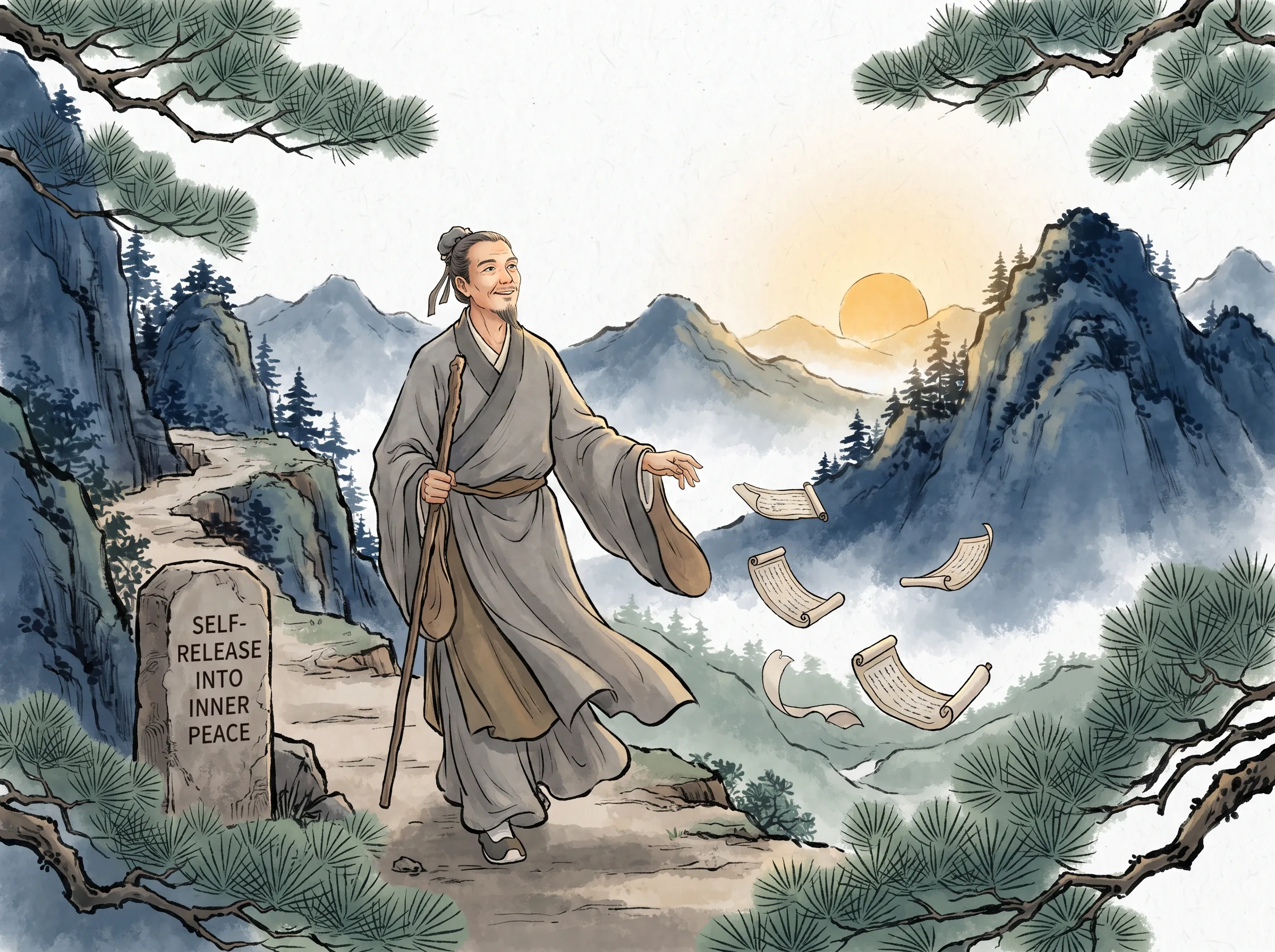
Qingming, if attributed to Du Mu, captures a moment of solitary wandering on a festival day associated with ancestor veneration and seasonal renewal. The speaker asks a shepherd boy for direction to a tavern, and the boy points toward a distant plum blossom village. The poem's power lies in its simplicity: sorrow acknowledged, then briefly set aside, then acknowledged again. There is no resolution, only a pause — and in that pause, a kind of wisdom.
Du Mu's later years showed a similar pattern. He eventually rose to the position of Secretariat Drafter (Zhongshu Sheren, 中书舍人), a senior role involved in drafting imperial edicts — a post that might have placed him near the center of power. But by then, the Tang dynasty's decline was irreversible, and Du Mu's energy had shifted from ambition to observation. He died in 852 at approximately fifty years of age.
The arc of his life — from strategic ambition to provincial governance to quiet acceptance — mirrors a pattern that many thoughtful people recognize: the gradual shift from asking "Why isn't this working?" to asking "What is actually here?" This is not surrender in the passive sense. It is the discernment that comes from prolonged engagement with reality. In Daoist terms, it approaches what the Zhuangzi describes as seeing the world without the distortion of personal desire — not because desire has been eradicated, but because it has been understood.
Practical Wisdom from Du Mu's Journey
Du Mu's life does not offer a blueprint for success by conventional standards. He never achieved the high office his talent seemed to promise. He never stopped caring about the empire's fate. Yet he produced poetry that has survived twelve centuries, and he did so without abandoning himself to bitterness.
Four principles emerge from his journey, each applicable to modern situations of professional setback, romantic loss, or broader uncertainty:
1. Disappointment is redirection, not termination. Du Mu's strategic writings were ignored in his lifetime but preserved for posterity. His political ambitions were frustrated, but the energy behind them found another outlet. When a path closes, the question is not "Have I failed?" but "Where else can this energy go?"
2. Joy is not the enemy of purpose. Du Mu's engagement with Yangzhou's cultural life has often been read as evasion. But the poetry that emerged from that period is among his finest. Creative and social engagement can be compatible with — even necessary to — a life of purpose, provided they are not mistaken for purpose themselves.
3. Art outlasts ambition. Du Mu's military analyses influenced real events; his poems influenced readers for a millennium. Both matter. But the poem is the form that survives institutional change. This does not mean ambition is worthless — only that it is temporal, and that something deeper often outlives it.
4. Acceptance is clarity, not defeat. The Du Mu who governed Huangzhou with integrity and wrote poems of quiet observation was not a man who had given up. He was a man who had stopped fighting reality. There is a difference. One exhausts; the other conserves.
These principles are not exclusively Chinese. They appear in Stoic reflections on indifferent external outcomes, in Buddhist teachings on non-attachment, and in modern psychological frameworks for resilience. What Du Mu's example adds is a particular cultural texture — the sense that releasing oneself from the performance of ambition is not laziness but a form of courage.
Frequently Asked Questions
Was Du Mu really a hedonist, or is that reputation unfair? Du Mu enjoyed Yangzhou's cultural world — its poetry, music, and companionship — and wrote about it honestly. But the same poems acknowledge political frustration and personal regret beneath the surface. Reading him only as a pleasure-seeker misses the complexity his work actually contains.
Does "Ten years — a single dream in Yangzhou" (shinian yi jue Yangzhou meng, 十年一觉扬州梦) mean Du Mu spent ten years in Yangzhou? No. Historical records indicate his official tenure in Yangzhou lasted approximately two years (833–835). The "ten years" in the poem refers to the approximate time that had passed since those events when he wrote the poem — a poetic compression, not a biographical claim [1].
Is the poem "Qingming" (清明) definitely by Du Mu? Authorship is disputed. The poem does not appear in Du Mu's collected works or in the Quantangshi compilation, which has led some scholars to question attribution. Others point to its presence in early Song-dynasty anthologies and thematic consistency with his known work. The question remains open in contemporary scholarship [3].
What is the connection between Du Mu's life and Daoist philosophy? Du Mu never wrote a philosophical treatise on Daoism, and he was equally shaped by Confucian and literary traditions. However, the pattern of his life — stepping back from political struggle, finding expression through art, moving toward acceptance — resonates with Daoist themes of non-striving and natural alignment. Reading his biography through this lens is an interpretive choice, not a historical certainty.
Where to Go From Here
Du Mu's story is not a prescription for how to live. It is an illustration of one possible response to a difficult situation: when the world does not reward your talents, when the relationships you valued slip away, when the institution you served begins to falter — what do you do? He chose to keep writing, to govern competently where he could, to feel genuinely without being destroyed by feeling, and eventually to let go of the need to control outcomes he could not influence.
If this resonates with you, the next step is not to replicate Du Mu's life — that is impossible and unnecessary — but to ask a simpler question: where in your own situation is ambition blocking clarity? Where might release, rather than effort, be the wiser path?
For readers interested in exploring these themes further, the following sources provide additional context on Du Mu's poetry, the historical debates around his work, and the philosophical traditions that inform this reading, reflecting the enduring wisdom of Du Mu Yangzhou Years Daoist Lesson.
Gain deeper perspective on weathering adversity through the poetic resilience explored in How Ancient Chinese Poets Cultivated Inner Stillness.
Deepen your understanding of these principles in our reflection on Why Ancient Chinese Wisdom Would Hate the Revenge Stories We Love Today.
Sources & Further Reading
[1] An Appreciation of “Ten Years — a Single Dream in Yangzhou” (《“十年一觉扬州梦”全诗赏析》) — Analysis of Du Mu's Qian Huai poem, including interpretation of the "ten years" phrase and its relationship to his political frustration.
[2] Comprehensive Mirror for Aid in Government, Volume 247 (Zizhi Tongjian, 《资治通鉴》卷247) — Records Du Mu's military memorial to Li Deyu regarding the Zelo rebellion and notes that Li Deyu "made considerable use of Du Mu's suggestions."
[3] Was Du Mu the Author of Qingming? (《〈清明〉的作者是杜牧吗》) — Scholarly discussion of the poem's disputed authorship, presenting arguments both for and against attribution to Du Mu.
Further Reading
- The Cambridge History of China, Vol. 3: Sui and Tang China — Comprehensive overview of the Tang political and cultural context in which Du Mu lived.
- Zhuangzi: Basic Writings (trans. Burton Watson) — Accessible translation of key Daoist texts, including passages on zuo wang (坐忘) and xin zhai (心斋).
- Poems of Mi and Du: The Great Masters of Mid-Tang China (trans. Stephen Owen) — English translations and commentary on Du Mu's major poems.
- The Tale of Hikaru Genji contextual comparisons with Tang literary culture — useful for understanding the broader East Asian aesthetic world Du Mu inhabited.






