
The world has a way of rearranging itself when you least expect it. A career setback that lands overnight. A relationship that unravels after years of assumption. A public failure that seems to erase everything you built. In those moments, the most natural impulse is to ask: who am I when the ground disappears? It is tempting to let external collapse become internal defeat — to believe that being pushed down means you have fallen.
In eleventh-century China, a man named Su Shi (苏轼) learned this lesson the hard way. He was thirty-eight, already one of the most celebrated writers and officials of his age, when a political rival used his poetry against him. The charge was sedition. The punishment was imprisonment, near-execution, and then banishment to a remote city called Huangzhou (黄州), stripped of status and livelihood. By every conventional measure, his life was over. What happened next is one of the most remarkable stories of resilience in Chinese intellectual history — not because Su Shi escaped suffering, but because he refused to let suffering define who he was—a foundational perspective explored in Staying True to Yourself Chinese Wisdom.
Staying True to Yourself Chinese Wisdom: When Everything Falls Apart
In 1079, Su Shi was arrested and thrown into prison during what is known in Chinese tradition as the Wutai Poetry Case (乌台诗案) — an incident in which officials accused him of mocking the government through his verse [1]. He survived, but barely. The emperor spared his life and instead stripped him of his post, exiling him to Huangzhou as a low-ranking military administrator with no real authority and little pay.
What followed was not immediate enlightenment. Historical accounts suggest Su Shi spent much of his early years in Huangzhou in a state of deep depression — sleeping through days, walking alone at night, haunted by fear and grief [4]. One famous scene from this period describes him returning home after a night of drinking to find his gatekeeper asleep and his door unopened. Standing by the river at midnight, listening to the waves, he wrote: "Leaning on my staff, I listen to the rivers voice" (倚杖听江声) — a line from his poem Linjiang Xian (《临江仙·夜归临皋》) that captures the loneliness of a man suspended between worlds [4].
This is the first lesson: devastation is not instantaneous transformation. Su Shi did not wake up one morning in Huangzhou and become a serene sage. He grieved. He raged. He wandered the riverbank in the dark. Anyone who has experienced a sharp turn in life — a layoff, a betrayal, a diagnosis, a loss — knows that the first response to shock is rarely clarity. It is numbness, anger, confusion. The question is not whether you will feel broken. The question is what you do when the breaking stops.
The Turning Point — Finding Freedom Inside Confinement
Something shifted in Su Shi during those early years in Huangzhou, though historians differ on when and how exactly. What is clear is that he eventually made two decisions that changed everything.
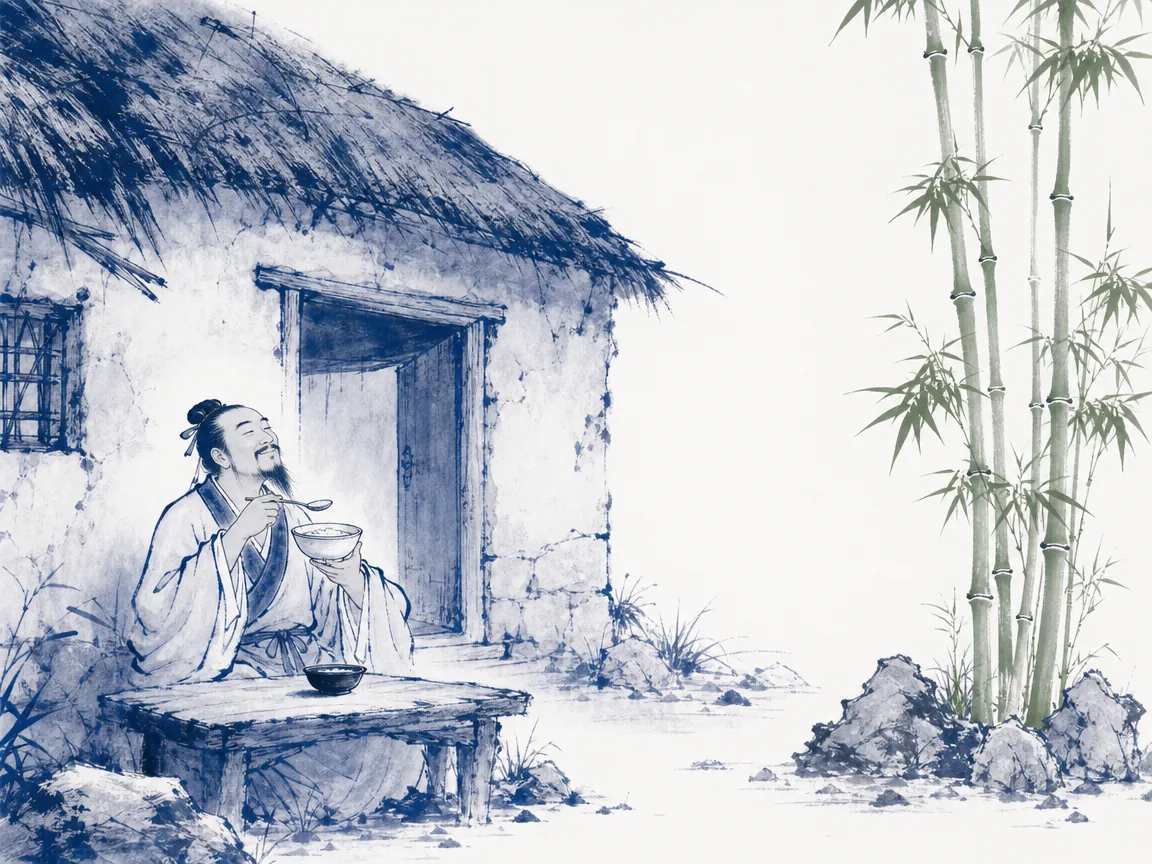
First, he asked a friend, the local official Ma Zhengqing, to secure a plot of unused land on the eastern slope of Huangzhou [2]. He farmed it himself. He called it "Eastern Slope" (东坡) — and from that moment on, he began referring to himself as Su Dongpo (苏东坡), "the Resident Scholar of the Eastern Slope" (东坡居士) [1]. The name stuck for centuries. The man who had been stripped of his court title had invented a new identity from dirt and labor.
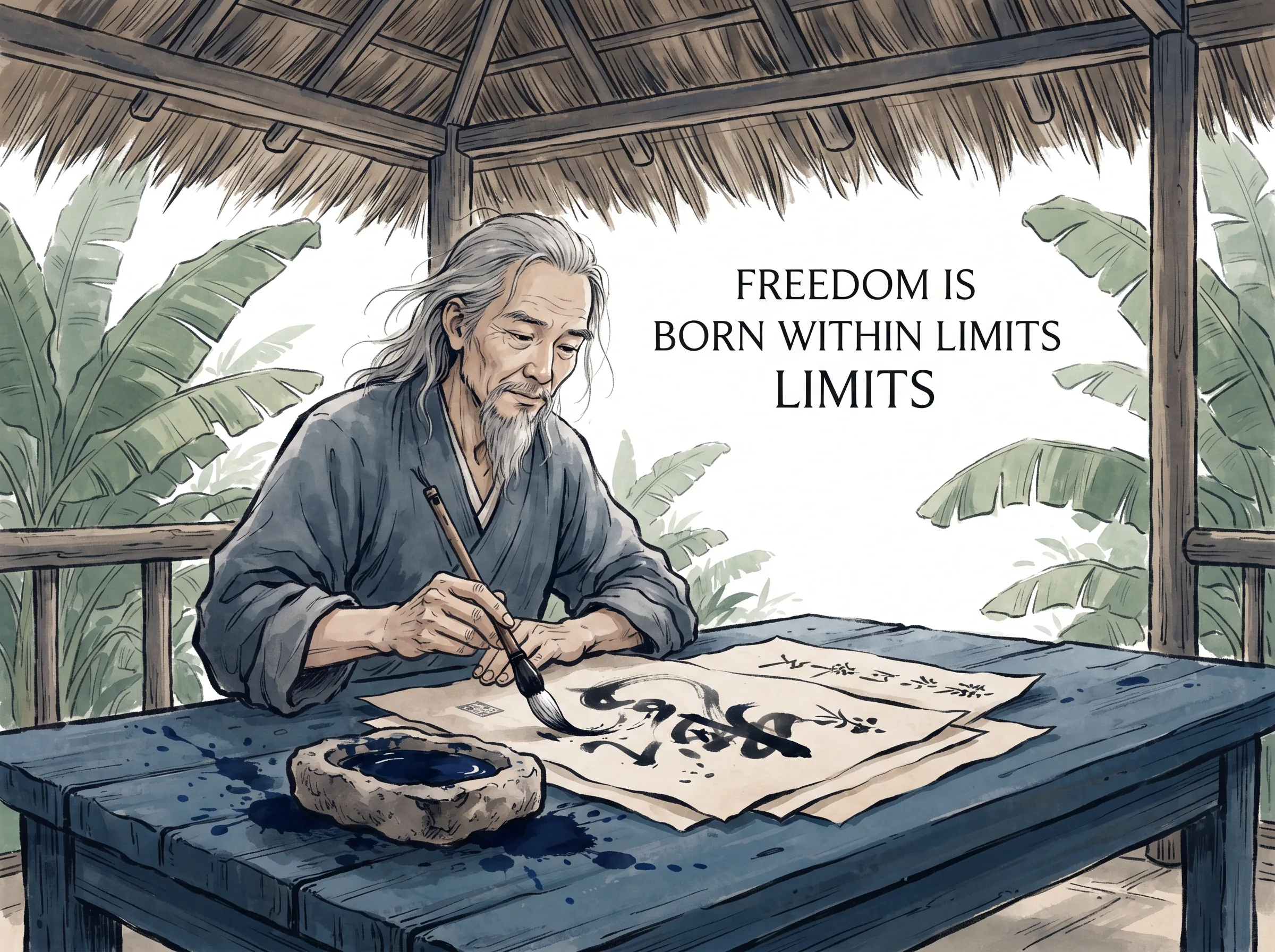
Second, he began writing with a freedom he had never known before. Banished from the capital and freed from the obligations of official life, Su Shi produced some of the most enduring works in Chinese literary history during his Huangzhou years — poems, essays, and ci lyrics that explored impermanence, nature, and the limits of human control. The Former and Later Odes on the Red Cliff (《前赤壁赋》 and 《后赤壁赋》), written in 1082, are among the most celebrated pieces of Chinese prose, reflecting on how brief human lives are against the backdrop of an eternal river.
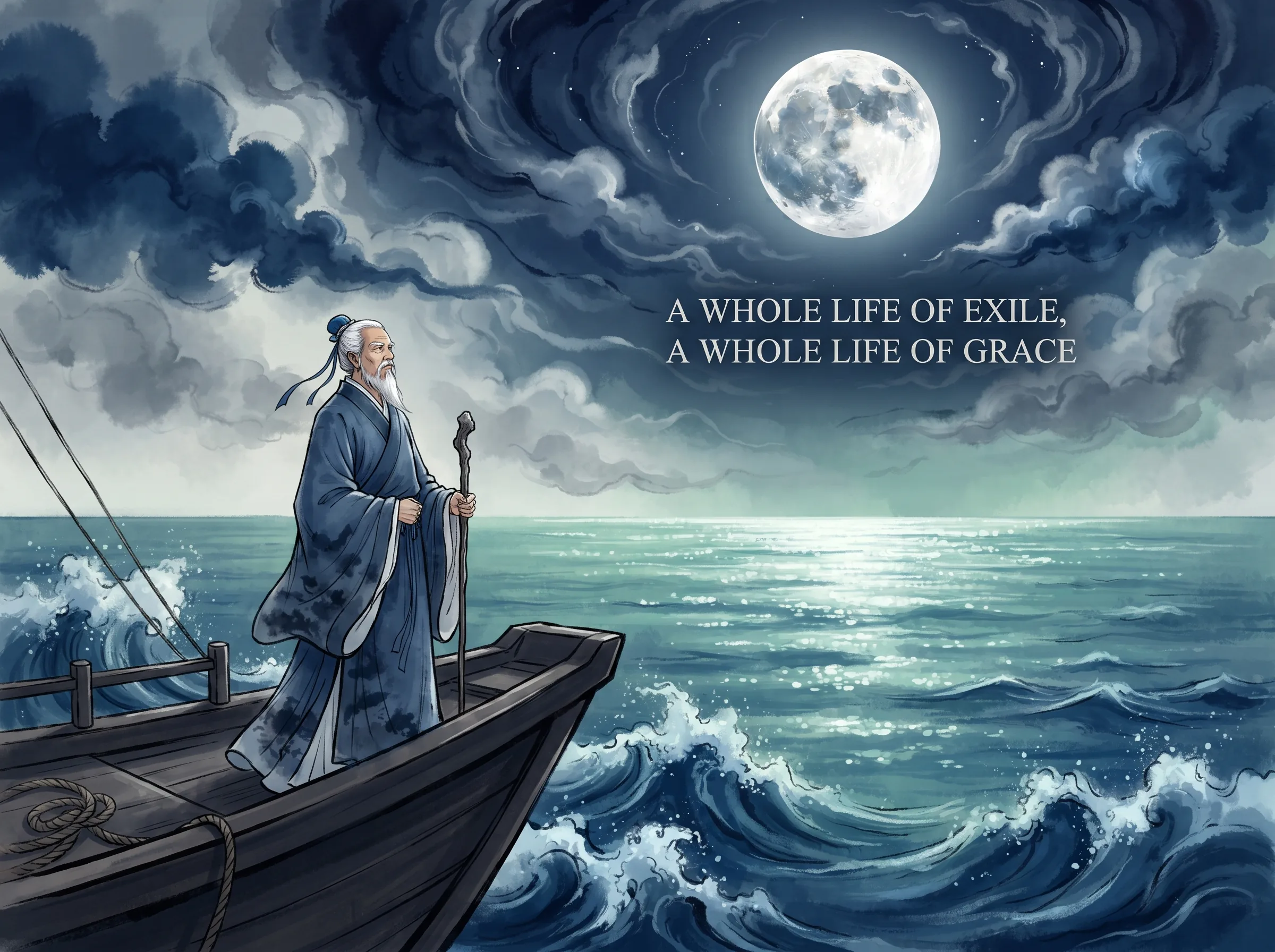
A particularly famous moment came during a rainstorm on a country road. The original preface to his poem Ding Feng Bo (《定风波·莫听穿林打叶声》) records that on March 7th of that year, Su Shi and companions were caught in sudden rain while traveling to inspect a farm. The others ran for cover in distress, but Su Shi walked slowly and began to chant [3]:
Who cares about the rain drumming through the trees? Why not chant and walk slowly? Bamboo staff and straw sandals are lighter than a horse. Who's afraid? A straw cloak against the wind and rain is enough for a lifetime. (莫听穿林打叶声,何妨吟啸且徐行。竹杖芒鞋轻胜马,谁怕?一蓑烟雨任平生。)
This was not naivety. Su Shi knew the storm would pass. He knew the rain was temporary. What he chose was not to run from discomfort, but to refuse to let it dictate his state of mind. The ancient Chinese philosophical traditions — both Daoist and Confucian — offer frameworks for understanding this stance. Daoism teaches acceptance of what cannot be changed, without surrendering one's sense of self. Confucianism teaches that character is forged through daily practice, even — or especially — in conditions of hardship. Su Shi seemed to draw on both streams without fully belonging to either. Gain deeper perspective on weathering adversity through the poetic resilience explored in When Exile Becomes Awakening: Su Shi’s Blueprint for Finding Purpose in Hard Times.
The Discipline of Living Simply
After Huangzhou, Su Shi's story could have ended with a happy ending — a recall to court, restoration of favor, a comfortable retirement. And for a time, it did. He returned to the capital around 1085, but the political climate was just as hostile. Rather than stay silent, he criticized the very faction that had brought him back, drawing on Confucian ideals of the scholar-official's duty to speak truth to power. The cost was immediate and severe.
From 1094 onward, Su Shi was exiled again and again — to Huizhou (惠州), then to Danzhou (儋州, on modern Hainan Island). Each destination was further from civilization, further from everything he had known. The Song dynasty rarely sent officials to Hainan; it was considered one of the most remote and punishing places in the empire.
Yet Su Shi's response to each new exile followed a pattern. He did not wait for rescue. He farmed. He brewed wine. He made use of whatever was at hand. In Hangzhou, decades earlier, he had already shown this capacity: as a local administrator, he drained swamps, rebuilt irrigation systems, and constructed what is still called the Su Causeway (苏堤) — a causeway lined with willows and lotuses that remains one of Hangzhou's most iconic landmarks [1]. Even in exile, his energy was directed outward, toward service and creation rather than inward toward suffering.
The Daoist concept of wuwei (无为, often translated as "non-action" or "effortless action") is frequently misunderstood as passivity. But in the context of Su Shi's life, wuwei looks more like alignment: moving with the current of reality rather than fighting it pointlessly, while still finding ways to act meaningfully within whatever circumstances exist. It is not the absence of effort; it is the absence of resistance to what is already true.
Practical application: When your circumstances shift dramatically — a job loss, a diagnosis, a relationship ending — the instinct is often to fight the new reality or to withdraw from it entirely. Su Shi's approach offers a third path: acknowledge what has changed, stop wasting energy on what cannot be changed, and ask a deceptively simple question: what can I do with what is already here? Not what you wish were here. What is here. Start there.
Exile After Exile — But the Soul Remains Unconquered
Su Shi was exiled five times across his adult life. By the time he reached Danzhou at age sixty-four, he had been stripped of nearly everything: no wealth, no protection, no reliable access to medicine or books. Yet records indicate he dedicated himself to education there, founding schools and mentoring students — one of whom, Jiang Tangzuo, would later become Hainan's first successful examination candidate. He reportedly studied herbs and local medicine during this period. His letters from this time show a man who had stopped asking why me and started asking what now.
When he finally received news of a pardon in 1100, he was on his way back north. He died in Changzhou later that year, but not before leaving behind one of the most moving lines in Chinese literature: "Ten thousand miles of southern wilderness — I do not regret it. This completes a life beyond compare." The line is commonly rendered: "Nine deaths in the southern wilds—I have no regrets; this extraordinary journey crowns my life" (九死南荒吾不恨,兹游奇绝冠平生).
This is the paradox that defines Su Shi's legacy: adversity did not break him. It refined him. Each exile stripped away something unnecessary — status, comfort, certainty — and revealed something essential: a self that could not be exiled because it was no longer dependent on external conditions to exist.

The Confucian ideal of the junzi (君子, "the exemplary person") holds that character is tested, not created, in hardship. A person of integrity does not change their principles when circumstances change. Su Shi lived this principle not as abstract philosophy but as daily practice. He governed when he could. He wrote when he was silenced. He taught when he was cast out. And when he could no longer act on the world, he acted on himself — his attention, his responses, his inner landscape.
Practical application: Consider the difference between resilience as "bouncing back" and resilience as "bouncing forward." Bouncing back implies returning to a previous state — as if nothing happened. Bouncing forward means carrying what you've learned into a new configuration of life. Su Shi never "returned" to his pre-exile self. He became someone else — not because the world had changed, but because he had. When facing your own disruption, ask not how to get back to normal, but what kind of person this experience is making you.
Integrity Without Self-Destruction
Perhaps the most important chapter in Su Shi's story is not about exile at all, but about choice. On multiple occasions, he had the opportunity to stay quiet, to accept comfort, to play it safe. Each time, he chose differently.
After his return to the capital in 1085, Su Shi criticized the very reformist policies that had caused his original downfall — and then, when the political winds shifted again, he criticized the conservatives who had replaced them. He knew the cost. He paid it repeatedly.
One tradition attributes to him a sentiment roughly equivalent to: "Living is easy. But if living means betraying yourself, better not to live." Whether Su Shi said these exact words is impossible to verify from the surviving records. But the pattern of his life — his willingness to suffer for his convictions rather than abandon them — is well documented in the Song Shi and in his own surviving corpus of poems and essays.
This is where the Daoist tension becomes most visible. Zhuangzi, the great Daoist philosopher, frequently warned against burning yourself for the world — against sacrificing your inner peace on the altar of external causes. Yet Su Shi seems to have held both truths: the Daoist insight that not everything is yours to control, and the Confucian commitment that some things are worth controlling — your own actions, your own integrity, your own voice. He did not see these as contradictions. He saw them as complementary.
Practical application: How do you hold your values without letting them consume you? The answer may lie in distinguishing between what is yours to fight for and what is yours to release. Su Shi fought for truth-telling and public service. He released his attachment to outcomes — fame, safety, comfort. The result was a life that was difficult but not bitter, principled but not rigid. You do not need to choose between integrity and well-being. You need to learn which battles serve both and which serve only one.
FAQ
Q: Was Su Shi's response to exile really that positive? Not always. Historical sources describe him experiencing deep depression, especially in the early years of his Huangzhou banishment. The image of the serene, enlightened Su Dongpo emerged gradually — it was earned through struggle, not given through wisdom alone.
Q: Can ancient Chinese philosophy really help with modern problems? The value lies not in applying ancient answers to modern questions, but in studying how a particular person navigated extreme difficulty with clarity and creative energy. Su Shi's strategies — finding meaning in small daily acts, refusing to let external events dictate inner state, maintaining integrity despite cost — are transferable across time and culture.
Q: How did Su Shi afford to live in Huangzhou with no income? He received assistance from a friend, Ma Zhengqing, who secured for him a plot of land on the eastern slope. Su Shi farmed it himself and gradually achieved enough self-sufficiency to support his family, though he remained in modest circumstances throughout his exile.
Q: Did Su Shi's philosophy change over his lifetime? Yes. Scholars note that his early work reflects more Confucian concern with social responsibility, while his Huangzhou period shows a deepening engagement with Daoist and Buddhist ideas. Later writings, especially from his final exile in Hainan, integrate these streams into a more personal and less formally philosophical voice.
Staying True When the World Pushes Back
Su Shi's life offers no promise that integrity guarantees comfort. In fact, the opposite is true: he paid a high price for his principles, repeatedly and throughout his adult life. But his story does offer something rarer and perhaps more valuable — the demonstration that integrity, properly understood, is not a strategy for success but a way of living that remains intact regardless of success or failure.
The world will keep pushing. Careers will falter. Relationships will change. Systems will disappoint. The question is never whether you will be tested, but how you will answer. Su Shi's answer, written across a hundred poems and a thousand letters, was simple: build something. Speak something. Care for something. And do not let the scale of your circumstances determine the depth of your commitment.
Next step: Read Su Shi's Ding Feng Bo (《定风波·莫听穿林打叶声》) in its original context. Read the preface carefully — it is only three sentences long and sets the entire tone. Then ask yourself: what is your "eastern slope"? Not the grand answer. The small one. The place where you can start, today, with what you have, reflecting the enduring wisdom of Staying True to Yourself Chinese Wisdom.
Gain deeper perspective on weathering adversity through the poetic resilience explored in What Can Du Fu’s Lifelong Failures Teach Us About Finding Meaning in Disappointment?.
For a deeper comparative examination of these ideas, explore our related study on How a Tang Dynasty Poet Broke Every Rule—and Paid the Price.
Sources & Further Reading
[1] History of Song, scroll 338 (《宋史·卷三百三十八》) — Primary biographical record of Su Shi's life and official career, including his exile to Huangzhou, his work in Hangzhou, and his self-designation as "Dongpo Jushi."
[2] Su Shi, Eight Poems on the Eastern Slope, with Preface (《东坡八首(并叙)》) — Su Shi's own account of farming on the eastern slope in Huangzhou and the origin of his pseudonym.
[3] Su Shi, Ding Feng Bo (《定风波·莫听穿林打叶声》) — Full text and preface of the famous rain poem, including the line "Bamboo cane and straw sandals are lighter than horses—who's afraid? A straw cloak amidst misty rain, I live out my life at ease" (zhúzhàng mángxié qīng shèng mǎ, shuí pà? yī suō yānyǔ rèn píngshēng, 竹杖芒鞋轻胜马,谁怕?一蓑烟雨任平生).
[4] Su Shi, Linjiang Xian: Returning at Night to Lingao (《临江仙·夜归临皋》) — Su Shi's poem describing his midnight return home during his Huangzhou exile, including the line about leaning on his staff to listen to the river.
Further Reading
- The Columbia Companion to Chinese Poetry — for contextual background on Song dynasty literary culture
- Su Shi: His Life and Thought by Michael Nylan — scholarly overview of Su Shi's intellectual development across his three exiles
- The Selected Poetry of Su Shi (translated by Stephen Owen) — accessible English translations with commentary






