
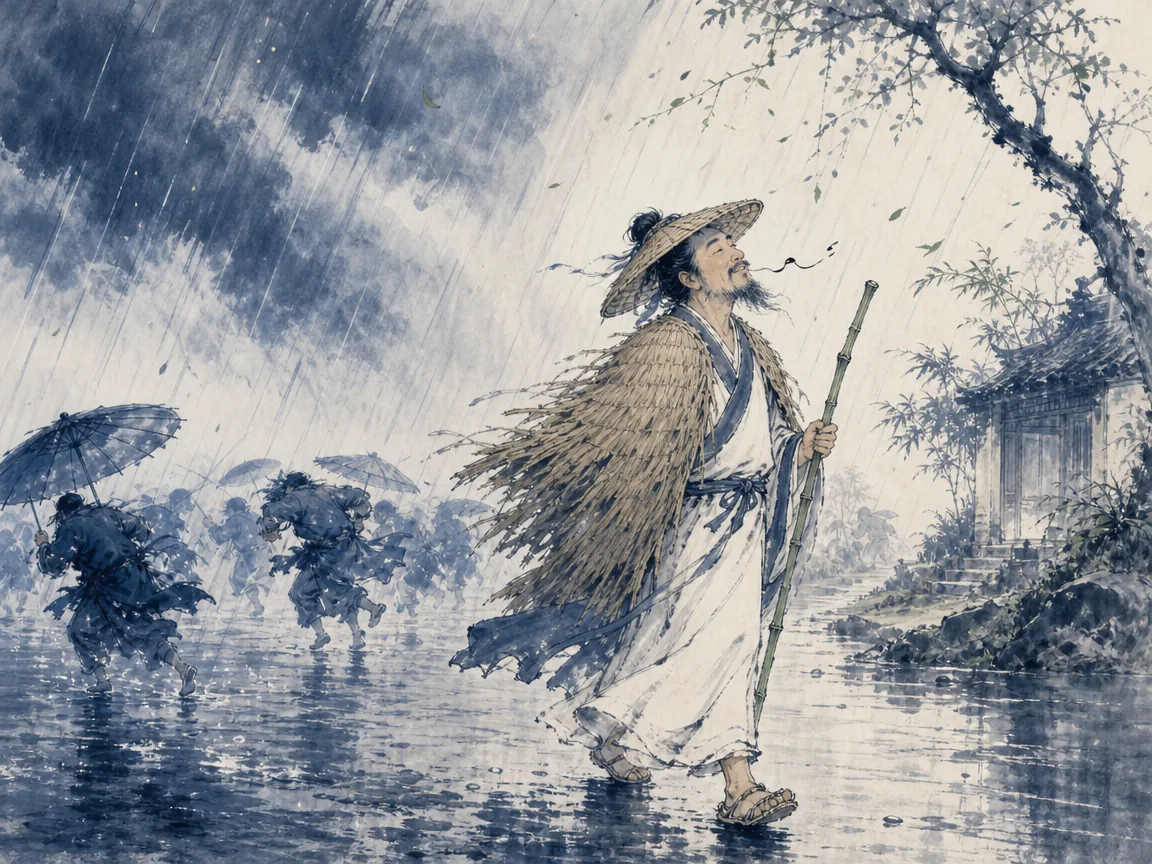
When a brilliant writer is arrested for his poetry, stripped of every title and sent to a remote province where he must survive by farming abandoned land, something unexpected happens. Instead of breaking, he transforms. In the smallest and most uncertain stretches of our own lives, we often feel the same weight—that sharp pivot from stability to loss, from certainty to groundlessness. What ancient Chinese thinkers call ziran (natural spontaneity) suggests that transformation does not require us to force a new meaning onto our lives. It arises when we stop resisting what has already happened and allow ourselves to begin again, however humbly.
Su Shi, one of the most celebrated figures in Chinese literary history, experienced this transformation in its most dramatic form. Arrested during the Wutai Poetry Case in 1079, imprisoned for months, and exiled to Huangzhou—a place considered a dead-end by any standard—he arrived without land, income, or status. Yet from that year onward, he produced some of the most enduring works in all of Chinese literature. His story is not one of triumph over adversity so much as it is about what happens when a person stops fighting reality and begins to build something new from whatever ground remains—a foundational perspective explored in Su Shi Finding Purpose in Hard Times.
Su Shi Finding Purpose in Hard Times: The Fall
Su Shi's early life was defined by brilliance and promise. He passed the imperial examinations at a young age and quickly rose through the ranks of officialdom. He wrote with eloquence, debated with rigor, and earned the respect of literary giants such as Ouyang Xiu, who recognized in Su Shi a talent that would define a generation. But Su Shi's honesty and his refusal to remain silent in the face of policies he viewed as harmful eventually placed him at odds with the political establishment.
In 1079, his career—and nearly his life—was shattered. The Wutai Poetry Case began when critics seized upon passages from his poems, claiming they mocked the ruling regime. He was arrested, interrogated, and imprisoned for several months. Accounts vary regarding the specifics of the proceedings and the interventions that followed, but what is clear is that Su Shi was ultimately spared execution and instead demoted to a marginal post in Huangzhou, far from the political center he had once occupied. For a man whose identity had been built on scholarship, service, and public influence, this was not merely a professional setback. It was the collapse of an entire way of life.
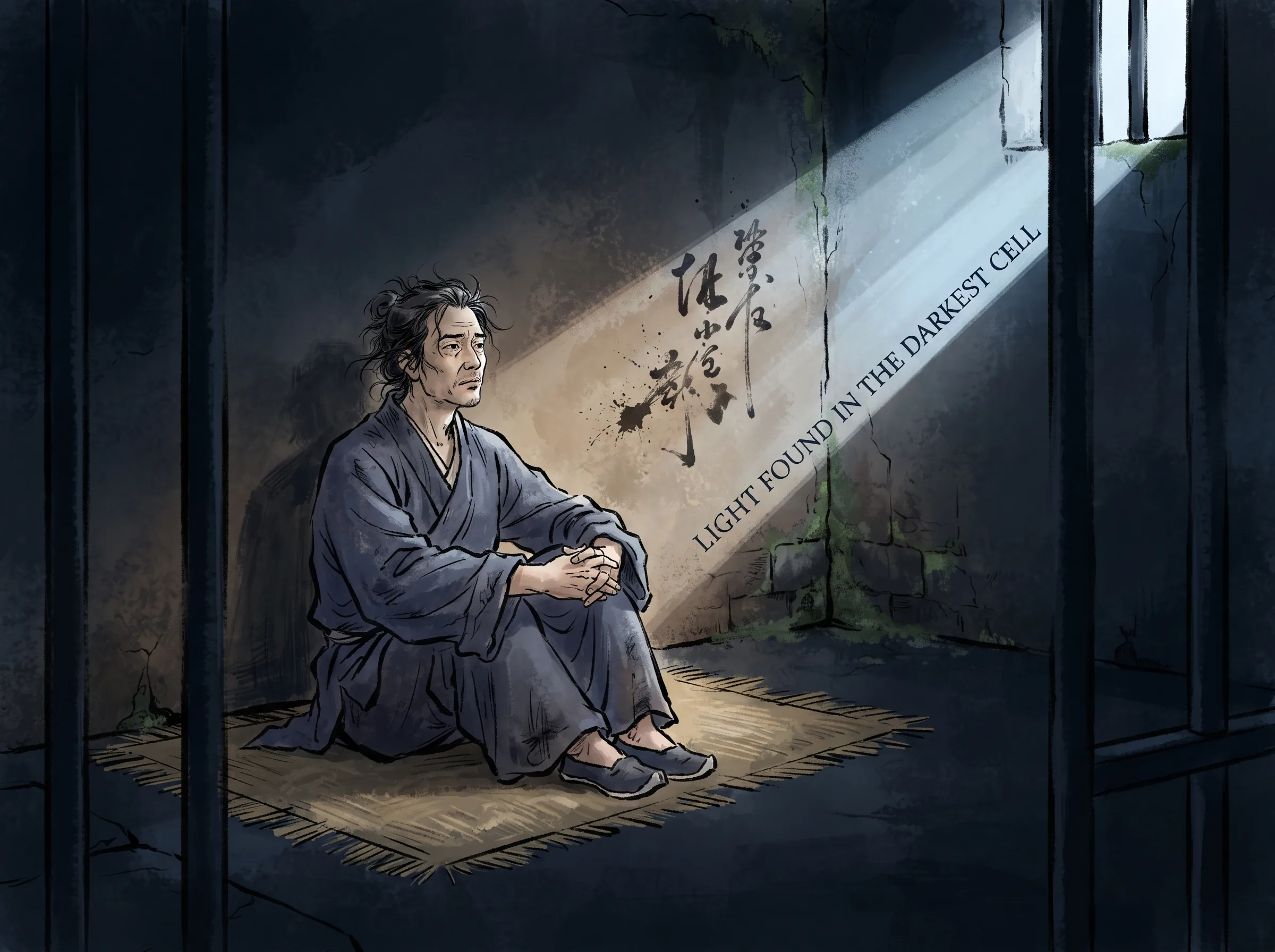
The modern parallel is often closer than we realize. A sudden job loss, a public failure, a health diagnosis, a relationship that ends unexpectedly—each of these can produce the same sense of groundlessness. Su Shi's experience is a reminder that the worst moments are rarely just about the event itself. They are about what the event takes away from us: our sense of who we are, the narrative we built our lives around, and the future we assumed was ours.
The Turning Point — Why "Su Dongpo" Was Born in Exile
By Su Shi's own account, he reached Huangzhou two years in and found himself in genuine hardship. He wrote later that he faced daily shortages and begged a friend, Ma Zhengqing, to help him secure land for cultivation. Ma obtained permission to use several acres of abandoned military farmland east of the city walls, and Su Shi began to farm it himself [2]. He called the land "Dongpo," meaning Eastern Slope, and the name he is best known by—Su Dongpo—was born from that act of clearing, planting, and taking responsibility for a small piece of ground.
The significance lies not in the romantic interpretation of this moment but in what it reveals about how people rebuild after loss. Su Shi did not retreat into abstract contemplation while waiting for better circumstances. He did not wait for the court to recall him or for his former life to resume. He worked the earth. He named it. He created a new relationship with a place that had been given to him by chance. In doing so, he practiced something that Daoist philosophy describes as ziran—allowing things to follow their natural course, responding to reality rather than clinging to what was taken away.
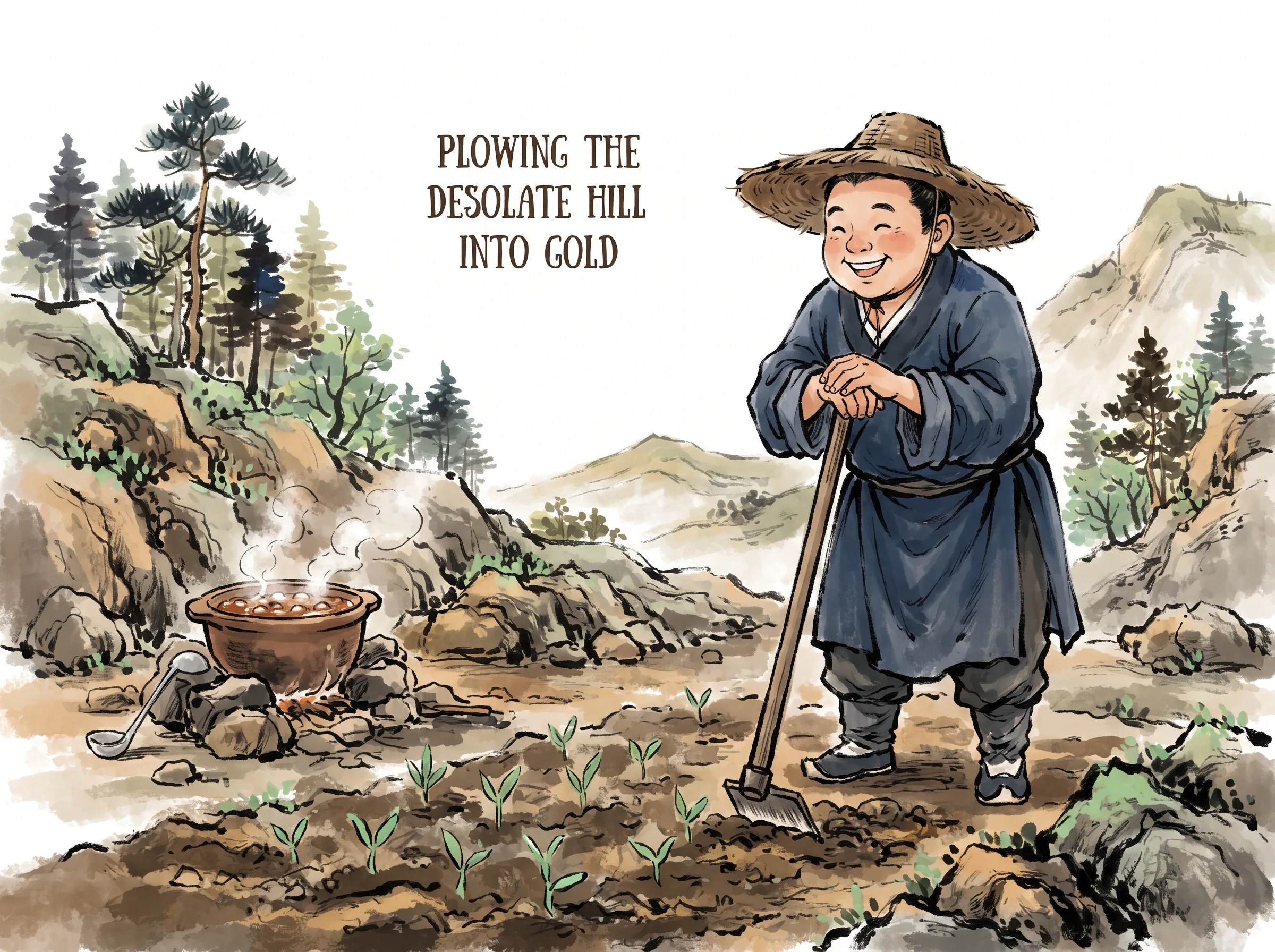
This is not the same as resignation. Su Shi continued to write, to reflect, to cook, to entertain himself with neighbors and local characters. His farming was both practical necessity and a form of philosophical engagement. He chose to inhabit his new life fully rather than live in the past. The name "Dongpo" became more than a label for a field—it became a marker of a reorientation, a declaration that he would not be defined solely by what he had lost.
Three Ancient Chinese Ideas for Hard Times
Finding Peace Where You Are
The Chinese tradition speaks often about meeting reality without resistance. This idea is sometimes summarized by the phrase sui yu er an—finding peace in whatever circumstances arise. It is not passive defeat. It is the disciplined practice of stopping the internal argument with what is, which is often the hardest thing to do after loss.
Philosophical roots for this attitude can be traced to Zhuangzi, who wrote about accepting the times and dwelling in balance (an shi chu shun). The teaching does not suggest that suffering is good or that we should welcome injustice. Rather, it suggests that after the initial shock passes, the most useful stance is one of clarity: seeing what is actually happening, rather than what we wish were happening, and beginning from there.
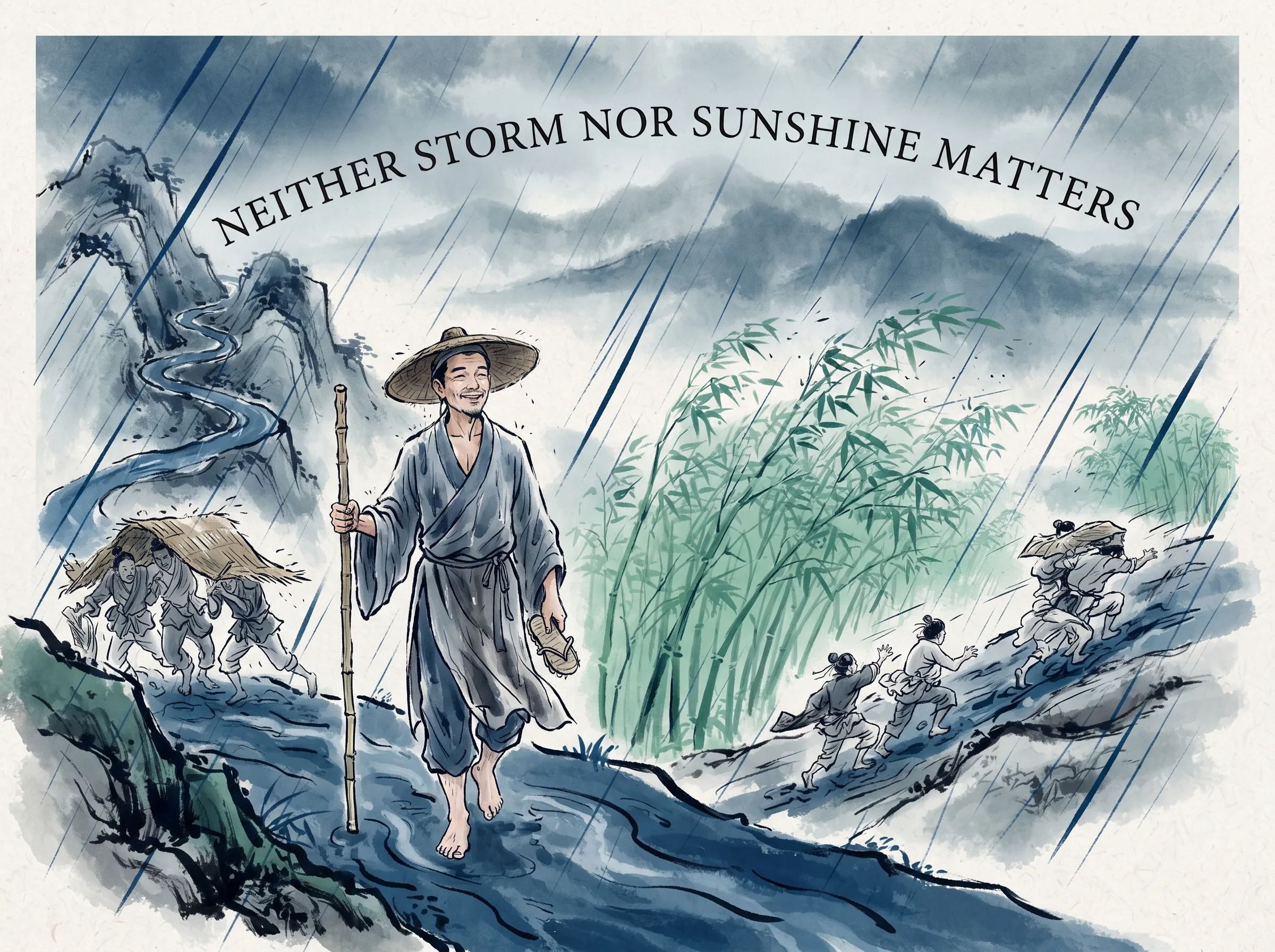
Practical application: When life forces a sudden change—layoff, illness, betrayal, displacement—the first wise response is not to demand that things return to normal. The second response is not to panic. The first response is to acknowledge, as plainly as possible, what has shifted. Name it without embellishment. From that honest assessment, small acts of rebuilding become possible.
Misfortune and Fortune Interpenetrate
One of the most recognizable lines from Laozi's Daodejing is the observation that blessing and misfortune lean into each other: huo xi fu zhi suo yi, fu xi huo zhi suo fu — where misfortune lies, fortune depends; where fortune lies, misfortune hides. This is not optimism dressed as philosophy. It is a recognition that any single moment in a life contains more than its immediate appearance suggests. Gain deeper perspective on weathering adversity through the poetic resilience explored in How to Stay True to Yourself When the World Keeps Pushing You Down.
Su Shi's greatest works—including his famous pieces on the Red Cliffs—are associated with his years in Huangzhou. Whether scholars agree on precise dates or on ranking his output remains a matter of ongoing discussion. What is clear, however, is that the period of his greatest creative flourishing coincided with the period of his deepest personal and political displacement. The same circumstances that would have crushed a lesser spirit became the ground for extraordinary artistic expression.
Practical application: When facing a crisis, it can help to ask: What does this moment contain that safety never could? The answer is rarely obvious. It may be a skill you had no reason to develop. It may be a relationship you would not have entered. It may be a perspective you could not have gained while comfortable. You do not need to romanticize suffering to see that it can carry seeds. You only need to stay present long enough to notice them.
Where the Heart Finds Peace Is Home
The phrase ci xin an chu shi wu xiang—"where the heart finds peace is home"—is one of the most widely quoted lines associated with Su Shi. It comes from a ci poem addressed to a friend who had also suffered exile and displacement. In the poem, a companion named Rou Nu expresses this sentiment when asked why she chose to follow her friend into hardship rather than return to a comfortable life. The line has since become a touchstone for understanding how people maintain inner stability across changing external conditions.
The concept belongs to a broader tradition in Chinese thought that locates home not in geography or status but in the condition of the mind. This is not a call to detach from the world. It is an acknowledgment that no external arrangement—not a title, a house, a city, or a career—is immune to disruption. The only homeland that cannot be confiscated is the one built through sustained attention, integrity, and care.
Practical application: In an age marked by frequent relocation, burnout, and economic precarity, the idea of an inner rootedness is not abstract comfort. It is practical. Begin by identifying what you can control: your daily routines, the relationships you nurture, the work you take seriously. These are the materials from which a portable home is constructed.
What Not to Do
Ancient wisdom is often simplified into motivational slogans, and Su Shi's story is no exception. A few clarifications matter.
First, do not romanticize suffering. Su Shi did not glide serenely through hardship. He faced real despair, wrote about anxiety, and experienced genuine fear during his imprisonment. The value of his story is not that he was always calm but that he kept working, writing, and engaging even when calm felt impossible.
Second, do not confuse acceptance with surrender. Su Shi's farming, cooking, letter-writing, and social life in Huangzhou were not signs of resignation. They were fierce acts of engagement. Acceptance in this tradition means aligning your actions with reality, not abandoning action.
Third, do not look for quick resolution. Su Shi's transformation was not instantaneous. It unfolded over years of daily practice—rising early to tend crops, responding to the weather, writing when inspiration came, and learning to live without the privileges he once held. Meaning in hard times is built gradually, not discovered fully formed.
Your Huangzhou Moment
Every person faces a moment that strips away something essential: a role, a relationship, a version of themselves they believed was permanent. Su Shi's exile was extreme, but the pattern it reveals applies to smaller losses as well.
Begin by naming what has changed, without decoration. Then ask what remains available to you—not what you wish were available, but what actually is. Su Shi had a friend who secured land, a body that could still work, a mind that could still write. Those were enough to begin.
The goal is not to return to who you were before the disruption. The goal is to become someone this moment requires. You may not produce great art. You may not write a lasting poem. But you can plant something. You can name it. You can begin again.
FAQ
Did Su Shi really lose everything and start over in Huangzhou? Yes. After the Wutai Poetry Case in 1079, Su Shi was demoted to Huangzhou with no real authority or income. By his own later account, he faced serious material hardship and relied on a friend to secure land for farming. This period is well documented in classical sources and is considered a turning point in his life and work [2].
Is "where the heart finds peace is home" actually from Su Shi? The line is associated with Su Shi's ci poetry and has become one of the most well-known phrases in Chinese literary culture. It appears in a poem linked to his friend Wang Dingguo and his companion Rou Nu, both of whom experienced hardship and displacement. The exact textual history of the phrase has been discussed by scholars, and it is presented here as a widely recognized line connected to Su Shi's circle rather than as a conclusively settled attribution.
Did Su Shi write his greatest works during his exile? Many readers and scholars consider the works Su Shi produced in Huangzhou to be among his most important, including pieces associated with the Red Cliffs and poems that shaped the development of ci poetry. Whether these represent his absolute peak is a matter of scholarly interpretation, and dating some of these works precisely remains debated. What is clear is that this period was enormously productive and influential.
How is this relevant if my problem is not as extreme as exile? The principle behind Su Shi's transformation does not require catastrophe to apply. Any significant loss—job, relationship, health, status—produces a version of the same rupture. The practical question is always the same: given what remains, what can I build today?
Su Shi's story is not a prescription for suffering. It is evidence that meaning can be rebuilt after loss, often in ways that the original life could not have prepared a person for. The ancient Chinese tradition of Daoist resilience and Chan openness offers tools for this kind of rebuilding—not through denial or forced positivity, but through clear seeing, patient practice, and the willingness to begin again from wherever you stand.
If you are navigating a difficult transition, consider starting small. Identify one thing you can tend today. Name it honestly. Let it be enough for now, reflecting the enduring wisdom of Su Shi Finding Purpose in Hard Times.
Examine this artistic principle further through the classical aesthetic philosophy of Beyond Effortlessness: What Chinese Classical Wisdom Says About Mastery, Burnout, and Letting Go.
Deepen your understanding of these principles in our reflection on Song Dynasty Poets: Ancient Wisdom for Modern Uncertainty.
Sources & Further Reading
[1] Primary and scholarly sources referenced:
[2] Su Shi, "Eight Poems on Dongpo (with Preface)" (《东坡八首(并叙)》) – Chinese Classical Poetry Library — Su Shi, "Eight Poems on Dongpo (with Preface)" (《东坡八首(并叙)》) – Chinese Classical Poetry Library. The autobiographical preface to Su Shi's "Eight Poems on Dongpo," providing direct testimony about his life in Huangzhou and the origins of his farming activities.
[3] Further reading (not cited in the body):
[4] History of Song: Biography of Su Shi (宋史·苏轼传) — for biographical details on Su Shi's official career
[5] Daodejing (老子道德经), Chapter 58 — for the source of the "misfortune and fortune" passage
[6] Su Shi, Dongpo Zhilin (东坡志林) and personal prefaces — for Su Shi's own reflections on his Huangzhou period
[7] Wang Shuizhao, Selected Works of Su Shi (王水照《苏轼选集》) — a widely used modern scholarly edition of Su Shi's works
[8] Lin Yutang, The Gay Genius: The Life and Times of Su Tungpo (林语堂《苏东坡传》) — for an accessible modern narrative framing of Su Shi's life






