
Modern life has a particular way of flattening you. You wake up, check your phone, answer messages, commute, work through a long to-do list that never quite shrinks, come home exhausted, and lie awake wondering where the time went. Careers stall. Plans unravel. You keep running on schedule, but something inside you feels increasingly hollow. The future looks less like a path and more like a fog. If this sounds familiar, you are not alone. But you might also be asking the wrong question. The question is not how to push harder or find a better strategy. The question is how to stay human when everything around you feels unstable.
There is an eighth-century poet and official who understood this problem better than most people alive today. His name was Wang Wei (王维, Wáng Wéi), and he lived through career ruin, political betrayal, forced collaboration with enemy forces, the deaths of his wife and child, and the collapse of the golden age he loved. Yet his poetry does not read like the work of a man crushed by sorrow. It reads like the work of a man who found a way to breathe inside impossibility. That is the point. Wang Wei did not escape difficulty. He learned how to move through it with quiet dignity. His life offers a practical, hard-won framework for anyone feeling overwhelmed by the dead ends of modern life—a foundational perspective explored in Wang Wei Guide to Calm.
Wang Wei Guide to Calm: The Man Behind the Title "Poet Buddha"
Wang Wei was born in 701 in Hedong, into the prominent Wang clan of Taiyuan [1]. His father, Wang Chulian, held the official post of Sima of Fenzhou before the family settled in Pusuo [1]. He was a prodigy in every conventional sense: gifted at poetry, skilled in calligraphy and painting, and deeply accomplished in music [1]. Early in life he suffered a devastating blow — his father died when Wang Wei was only nine, and his family's fortunes declined sharply. His mother, from the powerful Cui clan, raised him and his siblings under conditions of real hardship. She was also deeply rooted in Buddhist practice, and her influence shaped Wang Wei's inner life more than any formal education could.
The label "Poet Buddha" (诗佛, Shīfó) is one of the most famous nicknames in Chinese literary history. The Chinese term combines shī, meaning "poetry," with fó, meaning "Buddha." But it is important to understand what that label actually means. According to available scholarship, no known source from the Tang dynasty itself used this term for Wang Wei [5]. The title appears to have emerged centuries later, with some research pointing to the late Qing period as the earliest documented use [5]. In other words, Wang Wei was not called the Poet Buddha in his own lifetime. The label was a later construction — an attempt by subsequent generations to capture something essential about his art and temperament.

What those later generations recognized was not sudden enlightenment but sustained practice. Wang Wei and his younger brother Wang Jin were known for their devotion to Buddhism, eating vegetarian food and avoiding meat throughout their lives [1]. In his later years, Wang Wei maintained a strict vegetarian diet and made meditation and chanting the center of his daily routine [1]. After leaving court, he spent his evenings alone, burning incense and reading Buddhist texts [1]. This was not performance. It was a discipline honed over decades, through personal loss and political humiliation.
Setbacks That Shaped a Sensibility
Wang Wei's life was marked by a series of crises that would have destroyed lesser people, or turned them bitter. The first major stumble came early. He passed the jinshi examination (进士, the highest-level imperial civil-service degree) in the ninth year of the Kaiyuan era (721), but the path to success was far from smooth [1]. Like many officials of his era, he initially relied on the support of powerful patrons. The story of his recommendation through Princess Yuzen is widely told in popular accounts, but its historical reliability is uncertain and should be treated with caution [transcript, unverified]. What is clear from the records is that his career was never straightforward, and that he experienced professional failure before he experienced professional success.
His political downfall came later. At one point, Wang Wei offended the emperor — possibly over an incident involving a restricted piece of court music, sometimes referred to in later sources as the "Yellow Court" affair — and was demoted to a remote post in Jizhou. The fall from the cultural center of Chang'an to a provincial backwater would have been humbling for anyone. Wang Wei did not respond with public outrage. He wrote poetry about the landscape, the seasons, and the quiet spaces between events.
The deepest wound came in his personal life. His wife died, and according to the Old Book of Tang, he never remarried, living alone for thirty years thereafter [1]. The transcript mentions that she may have died in childbirth and that he also lost a child, but the primary historical record only specifies her death and his subsequent celibacy. Whether or not the fuller story is accurate, the grief was real and transformative. It deepened his meditation on impermanence (无常, wúcháng)—the Buddhist understanding that all conditioned things are subject to change—which became a central theme in his mature poetry.
Then came the An Lushan Rebellion. In 755, the empire Wang Wei served collapsed into civil war. He was captured by rebel forces and forced to accept a nominal position in their administration [1]. This was not a voluntary choice. The rebellion's leader, An Lushan, was known to admire Wang Wei's talents and brought him to Luoyang under restraint [1]. Wang Wei attempted to distance himself by taking medicine to induce diarrhea and feigning illness, but he could not escape entirely [1]. During this period, he secretly wrote a poem mourning the devastation — what is known as the "Ningbi poem" — expressing sorrow for the people and loyalty to the Tang [1]. Lines such as "Ten thousand households mourn in wild smoke; when will the officials return to pay homage at court" captured the anguish of a man trapped inside impossible circumstances [1].
When the rebels were defeated, Wang Wei faced trial. His crime was collaboration, however reluctant. The verdict should have been death. But two factors intervened. First, Emperor Suzong (肃宗, Sùzōng) admired the Ningbi poem as evidence of his true loyalty [1]. Second, Wang Wei's brother Wang Jin, who had served the imperial cause during the rebellion, offered to surrender his own official rank to redeem his brother [1]. Wang Wei was pardoned. He was later promoted to Vice Director of the Department of State Affairs (尚书右丞, Shàngshū Yòuchéng), a senior office that became the source of his later honorific, "Wang Youcheng". But the moral stain of collaboration remained. He carried it for the rest of his life.
These were not abstract difficulties. They were real ruins — professional, personal, political, moral. And each one pushed Wang Wei deeper toward simplicity and inner stillness. None of them were resolved by force, rage, or denial. Connect these enduring values to the broader cultural heritage explored in How the Dragon Teaches Us to Change Without Losing Ourselves.
The Philosophy in Plain Language
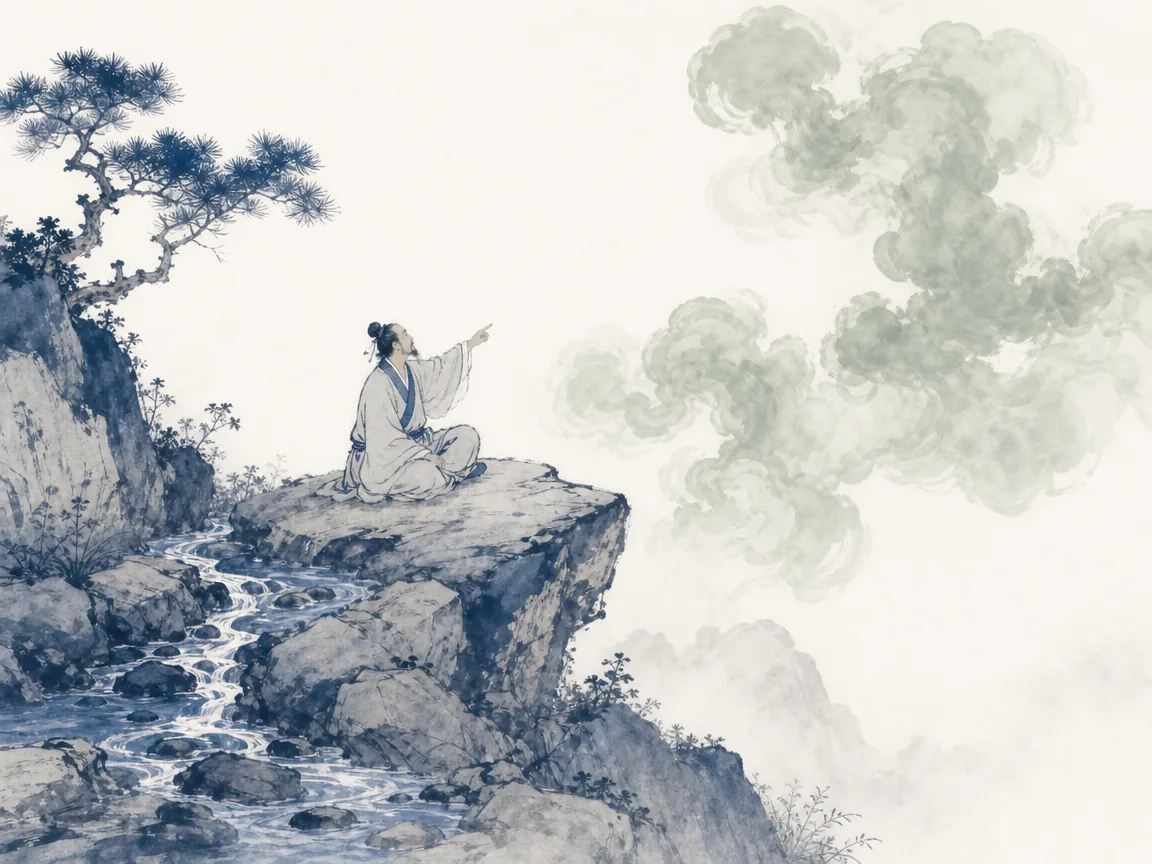
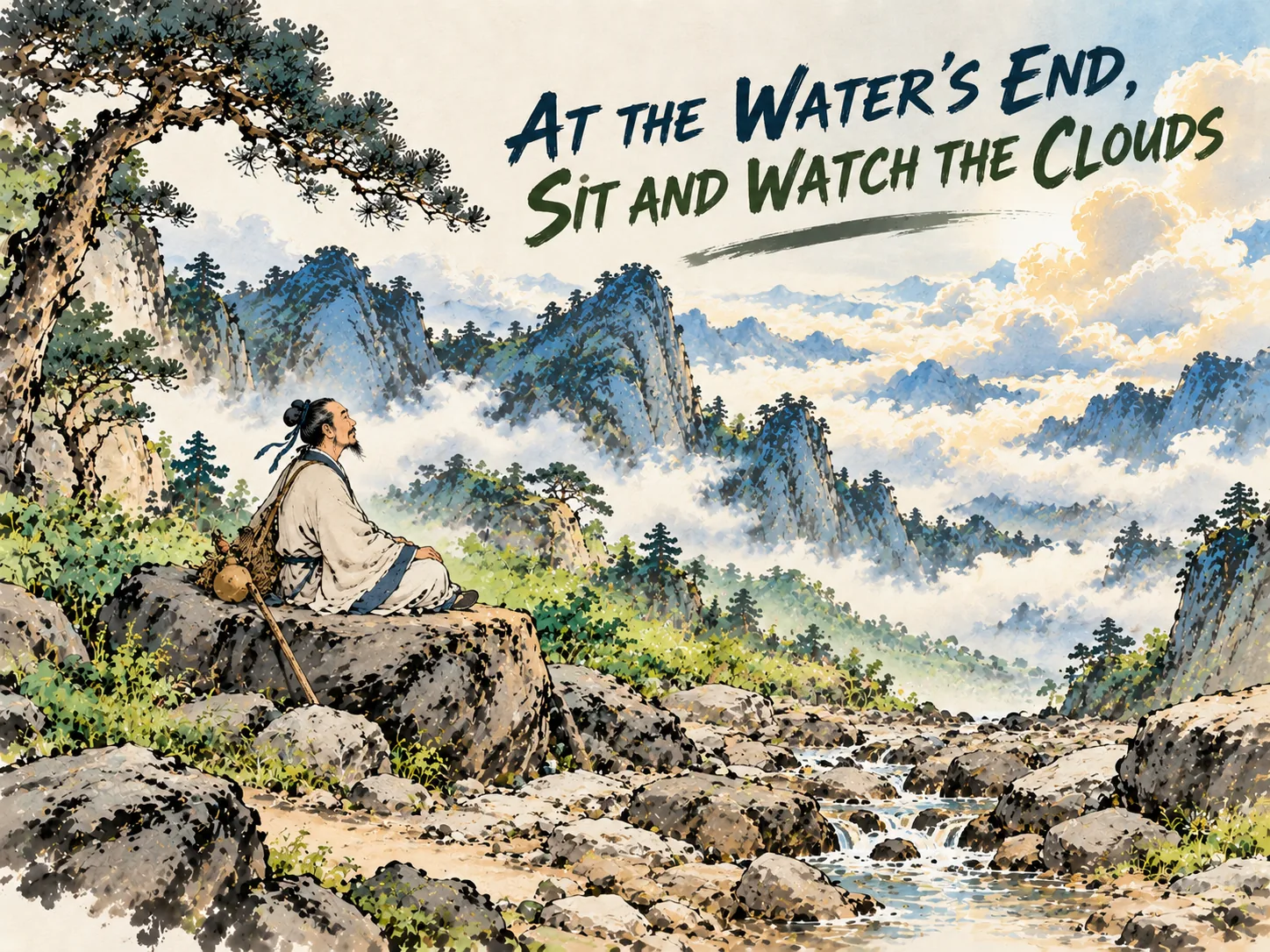
Wang Wei's most famous lines, "Walk to where the water ends, then sit and watch the clouds rise" (行到水穷处,坐看云起时; Xíng dào shuǐ qióng chù, zuò kàn yún qǐ shí), come from his poem "My Retreat at Mount Zhongnan" (《终南别业》, Zhōngnán Biéyè) [3]. Taken out of context, they could sound like resignation — the poetry of a man who has given up. But the full poem tells a different story. It begins with "I rise whenever the mood takes me, going alone; I know the joy such moments bring" [3]. The water ending is not defeat. It is the moment when the old path disappears, and something new becomes possible. Sitting down to watch the clouds is not passive. It is a deliberate shift in attention — a choice to meet uncertainty with openness rather than panic.
In "Deer Enclosure" (《鹿柴》, Lù Zhài), another poem preserved in the Complete Tang Poems anthology, Wang Wei writes: "Empty mountain—no one in sight, yet human voices echo" (空山不见人,但闻人语响; Kōng shān bú jiàn rén, dàn wén rén yǔ xiǎng) [4]. The image is striking because it does not describe silence. It describes a world where presence and absence coexist. Voices are heard, but no one is seen. The mountain is empty, yet alive with sound. This is not escapist fantasy. It is a disciplined way of noticing — observing experience without immediately grasping at it, analyzing it, or trying to control it.
These ideas resonate with what modern psychology calls mindfulness: the practice of attending to the present moment without judgment. They also connect to acceptance and commitment approaches, which teach that suffering often arises not from difficult circumstances themselves, but from our resistance to them. Wang Wei's poetry does not offer a religious prescription. It offers something more practical — a way of orienting oneself toward life when everything feels out of control.
The Buddhist dimension of his work is real but should not be overstated. Wang Wei's devotion to Buddhism shaped his habits and his imagination, but his poetry speaks to anyone who has ever faced a door closing and had to decide what to do next. The point is not to become Buddhist. The point is to learn how to stand still when standing still is the hardest thing in the world.
A Model for Modern Readers
What does Wang Wei's approach look like when translated into ordinary life? Consider three common modern situations.
First, career uncertainty. A project fails. A promotion passes you by. The industry shifts beneath your feet. The instinctive response is often to scramble — to work harder, network more aggressively, or reinvent yourself entirely. Wang Wei's alternative is subtler. When the water ends, you do not pretend the path is still there. You sit. You assess. You allow yourself to feel the disappointment without mistaking it for the whole truth. From that place of honest assessment, you may find a new direction that was invisible while you were running.
Second, grief and impermanence. No amount of positive thinking erases the fact that people die, relationships change, and plans fail. Wang Wei faced irreversible loss — the death of his wife, the collapse of the world he knew — and did not pretend it did not hurt. His poetry acknowledges pain while refusing to be consumed by it. The practice here is not detachment from feeling but refusal to be ruled by it. Grief is honored. But it is not allowed to become the only story.
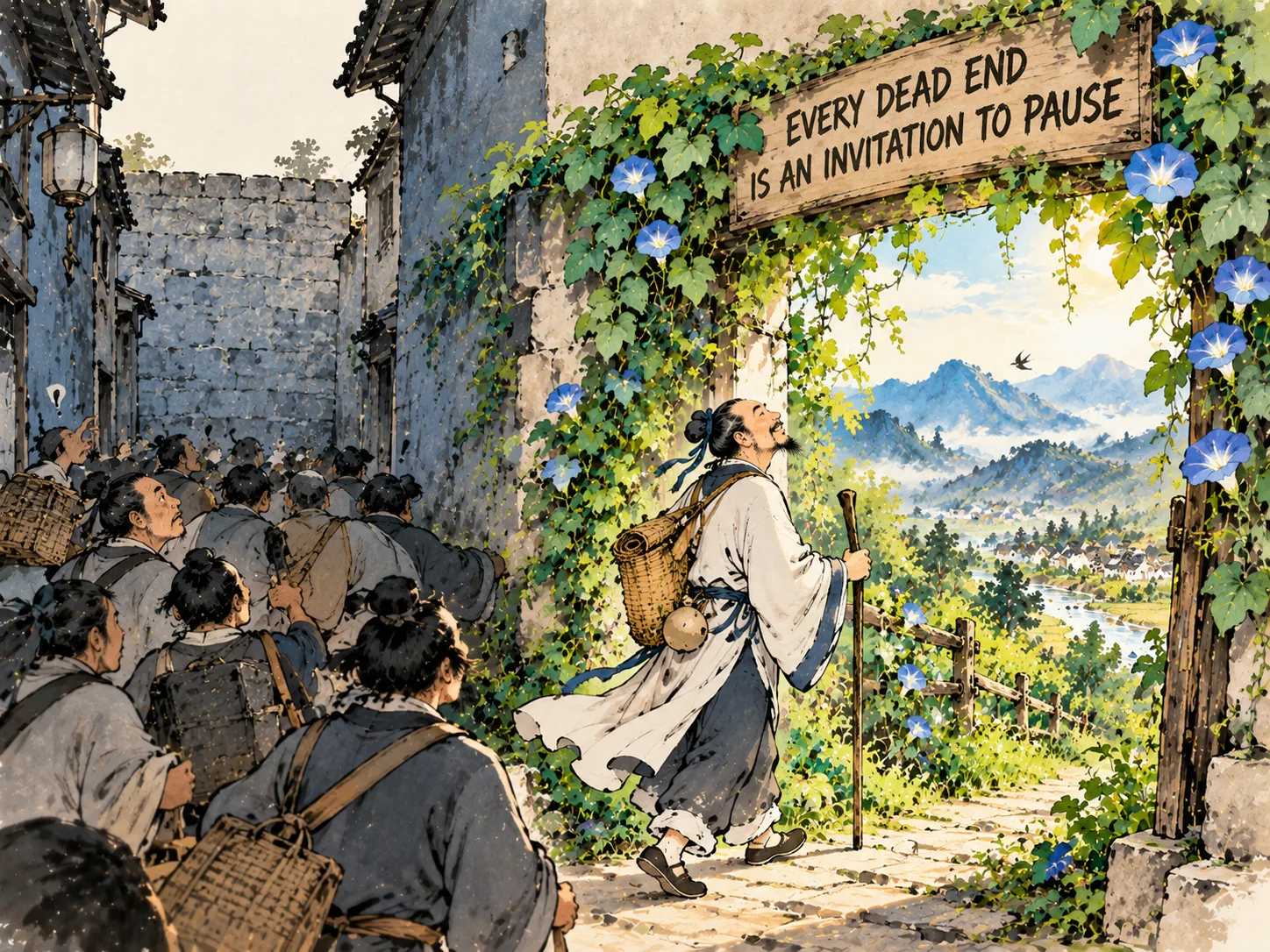
Third, noise and distraction. Wang Wei lived as a public servant in a court full of factionalism, intrigue, and danger. He also cultivated a private life of nature, silence, and creative work. This balance — engagement without identification — is something many professionals today seek. The practical takeaway is small: designate time each day for attention without agenda. Walk in nature. Sit in silence. Make something with your hands. These are not luxuries. They are counterweights to the chaos that defines much of modern existence.
Warnings and Nuance
It is important not to romanticize Wang Wei's life. He was not a serene sage who transcended suffering through superior willpower. He was a man who suffered profoundly and found, through repeated practice, a way to carry it without breaking. His silence was earned, not innate.
He also made compromises he could not undo. The forced collaboration with the An Lushan regime left a moral scar that accompanied him for the rest of his days. His pardon was an act of political grace, not a clearing of his record. To read Wang Wei as simply peaceful is to misunderstand him. His peace was forged in fire.
There is also a distinction worth noting between the kind of stillness Wang Wei cultivated and other paths to meaning. His approach was shaped by Buddhist practice, but it is not dependent on accepting Buddhism as a doctrine. The underlying principle — paying attention, meeting difficulty without force, finding space inside constraint — is available to anyone regardless of their spiritual affiliation. What matters is practice, not pedigree.
And one factual note: the traditional dating of Wang Wei's life as 701–761 appears in some sources, but the Old Book of Tang records his death in the seventh month of the Qianyuan era, which corresponds to 759 [1]****[5]. This discrepancy means the commonly cited lifespan should be treated as approximate rather than definitive.
From Stillness to Action
Wang Wei's life teaches a simple but difficult lesson: you do not need to resolve every uncertainty before you can move forward. You do not need to fix everything before you can find peace. Sometimes the most courageous thing you can do is stop running, sit down, and look at what is actually in front of you. The water ending is not the end. It is an invitation — to see differently, to breathe deeper, to begin again from a place of honesty rather than panic.
If you feel stuck today, ask yourself: what would it look like to walk to the edge of the water and simply sit? Not to give up, but to meet the moment with your full attention. That is where stillness begins.
FAQ
Who was Wang Wei, and why is he associated with Buddhism? Wang Wei (701–759) was a Tang dynasty poet, painter, musician, and official. He and his brother were known for their Buddhist practice, maintaining vegetarian diets and devoting time to meditation and chanting. The label "Poet Buddha" was applied to him centuries after his death, not during his lifetime [1]****[5].
What does "walk to where the water ends, then sit and watch the clouds rise" mean? This line comes from Wang Wei's poem "My Retreat at Mount Zhongnan" (《终南别业》, Zhōngnán Biéyè) [3]. It describes the moment when a familiar path disappears and the only honest response is to pause and observe. It is not about passive resignation but about shifting attention when control is no longer possible.
Did Wang Wei really survive the An Lushan Rebellion, and how? Wang Wei was captured by rebel forces during the An Lushan Rebellion and forced to accept a nominal position [1]. He secretly expressed loyalty to the Tang in poetry [1]. After the rebellion was suppressed, he was pardoned partly because of this poetry and partly because his brother offered to surrender his own official rank to redeem him [1].
Should I practice Buddhism to benefit from Wang Wei's approach? No. Wang Wei's insights are rooted in Buddhist practice, but the underlying principle — paying attention without grasping, meeting difficulty with stillness rather than resistance — does not require adopting any specific religion. The practice is available to anyone willing to cultivate patience and presence, reflecting the enduring wisdom of Wang Wei Guide to Calm.
Examine this artistic principle further through the classical aesthetic philosophy of When the World Closes the Door: What Ancient Chinese Wisdom Says About Your Next Move.
Deepen your understanding of these principles in our reflection on Hong Kong Wuxia Cinema: Where the Sword Meets the Soul — Ancient Chinese Wisdom in Blade and Shadow.
Sources & Further Reading
[1] Old Book of Tang, Volume 190, Part 2 (《旧唐书》卷一百九十下) — Chinese Wikisource,
[2] New Book of Tang, Volume 202 (《新唐书》卷二百零二) — Chinese Wikisource,
[3] "My Retreat at Mount Zhongnan" (《终南别业》) — Chinese Wikisource,
[4] "Deer Enclosure" by Wang Wei (《鹿柴》, 王维) — Chinese Wikisource,
[5] "Who Is the Poet Buddha?" (《“诗佛”是谁?》) — China Writers Association,
Further Reading
- Collections of poetry by Wang Wei and anthologies of Tang poetry provide a broader view of his style and recurring themes.
- Studies of Buddhism and literary life in the Tang dynasty offer useful context for understanding the cultural world of Wang Wei.
- Research on mindfulness and acceptance-based psychological approaches may interest readers seeking modern parallels to the practice of Wang Wei.







[…] Deepen your understanding of these principles in our reflection on When You Reach the Water’s End: Wang Wei’s Guide to Calm in Uncertain Times. […]