
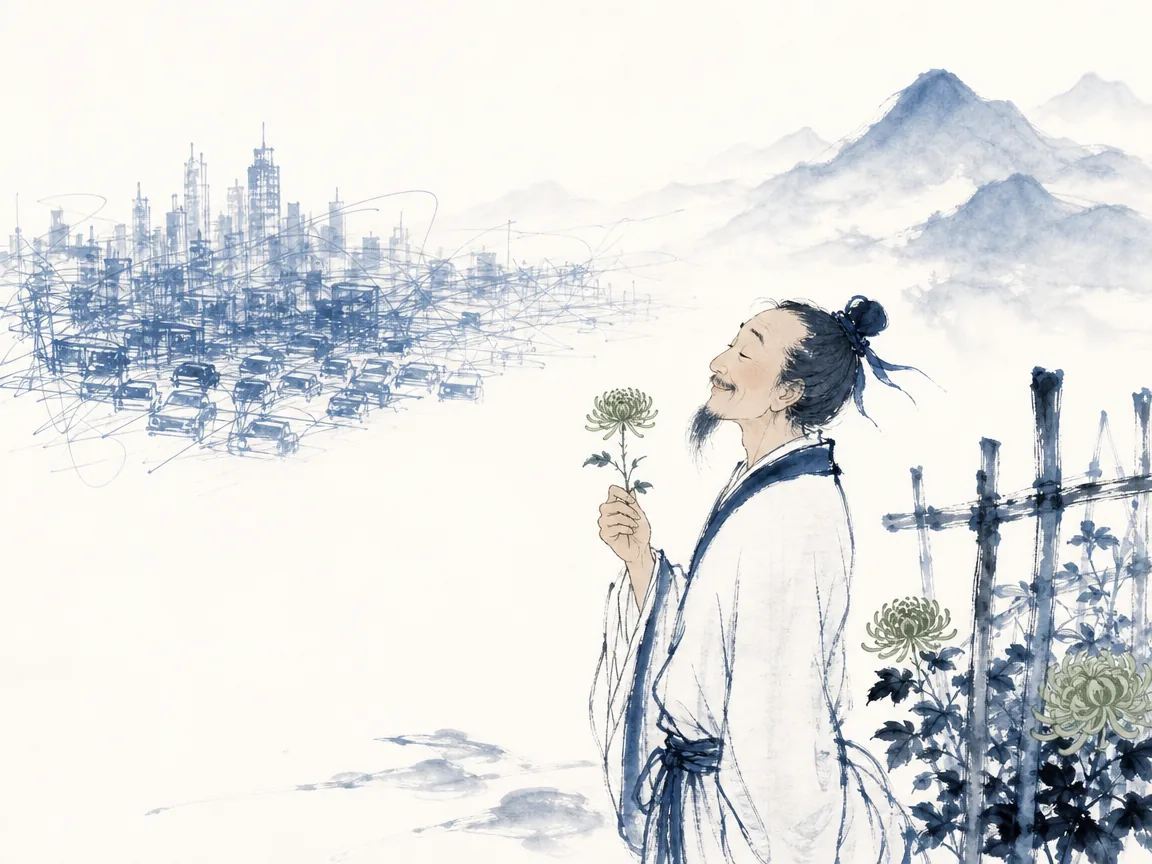
Modern life often feels like a room with no doors. Notifications arrive, tasks multiply, and attention is pulled in every direction until the sense of a quiet center becomes almost forgotten. Yet long before the contemporary culture of productivity and distraction, classical Chinese poets were engaging in something closer to what we might now call contemplative practice. Their poems were not merely decorative art or entertainment; they were records of attention, of breath, of the disciplined effort to see what was actually present.
Two poets in particular offer useful entry points for readers seeking stillness today: Tao Yuanming, who lived during the Eastern Jin dynasty (c. 365–427 CE), and Wang Wei, who flourished in the Tang dynasty (701–761 CE). Both wrote about ordinary scenes — fields, mountains, forest light, simple human moments — but the way they attended to those scenes reveals a deeper practice. They did not rush past the surface of experience in search of dramatic meaning. They lingered. They observed. And in doing so, their poems model a way of being that may feel unfamiliar but is increasingly necessary—a foundational perspective explored in Chinese Poetry Wisdom.
This is not about escaping modern life through ancient poetry. It is about noticing how certain methods of attention, cultivated over centuries, can help recalibrate the way we meet our own days.
Chinese Poetry Wisdom: Poetry as a Practice of Attention
In the classical Chinese tradition, poetry was understood as more than aesthetic display. One foundational principle held that “poetry expresses what is in the heart” (shi yan zhi; Chinese: 诗言志). Developed through early Confucian commentary, this idea helped explain why people wrote verse. The act of composing was seen as closely linked to self-cultivation, to the careful tuning of one's inner life rather than simply the production of beautiful lines.
This differs from some Western romantic assumptions about inspiration, where the poet receives a sudden gift from elsewhere. In the Chinese tradition, writing was more often treated as a daily practice — a kind of meditation in language. The poet trained attention, shaped perception, and recorded what arose. For the modern reader, this framing can be quietly liberating. It suggests that reading poetry does not require specialized knowledge or religious commitment. It only asks for the willingness to pay attention.
Tao Yuanming exemplifies this. After serving briefly as a county magistrate — he held the post at Pengze for a little over eighty days in 405 CE before resigning — he spent roughly twenty-two years in retirement, supporting his family through farming [1]****[3]. His poetry emerged from that life. He wrote about planting, harvesting, clouds moving across a hillside, wine shared with neighbors, and the slow passage of seasons. Nothing spectacular happened in most of his poems. And precisely because nothing spectacular happened, his attention to the ordinary becomes a form of practice. He did not write to escape the world but to inhabit it more fully.
Wang Wei, by contrast, came from a different temperamental and spiritual background. He studied under the Chan Buddhist master Daoguang for ten years, wrote essays in praise of the faith, and dedicated part of his estate to monastic use [4]. His landscapes are often described as meditative not because they preach Buddhism but because they show a particular way of seeing — one that allows the scene to speak without immediate commentary or moralizing. Both poets, in their own registers, practiced attention as a form of cultivation.
Tao Yuanming: The Art of Unhurried Attention
Tao Yuanming's decision to leave official service was not driven solely by abstract philosophy. His preface to Returning to Dwell at Home (Chinese title: 《归去来兮辞》) gives several concrete reasons: his natural disposition did not suit forced constraint, the dissonance between his inner nature and official demands caused suffering, and his sister had died in Wuchang, calling him to return [1]. These are human reasons — practical, emotional, spiritual — rather than purely doctrinal ones. That honesty makes his choice feel accessible.
What matters for our purposes is not whether Tao Yuanming was a Daoist, a Confucian, or something else. The sources simply note that he became a precursor to the “fields and gardens” tradition of pastoral poetry (tianyuan shi; Chinese: 田园诗), favoring themes of drinking and rustic life [3]. Later poets, including Wang Wei and Meng Haoran, inherited aspects of his approach. The tradition he helped establish valued slowness, routine, and the dignity of unremarkable hours.
One of his most frequently discussed techniques is what we might call unhurried attention. In poems such as those from his Drinking sequence, he often begins with an action — picking chrysanthemums beneath the eastern hedge, for example — and lets the scene unfold without forcing it toward a dramatic conclusion. The clouds rise and drift. The birds return to their nests. The moment is sufficient. This is not passive boredom; it is an active practice of remaining where one is.
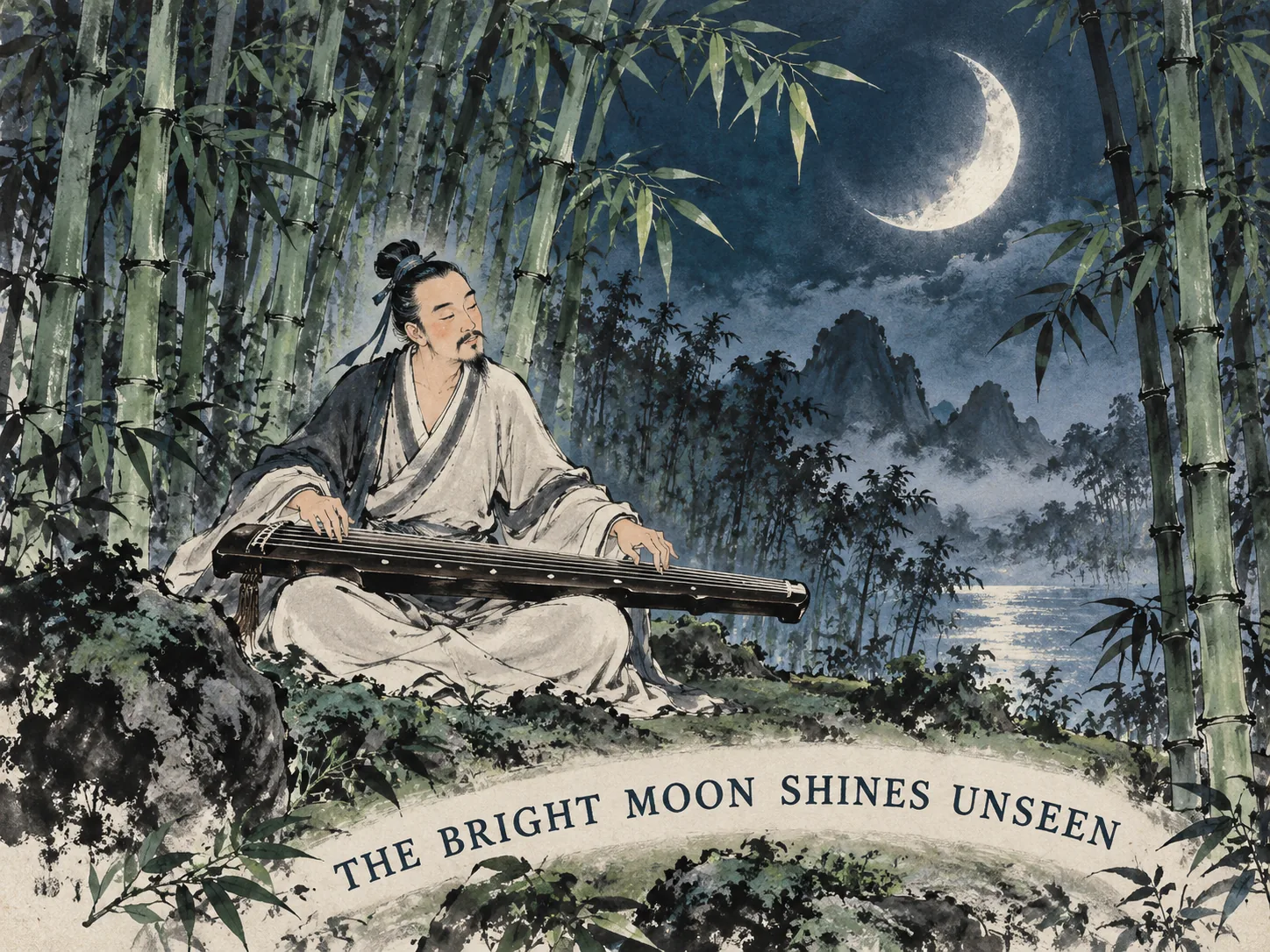
A practical exercise for readers: Choose one ordinary ritual in your day — making tea, walking to work, waiting for a kettle to boil, stepping outside for a moment of air. For three minutes, do nothing with that moment except observe it. Notice what your senses register without trying to improve the experience or turn it into content. Tao Yuanming's poems suggest that the point is not to transcend the ordinary but to meet it without rushing past it. To explore these themes from another angle, read our related reflection on Beyond Escape: How Zhuangzi Can Help You Live Authentically in a World That Won’t Stop Defining You.
Wang Wei: Seeing Without Narrating
Wang Wei's poem Deer Park (Chinese title: 《鹿柴》), part of his Wangchuan collection, is one of the clearest examples of a contemplative technique in classical Chinese verse:
An empty mountain — no one in sight,
Only the echo of human voices.
The setting light enters the deep forest,
And shines again upon the green moss.
(Original Chinese: 空山不见人,但闻人语响。返景入深林,复照青苔上。)
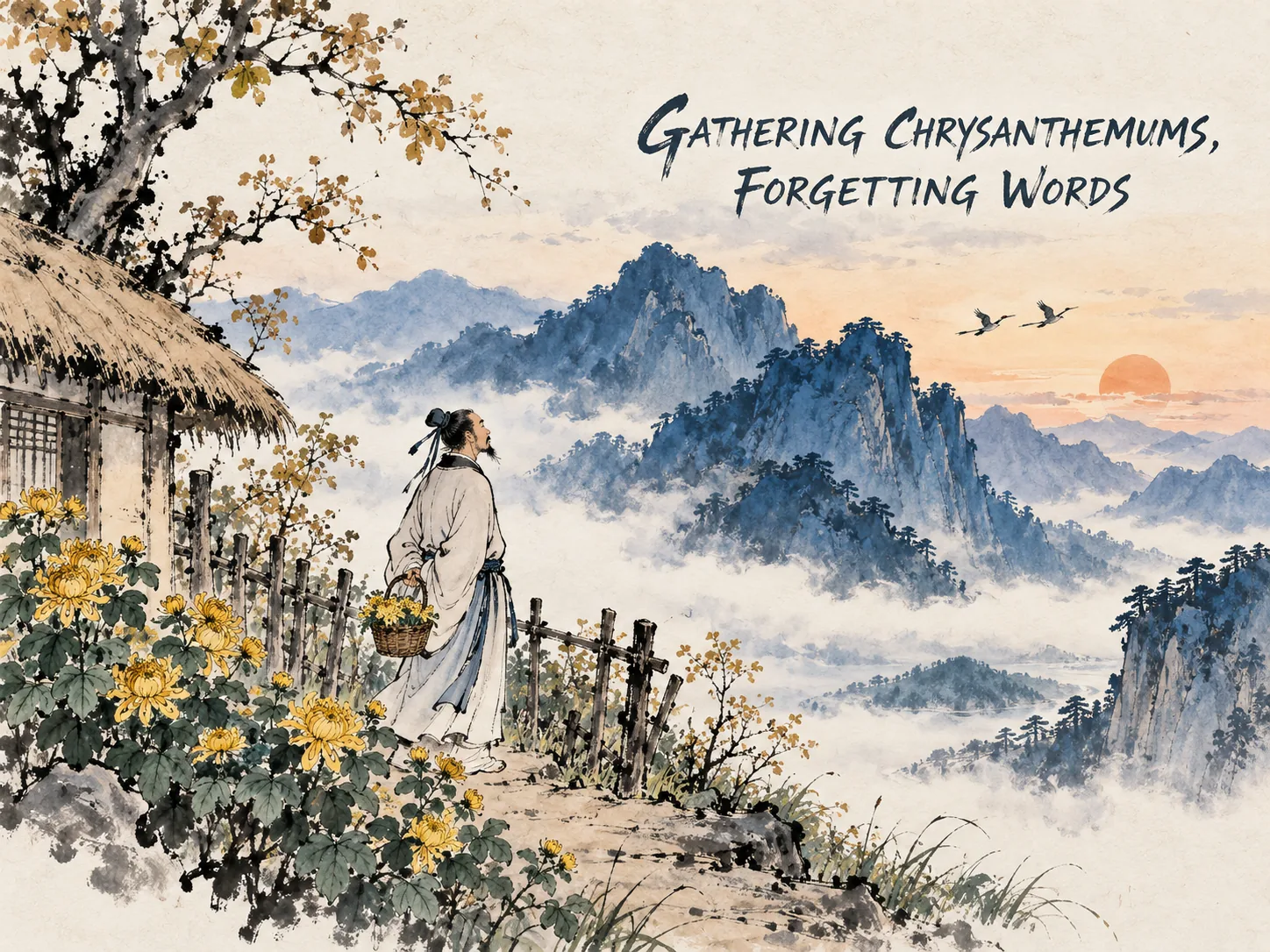
The first two lines establish absence and sound in the same breath. The mountain is empty, yet voices are heard. The second couplet moves from the wide scene to something almost microscopic — light falling on moss. There is no judgment, no moral lesson, no emotional explanation. The image carries its own weight.
This technique connects to Chan (Zen) Buddhist ways of seeing that emphasize direct perception before conceptual labeling. Wang Wei studied Chan for a decade and was closely associated with Buddhist practice [4]. Whether his poetry should be read strictly as Buddhist meditation or as something broader remains a matter of scholarly interpretation, but the method is recognizable: place concrete sensory detail before any statement of feeling, and allow the image to stand.
A practical exercise for readers: Find a single scene — a street corner, a patch of sky, a room in your home. Describe it in three or four sentences, but resist the impulse to explain what it means or how it makes you feel. Report only what you can perceive directly. This is not an exercise in literal transcription but in slowing the mind's habit of immediately interpreting. Wang Wei's poems often feel spacious precisely because he withholds interpretation long enough for the reader to experience the scene themselves.
Grounded Emotion: From the Classic of Poetry
The contemplative possibilities of Chinese poetry extend beyond the individual master poets. The earliest collection, the Classic of Poetry (Shijing; Chinese: 《诗经》), contains the Airs of the States (Guofeng; Chinese: 国风), a set of folk songs that give voice to ordinary feelings — longing, fatigue, joy, grief — without abstraction or ornament. These poems do not dramatize emotion for rhetorical effect; they anchor it in specific bodily and social situations.
Later Confucian commentary framed this tradition with principles such as “gentle restraint and sincerity” (wenrou dunhou; Chinese: 温柔敦厚), understood as an aesthetic and ethical ideal about how emotion should be expressed. The point here is not moral instruction but a way of being honest with feeling without losing control of it. A poem can hold sorrow without collapsing into despair or performing grief for an audience.
A practical exercise for readers: When a strong emotion arises today — frustration, sadness, relief, envy — name it plainly, without embellishment or minimization. Say to yourself or write down: "I am feeling X." Do not add a story about why it happened or whether it is justified. The Shijing tradition suggests that simply naming a feeling with clarity is itself a form of cultivation.
Three Questions from Classical Poetry
The practices suggested above can be gathered into three simple questions that readers might carry through a day. These are not religious formulas. They are attentional tools rooted in literary practice.
What am I paying attention to right now? Tao Yuanming's gaze returns us to this question again and again. His poetry consistently asks: where is your attention placed? Is it scattered across urgent demands, or has it settled, even briefly, on the actual world in front of you?
Can I describe this moment without explaining it? Wang Wei's method models this. Many of his poems present a scene and stop. The reader is invited to sit inside the image rather than receive a conclusion about it. This restraint is a discipline, not a failure of expression.
Is this feeling honest, or is it performed? The Shijing tradition and the Confucian emphasis on sincerity both push toward this distinction. Emotion that is named plainly tends to be stabilizing. Emotion that is amplified for effect or minimized to avoid discomfort tends to circulate restlessly.
These questions are cumulative. Taken together, they offer a modest practice of presence that requires no special equipment, no membership, and no change of lifestyle beyond what is already happening.
When Poetry Falls Short
It is important to acknowledge that classical Chinese poetry does not only model stillness. The tradition also includes courtly ornamentation, formal constraint, political frustration, and social anxiety. Many poems express the very turbulence that modern readers might hope to escape. Tao Yuanming himself wrote verses of complaint and weariness alongside his pastoral calm. Wang Wei lived through the An Lushan Rebellion and produced work shaped by political catastrophe.
Romanticizing the past as uniformly peaceful would be inaccurate. The value of these poets lies not in claiming that they never suffered but in observing that some of them found ways to attend to reality with a clarity that did not dissolve under pressure. Their poems are records of that effort, not guarantees of its success.
A Note on Limits
The sources available here do not support broad claims that classical Chinese poetry is universally effective as a contemplative tool or that it has proven psychological benefits across populations. What they do support is a description of how certain poets practiced attention and how their methods have been understood within Chinese literary tradition. Readers who find value in this approach may explore it as one resource among many. It is not a substitute for professional mental health support when that is needed.
Conclusion and Next Steps
Classical Chinese poetry offers more than beautiful language. It preserves specific methods of attending to the world — unhurried observation, sensory description without immediate interpretation, honest naming of feeling. Tao Yuanming, Wang Wei, and the earlier traditions they inherited practiced these methods not as performance but as forms of cultivation.
For a modern reader seeking stillness, the first step need not be grand. It can be as small as pausing for three minutes during a daily ritual, writing four sentences about a scene without explaining it, or simply naming a feeling plainly. These are modest practices. They are also, perhaps, the ones most worth trying.
If you would like to go further, consider reading a single poem each day and spending a few minutes with one of the questions above. Return to the text slowly. The goal is not to finish more quickly but to meet what is already here.
FAQ
Q: Do I need to know Chinese or classical literature to benefit from these practices? A: No. The exercises described here are based on translations and adaptations of classical poems. What matters is willingness to pay attention, not expertise in the source language or literary history.
Q: Are Tao Yuanming and Wang Wei considered Buddhist or Daoist poets? A: Tao Yuanming is sometimes associated with Daoist themes, though his personal reasons for retiring were practical and emotional as much as philosophical. Wang Wei studied Chan Buddhism and wrote about Buddhist practice, but his poetry is not strictly sectarian. The contemplative methods in their work can be approached without adopting any religious belief.
Q: How accurate are the translations of the poems cited here? A: The lines from Deer Park presented in this article correspond to widely circulated translations. Multiple English versions exist, and no single translation is universally definitive. The original Chinese text is preserved in the source cited [2].
Q: Can reading poetry replace other forms of stress management or therapy? A: Poetry can be a valuable complementary practice, but it is not a substitute for professional mental health care. If you are experiencing significant distress, consulting a qualified professional is recommended, reflecting the enduring wisdom of Chinese Poetry Wisdom.
To explore these themes from another angle, read our related reflection on Why Do You Keep Chasing Goals That Don’t Make You Feel Free?.
Deepen your understanding of these principles in our reflection on When You Reach the Water’s End: Wang Wei’s Guide to Calm in Uncertain Times.
Sources & Further Reading
[1] Tao Qian — Renditions, Chinese University of Hong Kong. Provides biographical details on Tao Yuanming, including his dates (365–427 CE), retirement lifestyle, and role as a precursor of the pastoral poetic tradition.
[2] Wang Wei — Renditions, Chinese University of Hong Kong. Covers Wang Wei's dates (701–761 CE), his study under Chan master Daoguang, and his establishment of monastic space on his estate.
[3] Returning to Dwell at Home, with Preface (Chinese: 《歸去來辭並序》) — Wikisource. Contains the full text and preface of Tao Yuanming's Returning to Dwell at Home, including the 405 CE dating and his stated reasons for resigning.
[4] Deer Park by Wang Wei (Chinese: 《鹿柴》) — Wikisource. Preserves the original Chinese text of Wang Wei's Deer Park, including its placement within the Wangchuan collection.
[5] An Overview of the Development of Ancient Chinese Poetry, four-part series (Chinese title: 《中国古代诗歌发展概述》) — Bilibili documentary series (BV1XGu768EJL). Provides broader historical context on the development of Chinese classical poetry, including discussions of Tao Yuanming's influence and Wang Wei's artistic achievements.






