
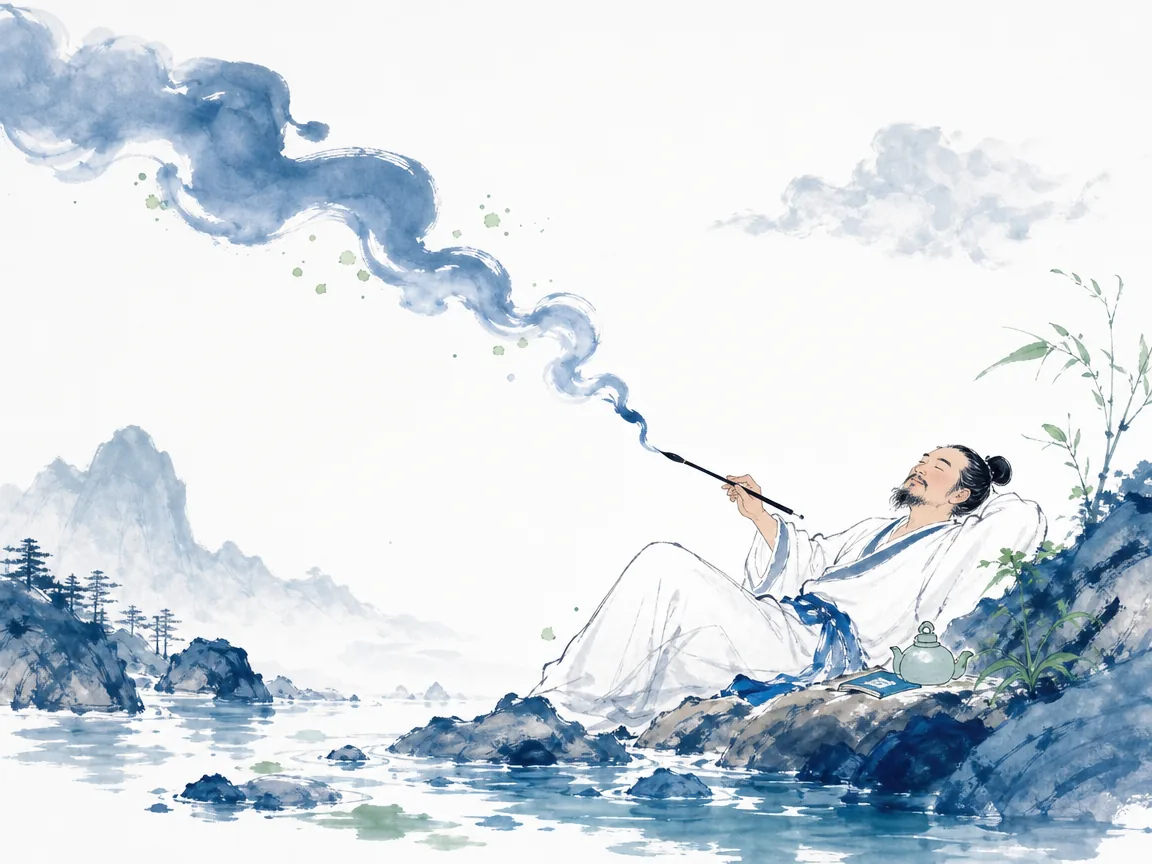
Long before the word "flow state" entered Western psychology, Chinese poets were describing something very similar — a creative condition in which work does not feel forced but instead seems to arrive through the artist who has prepared a clear channel for it. The Chinese literary tradition has long recognized two paths to creative expression: relentless grinding, and spontaneous flow. One model is embodied by the Tang poet Jia Dao, who reportedly spent three years producing just two lines and wept when they were finally finished. The other is captured in the words of the Southern Song poet Lu You, who wrote that "writing is inherently formed by nature, and a skilled hand merely happens upon it" (wénzhāng běn tiān chéng, miàoshǒu ǒu dé zhī, 文章本天成,妙手偶得之).
This tension between effort and ease is not limited to Chinese thought. Plato, in the Ion, puts Socrates to argue that poets do not produce their finest work by technique at all, but because they are stirred by divine influence, serving as vessels for a power greater than their own craft Yet the Chinese tradition resolves the tension in its own distinctive way: not by choosing between discipline and passivity, but by suggesting that deep preparation — long cultivation of attention, sensitivity, and inner stillness — makes the mind ready to receive what is already there, waiting to be expressed—a foundational perspective explored in Zhuangzi Philosophy.
The question this essay explores is both practical and philosophical: what can this ancient view teach us about how we approach creative work, professional projects, and even daily life today? We live in an era that glorifies hustle, where productivity is measured in output per hour and creative blocks are treated as personal failures. The Chinese poetic tradition offers a different vocabulary — one in which the highest art is not seized by force, but allowed to come through.
Zhuangzi Philosophy: They Were Work Songs
It is often said, with some scholarly caution, that China's oldest known verse is an eight-character fragment recorded in the Wu Yue Chun Qiu (Spring and Autumn Annals of Wu and Yue), a text compiled during the Eastern Han period:
"Break bamboo, join bamboo; cast earth, chase game." (duàn zhú, xù zhú; fēi tǔ, zhú ròu, 断竹,续竹;飞土,逐宍。)
"Cut the bamboo, join the bamboo; launch the clay, chase the flesh". These four brief lines describe — in stark, action-driven language — the process of making a projectile weapon and using it to hunt. What is striking about this verse is not that it is beautiful in a literary sense, but that it was never written down as "poetry." It emerged from collective labor: a work chant used to coordinate movement, synchronize breathing, and sustain rhythm during physical exertion.
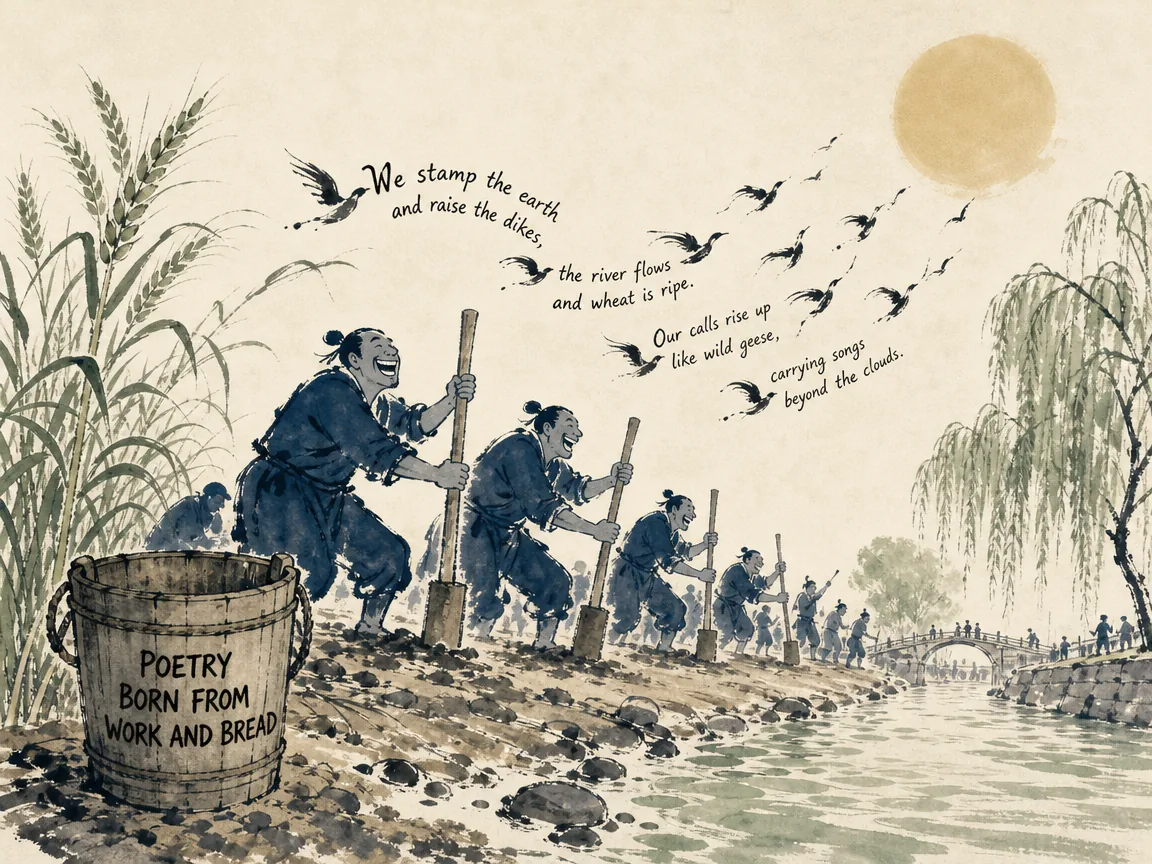
The implication is significant. The earliest known Chinese verse was not born in isolation, contemplation, or deliberate self-expression. It arose from the body, from shared effort, from the practical need to move together toward a common purpose. In this sense, creation is not something imposed from the top down by a lone genius; it is something that emerges when individuals are aligned with an activity and with each other.
This stands in quiet contrast to a dominant modern assumption: that creativity is primarily an individual act of will, produced through sustained struggle against resistance. The work song suggests something simpler and perhaps more honest — that rhythm and form can arise naturally from engagement with a task, not from sitting alone and forcing something out of nothing.
Ritual, Order, and the Idea That Things Belong Where They Are
Another early text, preserved in the Liji (Book of Rites) in a section describing the seasonal sacrifice known as Laci, contains a short invocation addressed to the natural world:
"Let earth return to its abode, water to its ravines, insects cease their stirring, grasses and trees flourish in their wetlands." (tǔ fǎn qí zhái, shuǐ guī qí hè, kūnchóng wú zuò, cǎomù guī qí zé, 土反其宅,水归其壑,昆虫毋作,草木归其泽。)
"Earth, return to your resting place. Water, flow back to your gullies. Insects, do not arise. Vegetation, return to your marshes" [Liji, Chapter Jiao Te Sheng, via Wikisource]. This is not decorative language. It is a prayer for cosmic and ecological order — a request that each element of the world settle into its proper place.
In traditional Chinese thought, harmony does not come from dominating nature or bending it to human will. Harmony comes from recognizing the natural tendency of things and allowing them to follow it. This idea is closely related to what Daoist philosophers call ziran — sometimes translated as "self-so-ness" or "natural spontaneity." In the Stanford Encyclopedia of Philosophy's entry on Chinese metaphysics, ziran is explained as "to be so-of-oneself" — a mode of being that excludes appeals to external purpose, deliberation, or design [Stanford Encyclopedia of Philosophy: Metaphysics in Chinese Philosophy]. The ideal is not forced perfection; it is the alignment of elements within their own natural context.
Applied to creative work, this means that the anxiety many people feel about "making something perfect" may rest on a misunderstanding. Perfection, in this tradition, is not an imposed standard. It is the result of each part finding its right place. A project does not need to be beaten into shape; it needs to be observed, attended to, and allowed to reveal its own internal logic. To explore these themes from another angle, read our related reflection on The Highest Cultivation Needs No Effort.
Two Models of Creation: Jia Dao and Lu You
The Chinese poetic tradition preserves two strikingly different attitudes toward creative effort, and both have been deeply influential.
Jia Dao (贾岛, 779–843) is remembered as a "bitter-chanting" poet (kǔ yín, 苦吟) — one associated with painstaking craft and emotional intensity. He is said to have spent three years on two lines of poetry, and when they were finally complete, he wept. The poem he attached to those lines, traditionally called After Writing the Poem (Tí Shī Hòu, 题诗后), reads:
"Two lines, three years to win; one chant, two streams of tears flow. If the soul-knower fails to prize them, I will return to lie among autumn hills of my home." (liǎng jù sān nián dé, yī yín shuāng lèi liú. zhīyīn rú bù shǎng, guī wò gùshān qiū., 两句三年得,一吟双泪流。知音如不赏,归卧故山秋。)
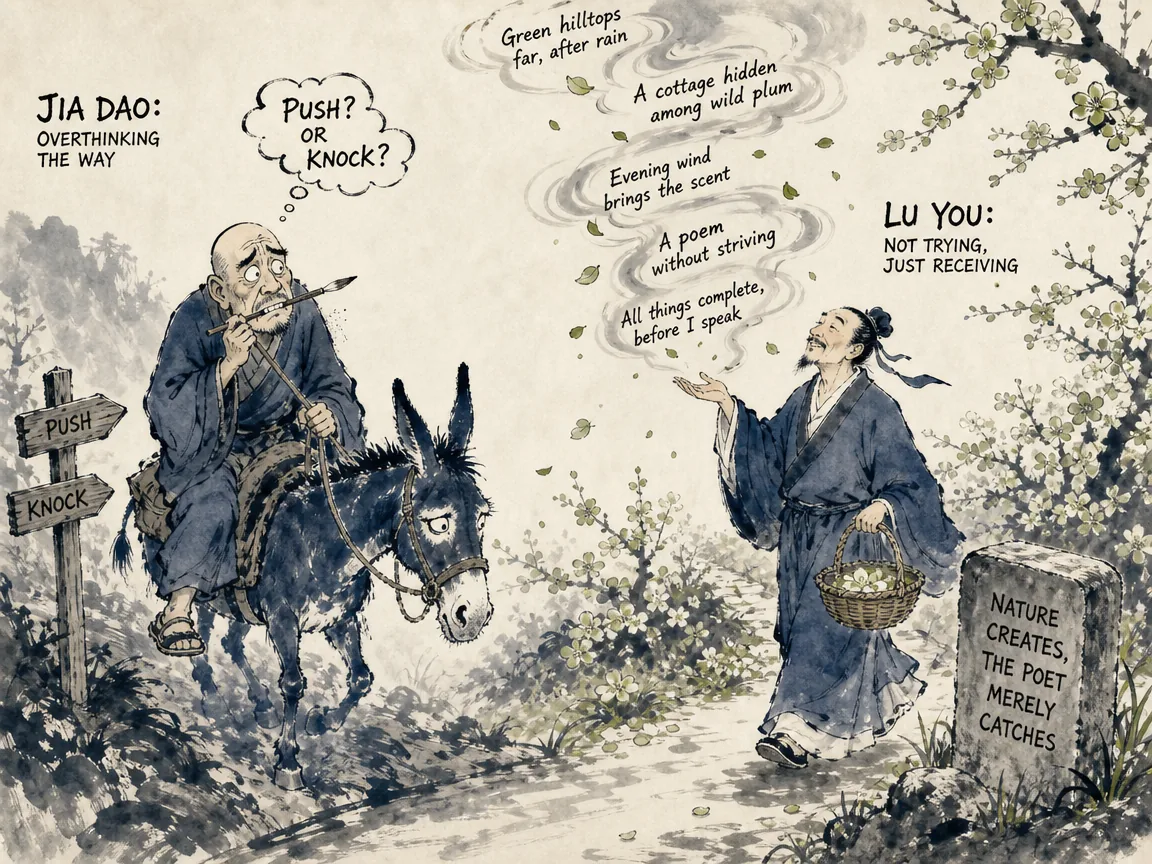
"Two lines, three years to win; one chant, both eyes run with tears. If no one who understands fails to appreciate them, I will return to lie among the autumn hills of my native mountains" [Gushiwen: Jia Dao, Ti Shi Hou]. According to traditional interpretation, these lines were written as a note after Jia Dao completed the couplet "Alone, a reflection walking at the pool's bottom; counting breaths, my body rests beside the trees" (dú xíng tán dǐ yǐng, shǔ xī shù biān shēn, 独行潭底影,数息树边身) from his poem Sending Off Master Wu [Gushiwen: Jia Dao, Ti Shi Hou]. This portrait of the poet weeping over two lines has become a powerful symbol of relentless discipline — and also of the human cost of that discipline.
Lu You (陆游, 1125–1210), writing nearly three centuries later, offered a very different picture. In his poem On Writing (Wénzhāng, 文章), he begins:
"Writing is inherently formed by nature; a skilled hand merely happens upon it. Pure without flaw or blemish, how could it ever require human forcing?" (wénzhāng běn tiān chéng, miàoshǒu ǒu dé zhī. cuì rán wú cīxiá, qǐ fù xū rén wéi?, 文章本天成,妙手偶得之。粹然无疵瑕,岂复须人为?)
"Writing is formed by nature; the skilled hand captures it by chance. Flawlessly pure, without blemish — does it really require human effort at all?" [Gushiwen: Lu You, Wen Zhang]. The implication is not that effort is worthless, but that the finest writing does not come from forcing. It comes from a readiness that meets an opportunity — from a mind prepared to receive rather than a will determined to seize.
These two models are not simply historical curiosities. They map onto a tension that every creative person encounters: the voice that says you must push harder, and the voice that says you must be still enough to let it come. Neither extreme is entirely satisfying. Pure grinding leads to exhaustion. Pure passivity leads to emptiness. The Chinese tradition, as reflected in these poets, suggests a middle path: cultivate yourself so thoroughly that you become sensitive to what wants to emerge, and then step aside long enough for it to do so.
This is not a rejection of discipline. Jia Dao's three years of work were real. But the tradition also asks: what is the cost of that effort? And is there a way to achieve depth without burning out?
What This Means for Creative Work and Daily Life
Modern culture celebrates effort as a moral virtue. The narrative is familiar: sleep less, grind harder, post daily, never stop creating. Burnout is reframed as dedication. When creativity stalls, the default explanation is that more effort is needed — more hours, more tools, more discipline.
The Chinese poetic tradition offers a different possibility. It does not deny the value of practice or skill. But it insists that the most valuable outcomes — in art, in work, in relationships — often come not from maximal effort, but from the right conditions. A farmer does not pull seedlings upward to make them grow faster. A musician does not force a melody by playing louder. A writer does not create clarity by writing more words; clarity often arrives when the noise settles.
There are a few practical implications worth considering.
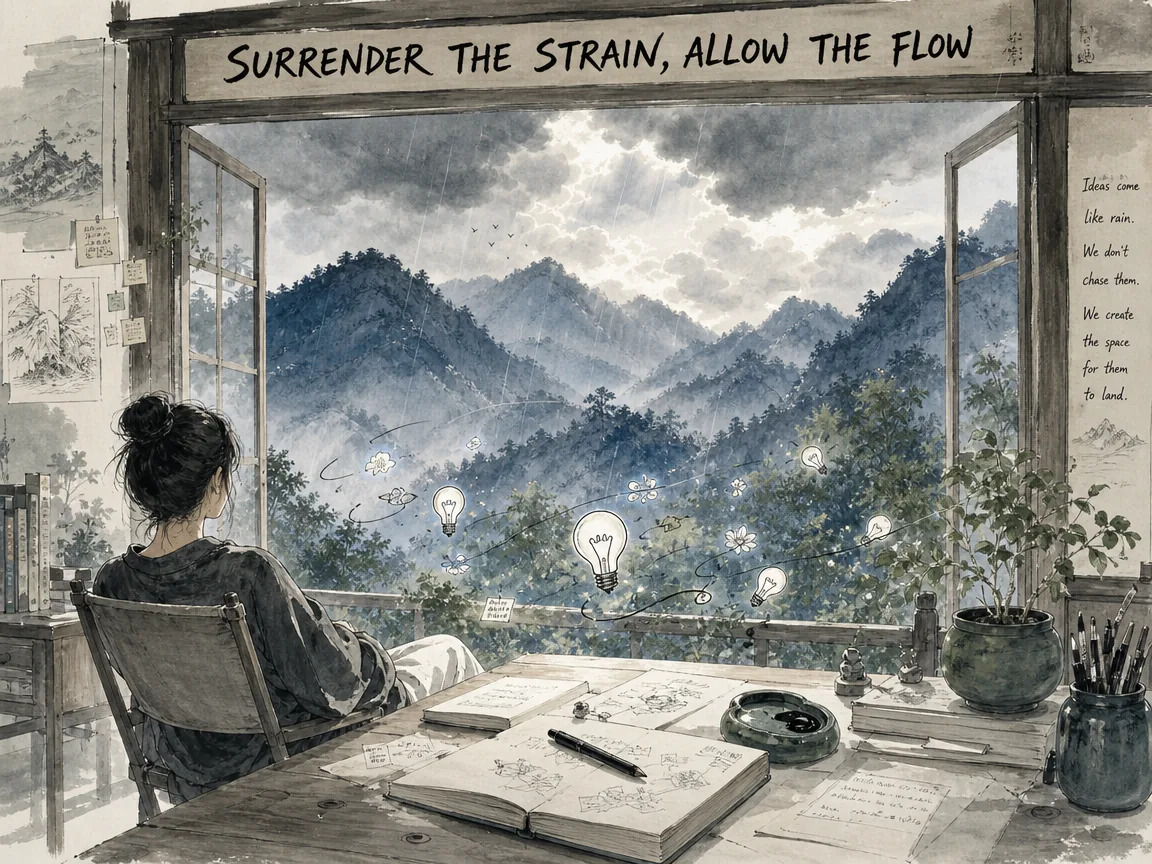
First, cultivate sensitivity rather than only output. The ancient Chinese view suggests that the quality of what emerges depends heavily on the quality of attention brought to the process. Reading widely, observing carefully, maintaining stillness — these are not distractions from creative work. They are the groundwork. As one translator noted about classical Chinese aesthetics, the cultivator of the mind develops not just technique but a refined sensitivity to the world [Stanford Encyclopedia of Philosophy: Metaphysics in Chinese Philosophy].
Second, recognize that resistance and fatigue are not always signs of correct effort. Sometimes difficulty signals that the approach is wrong, not that persistence is lacking. The distinction matters. Pushing through a creative block may produce something — but it may also produce something strained. Stepping back may feel like failure in a culture that rewards visible activity. But the tradition of ziran suggests that stillness can be a form of work.
Third, understand that preparation and openness are not opposites. Lu You did not become a skilled poet by waiting passively for inspiration. His "skilled hand" was the result of decades of practice, reading, and reflection. The difference is that his later work reflected a shift in attitude — from force to receptivity, from producing to receiving. The same pattern appears in many creative traditions: the beginner must learn discipline; the mature practitioner learns when to release control.
Fourth, accept that the best results often come at unexpected times. "A skilled hand captures it by chance" (miàoshǒu ǒu dé zhī, 妙手偶得之). This is not an argument against planning or routine. It is an argument against believing that certainty of outcome is possible through effort alone. Some of the most important insights, solutions, and creative breakthroughs arrive when the mind is not actively hunting for them.
This is not a call to laziness. It is a call to discernment — to learn the difference between productive effort and futile strain, between preparation and anxiety, between doing and forcing.
FAQ
Q: Does this mean effort is useless in creative work?
No. Both Jia Dao and Lu You were highly skilled practitioners. The tradition distinguishes between effort that refines sensitivity and effort that tries to overcome natural resistance through force. The first is essential. The second is often counterproductive.
Q: Is "writing is formed by nature" (wénzhāng běn tiān chéng, 文章本天成) saying that poets should do nothing and wait for inspiration?
That would be a misreading. Lu You's point is that the finest writing has a quality that cannot be manufactured through technique alone. His "skilled hand" implies years of practice. The wisdom lies in recognizing that practice and receptivity are both necessary — and that over-reliance on either one creates imbalance.
Q: How does this relate to the concept of flow in modern psychology?
There are significant parallels. Both describe a state in which action and awareness merge, effort feels effortless, and the work seems to come through the person rather than being forced out. The Chinese tradition expresses this in terms of ziran and natural alignment rather than in psychological terminology, but the observed experience is strikingly similar.
Q: Can this approach be applied to non-artistic work, like business or writing reports?
Yes. The underlying principle — that clarity and quality often emerge from attention and stillness rather than from frantic output — applies wherever humans produce meaningful work. It does not mean skipping planning or discipline. It means recognizing that some of the most valuable outcomes arise from conditions that cannot be manufactured through pressure alone.
The ancient Chinese view of poetry as something that flows naturally is not a rejection of effort. It is a correction of the assumption that effort alone is sufficient. The tradition preserved by poets like Jia Dao and Lu You suggests that creative work — whether in art, in professional projects, or in everyday life — benefits from both deep preparation and the willingness to let go of control at the right moment.
The path forward is not to choose between grinding and waiting. It is to cultivate both: to build skill through sustained practice, to develop sensitivity through attention and reflection, and to recognize when the moment has arrived to step back and allow the work to find its own form. In a culture that equates busyness with value, this may be the most useful insight of all, reflecting the enduring wisdom of Zhuangzi Philosophy.
To explore these themes from another angle, read our related reflection on From the Northern Ocean to the Nine-Thousand-Li Sky: Zhuangzi’s Blueprint for Unconditional Freedom.
Deepen your understanding of these principles in our reflection on Why the Best Comes After the Fall: Cao Zhi’s Paradox of Failure and Genius.
Sources & Further Reading
[1] Plato, Ion, page 534 — Perseus Digital Library
[2] "Two Lines Won Over Three Years" (两句三年得,一吟双泪流) Full Poem Appreciation — Gushiwen.cn
[3] "Writing is Inherently Formed by Nature" (文章本天成,妙手偶得之) Full Poem Appreciation — Gushiwen.cn
[4] Metaphysics in Chinese Philosophy — Stanford Encyclopedia of Philosophy
[5] Book of Rites (Liji), Chapter Jiao Te Sheng — Wikisource — /Book_3,_Part_A#XXI._The_Sacrifice_at_the_End_of_the_Year)
[6] Wu Yue Chun Qiu (Spring and Autumn Annals of Wu and Yue) — Internet Archive
Further Reading
- Zhuangzi, Chuang Tzu — selections on natural spontaneity and effortless action
- Analects (Lunyu) — passages on self-cultivation and the moderation of effort
- Csikszentmihalyi, Mihaly — Flow: The Psychology of Optimal Experience
- Robin Waterfield (trans.), Plato: Ion and Other Dialogues






