
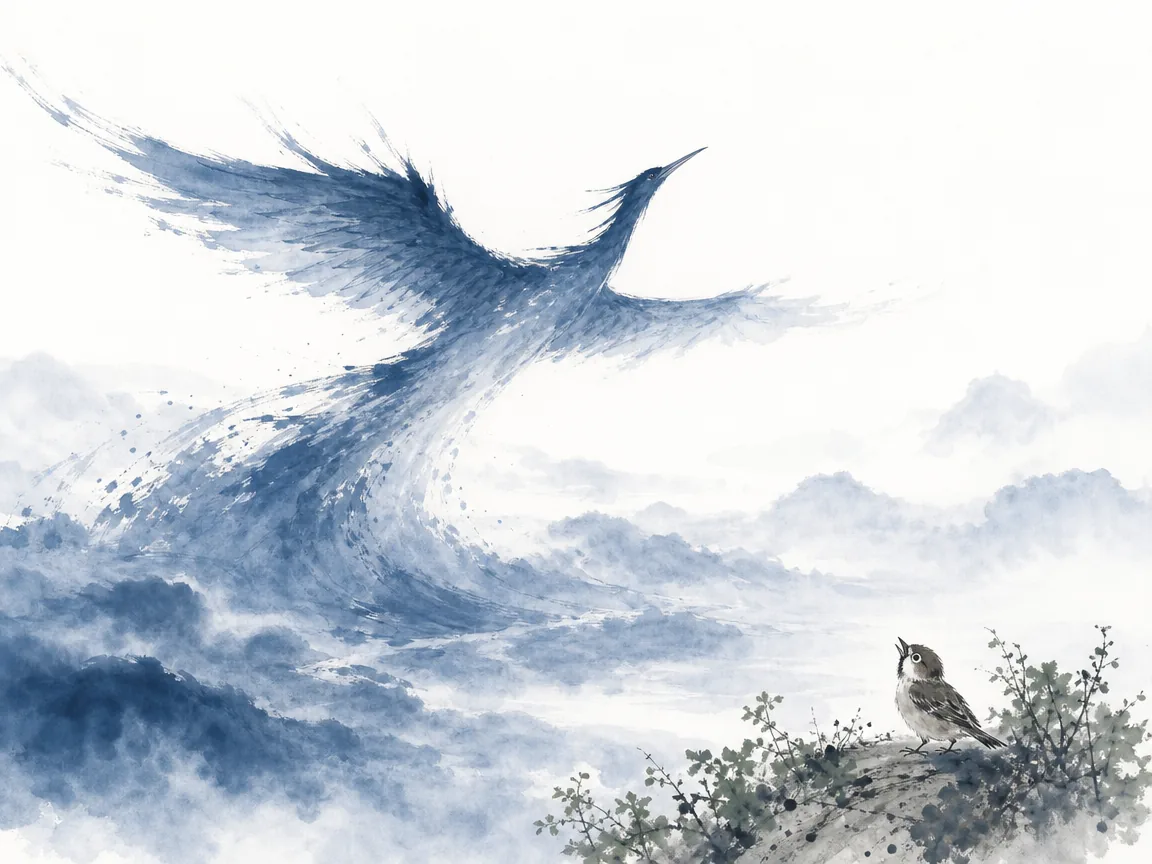
Why does true freedom feel just out of reach? For many of us, the answer is wrapped in a quiet, recurring sentence: I'll be free when… When I reach the next milestone. When my bank account hits a certain number. When someone finally acknowledges what I've done. When the noise outside stops demanding something from me. The sentence promises relief, but it delivers a new condition. Add one more, and the horizon moves again.
Zhuangzi, the fifth-century BCE Chinese philosopher, confronts this exact trap at the opening of his most famous chapter, the Xiaoyaoyou ("Free and Easy Wandering"). Rather than starting with human troubles, social anxiety, or moral instruction, he opens with a fish in the Northern Dark — "In the northern darkness there is a fish named Kun" (běi míng yǒu yú, qí míng wéi kūn, 北冥有鱼,其名为鲲) — so vast that its size is "unknown, several thousand li" across [1]. That fish transforms into a bird whose wings span the sky like hanging clouds, and soars ninety thousand li southward. On its face, this is fantasy. Beneath it, Zhuangzi offers something sharper: a diagnosis of why most of us live inside invisible cages, and a map toward an experience of freedom that does not depend on external conditions being arranged first—a foundational perspective explored in Zhuangzi Freedom.
That map centers on a distinction Zhuangzi draws in the same chapter — the difference between conditional dependence (yǒu suǒ dài, 有所待) and what later interpreters summarize as unconditioned freedom (wú suǒ dài, 无所待). Almost everyone, he suggests, lives conditionally dependent (yǒu suǒ dài, 有所待): their peace, worth, and sense of possibility are held hostage to outcomes, labels, relationships, and circumstances beyond full control. True carefree wandering (xiāoyáo, 逍遥), the freedom the chapter names, is not escape from the world. It is the gradual loosening of the habit of letting the world decide who you are.
Zhuangzi Freedom: The Trap of Conditional Freedom
Modern life runs on conditions. We are taught from an early age to treat freedom as a destination rather than a quality of attention. Get the degree, then breathe. Get the promotion, then live. Get clear, get loved, get safe — and then freedom begins. This is not necessarily poor advice; it is practical advice for navigating a world with bills, hierarchies, and physical needs. But when conditions become the sole ground of your inner stability, freedom turns fragile. You do not own it. You lease it, and the lease is always renewable by whoever controls the outcome.
Zhuangzi calls this state conditional dependence (yǒu suǒ dài, 有所待). The term appears explicitly in the Xiaoyaoyou when he discusses Liezi, a legendary figure said to ride the wind so deftly that he glides for fifteen days before returning. Even Liezi, Zhuangzi notes, "he still had something he depended upon" (yóu yǒu suǒ dài zhě yě, 犹有所待者也) [1]. Dependence, in this context, is not merely a moral failure. It is a structural condition of ordinary consciousness: your sense of completeness is tethered to something external. Lose that thing, and completeness collapses. Gain it, and the relief is real but temporary — because the next want will occupy its place.
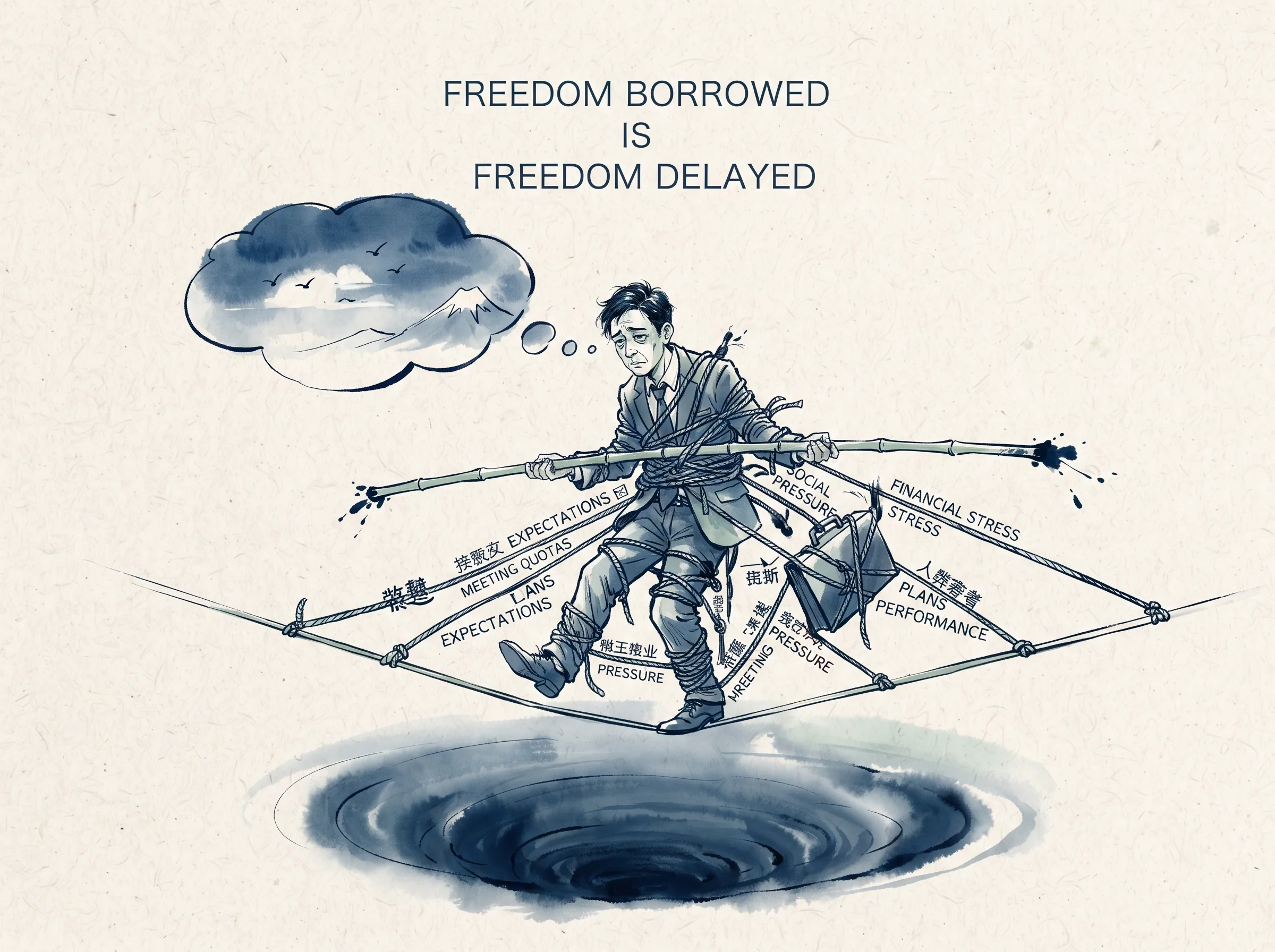
This is why achievement culture often leaves people hollow. Every success is conditional. Rankings shift. Markets turn. Recognition fades. The individual who anchors identity to outcomes inherits a life of perpetual preparation — always bracing for the possibility that the ground will move. Zhuangzi's insight is that the problem is not that conditions exist. The problem is that conditions have become the ruler by which existence is measured.
Zhuangzi's Opening Image: The Northern Dark and the Immense Self
The Xiaoyaoyou begins with a creature most readers never stop to notice: "In the northern darkness there is a fish named Kun; the vastness of Kun spans who knows how many thousand leagues. It transforms into a bird named Peng" (běi míng yǒu yú, qí míng wéi kūn. kūn zhī dà, bùzhī qí jǐ qiān lǐ yě; huà ér wéi niǎo, qí míng wéi péng, 北冥有鱼,其名为鲲。鲲之大,不知其几千里也;化而为鸟,其名为鹏) [1].
A fish in the Northern Dark. Not a heroic figure, not a moral exemplar, but something submerged, ancient, and beyond ordinary measurement. Why does Zhuangzi open with this?
One reason is scale. Human beings tend to define themselves by what fits inside their daily experience — job title, relationship status, income bracket, reputation. Zhuangzi drags the reader outward, past those containers, into a space where such categories seem momentarily absurd. The fish is "unknown, several thousand li" in size. Its magnitude cannot be captured by the ruler most people use. It is there, but not accessible to ordinary perception. In psychological terms, this mirrors what many people sense but cannot name: a feeling that behind the visible self — the one that answers to emails, pays rent, performs socially — there is a deeper, vaster presence that has not yet found expression.
Zhuangzi then triggers a transformation: "transforming into a bird" (huà ér wéi niǎo, 化而为鸟). The crucial character here is hua (化), transformation, not growth. The fish does not simply become a bigger fish. It becomes a different kind of being, operating under a different set of conditions. Water and sky are not interchangeable worlds. What works in one fails entirely in the other.
This distinction matters for anyone trying to live more freely. Many people try to optimize their current situation — work harder, manage time better, acquire more skills — hoping that improvement will eventually yield freedom. Zhuangzi suggests this approach can produce a more competent version of the same constrained self. Transformation, by contrast, implies a shift in operating layer: from a condition-seeking mindset to a mindset that no longer treats external validation as the prerequisite for existence.
Conditional vs. Unconditioned Freedom (Yǒu Suǒ Dài and Wú Suǒ Dài, 有所待与无所待): Freedom That Does Not Borrow Its Worth
Zhuangzi does not stop at transformation. He pushes the image further, and this is where his argument becomes genuinely radical.
When Peng the bird rises, it does not do so alone. "If the accumulation of wind is not thick, it has no power to bear great wings" (fēng zhī jī yě bù hòu, zé qí fù dàyì yě wúlì, 风之积也不厚,则其负大翼也无力) [1]. Even the magnificent Peng depends on wind. This is not a oversight. It is the pivot of the entire chapter. To study the primary classical text and commentary, explore the original Chinese text and deep philosophical translation in Free and Easy Wandering: Soaring Beyond Boundaries with the Cosmic Peng.
Zhuangzi is saying: almost everything impressive is still conditional (yǒu suǒ dài, 有所待, "depending on conditions"). Wealth depends on markets. Status depends on other people's recognition. Health depends on biology and environment. Genius depends on opportunity. Even the ability to ride the wind, as Liezi supposedly could, remains conditional [1]. If freedom requires aligning enough favorable conditions, it remains one disaster away from collapse.
So what is unconditioned freedom (wú suǒ dài, 无所待, "depending on nothing")? It is easy to misread this as asceticism or emotional detachment. It is neither. In Zhuangzi's framework, wú suǒ dài (无所待) describes a mode of being in which the self is no longer defined by external conditions. Conditions still arise. Life still requires food, shelter, relationships, and action. But the inner ground — the sense of "who I am" — does not tremble when circumstances shift.
The chapter names this state indirectly, with a rhetorical question: "What does he depend on?" (bǐ qiě wū hū dài zāi, 彼且恶乎待哉) — describing someone who rides the rightful patterns of heaven and earth, and navigates the changes of the six breaths, wandering through the boundless [1]. The phrase "depending on nothing" (wú suǒ dài, 无所待) itself is a later summary rather than a direct quotation from the chapter, but it accurately captures what Zhuangzi is pointing toward [1].
The practical consequence is subtle but profound. A person operating from unconditioned freedom (wú suǒ dài, 无所待) can still pursue goals. They can still work, create, love, and build. But the pursuit is no longer anchored to the belief that success will produce worth and failure will destroy it. The self is not a project awaiting approval. It is already coherent, already complete in a way that does not require external verification.
The Three Peaks: Perfected Person Has No Self, Spiritual Person Has No Merit, Sage Has No Fame (Zhì Rén Wú Jǐ, Shén Rén Wú Gōng, Shèng Rén Wú Míng, 至人无己,神人无功,圣人无名)
At the close of the Xiaoyaoyou chapter, Zhuangzi offers three concise formulations that describe this unconditioned state: "The perfected person has no self, the spiritual person has no merit, the sage has no fame" (zhì rén wú jǐ, shén rén wú gōng, shèng rén wú míng, 至人无己,神人无功,圣人无名) [1]. Each cuts through a different form of attachment.
The perfected person has no fixed self (zhì rén wú jǐ, 至人无己) — This does not mean the self is annihilated. It means the rigid, defensive ego — the one constantly comparing, justifying, and seeking validation — loses its authority. The person still acts, decides, and responds, but the movements are no longer driven by the anxiety of "How does this reflect on me?"
The spiritual person has no clinging to merit (shén rén wú gōng, 神人无功) — Action continues. Achievement happens. But the mind does not hoard accomplishments as proof of value. Merit is used, not worshipped.
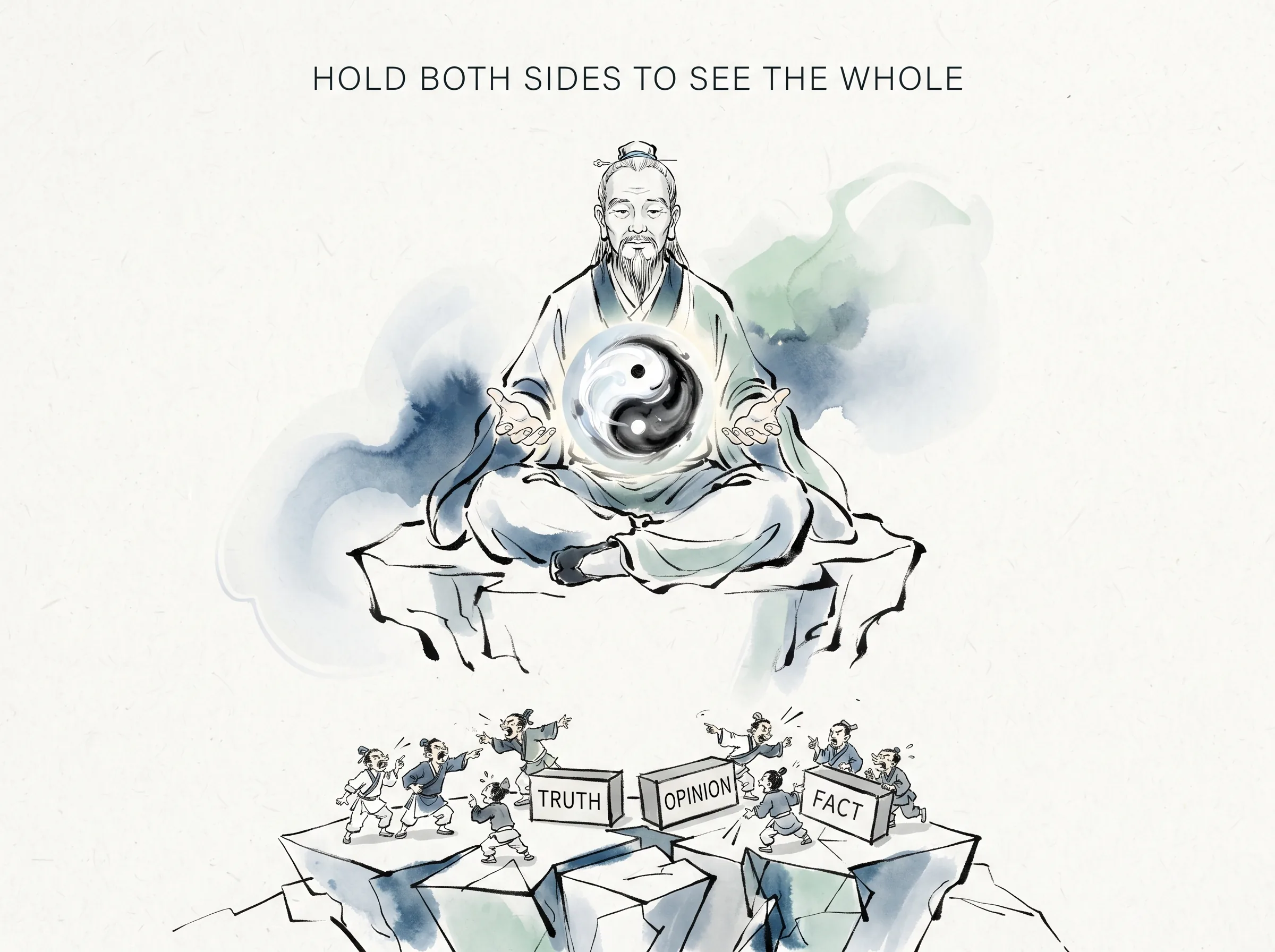
The sage has no need for reputation (shèng rén wú míng, 圣人无名) — Recognition is permitted but not required. The sage exists without outsourcing identity to labels, titles, or social ratings.
These three peaks are not abstract ideals reserved for saints or mystics. They are descriptions of a concrete psychological shift. Notice what they share: each one releases a specific external condition that normally sustains the ordinary ego — self-image, achievement, reputation. Once those conditions are no longer treated as prerequisites for existence, a different kind of presence emerges. It is quieter. It is less reactive. And it is far more stable.
Modern readers sometimes mistake this for passivity. But having no self (wú jǐ, 无己), no merit (wú gōng, 无功), and no fame (wú míng, 无名) do not remove agency. They remove the anxiety that distorts agency. A person freed from the need to prove themselves can act more clearly, take more honest risks, and respond more directly to what is actually happening rather than to what they think should happen.
Bringing the Teaching Into Modern Life
Philosophy becomes useful when it reframes a problem, not when it merely describes one. Zhuangzi's Xiaoyaoyou reframes freedom from "getting the right conditions" to "outgrowing the need for conditions to define you." Here is how that reframing can look in practice.
Recognizing your own Northern Dark
Begin by asking where your sense of freedom is currently conditional. Write down the sentences that end with "I'll be free when…" or "I'll feel okay once…". Do not judge them. Observation comes before transformation. Often these conditions reveal a pattern — career, relationships, appearance, financial security — that points to the underlying wound: a belief that you are not enough as you are now.
Identifying what you are waiting for
Zhuangzi would likely ask you to notice not just what you want, but how urgently you need it to arrive before you allow yourself to feel complete. The urgency itself is a signal. When peace is perpetually delayed, something deeper than the goal is at stake.
Practicing scale expansion
The Xiaoyaoyou contrasts the morning fungus, which knows neither the dark nor the light, with Peng, which crosses vast distances [1]. The point is not literal biology. It is perspective. Try viewing a current difficulty from a wider vantage point — five years from now, ten feet above your body, the scale of a whole life rather than a single week. The problem may not disappear, but its authority over you usually shrinks.
Learning to ride conditions without being ruled by them
You do not need to abandon goals, relationships, or ambition. Zhuangzi is not asking for asceticism. He is asking for a change in allegiance. Let conditions serve your action, not define your worth. When circumstances support you, move. When they do not, do not collapse. The internal ground remains.
FAQ
What is the difference between conditional dependence (yǒu suǒ dài, 有所待) and unconditioned freedom (wú suǒ dài, 无所待) in Zhuangzi?
Conditional existence (yǒu suǒ dài, 有所待) means existing conditionally — your peace, value, or sense of freedom depends on external factors such as success, approval, or circumstances. Unconditioned freedom (wú suǒ dài, 无所待) means those factors no longer determine your inner stability. You may still use conditions skillfully, but you are not defined by them. The Xiaoyaoyou chapter discusses both concepts, noting that even apparently liberated figures like Liezi remain conditionally dependent (yǒu suǒ dài, 有所待) because they depend on wind [1].
Is Zhuangzi saying we should stop pursuing goals?
No. The Xiaoyaoyou does not reject action, ambition, or social engagement. It questions the assumption that fulfillment depends on external outcomes arriving first. Zhuangzi encourages acting from clarity rather than from lack. When the need for validation loosens, action often becomes more precise and less driven by anxiety.
Does unconditioned freedom (wú suǒ dài, 无所待) mean becoming emotionally detached?
Not exactly. Detachment implies coldness or indifference. Unconditioned freedom (wú suǒ dài, 无所待) implies freedom from the compulsion to let outside events dictate inner state. One can feel deeply, care actively, and engage fully without tying selfhood to results. The three peaks — zhì rén wú jǐ, shén rén wú gōng, shèng rén wú míng (至人无己,神人无功,圣人无名) — describe release from ego-defense, achievement-attachment, and reputation-dependence, not release from life itself [1].
Can this teaching be applied by someone without interest in Daoism or philosophy?
Yes. The core mechanism — recognizing that conditional freedom is fragile and practicing a shift in how you relate to outcomes — is psychologically practical regardless of spiritual affiliation. You do not need to adopt Daoist belief to notice when your well-being is hostage to external conditions, nor to experiment with loosening that hostage relationship.
Closing: From the Northern Dark to the Open Sky
True freedom, as Zhuangzi frames it in the Xiaoyaoyou, is not achieved by stacking more conditions onto your life. It is awakened by realizing that the ground of your worth does not need external permission to exist. The fish in the Northern Dark is not a myth. It is a reminder that beneath the daily surface of schedules, performances, and judgments, there is a latent depth that far exceeds the small self most people identify with. When that depth begins to transform — when you stop treating conditions as prerequisites and start treating them as materials — freedom becomes less distant.
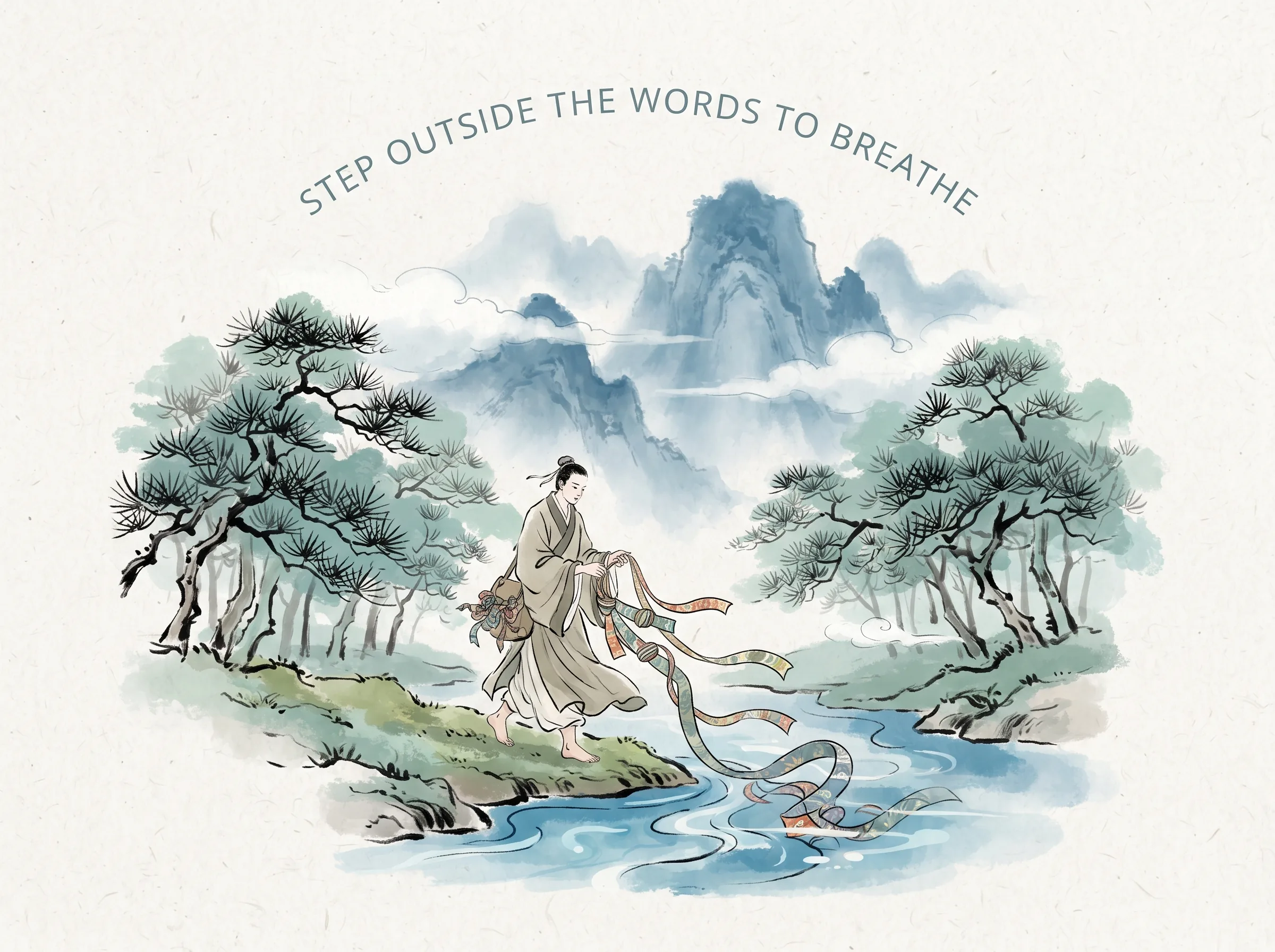
You do not need to leave the world to find it. You only need to stop letting the world write the terms of your existence. Start by noticing what you are waiting for. Then ask whether that thing is truly the source of your freedom, or merely the latest condition you have attached to it. The sky does not depend on the wind to be sky. It may be time to remember that you do not depend on your circumstances to be whole, reflecting the enduring wisdom of Zhuangzi Freedom.
To explore these themes from another angle, read our related reflection on Why Knowing More Doesn’t Make Us Wiser: Zhuangzi’s Warning About Fragmented Truth.
For a deeper comparative examination of these ideas, explore our related study on The Highest Cultivation Needs No Effort.
Sources & Further Reading
[1] Primary classical source
[2] Zhuangzi / Free and Easy Wandering (莊子/逍遙遊) – Wikisource — Full Chinese text of the Xiaoyaoyou chapter, including the passages on Kun-Peng, conditional/unconditioned existence (yǒu suǒ dài / wú suǒ dài, 有所待/无所待), Liezi, and the triad of the perfected person (zhì rén wú jǐ, shén rén wú gōng, shèng rén wú míng, 至人无己,神人无功,圣人无名).
[3] Zhuangzi (Stanford Encyclopedia of Philosophy, Fall 2025 Edition) — Academic overview of Zhuangzi's thought, editorial history, and the structure of the received text.
[4] Further Reading (延伸阅读)
[5] Zhuangzi, The Complete Works (various translations, e.g., Burton Watson, Brook Ziporyn) — Recommended for readers who wish to explore the Xiaoyaoyou in context alongside other chapters.
[6] Introduction to Taoist Alchemy: (3) Neidan — Background on later Daoist interpretive frameworks that some readers apply to Zhuangzi's imagery; useful for understanding how later traditions re-read classical texts.






