
Zhuangzi Chapter 15: A Zhuangzi Insight for the Age of Spiritual Consumerism
You have probably noticed it, if not in yourself, then in the quiet corners of your feed: the new anxiety. It no longer whispers that you need more money, a better title, a more impressive inbox. Now it tells you that you need to be more awake. More aligned. More detached. That your energy needs raising, your inner child healing, your nervous system regulating, your core holding strong. The cage has been repainted in beige and sage green, but it is still a cage.
This is not a new observation, only a new vocabulary. Over two thousand years ago, Zhuangzi wrote a chapter called Ke Yi — "Deliberate Effort" — in which he dissected precisely this trap. He did not argue that cultivation is pointless. He argued that the most dangerous kind of effort is the effort to appear cultivated, to perform spiritual growth, to carve oneself into the shape of someone who does not care about shapes at all [1]. The modern urge to curate enlightenment, to signal detachment, to optimize relaxation — Zhuangzi would recognize this instantly. It is still deliberate calculation (kèyì, 刻意) wearing its prettiest clothes.
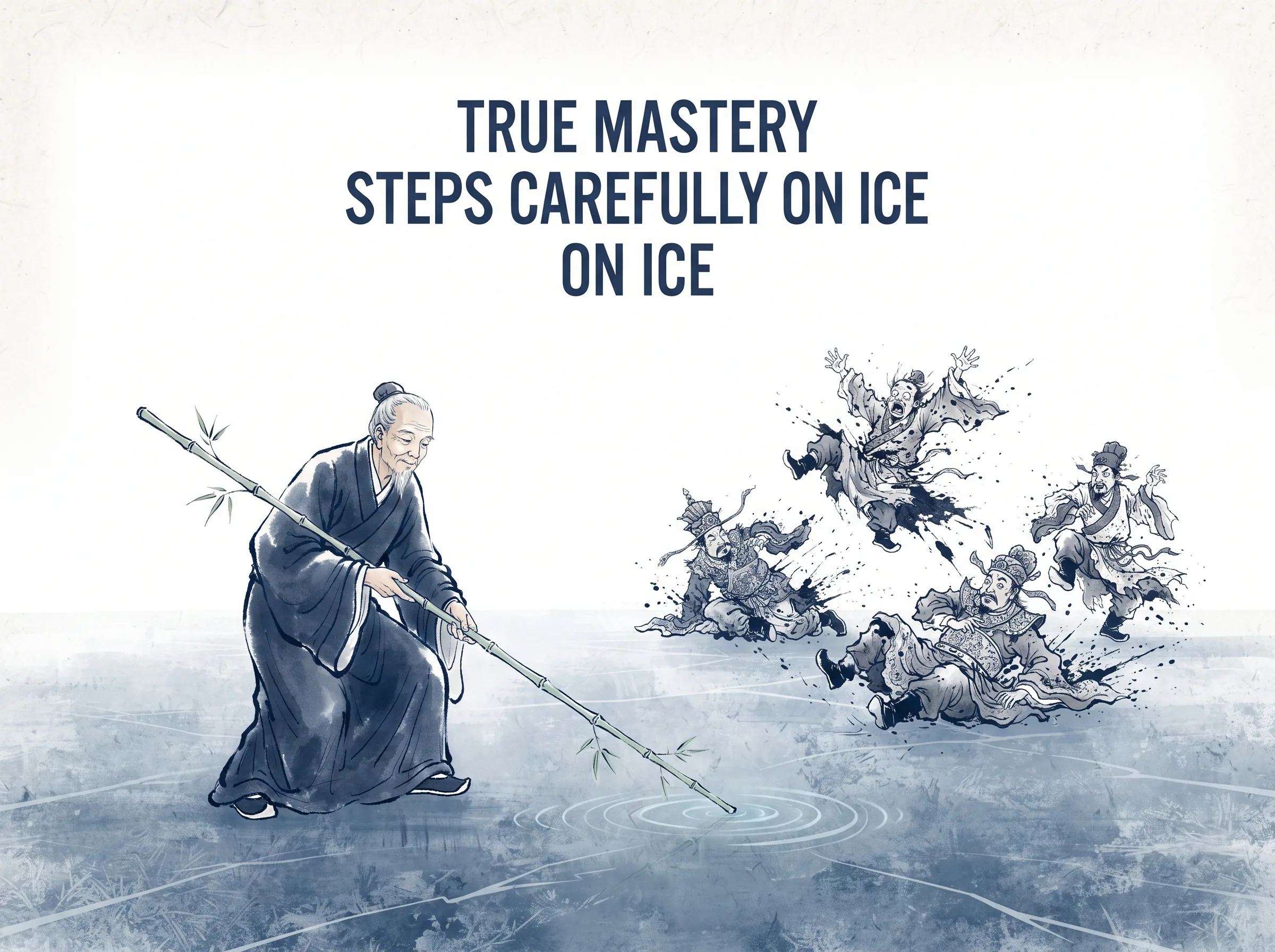
What follows is not a prescription for doing less. It is an invitation to see what happens when the doing itself becomes the problem.
The Five Faces of Deliberate Cultivation
Zhuangzi's Ke Yi chapter begins by listing five kinds of people who mistake their practices for freedom [1]. He does not mock them. He observes them. And each type maps, uncannily, onto a pattern we still live with today.
The Moral Performer. Zhuangzi describes those who loudly display ren, yi, zhong, xin — benevolence, righteousness, loyalty, trustworthiness — as a way of marking themselves as superior [1]. The modern equivalent wears softer language: spiritual vocabulary, conscious living, woke identity. The practice is not the problem; the performance is. When virtue becomes a badge rather than a posture of the whole person, it functions as social currency. And currency always measures distance — between those who have it and those who do not.
The World-Rejecting Critic. These are the ones who distance themselves from society, criticize it openly, and derive identity from having stepped outside it [1]. Their freedom depends on there being something to flee from and a crowd below to look down upon. In contemporary terms, this is the person who curates disdain for "the matrix" while building their entire self-concept around it. Disengagement without inner settlement is still engagement — just on the other side of a screen.
The Power Seeker in Disguise. Zhuangzi singles out those who chase great achievements, establish grand reputations, and position themselves within hierarchies of power [1]. This is the oldest trap, and therefore the easiest to miss dressed in new clothing. Today it appears as the hustle-adjacent mindfulness entrepreneur, the productivity-optimized meditation app, the quantified self whose data feeds an ever-expanding dashboard of optimization. The pursuit has not changed; only the metrics have grown more sophisticated.
The Recluse Who Has Not Let Go. Zhuangzi names those who withdraw to marshes and valleys, fishing and lingering in empty spaces, calling this wu wei — non-action [1]. The physical withdrawal is not the issue. The issue is carrying the same restless mind into a different zip code. A person who retreats to the mountains but remains consumed by resentment, comparison, and the need to prove they are special has not escaped; they have relocated the prison.
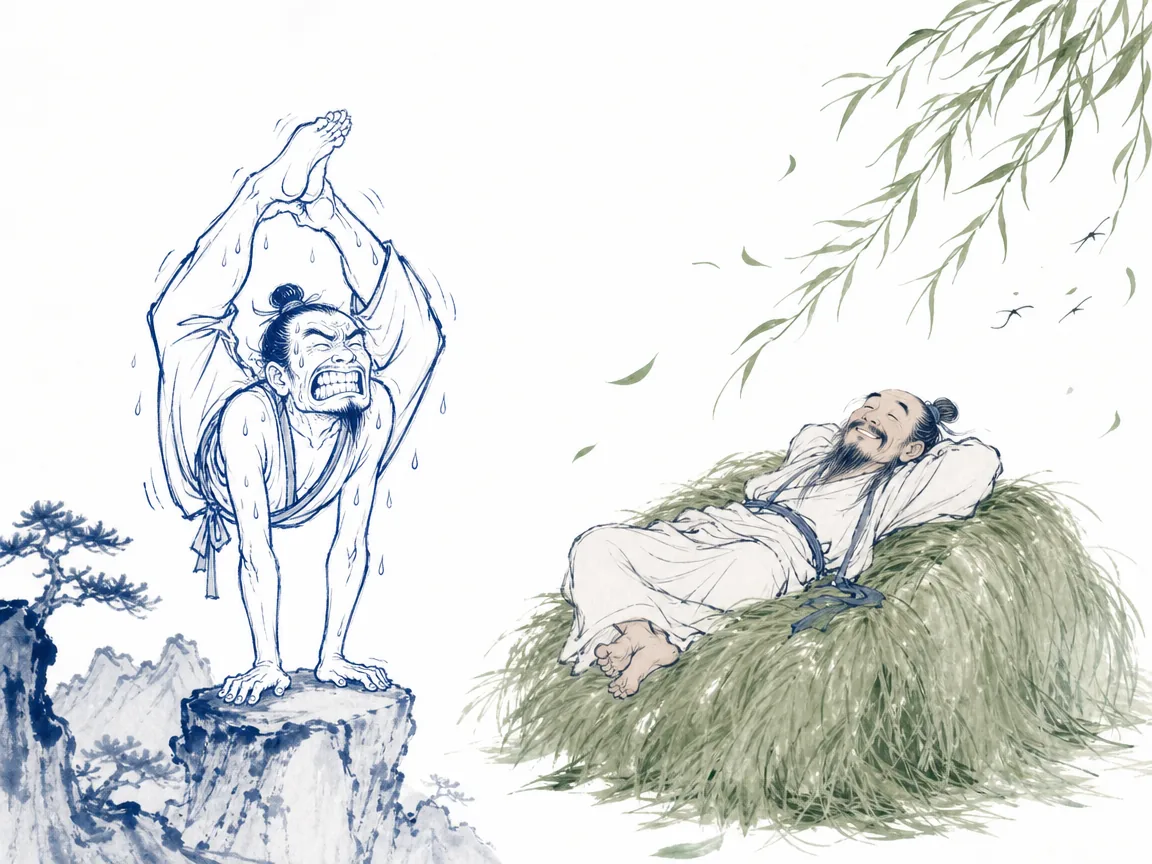
The Health Obsessed. Finally, Zhuangzi points to those who practice breath control, imitate the movements of bears and birds, and pursue longevity as a supreme good [1]. The impulse to nourish the body is natural. The impulse to treat the body as a project to be managed, optimized, and defended against decay — that is the performance. When health becomes the new metric of worth, the fear of death simply changes its costume.
Zhuangzi does not dismiss any of these paths. Each contains genuine value. But each becomes a trap when the practice is performed for an image rather than arising from genuine inner settlement [1]. The trap is not the activity. The trap is the deliberateness.
Continue with the deeper interpretation and practical application.
ChiDestiny members get access to the full analysis, modern applications, and the growing Chinese Wisdom Library.
Frequently Asked Questions
Does Zhuangzi mean we should stop all self-cultivation entirely?
No. Zhuangzi is not anti-practice. He is anti-performing-practice. He explicitly rejects only the kind of cultivation that is driven by the need to appear a certain way [1]. In the Ke Yi chapter, he praises the state of calm tranquility (píngyì tiándàn, 平易恬淡) as the true balance of heaven and earth [1]. The question is never whether to cultivate, but whether the cultivation is becoming another form of self-imposed pressure.
How is effortless action (wúwéi, 无为) different from doing nothing?
This is one of the most common misunderstandings in Zhuangzi scholarship. Effortless action (wúwéi, 无为) does not mean inaction. It means action without artificial strain, without the tense (jǐnbēng, 紧绷) quality of trying to force a specific outcome. A river does not struggle to reach the sea. It simply flows. Zhuangzi's ideal is not passivity but natural efficacy — action that arises from alignment rather than from anxiety [1].
Can someone be genuinely detached and still talk about it?
Yes. There is a difference between sharing wisdom and performing it. A person who has settled inward may speak freely about their insights without needing those insights to confirm their identity. A person still performing detachment will feel anxious when others do not recognize their level of awareness. The distinction lies in whether the teaching is an overflow or a strategy.
Is Zhuangzi saying that spiritual ambition is worse than material ambition?
Not worse — just more deceptive. Material ambition is visible. Spiritual ambition disguises itself as its opposite. Both are forms of deliberate calculation (kèyì, 刻意) when they are driven by the need to construct a particular self-image [1]. Zhuangzi's warning is that the more virtuous the goal appears, the harder it is to see when that goal has become a chain.
A Closing Thought
The deepest freedom Zhuangzi describes is not achieved by adding more practices, disciplines, or labels to your life. It is revealed when the effort to appear free finally relaxes — and what remains is simply living.
You do not need to become more enlightened. You need to stop performing enlightenment. You do not need to become calmer. You need to stop trying so hard to seem calm. You do not need to become detached. You need to notice when detachment has become just another thing to cling to.
The tree does not announce its growth. The water does not advertise its humility. Neither needs your permission, your approval, or your audience. They simply are.
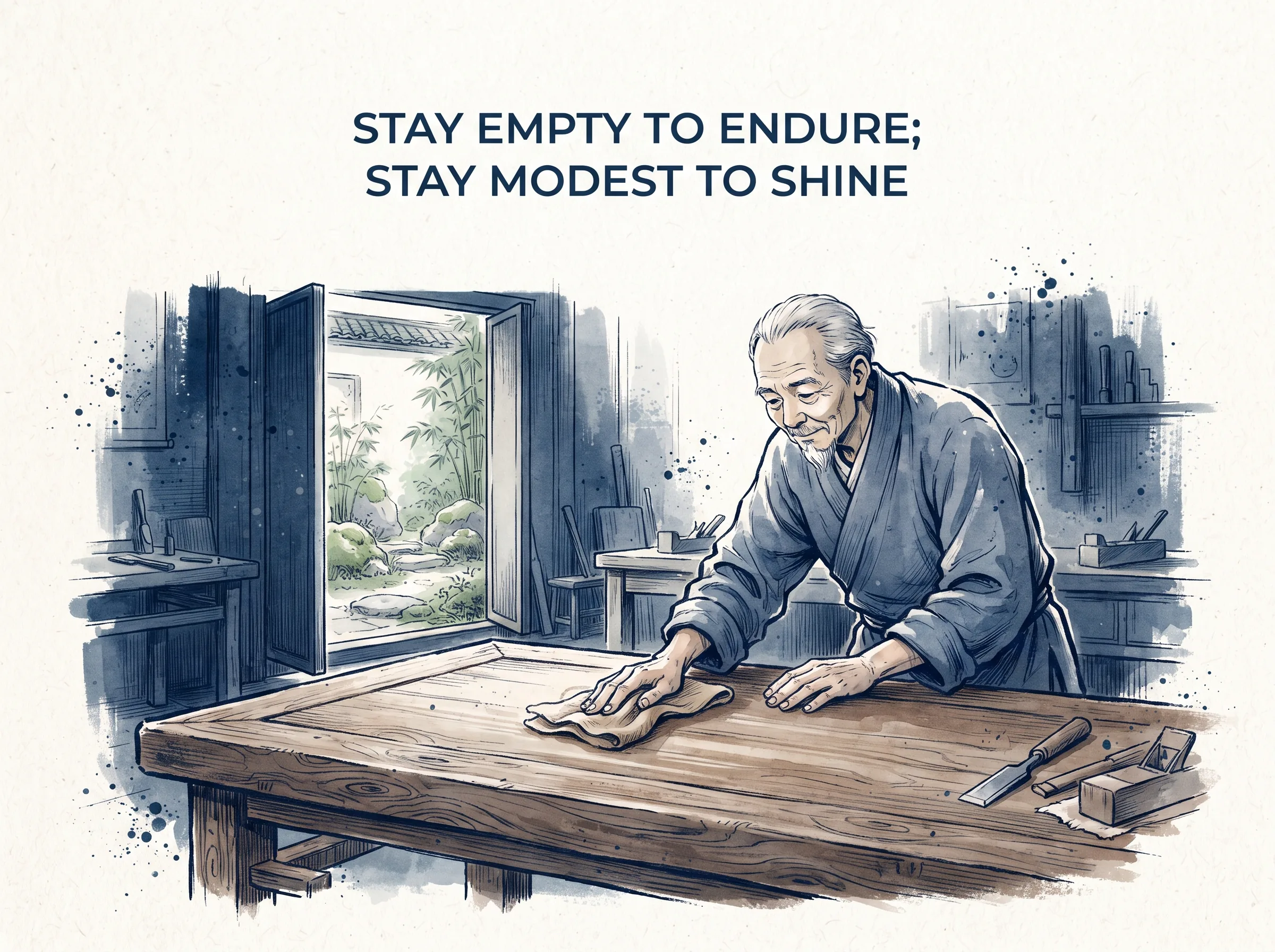
Perhaps the most advanced form of self-collivation is not the one that looks the most cultivated — but the one that no longer needs to look like anything at all, reflecting the enduring wisdom of Zhuangzi Chapter 15.
To explore these themes from another angle, read our related reflection on Why Knowing More Doesn’t Make Us Wiser: Zhuangzi’s Warning About Fragmented Truth.
Deepen your understanding of these principles in our reflection on Why Poetry Flows Naturally — Ancient Chinese Wisdom for Modern Creativity.
Sources & Further Reading
[1] Zhuangzi, Chapter 15 "Ke Yi" (《刻意》) — Classical text from the Wiki Source library, containing the full passage on deliberate effort and the five categories of cultivation [1]
[2] Zhuangzi (Hackett Publishing) — About the Text — Scholarly overview confirming the chapter classification within the Outer Chapters (chapters 8–22) [2]
Further Reading
- Watson, Burton (translator). Chuang Tzu: Basic Writings. Columbia University Press. — Authoritative translation and commentary on the Ke Yi chapter, including discussion of the five types of deliberate practitioners [3]






