
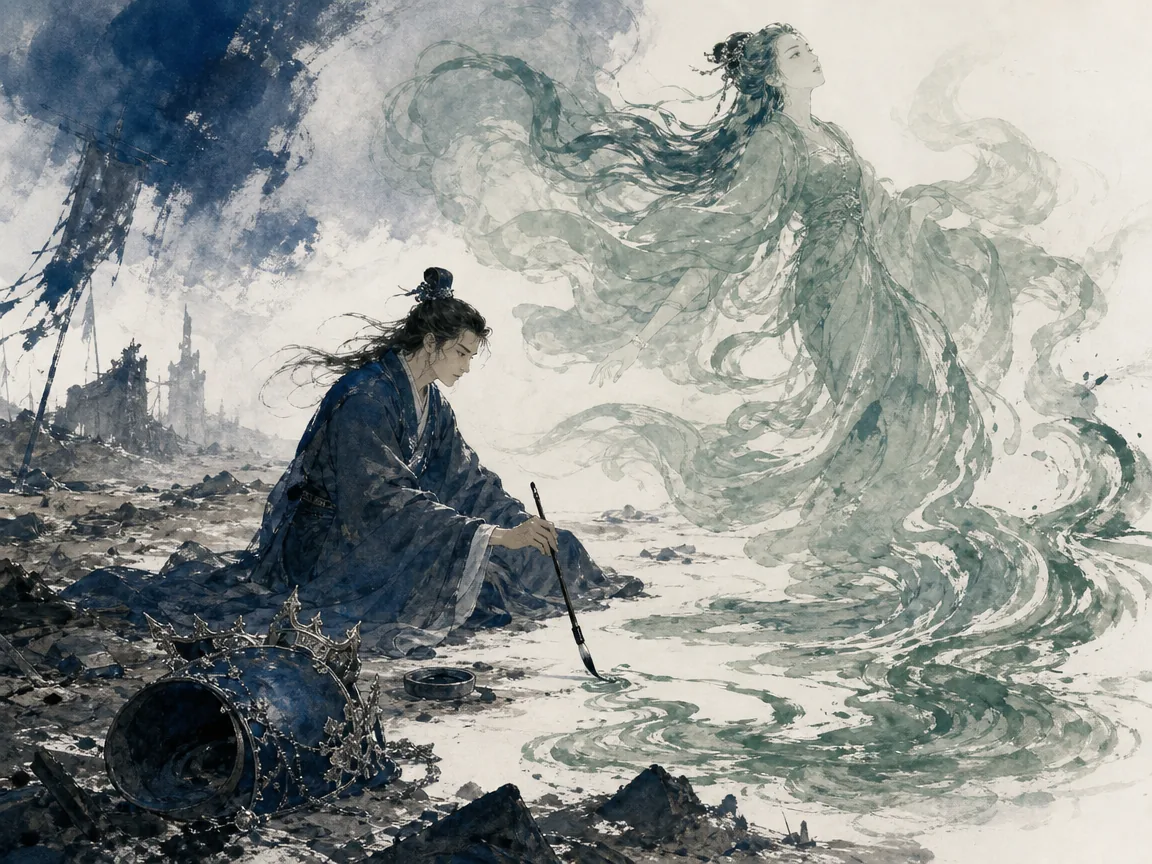
Cao Zhi stands as one of the most celebrated poets in the Chinese literary tradition, yet his greatest works were born not from power and ease, but from political ruin and quiet exile. It is a paradox that repeats across history: the circumstances that crush a public career sometimes forge a lasting inner one. When ambitions are blocked, when the world offers no clear path forward, what do we do with the energy that no longer has an original outlet? Cao Zhi's life offers one ancient answer, and it remains strangely relevant for anyone navigating loss, detour, or unplanned reinvention.
In the early third century, Cao Zhi was the son of Cao Cao, the warlord who would become the foundational figure of the state of Wei during the turbulent Three Kingdoms period. He possessed a brilliance that drew even his father's astonishment. By his teenage years he could recite hundreds of thousands of characters of poetry and prose, and he wrote with striking facility. [1] At a celebration following the completion of the Bronzed Sparrow Terrace, Cao Cao ordered his sons to compose rhapsodies on the spot; Cao Zhi picked up his brush and produced a piece that impressed everyone present. [2] For a time, he seemed destined for something far greater than poetry—he was nearly named heir apparent, with Cao Cao wavering on the question on multiple occasions. [3] This principle is central to Cao Zhi Poetry and Philosophy.
But Cao Zhi's talent was matched by a temperament ill-suited to the calculated world of court politics. He drove through forbidden imperial avenues (jìnzhǐ tōngdào, 禁止通道), opened the palace's Sima Gate (Sīmǎ Mén, 司马门), and at a critical military moment in 219 CE, accepted a commission to relieve a besieged commander only to find himself too intoxicated to obey. [4] Cao Cao withdrew his trust, and Cao Zhi's political future collapsed. After Cao Cao's death in 220 CE and Cao Pi's succession, Cao Zhi was stripped of real authority, moved repeatedly from fief to fief, and placed under surveillance. [5] What remained was his writing. And it was from this diminished, constrained existence that some of Chinese literature's most enduring works emerged—including the Luo Shen Fu, composed in 222 CE during a journey back to his eastern fief after a visit to the capital. [6]
His story invites us to consider how personal failure can become the crucible of something lasting.
Cao Zhi Poetry and Philosophy: and What He Lost
Cao Zhi's early life reads almost like a myth about raw talent meeting raw opportunity. Born into the most powerful family in northern China, he grew up surrounded by advisors, soldiers, poets, and strategists. His father, Cao Cao, was himself a accomplished writer and patron of letters, and the intellectual atmosphere of the court was unusually vibrant for its time. Young Cao Zhi absorbed it all. The historical record notes that by his early teens he had already internalized enormous quantities of classical text and could compose with confidence. [7]
Yet talent alone does not secure power, especially in a family where ambition runs deep and rivals are everywhere. Cao Zhi's approach to life was impulsive and unrestrained. According to the Records of the Three Kingdoms, he drove a carriage along paths reserved for the emperor, forced open the palace's main gates, and behaved in ways that any ruler would find threatening. [8] These were not minor infractions; they signaled a man who did not recognize—or did not respect—the boundaries that held political order together.
Cao Cao responded with anger and distance. The official who enforced the gate incident was executed, and new restrictions were imposed on all princes. [9] Cao Zhi's favor with his father faded steadily. When the opportunity arose in 219 CE to lead a relief force to a commander under siege by Guan Yu, Cao Cao had already chosen Cao Zhi for the mission—but on the day of departure, Cao Zhi was too drunk to receive orders. [10] Cao Cao's disappointment appears to have been final. The path to leadership, already narrow, closed completely.
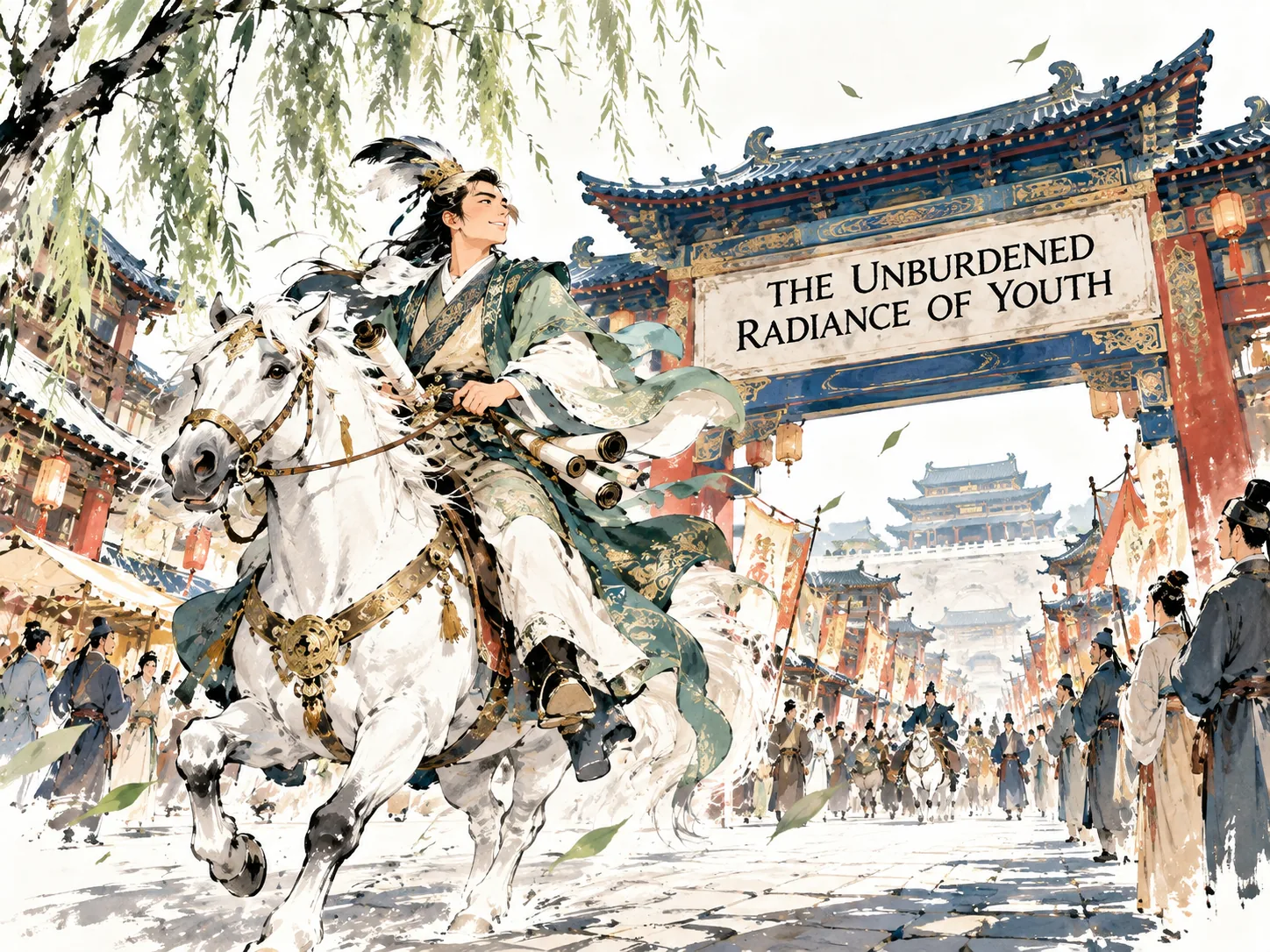
What made Cao Zhi brilliant also made him politically vulnerable. His sensitivity, his spontaneity, his willingness to speak and act without filtering for consequence—these were the qualities of a poet, not a statesman. Neither quality is inferior in itself. But in the context of succession politics, they were fatal.
The Fall and the Writing That Survived It
The years following Cao Pi's ascension mark a sharp turning point. Cao Zhi was required to leave the capital and take up residence in his assigned fiefdom. He was monitored by officials whose job was to report any misstep. [11] Multiple relocations and demotions followed. He was, in effect, removed from the centers of power and confined to the margins.
It is important to note that these relocations were not dramatic exiles in the romantic sense, nor were they formal imprisonments. But they were deeply constraining. A man accustomed to influence, proximity to his father, and the energy of court life was suddenly placed in a series of regional seats with limited authority and constant oversight. He could write, but he could not act. He could petition, but he was unlikely to be heard.
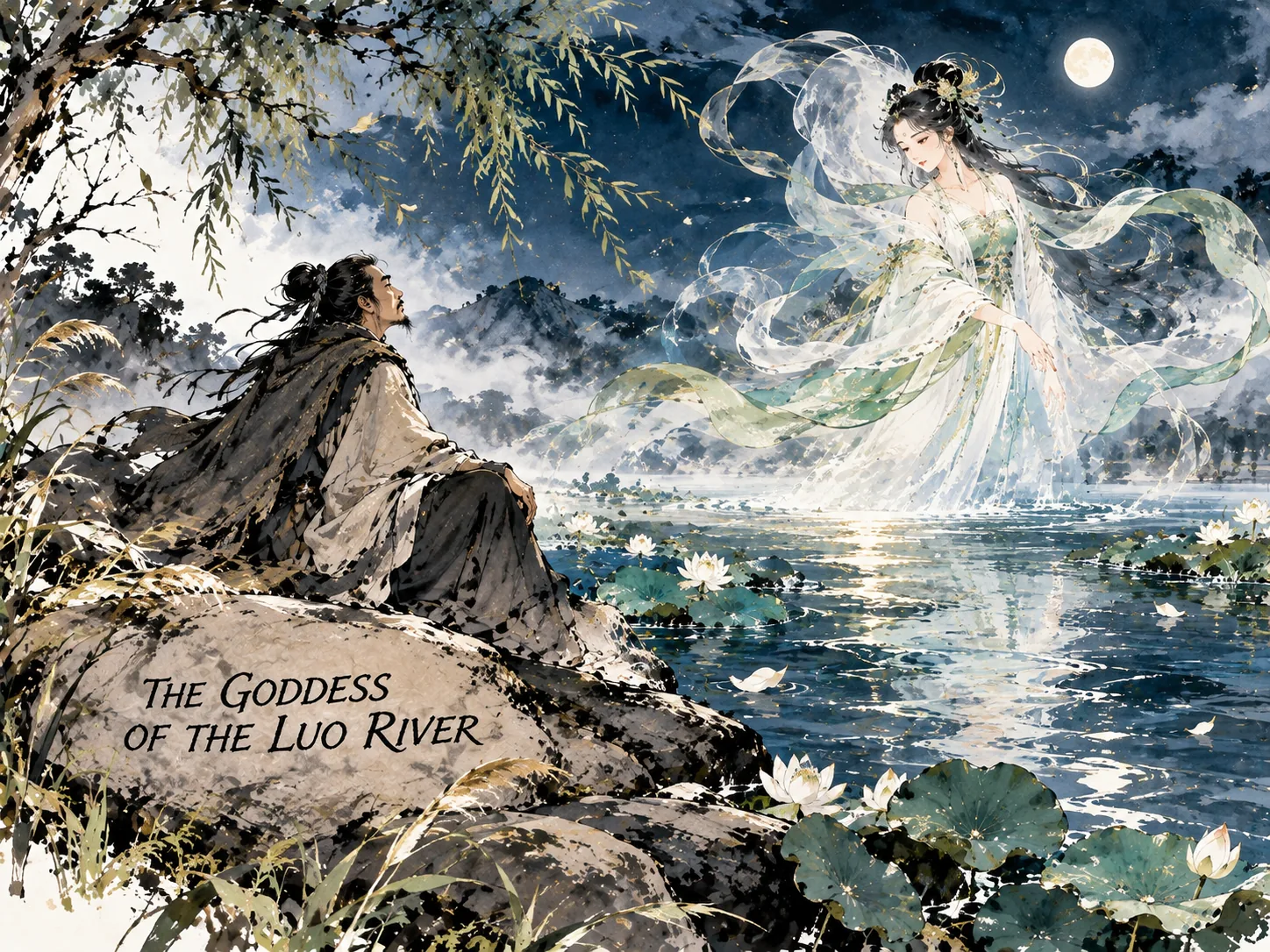
And yet it is from precisely this period that some of his most celebrated works are dated. The Luo Shen Fu—the Rhapsody on the Goddess of the Luo River—bears a preface specifying the third year of the Huangchu era, which corresponds to 222 CE. [12] The piece describes a encounter with a divine figure on a journey home from the capital, and it is rendered in language of extraordinary beauty and emotional depth. Scholars have long noted that the poem's themes of longing, unattainable love, and the tension between worldly desire and spiritual transcendence resonate with a man whose own ambitions had been redirected into art.
There is also the famous Seven Steps Verse, a poem said to have been composed under threat of death when Cao Pi demanded Cao Zhi produce a poem within seven steps. The story is widely known, but it does not appear in the primary historical record, the Records of the Three Kingdoms. Instead, it survives in later literary collections, and its authenticity remains debated among scholars. [13] Whether or not the story is historically accurate, it has become part of Cao Zhi's cultural legend—a symbol of creative brilliance under pressure.
What connects these works is not circumstance but transformation. The same sensitivity that made Cao Zhi politically reckless also gave him access to emotions that straightforward court poets often lacked. The isolation of his later years, the absence of political fulfillment, the weight of unexpressed ambition—these became fuel rather than firewood.
When Options Run Out, Creation Begins
The Chinese literary tradition has a phrase often summarized as cí qióng ér hòu gōng—roughly, that a writer's best work arrives when worldly options have been exhausted. The idea is that hardship, restriction, and unmet desire channel creative energy in a more concentrated form.
It is worth noting that the most famous formulation of this principle comes from the Song dynasty essayist Ouyang Xiu, who wrote in his preface to the collected poems of Mei Yaochen: "Poets are seldom successful in life and often encounter hardship… The more destitute a person becomes, the more refined his work." [14] Ouyang Xiu was reflecting on a broader pattern across centuries of Chinese literature, and Cao Zhi's life fits that pattern remarkably well—even though he lived centuries before Ouyang Xiu articulated the rule. Gain deeper perspective on weathering adversity through the poetic resilience explored in Why Poetry Flows Naturally — Ancient Chinese Wisdom for Modern Creativity.
The mechanism is not mystical. When a person can no longer pursue an original goal, the energy that was directed toward that goal does not simply vanish. It must go somewhere. For some, it turns inward as resentment or despair. For others, it finds expression in a new form—writing, mentoring, building something smaller but more authentic, committing to a craft that does not depend on external validation.
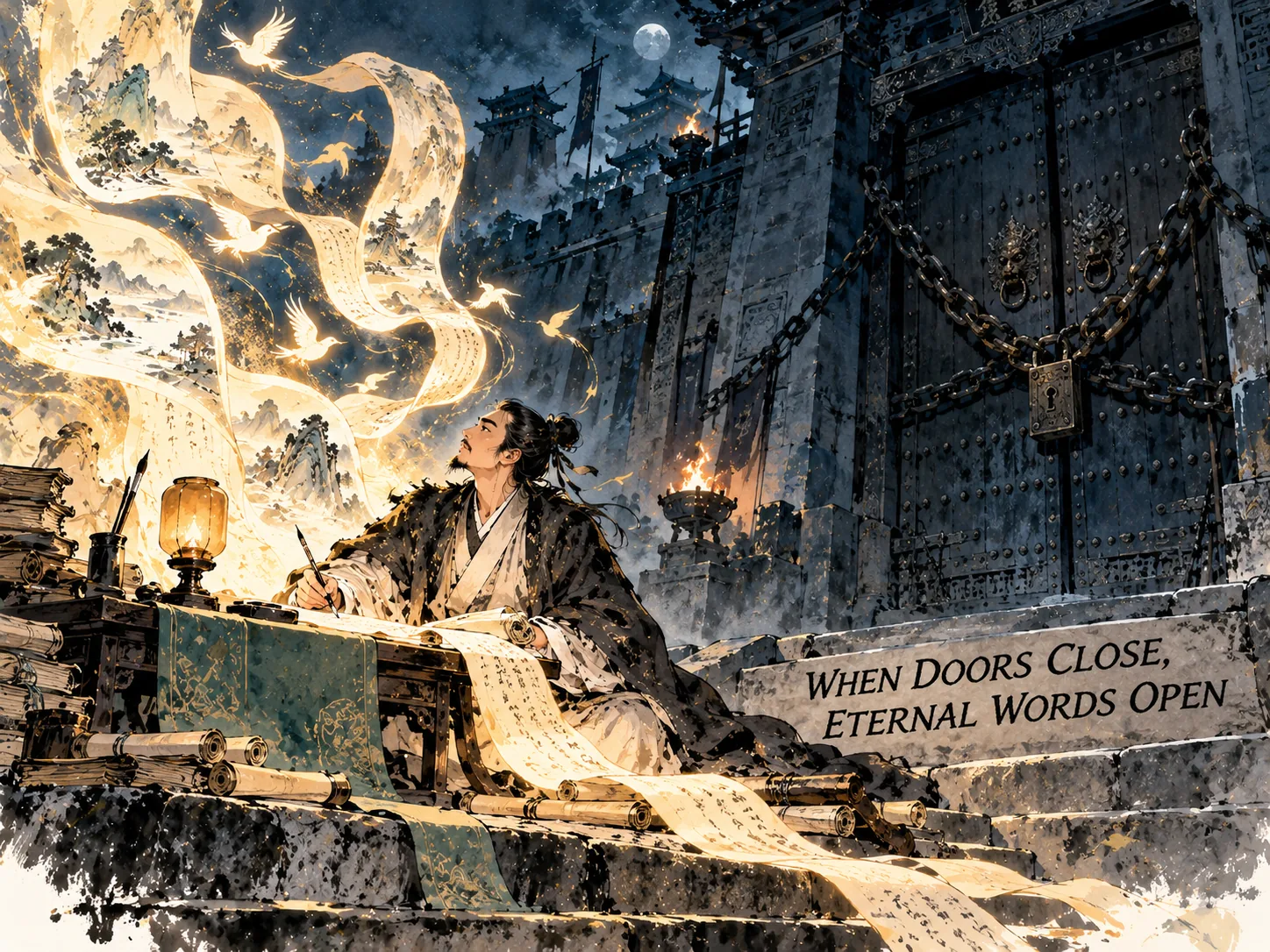
Cao Zhi's Luo Shen Fu is not a political tract. It is not a plea for restoration. It is a poem about beauty, loss, and the space between what is desired and what can be held. That shift in focus—from governing to imagining, from action to reflection—is itself a kind of wisdom. It is not the wisdom of defeat, but the wisdom of adaptation.
This does not mean that political failure is good, or that suffering is necessary for art. Cao Zhi's hardships were real and painful. The Records of the Three Kingdoms notes that he grew restless and sorrowful during his repeated relocations and died relatively young. [15] But within those constraints, he produced work that outlasted the dynasty that marginalized him. That is the paradox.
What This Means for Unplanned Detours
We rarely face the life-and-death stakes of Three Kingdoms politics, but we do face blocked paths. A promotion that doesn't come. A project that fails. A relationship that ends. A career trajectory that shifts unexpectedly. In each case, the initial reaction is often grief—or worse, the refusal to grieve, and the insistence that the original plan still applies.
Cao Zhi's example suggests a different response: redirect. Not through forced optimism or toxic positivity, but through honest acknowledgment that the old door is closed and the energy must find a new outlet. This might mean changing the form of your contribution rather than abandoning contribution itself. It might mean writing when you cannot lead, teaching when you cannot manage, creating when you cannot control.
The danger is not failure itself. The danger is allowing unredirected energy to become stagnation—bitterness, withdrawal, or the slow erosion of creative capacity. Cao Zhi's story is not that he suffered and then succeeded; it is that he suffered and then created. The difference matters.
FAQ
Was Cao Zhi really too drunk to accept a military command? According to the Records of the Three Kingdoms, in 219 CE Cao Cao selected Cao Zhi to lead troops to relieve a siege, but on the day of departure Cao Zhi was intoxicated and unable to receive orders. Cao Cao cancelled the mission. [16] Whether this was the result of a single episode or a recurring pattern is less clear from the historical record.
Is the Seven Steps Verse a real poem by Cao Zhi? The poem is widely attributed to Cao Zhi, but the story of its composition—written in seven steps under threat of death—does not appear in the Records of the Three Kingdoms, the earliest biographical source. It survives in later literary compilations, and some scholars consider it a later attribution. [17] The poem itself may be genuine; the dramatic context is disputed.
What does cí qióng ér hòu gōng actually mean? The phrase, often translated as "hardship produces refined work," expresses the idea that creative output improves when a person's worldly prospects are restricted. The most influential formulation comes from the Song dynasty writer Ouyang Xiu, who argued that poets tended to produce their best work after experiencing difficulty. [18] The principle has been applied retrospectively to earlier figures like Cao Zhi, though the concept itself was articulated centuries after his death.
Did Cao Zhi die young because of his political situation? The Records of the Three Kingdoms states that he died at age forty-one, after a series of relocations left him perpetually restless and without joy. [19] Whether his political circumstances directly caused his early death is impossible to determine from the surviving sources, but the connection between his constrained life and his diminished spirits is clearly drawn in the historical narrative.
Conclusion
Cao Zhi's life demonstrates something simple and difficult: when the path you wanted closes, the path you take can still lead somewhere meaningful. His greatest works did not come from power but from its absence. Not because suffering is noble, but because the human need to express what cannot be done is itself a source of creative force. For modern readers navigating their own blocked ambitions, the lesson is not to seek hardship but to refuse stagnation—to find, however reluctantly, what can still be made, reflecting the enduring wisdom of Cao Zhi Poetry and Philosophy.
Gain deeper perspective on weathering adversity through the poetic resilience explored in How Ancient Chinese Poets Cultivated Inner Stillness.
Deepen your understanding of these principles in our reflection on How a Frustrated Genius Used Self-Release to Find Inner Peace: The Daoist Lesson Behind Du Mu’s Yangzhou Years.
Sources & Further Reading
[1] Biography of Cao Zhi, Prince of Chensi, Records of the Three Kingdoms (陈思王植传-三国志)
[2] Biography of Cao Zhi, Prince of Chensi, Records of the Three Kingdoms (陈思王植传-三国志)
[3] Biography of Cao Zhi, Prince of Chensi, Records of the Three Kingdoms (陈思王植传-三国志)
[4] Biography of Cao Zhi, Prince of Chensi, Records of the Three Kingdoms (陈思王植传-三国志)
[5] Biography of Cao Zhi, Prince of Chensi, Records of the Three Kingdoms (陈思王植传-三国志)
[6] Rhapsody on the Luo River Goddess (洛神賦) – Wikisource
[7] Biography of Cao Zhi, Prince of Chensi, Records of the Three Kingdoms (陈思王植传-三国志)
[8] Biography of Cao Zhi, Prince of Chensi, Records of the Three Kingdoms (陈思王植传-三国志)
[9] Biography of Cao Zhi, Prince of Chensi, Records of the Three Kingdoms (陈思王植传-三国志)
[10] Biography of Cao Zhi, Prince of Chensi, Records of the Three Kingdoms (陈思王植传-三国志)
[11] Biography of Cao Zhi, Prince of Chensi, Records of the Three Kingdoms (陈思王植传-三国志)
[12] Rhapsody on the Luo River Goddess (洛神賦) – Wikisource
[13] Biography of Cao Zhi, Prince of Chensi, Records of the Three Kingdoms (陈思王植传-三国志)
[14] Ouyang Xiu — Preface to Mei Shengyu's Poetry Collection (梅圣俞诗集序) – Guwen Island
[15] Biography of Cao Zhi, Prince of Chensi, Records of the Three Kingdoms (陈思王植传-三国志)
[16] Biography of Cao Zhi, Prince of Chensi, Records of the Three Kingdoms (陈思王植传-三国志)
[17] Biography of Cao Zhi, Prince of Chensi, Records of the Three Kingdoms (陈思王植传-三国志)
[18] Ouyang Xiu — Preface to Mei Shengyu's Poetry Collection (梅圣俞诗集序) – Guwen Island
[19] Biography of Cao Zhi, Prince of Chensi, Records of the Three Kingdoms (陈思王植传-三国志)
Further Reading (延伸阅读)
- Records of the Three Kingdoms (Sanguozhi) by Chen Shou — primary biographical source for Cao Zhi
- David Knechtges, Wen Xuan or Selections of Refined Literature — literary-historical context for Cao Zhi's works
- Arthur Waley or David Hawkes translations of Luo Shen Fu — English renderings of the rhapsody
- Biographical entries in the Cambridge History of Chinese Literature — modern scholarly overview of Cao Zhi's place in literary history






