
You've probably felt it — scrolling through perfectly composed images, rereading an email seven times before sending, or lying awake wondering if you said the right thing. There's a quiet exhaustion running through much of contemporary life, and it has a name. Researchers have found that perfectionistic concerns show a medium-to-large positive correlation with burnout and its symptoms [2]. The pursuit of flawlessness, it turns out, is costly.
Two thousand years ago, a Chinese thinker named Laozi offered a different way of seeing. In the Daodejing — one of the foundational texts of Daoism — he wrote a line that has echoed through centuries of East Asian thought: "great skill appears clumsy" (dà qiǎo ruò zhuō, 大巧若拙), "great skill appears clumsy" [1]. This is not a celebration of mediocrity. It is something far more precise, and far more unsettling to a world that confuses polished performance with genuine worth—a foundational perspective explored in Da Qiao Ruo Zhuo.
The principle suggests that the deepest mastery often looks unimpressive from the outside. Where contemporary culture pushes us toward constant self-enhancement and curation, Laozi points toward restraint — the deliberate choice to let things appear as they are, without the labor of making them shine. For anyone caught in cycles of overworking, comparison, and the feeling that nothing is ever quite enough, this ancient insight may offer a more sustainable path forward.
Da Qiao Ruo Zhuo: What "Great Skill Appears Clumsy" (Dà Qiǎo Ruò Zhuō, "great skill appears clumsy" (dà qiǎo ruò zhuō, 大巧若拙)) Actually Means
The four-character phrase "great skill appears clumsy" (dà qiǎo ruò zhuō, 大巧若拙) comes from Da Qiao Ruo Zhuo of the Daodejing, where Laozi presents a series of paradoxical statements: the greatest fullness seems empty, the greatest straightness seems crooked, the greatest skill seems clumsy, and the greatest speaker seems halting [1]. The pattern is deliberate. Laozi is not offering witty aphorisms; he is pointing toward a fundamental observation about how true quality operates in the world.
It is important to understand what this does not mean. "great skill appears clumsy" (dà qiǎo ruò zhuō, 大巧若拙) is not a recommendation to embrace incompetence. It is not an argument for doing less because effort is exhausting — though that may feel tempting when burnout is real. The principle carries a strict prerequisite: one must actually be skilled before one can genuinely choose clumsiness. A person who cannot play an instrument and plays badly is not practicing clumsy simplicity (zhuō, 拙). A person who can play flawlessly and chooses to leave space, to let the music breathe, is.
In this reading, clumsy unadornment (zhuō, 拙) is not a deficit. It is a form of restraint. It is the deliberate restraint of sharp brilliance (fēngmáng, 锋芒) — brilliance that could dazzle but instead chooses to comfort. The analogy often drawn is with a master calligrapher whose later works appear simpler, even awkward, because the showing-off has fallen away. The skill remains, but the performance of skill does not.
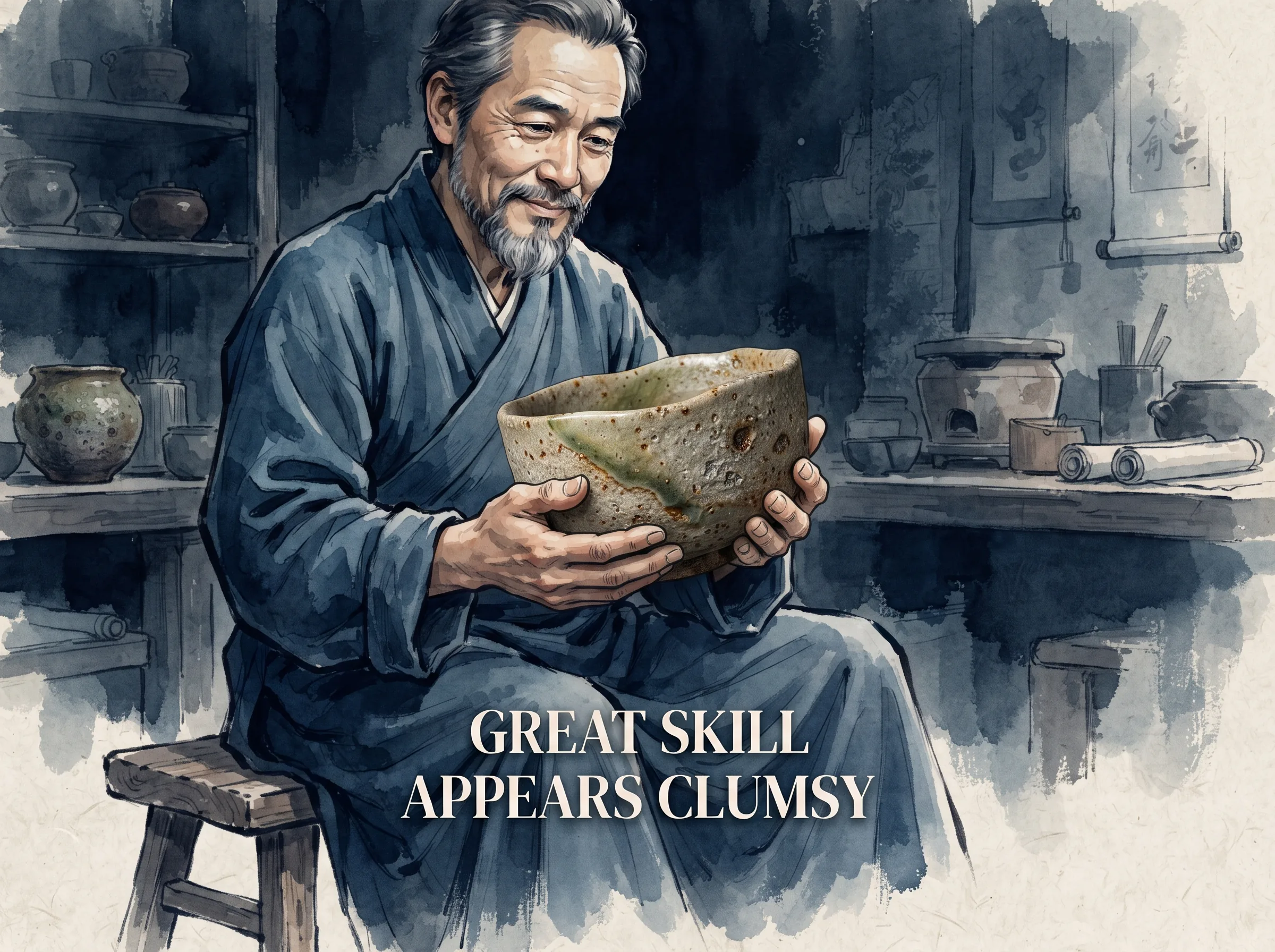
This distinction matters enormously for anyone struggling with perfectionism, because perfectionism is fundamentally performative. It asks: will I be seen as adequate? Will I pass the judgment of others? "great skill appears clumsy" (dà qiǎo ruò zhuō, 大巧若拙) answers a different question: what remains when the need to be seen as adequate drops away?
The Chinese Aesthetic of Restraint
The preference for simplicity (zhuō, 拙) over cleverness (qiǎo, 巧) runs deep through Chinese artistic and philosophical tradition, and it manifests in ways that can help clarify what Laozi was pointing toward.
Consider the difference between two celebrated periods in Chinese ceramics. Song dynasty wares are known for their restrained elegance — subtle glazes, clean lines, an almost ascetic simplicity. Qing dynasty pieces, by contrast, sometimes pushed decoration to extraordinary levels of intricacy. The Song approach says, almost invisibly: look at what this material already is. The Qing approach can read as: look at what I can make it do. Both represent skill. Only one hides its skill.
This tension between artificiality and authenticity appears repeatedly in classical Chinese thought. The Zhuangzi contains stories of craftsmen who prepare themselves through fasting and meditation before touching their materials, not to acquire new technique but to shed the chatter of self-consciousness. In one well-known account, a carpenter named Ziqing prepares to craft a musical instrument by first clearing his mind of ambition, then entering the forest to listen for the shape already present in the wood. The highest technique, in this telling, is the forgetting of technique itself.
Whether or not every detail of these stories can be traced to a single transmitted version of the text, they illustrate a consistent intuition: that genuine artistry involves surrendering the ego's demand to demonstrate itself. The work becomes something that emerges rather than something imposed.
The modern parallel is easy to see. Social media rewards the opposite impulse — the display of effortlessness that is actually the product of enormous effort, the curated ease that requires hours of planning. When every post is optimized and every image filtered, authenticity itself becomes a performance. "great skill appears clumsy" (dà qiǎo ruò zhuō, 大巧若拙) offers a quiet correction: the thing that appears simplest may be the product of the deepest mastery, precisely because mastery no longer needs to prove itself. To explore these themes from another angle, read our related reflection on When Society Gets Smarter, People Grow Farther From Themselves.
Why Perfectionism Feels So Exhausting
The connection between perfectionism and burnout is not merely poetic. Empirical research suggests it is real and measurable. A meta-analysis of 43 studies involving nearly ten thousand participants found that perfectionistic concerns — the anxiety about meeting standards and fear of negative evaluation — show medium-to-large positive relationships with overall burnout and its symptoms [2]. The pursuit of flawlessness exacts a physiological and psychological toll.
From a Daoist perspective, this toll is not surprising. The relentless pursuit of clever display (qiǎo, 巧) — of polished appearance, of perfect execution — requires constant energy expenditure. It demands that the self remain permanently on guard, forever adjusting, forever performing. Laozi's philosophy consistently favors low-effort modes of being: wuwei, often translated as "non-action" or "effortless action," describes a way of moving through the world that does not fight against it.
There is also a deeper point about the nature of reality. Some contemporary interpreters of Laozi have drawn connections between his thought and what we now understand about systems and complexity. A perfectly ordered system — one in which every element occupies its ideal position — is, physically speaking, a dead system. Life depends on variation, on asymmetry, on the kind of productive disorder that allows adaptation and growth. The thermodynamic principle of entropy, which describes the tendency of systems to move toward disorder, can be read as confirming an insight that Laozi expressed in poetic form: absolute order is indistinguishable from stasis, and stasis is indistinguishable from death.
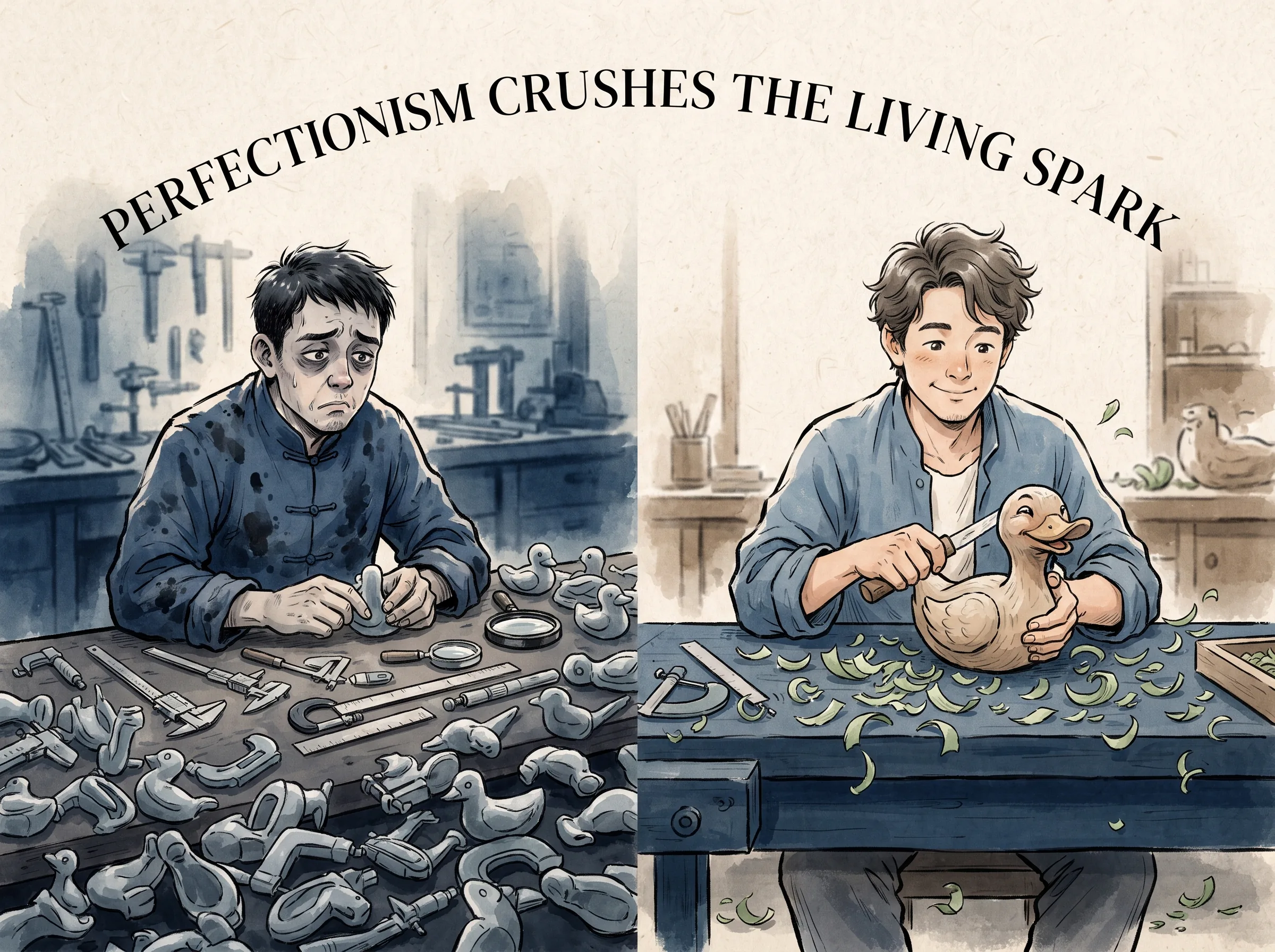
Whether or not one accepts this scientific framing, the observable truth remains: the most memorable and resonant things in art, relationships, and personal growth tend to carry traces of their own making. A painting that shows the artist's hand, a conversation that includes an unexpected pause, a life that includes evident struggle — these are not failures of polish. They are evidence of presence.
Practicing Uncalculated Simplicity (Zhuō, 拙): Three Ways to Let Go
Understanding great skill appearing clumsy (dà qiǎo ruò zhuō, "great skill appears clumsy" (dà qiǎo ruò zhuō, 大巧若拙)) philosophically is one thing. Living it is another. Here are three practical approaches that draw on the spirit of the principle without demanding spiritual commitment.
Guarding the Center (Shǒu, 守) — Keep your own rhythm. The pressure to perform constantly comes from external timers: deadlines, social media algorithms, workplace expectations. Guarding (shǒu, 守) means recovering your internal tempo. It might look like refusing to respond to messages immediately, choosing not to optimize every idle (kòngxián, 空闲) moment, or simply allowing yourself to move at a pace that feels sustainable rather than impressive. This is not laziness. It is the recognition that your energy is finite and that wasting it on performance is the surest path to burnout.
Capacious Tolerance (Róng, 容) — Tolerate your own roughness. Perfectionism thrives on the belief that any visible flaw is a moral failing. Tolerance (róng, 容) asks you to practice a different relationship with your own imperfections. Set aside time each month to do something deliberately unfinished — a drawing you don't refine, a meal you don't plate carefully, a message you send without the seventh rewrite. The goal is not to produce something good. The goal is to experience the relief of stopping before the compulsion to perfect takes over. Over time, this practice can reduce the anxiety that fuels perfectionistic cycles.
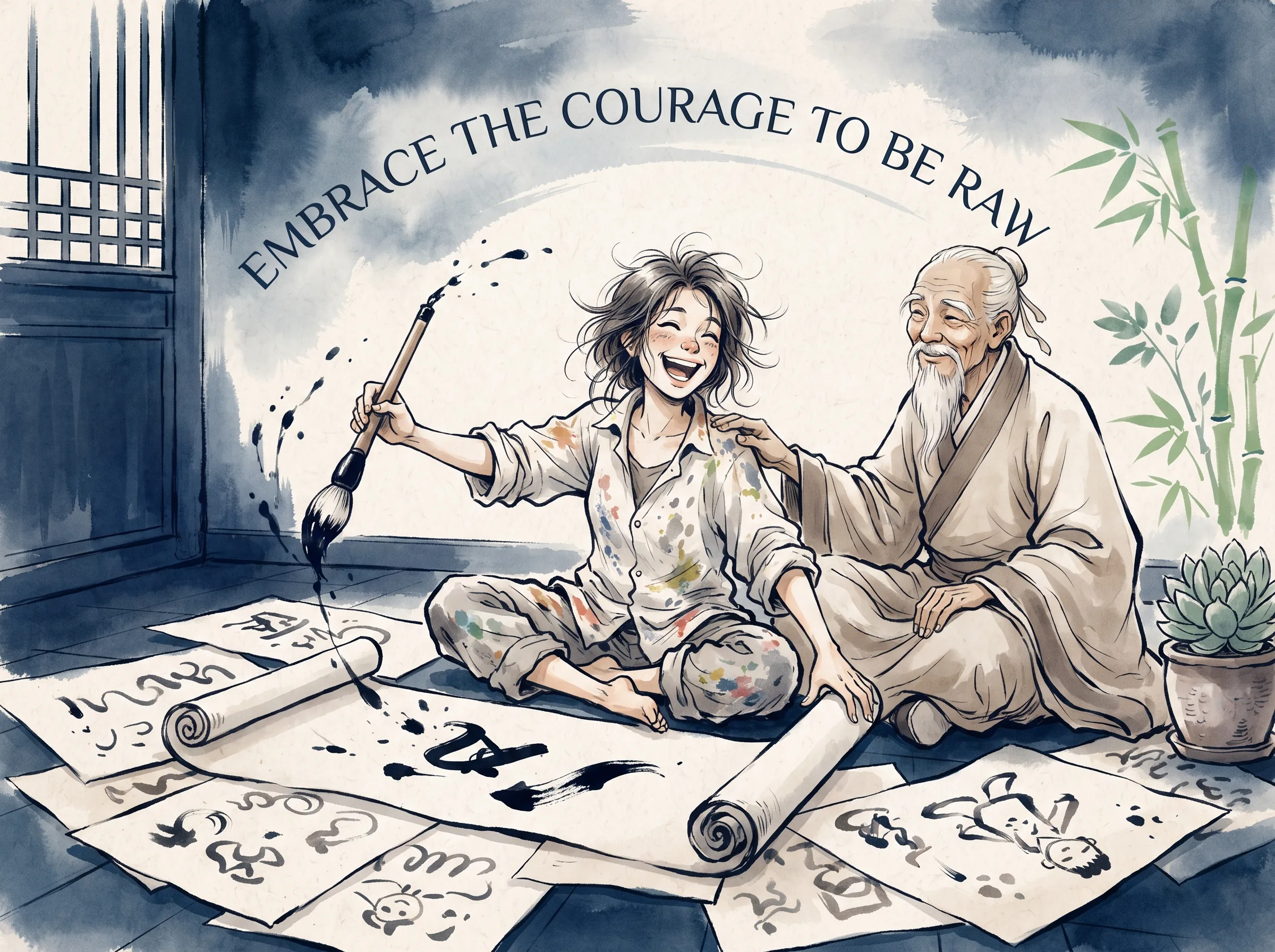
Letting Go (Fàng, 放) — Release the need to control. The most exhausting part of perfectionism is not the effort itself but the underlying belief that everything must go according to plan. Release (fàng, 放) means practicing acceptance of outcomes you cannot predict or manipulate. This can be as simple as allowing a conversation to drift into silence, letting a project evolve in directions you didn't initially intend, or trusting that a relationship does not require constant maintenance to survive. The Daoist ideal is not passivity — it is the confidence that comes from aligning with the natural flow of things rather than fighting against it.
These practices share a common thread: they treat imperfection not as a problem to be solved but as a condition to be inhabited. The aim is not to become worse at things. It is to become freer from the belief that your worth depends on visible excellence.
When Clumsiness Becomes a Strategy
There is a danger worth acknowledging. In a world that increasingly rewards self-optimization, the language of simplicity (zhuō, 拙) can itself become a performance. Someone might adopt the aesthetics of simplicity — wearing plain clothes, posting unfiltered photos, speaking in measured tones — as a way of standing out. This is uncalculated simplicity used as clever calculation (zhuō as qiǎo, 拙/巧), and it defeats the principle entirely.
The test is honest one: is the simplification coming from a place of genuine ease, or from a calculation about what will be well-received? Laozi did not advocate for a new style of self-presentation. He advocated for the dropping away of the need to present oneself at all.
This distinction becomes especially relevant in the context of artificial intelligence. As machines produce increasingly polished text, images, and speech, the human trace — the slight hesitation, the idiosyncratic turn of phrase, the visible effort — becomes more valuable precisely because it cannot be generated. Your genuine unadornment (zhuō, 拙) may, in a strange way, become your distinguishing feature. But only if it is genuine. Only if it comes from a place where the need to be impressive has genuinely relaxed.
FAQ
Is "great skill appearing clumsy" (dà qiǎo ruò zhuō, "great skill appears clumsy" (dà qiǎo ruò zhuō, 大巧若拙)) the same as saying "done is better than perfect"? They point in a similar direction but differ in depth. "Done is better than perfect" is a productivity slogan — a tactical instruction to stop optimizing and ship the work. "Great skill appearing clumsy" (dà qiǎo ruò zhuō, "great skill appears clumsy" (dà qiǎo ruò zhuō, 大巧若拙)) is a philosophical stance about the nature of mastery itself. It says that the highest form of skill does not look like skill at all. The slogan tells you what to do; the principle asks you to reconsider why you are doing it.
Does Laozi's teaching encourage people to stop trying to improve? No. The principle explicitly requires genuine capability as a prerequisite. One must be able to possess clever technique (qiǎo, 巧) before one can choose plain simplicity (zhuō, 拙). Laozi's point is not that improvement is worthless but that the obsessive pursuit of visible improvement — the kind driven by anxiety about how one is perceived — is self-defeating. Improvement undertaken from a place of ease, rather than from a place of fear, is entirely consistent with the Daoist vision.
How is this different from Western ideas about humility or minimalism? There are overlaps, certainly. Humility and minimalism both encourage restraint and a reduced focus on appearance. But "great skill appearing clumsy" (dà qiǎo ruò zhuō, "great skill appears clumsy" (dà qiǎo ruò zhuō, 大巧若拙)) carries a specifically epistemological claim: that the highest forms of skill and understanding operate in ways that are not immediately legible to conventional judgment. It is not just a moral attitude; it is a claim about how reality works. Western minimalism tends to be aesthetic or ethical; Laozi's principle is both, and also something more fundamental — a claim about the nature of power itself.
Can someone practice unadorned simplicity (zhuō, 拙) if their work environment rewards visible excellence? Yes, though it requires discernment. Unadorned simplicity (zhuō, 拙) does not mean neglecting responsibilities or underperforming. It means finding the space within your obligations where you can choose simplicity over display, presence over polish, and sustainability over spectacle. A teacher might choose clarity over theatricality. A writer might choose honesty over cleverness. A manager might choose directness over corporate language. The principle adapts to context without requiring its abandonment.
Bringing It Back to Daily Life
Laozi's observation that great skill appears clumsy is not a retreat from excellence. It is a redefinition of it. The perfectionism that drives so much contemporary anxiety confuses the appearance of excellence with excellence itself — and in doing so, exhausts the very energy it depends upon. "Great skill appearing clumsy" (dà qiǎo ruò zhuō, "great skill appears clumsy" (dà qiǎo ruò zhuō, 大巧若拙)) offers a different economy: one in which mastery is measured not by its visibility but by its durability, not by its dazzle but by its fit with the world as it actually is.
The path forward does not require abandoning ambition or rejecting care. It asks only that you notice when the drive to be flawless has become a form of suffering, and that you allow yourself the freedom to be simply, quietly, genuinely competent. The world has plenty of polished performance. What it rarely encounters is the calm presence of someone who no longer needs to prove anything.
If this perspective resonates with you, the next step is not to adopt a new practice but to notice an old pattern. The next time you find yourself obsessing over a detail that almost no one else will notice, ask: am I doing this for the work, or for the impression? The answer, however honest, is itself a form of uncalculated simplicity (zhuō, 拙) — the beginning of skill that no longer needs to announce itself.
Discover the historical and philosophical roots in the classical foundation in Vast Virtue: Greatest Perfection Appears Imperfect and Flawed.
Deepen your understanding of these principles in our reflection on No Restraint Without Release: The Chinese Art of Inner Freedom.
Sources & Further Reading
[1] Daodejing, Chapter 45: Greatest Perfection Seems Flawed (道德經/第四十五章) – Laozi — Primary source for the "great skill appears clumsy" (dà qiǎo ruò zhuō, "great skill appears clumsy" (dà qiǎo ruò zhuō, 大巧若拙)) passage and its context within Chapter 45 of the Daodejing
[2] Multidimensional Perfectionism and Burnout: A Meta-Analysis — Research at York St John — Empirical evidence linking perfectionistic concerns to burnout ### For Further Exploration
[3] The Daodejing (Laozi) — Chapter 45 and related chapters on simplicity, uncarved wood, and effortless action (zhuō, pǔ, wúwéi, 拙、朴、无为)
[4] The Zhuangzi — Stories of craftsmen and natural embodiment, particularly the "Internal Chapters"
[5] The Analects of Confucius — Passages on patience and the rejection of shortcuts
[6] Contemporary discussions of Daoist aesthetics and their relevance to modern design and art theory







[…] Tao Yuanming is perhaps the most recognizable name in this tradition. When a provincial inspector visited his county, his staff advised him to dress formally and greet the visitor with proper ceremony. Tao responded with a remark that has echoed through Chinese literary history: "I will not bend my waist for five bushels of rice" [3]. He removed his seal of office and wrote the "Return" essay, describing his decision to leave official life behind [3]. Examine this artistic principle further through the classical aesthetic philosophy of Why Great Skill Looks Clumsy: Laozi’s Antidote to Modern Perfectionism. […]