
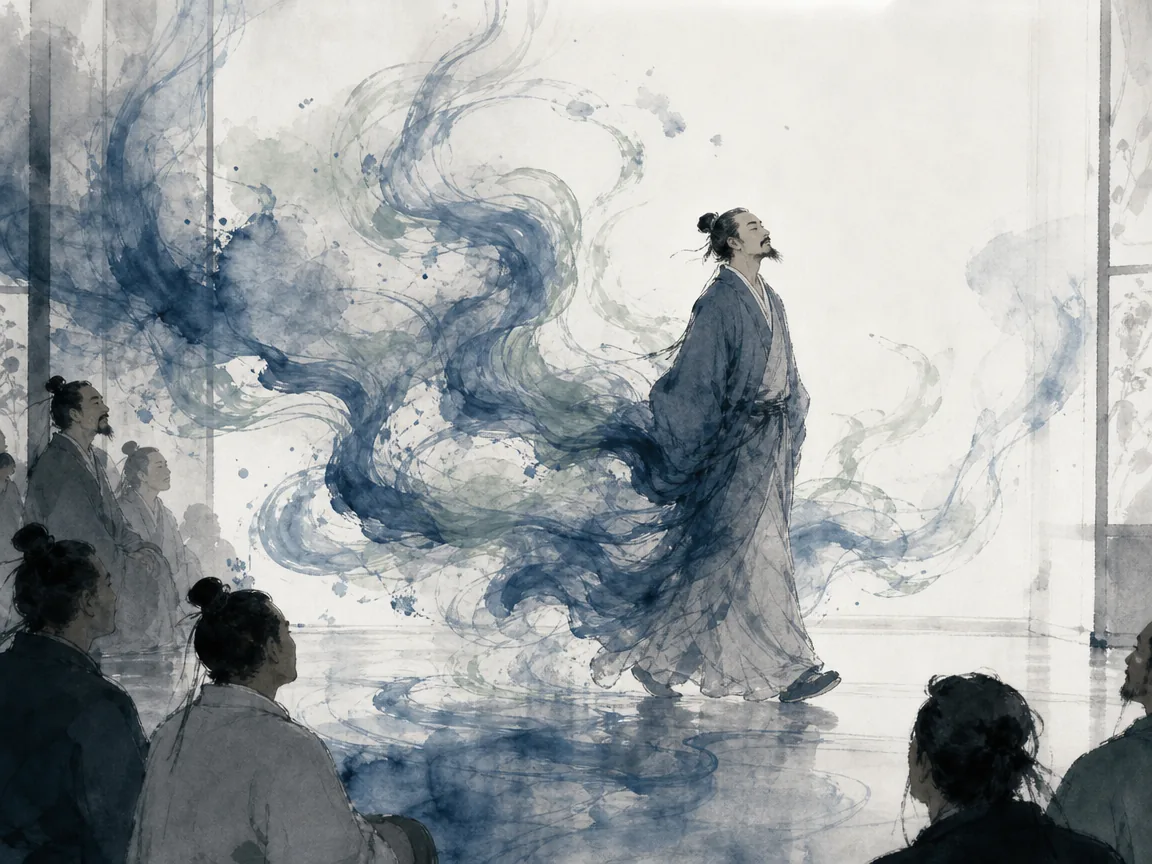
There is a kind of magnetism no amount of money can purchase. You have met people like this — perhaps you are even one. Their appearance may be entirely ordinary, yet standing near them feels different. A room seems to settle; attention naturally drifts toward them. Conversely, you may have encountered technically impeccable presentations, rehearsed to perfection, that left you feeling nothing at all.
This invisible quality has haunted every culture's attempt to name it. In English we call it charisma, presence, or x factor. The Chinese tradition discovered it first, gave it a precise name over fifteen hundred years ago, and built an entire framework around understanding and cultivating it. That name is spirit resonance (qì yùn, spirit resonance (qì yùn, 气韵)). And according to Chinese aesthetic theory, it is the single most important quality a person or work can possess — far above technical skill, attractiveness, or polish—a foundational perspective explored in Spirit Resonance in Chinese Painting.
Which raises a question modern life keeps returning us to: if charisma cannot be bought, faked, or rapidly manufactured, how does one actually develop it?
Spirit Resonance in Chinese Painting: The First Rule of Chinese Aesthetics
Around the fifth century, a painter and theorist named Xie He compiled what would become the most influential document in Chinese art criticism — the Gǔ Huà Pǐn Lù (《古画品录》, "Records of the Classification of Ancient Painters") [1]. In it, he laid out six principles for evaluating painting. The first, and most important, was: "vivid spirit resonance" (qì yùn shēng dòng, 气韵生动).
The ranking itself is revealing. In a system where one might expect technical mastery, accurate proportion, or beautiful coloring to top the list, Xie He placed an intangible quality first [1]. According to the principle, a painting lacking spirit resonance (qì yùn, spirit resonance (qì yùn, 气韵)) falls short regardless of how skillfully executed, while a work possessing it can endure rougher technique and still command respect. This hierarchy — that living presence matters more than flawless execution — shaped Chinese aesthetic judgment for over a millennium [1].
Consider two people writing the same Chinese character. One follows every stroke rule perfectly; the result is technically correct but flat, lifeless. The other writes with less precision, yet the character seems to breathe — there is energy passing between the strokes, a rhythm that makes you feel something. Both have technique. Only one has spirit resonance (qì yùn, spirit resonance (qì yùn, 气韵)).
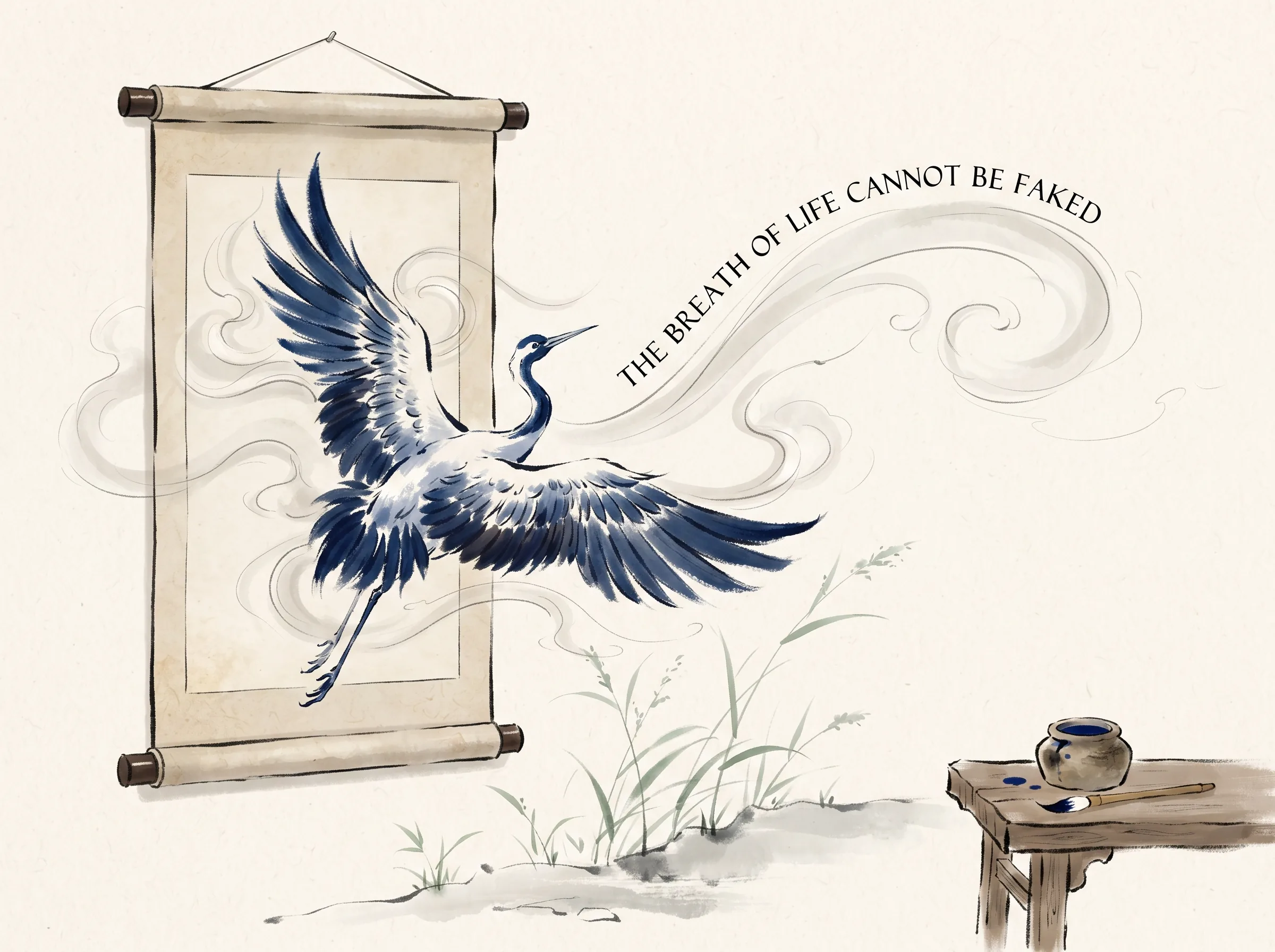
The same distinction appears in music. Two performers play the same guqin piece. One hits every note correctly; the other makes a slight mistake but somehow places you inside a mountain valley, wind moving past your ears. The first is technically superior. The second has spirit resonance (qì yùn, spirit resonance (qì yùn, 气韵)).
In modern terms: spirit resonance (qì yùn, spirit resonance (qì yùn, 气韵)) is what remains after technique steps aside. It is the quality of aliveness that cannot be reduced to a checklist.
Why It Cannot Be Replicated
The most famous illustration of this principle in Chinese cultural memory involves the Lán Tíng Xù (《兰亭序》, "Preface to the Poems Collected from the Orchid Pavilion"), written by Wang Xizhi in 353 CE. According to later accounts recorded by the Tang dynasty writer He Yan Zhi, Wang Xizhi composed the piece in a state of slight intoxication, guided by inspiration and the atmosphere of the moment [4]. When he awoke and attempted to replicate it the following days, writing dozens or hundreds of versions, none matched the original [4].
The story — whether taken as complete historical fact or as a cultural parable — captures something essential about spirit resonance (qì yùn, spirit resonance (qì yùn, 气韵)). It is not a technique that can be repeated on demand. It is the convergence of a person's accumulated life: everything they have read, every place they have walked, the mood of that particular afternoon, the wine, the company, the wind. When those conditions shift, the quality shifts with them.
Western aesthetics often asks what shape something has. Chinese aesthetics asks what state it is in. Shape is fixed; state is alive. This distinction matters because spirit resonance (qì yùn, spirit resonance (qì yùn, 气韵)) cannot be captured the way a photograph captures a face. It can only be cultivated the way a person is cultivated — through the totality of how one lives.
The Debate: Is Spirit Resonance (Qì Yùn, spirit resonance (qì yùn, 气韵)) Innate or Cultivable?
If spirit resonance (qì yùn, spirit resonance (qì yùn, 气韵)) is so fundamental, a natural question follows: can it be learned?
The Northern Song scholar Guo Ruoxu, writing in his Tú Huà Jiàn Wén Zhì (《图画见闻志》, "Further Records on Notable Paintings"), addressed this directly. Following Xie He's framework, Guo Ruoxu acknowledged that five of the six painting principles — including brushwork, form, color, composition, and copying — can be taught and practiced [2]. But spirit resonance (qì yùn, spirit resonance (qì yùn, 气韵)), he argued, belongs to a different category: it is "born with" (必在生知) and cannot be acquired through skill or accumulated over time [2]. In his reading, spirit resonance (qì yùn, spirit resonance (qì yùn, 气韵)) is innate, not teachable.
Centuries later, the Ming dynasty theorist Dong Qichang pushed back against this determinism. While the precise original phrasing of his arguments requires careful textual verification, his position is well known in Chinese aesthetic tradition: spirit resonance (qì yùn, spirit resonance (qì yùn, 气韵)) can indeed be cultivated, and the method is encapsulated in the famous maxim — reading ten thousand scrolls and travelling ten thousand miles (dú wàn juǎn shū, xíng wàn lǐ lù, 读万卷书,行万里路) [3]. The accumulated effect of this cultivation, Dong suggested, is a clearing of the mind's worldly turbidity, allowing an inner landscape to emerge naturally (xiōng zhōng tuō qù chénzhuó, zìrán qiūhè nèi yíng, 胸中脱去尘浊,自然丘壑内营) [3]. In this view, capturing technical likeness is strictly secondary to channeling the vital cosmic flow; explore this radical aesthetic tradition in our reflection on Why Chinese Painting Let Go of “Accuracy” — A Daoist Perspective.
The tension between these positions — innate versus cultivated — is not unique to Chinese thought. It mirrors the eternal debate between nature and nurture. But the Chinese tradition offers a subtle third way: spirit resonance (qì yùn, spirit resonance (qì yùn, 气韵)) is not simply given at birth, nor is it a skill like riding a bicycle. It is the emergent quality of a life genuinely lived. You are not born with it finished, and you do not learn it through repetition alone. It develops through sustained engagement with the world — reading, walking, working, solitude, encounter — over a lifetime.
Three Layers of Cultivating Spirit Resonance (Qì Yùn, spirit resonance (qì yùn, 气韵))
If spirit resonance (qì yùn, 气韵) is earned rather than inherited, the practical question becomes: how?
Chinese aesthetic tradition does not offer a quick fix. But it does offer a framework — one that moves from the outer world inward, then deeper still into character.
Layer One: Nourish Your Eye

You cannot cultivate what you cannot recognize. If your standard of beauty is shaped by algorithmic feeds, trend-chasing, and mass-produced imagery, your inner compass will mirror that environment. The Chinese tradition addresses this through the principle of exposing oneself to refined work — what some later formulations called feeding the eye thoroughly (饱游饫看) so that your aesthetic standard self-calibrates over time.
Practically, this means seeking out work of genuine depth. Visit museums. Study classical art, architecture, and design. Notice when something feels aesthetically coarse or emotionally flat. That discomfort is not snobbery; it is your sensibility growing. The Chinese painter Guo Xi described a similar process centuries ago, emphasizing that wide exposure to nature and great works trains the inner eye to discern quality [C9 note].
The mechanism is straightforward: what you regularly consume shapes what you can produce. An AI trained on low-quality data produces low-quality output. So does a person surrounded by low-quality aesthetic input. Feed the eye well, and the hand eventually follows.
Layer Two: Cultivate Inner Flow
The character qì (气) literally means breath, energy, or vital flow. A person with strong spirit resonance (qì yùn, 气韵) is someone whose inner energy moves freely — not blocked by anxiety, contradiction, or chronic performance. Blockage shows up as hesitation, people-pleasing, inner noise, and the constant sensation of being elsewhere.
Traditional Chinese practice offers four simple (pǔsù, 朴素) activities for cultivating this flow: reading, writing by hand, walking, and solitude. Each serves a distinct function. Reading allows ideas to circulate through the mind. Calligraphy or handwritten writing synchronizes breath, body, and attention — the hand becomes an instrument of presence rather than mere output. Walking connects the body to the rhythm of the outside world. Solitude removes the audience, allowing the authentic self to surface without performance.
The most dramatic illustration of this principle in Chinese literary history is Su Shi's (苏轼) exile to Huangzhou. In 1080, Su Shi was stripped of his official position and sent to a remote province [5]. Financially strained and politically isolated, he spent his third year there — in 1082 — producing what many consider his most profound work, including the Cold Food Observance poems (《黄州寒食诗帖》), now held in the National Palace Museum collection in Taiwan [5]. Stripped of status, wealth, and external validation, he was forced to confront himself. What emerged was not less impressive for its austerity — it was more impressive because it was unmediated. The energy that flows when nothing pretentious stands in the way is precisely what the Chinese tradition calls spirit resonance (qì yùn, 气韵).
Layer Three: Cultivate Character
Technical proficiency and inner flow can still produce shallow work if the inner world behind them is narrow. This is where inner stature (gé, 格) — character, moral orientation — becomes the final differentiator.
A performer who is technically excellent but driven by ambition, visibility, or comparison will leave an audience feeling something unresolved. The work carries the scent of self-interest, and human beings are remarkably sensitive to it. The Chinese tradition does not shy away from this: art is never separated from the artist. As the saying goes, painting is the person, calligraphy is the person, the work is the person.
The late calligraphy of Li Shutong (李叔同), who became the monk Hong Yi (弘一法师), is often cited as an example of this principle. His mature style — spare, unadorned, almost childlike in its simplicity — is valued not for technical complexity but for the spiritual clarity it communicates. Whether one attributes this to his Buddhist practice, his renunciation of worldly aims, or both, the observation remains: when the drive to impress disappears, what remains often carries a quality that technique alone cannot produce. The highest state of spirit resonance (qì yùn, 气韵) is not "I am impressive." It is "I no longer care whether I am impressive."
Why This Matters Now
We live in an era of personal branding, curated appearances, and infinite self-optimization. Charisma has become a commodity — sold in courses, workshops, and algorithms that promise to teach presence in thirty days. The Chinese aesthetic tradition offers a quietly radical counter-narrative: the quality you are looking for cannot be extracted from a technique module because it is not a technique. It is the residue of a life honestly lived.
Burnout, comparison culture, and the exhaustion of constant performance are not problems of insufficient skill. They are problems of disconnection — from what is real, from one's own rhythm, from the kind of inner clarity that allows spirit resonance (qì yùn, 气韵) to emerge. The tradition does not offer a shortcut. It offers something sterner and more honest: cultivate your eye, cultivate your flow, cultivate your character. Do this over years rather than days, and the quality you were trying to buy will appear on its own.
FAQ
Can spirit resonance (qì yùn, 气韵) really not be taught at all? Traditional sources differ. Guo Ruoxu argued that spirit resonance (qì yùn, 气韵) is innate and cannot be learned through technique [2]. Others, including Dong Qichang, held that it develops through lived experience — reading, traveling, and inner refinement — rather than formal instruction [3]. The broader Chinese tradition seems to hold both views: you cannot learn spirit resonance (qì yùn, 气韵) the way you learn a skill, but you can cultivate the conditions in which it emerges.
Is spirit resonance (qì yùn, 气韵) the same as charisma? They overlap significantly but are not identical. Charisma in the Western sense often emphasizes outward magnetism and social influence. spirit resonance (qì yùn, 气韵) is broader — it applies to art, calligraphy, nature, and personal presence alike. It describes a quality of aliveness and authenticity that transcends any single domain.
How long does it take to cultivate? There is no shortcut in the tradition. The examples offered — Su Shi's years of exile, the lifelong practice of reading and reflection — suggest that spirit resonance (qì yùn, 气韵) develops over years or decades, not weeks. It is tied to the rhythm of a life, not a training program.
Can anyone develop spirit resonance (qì yùn, 气韵), or is it limited to artists? The Chinese tradition treats spirit resonance (qì yùn, 气韵) as a quality of being, not a professional skill. While it arose in aesthetic discourse, its logic extends to any person: how one lives, what one pays attention to, and what one cultivates internally will shape the quality of presence one carries.
Summary
The Chinese aesthetic tradition offers a clear answer to a modern frustration: charisma cannot be purchased because it is not a technique — it is the visible expression of a person's inner life. Xie He's ranking of vivid spirit resonance (qì yùn shēng dòng, 气韵生动) above all other principles over fifteen hundred years ago [1] established a hierarchy that still holds: a living presence matters more than technical perfection. Whether spirit resonance (qì yùn, 气韵) is innate or cultivated has been debated by thinkers like Guo Ruoxu and Dong Qichang [2]****[3], but the practical tradition points toward cultivation through sustained attention, honest living, and the gradual refinement of character.
If you want to develop this quality, the path is not faster. It is deeper. Start by feeding your eye with work of genuine quality. Introduce spaces — reading, walking, solitude — where your inner energy can move without obstruction. And over time, let your character catch up with your ambitions. The rest will follow, reflecting the enduring wisdom of Spirit Resonance in Chinese Painting. To see how these principles extend beyond painting into daily objects and mindful living, explore Can Ancient Chinese Life Aesthetics Teach Us How to Live Beautifully Today?.
Cultivating spirit resonance begins with quieting inner hurry through unhurried daily rituals; reflect on the mindful art of tea in How to Be Like a Good Cup of Tea: Ancient Chinese Wisdom for Modern Life.
Sources & Further Reading
[1] Xie He — Gu Hua Pin Lu (古畫品錄) — Wikisource() · Source for Xie He's Six Principles and the ranking of vivid spirit resonance (qì yùn shēng dòng, 气韵生动)
[2] Classical Source (Shidian Guji, 识典古籍) — On Spirit Resonance Cannot Be Taught (Lùn Qì Yùn Fēi Shī, 论气韵非师) — · Source for Guo Ruoxu's argument that spirit resonance (qì yùn, 气韵) is innate and cannot be formally copied (bù kě xué, 不可学)
[3] Dong Qichang — Hua Chan Shi Sui Bi (畫禪室隨筆) — Wikisource() · Reference for Dong Qichang's position on cultivating spirit resonance (qì yùn, 气韵)
[4] He Yanzhi — Lan Ting Shi Mo Ji (蘭亭始末記) — Wikisource() · Source for the account of Wang Xizhi's inability to replicate the Lan Ting Xu
[5] Su Shi — Cold Food Observance Poetry Scroll (黄州寒食诗卷) — National Palace Museum() · Source confirming Su Shi's Huangzhou exile (1080) and the 1082 composition of the Cold Food Observance poems
[6] Further Reading (not cited as direct evidence):
[7] Guo Xi: Linquan Gaozhi (林泉高致集) — Landscape theory on broad immersion (bǎo yóu yù kàn, 饱游饫看)
[8] Guo Ruoxu: Tu Hua Jian Wen Zhi (图画见闻志) — Full treatise on painting, containing extended discussions of spirit resonance (qì yùn, 气韵) and artistic classification
[9] History of Ancient Chinese Aesthetics (中国古代美学史) — Scholarly surveys of Chinese aesthetic thought covering the development of spirit resonance (qì yùn, 气韵) theory across dynasties






