
Liubai in Chinese Art: Core Argument
Chinese aesthetics and philosophy treat emptiness not as a lack but as a choice. The principle of liubai—the deliberate use of empty space—appears in painting, gardens, poetry, and daily life as a practice of restraint. For modern readers overwhelmed by excess information, over-scheduling, and cluttered relationships, liubai offers a counterintuitive path to clarity, peace, and genuine luxury.
Two Interiors, Two Philosophies
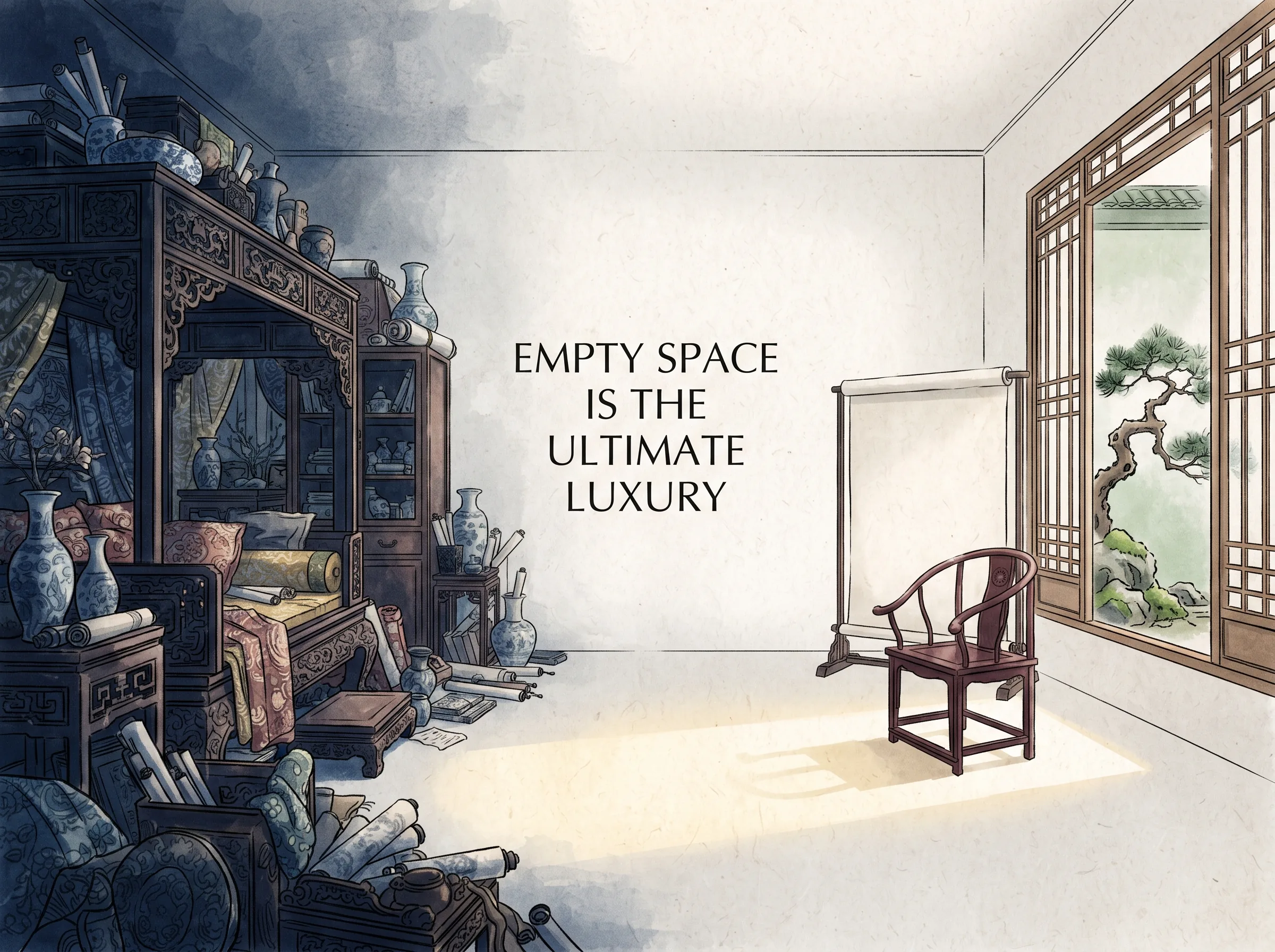
Walk into a traditional Western drawing room and you may find a crystal chandelier casting light over gilded frames, a Persian rug covering every inch of floor, walls hung with portraits and landscapes until nothing remains but color and texture. Everything signals that someone has the means to acquire and display. Luxuriance lives in accumulation.
Now step into a quiet Chinese study and you see a whitewashed wall, a half-open lattice window, a low wooden table holding only a single incense burner and a sparse branch of dried lotus in a celadon vase. The room seems almost empty. And yet visitors often describe it as more expensive than the gilded salon—not because the objects cost more, but because the silence around them carries weight.
Both spaces claim luxury. They simply define it differently. One shouts its worth through density. The other whispers it through restraint. The Chinese approach asks a question that may feel uncomfortable to a culture accustomed to adding rather than subtracting: what if the most valuable thing in a room is not the object, but the space it leaves behind?
This is the paradox of liubai, or deliberate emptiness, and it reaches far beyond art appreciation. It shapes how we speak, relate to others, spend our time, and understand the good life.
Liubai: More Than an Aesthetic Choice
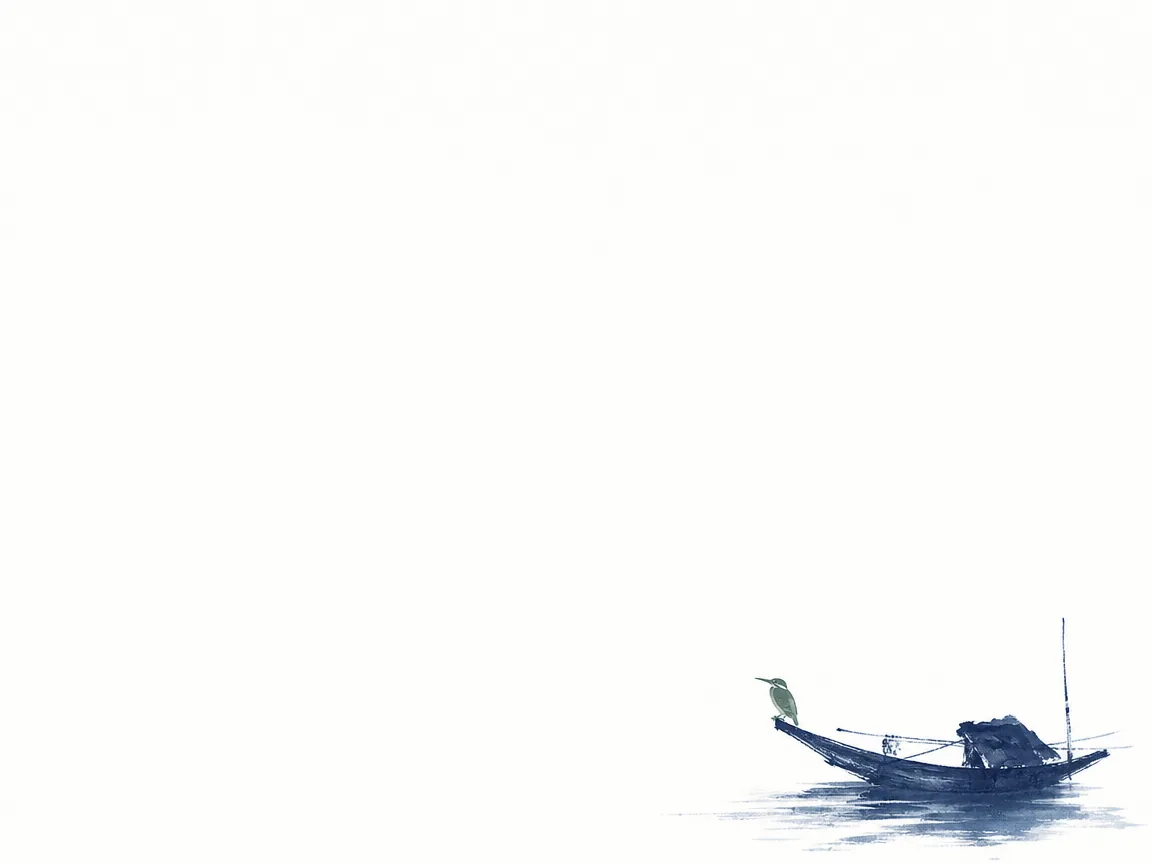
The visual language of liubai is perhaps most familiar in Chinese landscape painting. During the Southern Song period, painters such as Ma Yuan and Xia Gui developed a distinctive approach in which the subject—whether a mountain peak, a lone pine, or a figure on horseback—was concentrated in one corner of the composition, while the rest of the scroll dissolved into mist, water, or unpainted silk [6]. The resulting balance between a concentrated area of form and a broad field of emptiness became a distinctive feature associated with these two Southern Song masters (1127–1279).
The effect is not accidental. When the painter fills the entire surface, the viewer's eye has nowhere to rest and the imagination has nothing to enter. By leaving vast areas empty, the artist invites the viewer to complete the scene internally—to imagine the mountain extending into clouds, the river flowing beyond the frame, the wind moving through unseen valleys. The blank space is not a gap to be mourned. It is an invitation.
In this sense, liubai is not poverty disguised as simplicity. It is the confidence to omit. It says: I could fill this space, but I choose not to. Its power lies not only in what is present but also in what is deliberately withheld.
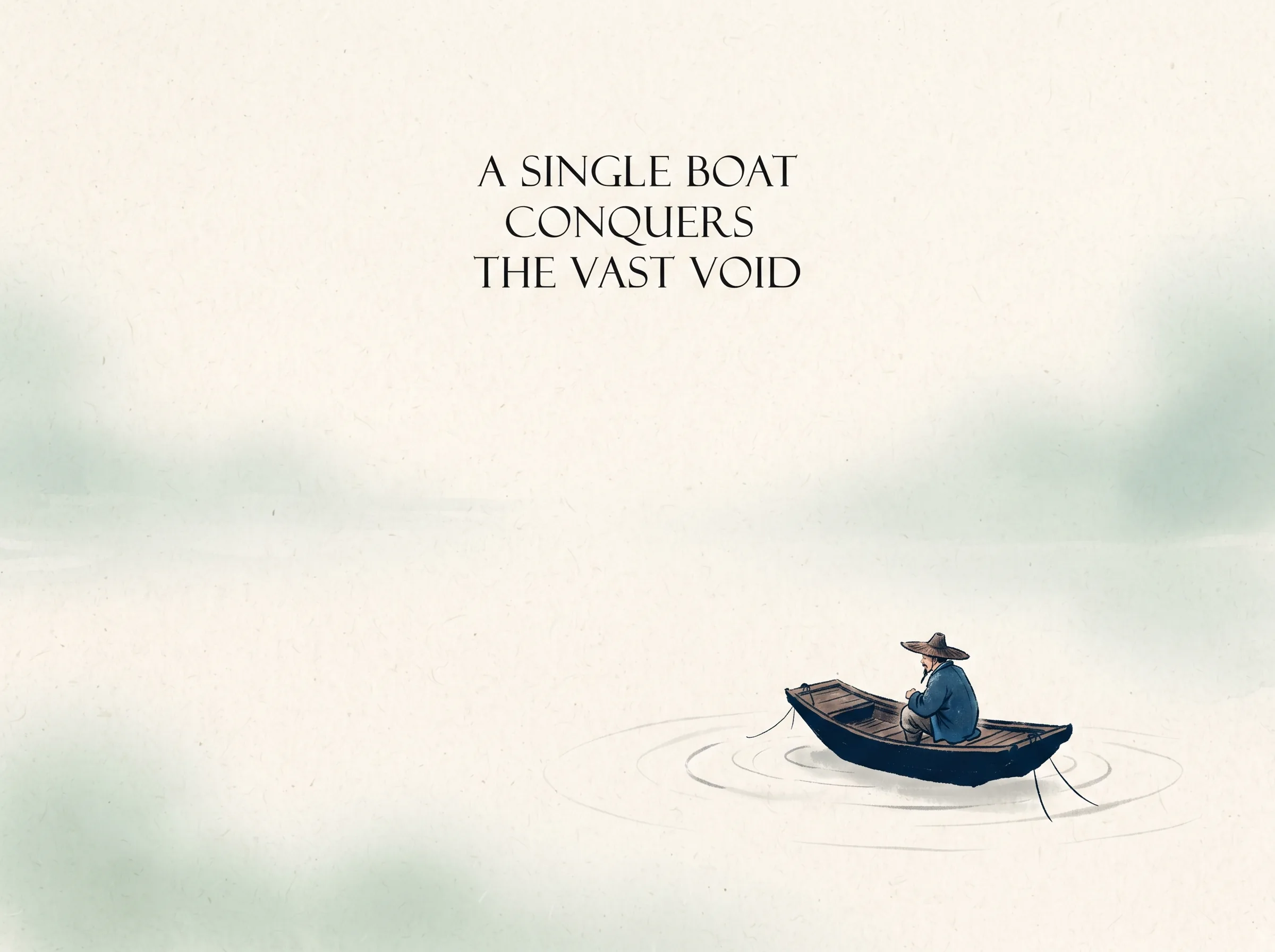
This distinction matters because we often confuse emptiness with loss. A half-empty glass suggests scarcity; a partially unpainted composition suggests possibility. The difference is intention. Liubai is an act of selection, not surrender. The painter could have added more; the decision not to do so is the point.
The Subtraction Philosophy: Roots in Daoist Thought
The aesthetic impulse behind liubai, the deliberate use of empty space, is deeply connected to a philosophical tradition that treats emptiness as a creative force rather than a deficit. In classical Daoist thought, emptiness is not the absence of value but the condition that makes value possible.
The Daodejing, traditionally attributed to Laozi, contains one of the most frequently cited passages on this theme. Liubai in Chinese Art observes that a wheel hub is useful because of the empty space at its center, a vessel because of its hollow interior, and a room because of the space enclosed by its walls: "We shape clay into a pot, but it is the emptiness inside that holds whatever we want." The chapter concludes with a succinct principle: "Profit comes from what is present, but usefulness from what is absent" [7].
These metaphors are not merely decorative. They reframe how we think about what matters. A cup that is already full cannot receive tea. A schedule packed to the brim cannot accommodate surprise, rest, or reflection. A heart crowded with opinions cannot listen. Emptiness, in this framework, is not nothing. It is capacity.
Modern minimalism shares something with this perspective—both favor simplicity over excess and intentionality over impulse. But the ancient Chinese roots run deeper than lifestyle aesthetics. The Daoist attention to emptiness is part of a broader worldview in which non-action (wú wéi), naturalness, and restraint are not weaknesses but strategies for living well. Where contemporary consumer culture asks, "What more can I add?" this tradition asks, "What can I let go of without losing what matters?"
That shift in question is not small. It reframes the entire pursuit of a good life.
Three Modern Applications of Liubai
The concept of leaving space is not confined to galleries or antique homes. It appears across Chinese cultural life—in speech, in relationships, in the way time is treated—and each domain offers a parallel for how modern readers might apply the principle today.
Speech: What Is Left Unsaid
Chinese literary and conversational traditions have long valued the power of the unspoken. This idea is sometimes expressed through the phrase hua liu san fen: leave a portion of your words unsaid. The reasoning is straightforward: when you say everything, there is nothing left for the listener to discover. When you say too much, you rob the moment of resonance.
Consider the etiquette of the traditional tea ceremony. Water is heated, vessels are warmed, tea is steeped, and cups are poured. But between sips there is often silence—not awkward silence, but shared silence. That pause communicates presence, respect, and attention in a way that small talk cannot. The tea itself becomes the conversation.
In modern life, constant communication has become both a tool and a trap. We message, we post, we explain, we justify, we fill every gap with words or notifications. The result is frequently exhaustion—for ourselves and for those around us. Leaving some words unsaid does not mean becoming evasive or withholding important truths. It means recognizing that not every thought requires expression, not every feeling needs explanation, and not every silence is a problem to solve. Sometimes the most honest response is a pause. Cultivate quiet mindfulness in everyday living through the meditative tea ritual in What a Leaf Can Teach You: Ancient Chinese Wisdom in the Art of Tea.
Relationships: The Wisdom of Distance
A Chinese saying warns that those who expose their sharpest edges are often the first to break. The image is of something sharp and exposed: it catches the eye, but it also catches on everything and wears down fastest. The alternative is to keep part of yourself reserved, not out of fear, but out of respect for the natural limits of any relationship.
Doing things "to the end"—pushing an argument until one side wins, giving so much attention that the other person feels smothered, resolving every tension immediately—leaves no room for the other person to breathe, to reflect, or to meet you halfway. Relationships, like paintings, require negative space. Without it, they become visually and emotionally claustrophobic.
This does not mean avoiding conflict or withholding love. It means understanding that closeness without distance is unsustainable. A healthy relationship, like a well-composed landscape, has figures and fields, sound and silence, presence and retreat. Knowing when to step back is not indifference. It is care for the space in which the relationship can live.
Time: The Luxury of Empty Hours
Perhaps the most urgent application of liubai concerns time. Modern schedules are often engineered to eliminate idle moments. Commutes are filled with podcasts. Breaks are filled with emails. Even leisure is scheduled, tracked, and optimized. The result is a population that is constantly occupied and increasingly depleted.
The Chinese aesthetic tradition offers a different model. Song dynasty porcelain, especially pieces from the Ru kiln, is celebrated for its restrained elegance: no elaborate patterns or assertive ornamentation, only a subtle blue-green glaze that seems to hold stillness itself [8]. These vessels do not shout. They invite contemplation. Their beauty lies in what they refuse to add.
Applied to time, this suggests that scheduling every minute turns people into machines, while leaving gaps—unstructured moments without purpose—creates room for the mind to rest, wander, and occasionally generate something unexpected. Boredom, in this view, is not a defect to be cured. It is a signal that the system is oversubscribed and needs relief.
The challenge is that we have been trained to fear stillness. We reach for our phones before we reach for our thoughts. We fill every pause because silence feels like failure. The Chinese tradition of liubai, however, suggests otherwise: emptiness is not waste but a precondition for clarity.
Cultural Touchstones: Gardens, Furniture, Poetry
The principle of liubai is not confined to a single art form. It moves across media, connecting painting with architecture, furniture, and verse.
Suzhou's classical gardens, such as the Humble Administrator's Garden (Zhuozheng Yuan), are frequently cited as architectural expressions of the same philosophy. Rather than filling every corner with elaborate structures, these gardens use white walls as canvases, moon gates as frames, and carefully placed plants—a single banana stalk or a leaning plum branch—to suggest entire landscapes through shadow and partial visibility [9]. Visitors do not see everything at once. The garden reveals itself gradually, inviting them to complete the picture in their minds.
Ming dynasty furniture is another example. Pieces from this period are noted for their clean lines, balanced proportions, and refusal to hide behind ornament. The grain of the wood speaks for itself. The joinery is exposed rather than concealed. Decoration is minimal because the craft is considered sufficient. As one source observes, the design ethos emphasizes "structural integrity and subtle grace… celebrating the natural beauty of the wood itself" [10]. The result is furniture that looks at home in a sparse room precisely because it does not demand attention—it earns it.
Chinese poetry follows a similar logic. The greatest classical poems often achieve their power not through explicit statement but through implication. A line about a distant mountain may evoke more than a paragraph of description. A brief image of falling leaves may carry the weight of an entire season of longing. What is left unsaid is not lost. It is transferred to the reader, who becomes a co-creator of meaning.
This cross-disciplinary consistency is significant. Liubai is not a technique borrowed from a single medium but a worldview expressed through many forms.
Practical Steps for a Life with More Space
Understanding liubai intellectually is one thing; living it is another. The following suggestions are not a rigid system but a set of starting points—small experiments in leaving room where you might otherwise fill it.
Morning: Five Minutes Before the Screen
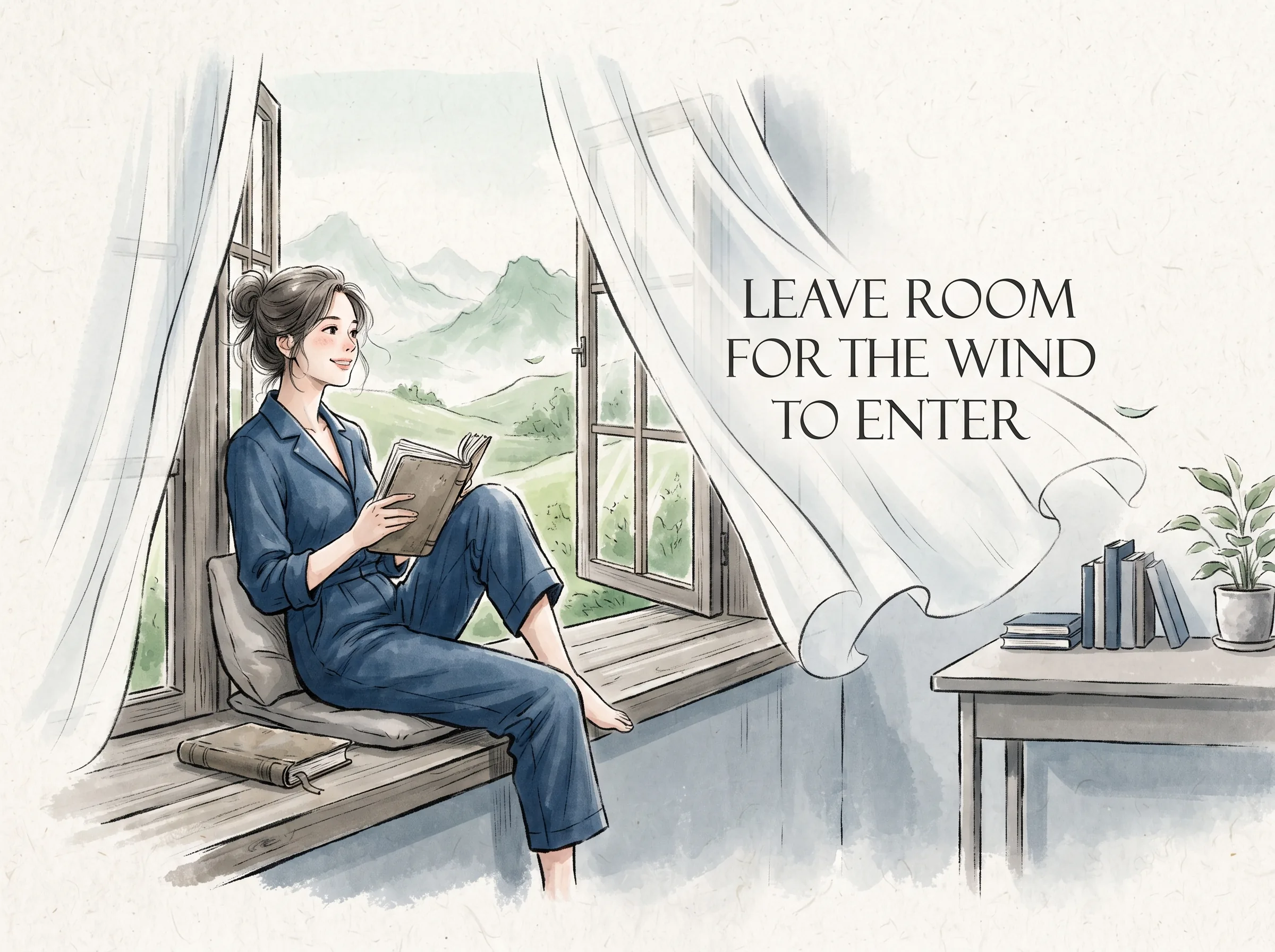
Most of us begin the day by reaching for our phones. Notifications, messages, news—these flood in before we have had a chance to arrive. Try this instead: wake up, sit on the edge of your bed, and spend five minutes doing nothing intentional. No podcast, no email, no plan. Just breath and awareness. This is liubai applied to time. It gives your nervous system a gentler entry into the day and creates a small pocket of space before the world asks anything of you.
Desk: One Object, Not Ten
Look at your workspace. How many items do you touch daily? How many are there simply because they were never removed? Choose one object that truly matters—a notebook, a pen, a plant—and remove the rest, at least temporarily. A desk with fewer items is not less functional. It is more legible. Your eye knows where to land. Your mind follows.
Conversation: Listen Without Preparing
In the next meaningful conversation you have, try listening without mentally drafting your reply. Let the other person's words occupy the space fully. When silence falls, resist the urge to fill it immediately. You will likely find that the silence was not empty—it was processing. And the person across from you will likely feel heard in a way that hurried responses rarely achieve.
Schedule: Leave Gaps on Purpose
If your calendar is a wall of color, pick one afternoon each week and leave it blank. Not "open for emergencies." Blank. No meeting, no errand, no productive hobby. If the urge to fill it arises, sit with the discomfort for ten minutes. Boredom is not the enemy. It is often the first sign that you have been running on autopilot for too long.
Home: One Empty Shelf
Choose one shelf, one surface, one corner of your home and leave it deliberately empty. Not dusty and neglected—empty by design. Place a single object there only if it earns the space. Watch how the room changes. You may notice that the emptiness does not look like lack. It looks like choice.
What Liubai Is Not
Before closing, it is worth clarifying what this principle does not ask of you.
Liubai is not asceticism. It does not require you to own nothing, say nothing, or feel nothing. Instead, it asks you to be intentional about what you fill and what you leave open. A room with one framed print on a white wall can feel richer than a room with twelve crowded frames because the single image can be seen clearly. A conversation that allows silence can feel more intimate than one that never stops because both people have room to be present. A schedule with gaps can feel more generous than one that runs for twelve hours without pause because it leaves room to respond to life rather than merely execute tasks.
Liubai is not a universal prescription either. Different cultures, temperaments, and stages of life require different balances. A new parent may need a tightly scheduled and inevitably messy household, while a minimalist may thrive in nearly empty surroundings. The point is not to turn liubai into a dogma, but to ask whether each area of your life leaves you room to breathe—or whether you have simply forgotten to notice the absence of that space.
The Price of Emptiness
The original question was simple: why does empty space feel more expensive in Chinese aesthetics? The answer, slowly assembled, is that emptiness reads as wealth because it signals choice. When you can afford to fill everything but choose not to, you demonstrate that you are not driven by necessity, anxiety, or the need to prove yourself. You are driven by discernment.
Western luxury often says: I have acquired. Chinese luxury, in this tradition, says: I have chosen.
The difference is subtle but profound. Acquisition is outward. Choice is inward. And the inner life—clarity, presence, the ability to sit with oneself without reaching for distraction—is the resource that modern life most often depletes.
True luxury, then, may not be the ability to accumulate. It may be the freedom to leave things unsaid, undone, and unfilled. The most expensive thing in a Chinese room is not the object. It is the space around it.
Frequently Asked Questions
Is liubai the same as Western minimalism?
They share a preference for simplicity, but their roots differ. Western minimalism often emerges from modernist design principles and critiques of consumer culture. Liubai is rooted in Chinese aesthetic and philosophical traditions, particularly Daoist and literati thought, in which emptiness is understood as a positive, generative force rather than merely an absence of decoration. Minimalism says, “Remove what is unnecessary.” Liubai says, “Leave room for what matters.” The practical results may look similar, but the underlying philosophies are distinct.
Does practicing liubai require a quiet life or special circumstances?
Not necessarily. The principle can be applied at any scale—from the arrangement of a single desk to the pacing of an entire day. You do not need a traditional Chinese garden or a tea ceremony to practice it. You need only one intentional pause: a moment where you choose not to fill the space. The smaller the experiment, the more accessible it becomes.
Can liubai be applied to digital life, or is it limited to physical spaces?
Absolutely. Digital liubai might involve turning off nonessential notifications, leaving your phone in another room for designated periods, or resisting the urge to respond to every message immediately. The underlying logic is the same: not every input deserves your attention, and not every message requires an immediate response. Digital environments are often the noisiest, making intentional silence especially valuable there.
Is leaving space a form of avoidance or irresponsibility?
It can become evasive if misunderstood. In the Chinese tradition, however, liubai is based on deliberate selection rather than avoidance. You are not ignoring responsibilities; you are refusing to treat every impulse, notification, and obligation as equally urgent. The practice requires discernment—knowing what to include and what to leave out—which is a form of responsibility, not its absence.
Next Steps
If the idea of liubai resonates with you, the most natural next step is not to read more about it but to put it into practice. Choose one small area of your life—your morning routine, your desk, or your evening schedule—and deliberately leave some space. Notice what happens within that space. Do you feel restless, relieved, or both? The answer may tell you more than another article could.
You might also explore how this principle intersects with other areas of Chinese thought, such as the Daoist emphasis on naturalness or the Confucian concern with proportion and measure. The tradition is not monolithic, and its richness lies in the tensions between its various currents.
If you would like to see liubai in practice rather than merely read about it, the Ashmolean Museum's Yousef Jameel Centre for Islamic and Asian Art provides online access to Southern Song paintings that demonstrate the principle in one of its most celebrated forms [6]. Spending a few minutes with one of these compositions—and observing how the eye moves from a painted corner into a vast expanse of empty space—can make the philosophy feel less abstract and more like a practice you can carry into your own life.
Cultivate quiet mindfulness in everyday living through the meditative tea ritual in A Cup of Tea Holds a World: Six Chinese Philosophies for Modern Living.
Deepen your understanding of these principles in our reflection on When You Can’t Escape: Ancient China’s Answer to Life’s Tracks.
Sources & Further Reading
[1] Ashmolean − Eastern Art Online, Yousef Jameel Centre for Islamic and Asian Art — Southern Song painting discussion featuring Ma Yuan and Xia Gui
[2] Dao De Jing · Lao Tzu · Chapter 11 — Classical text referencing emptiness and utility
[3] Song Ceramics – Sir Percival David Foundation of Chinese Art — Information on Song dynasty porcelain aesthetics
[4] Art History: Humble Administrator's Garden — Overview of Suzhou garden design principles
[5] Ming Chairs – The Metropolitan Museum of Art — Discussion of Ming furniture design philosophy
[6] Ashmolean − Eastern Art Online, Yousef Jameel Centre for Islamic and Asian Art
[7] Dao De Jing · Lao Tzu · Chapter 11
[8] Song Ceramics – Sir Percival David Foundation of Chinese Art
[9] Art History: Humble Administrator's Garden
[10] Ming Chairs – The Metropolitan Museum of Art






