
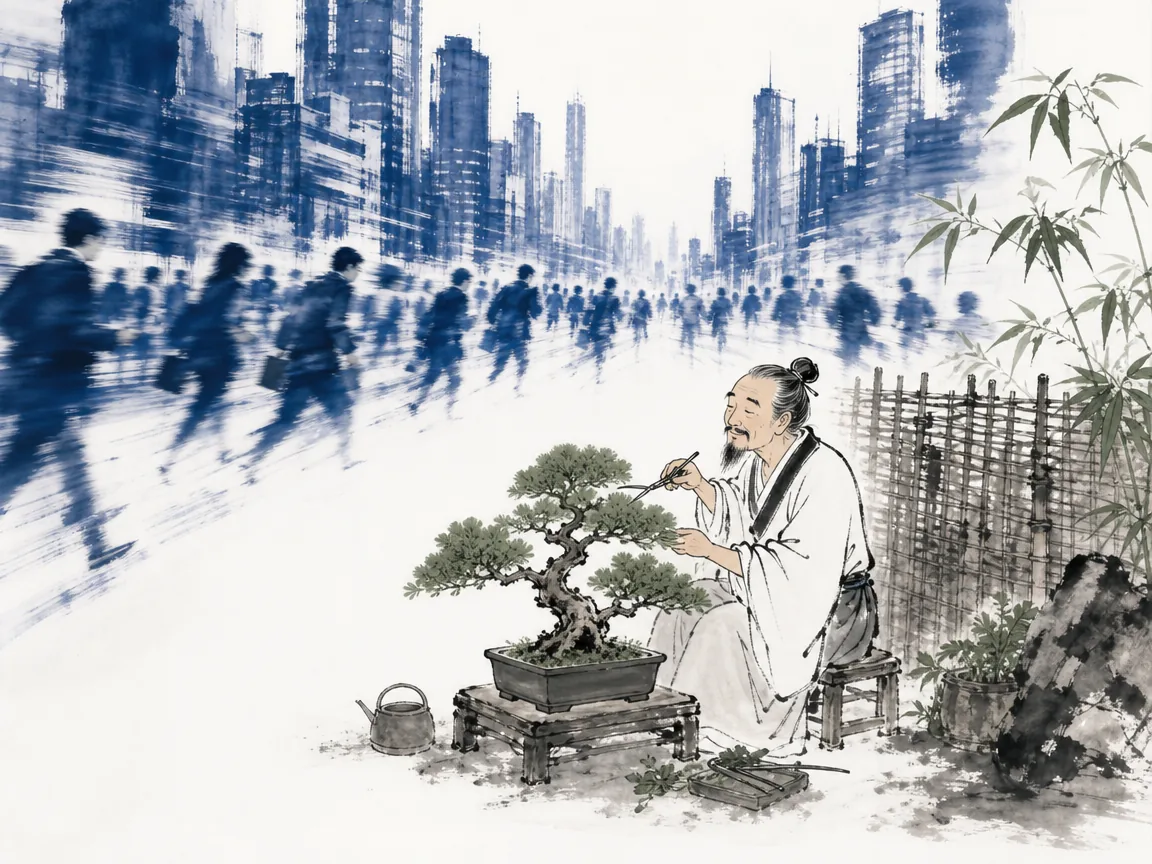
There is a sentence circulating widely online now: "Life is not a track; it is a wilderness." It sounds liberating. And yet the very people repeating it have carved out a new kind of track — a trend to perform freedom in exactly the expected way. Those who leave corporate jobs to become content creators often find themselves trapped by the same metrics they fled. Travel culture, too, has turned into something more checklist-driven than liberating: long queues for the perfect photograph, chasing the spots everyone else has already decided are essential. The pursuit of freedom becomes, paradoxically, another form of obligation.
This is not a new problem. It is simply dressed in new language. What ancient Chinese thinkers faced — and solved — was the same tension: how to live meaningfully when your body, your circumstances, and the expectations of the world will not bend to your will. They did not argue that you should escape. They argued that escape was the wrong question—a foundational perspective explored in Chinese Philosophy on Life Paths.
The answer they arrived at, expressed in the concept of woyou (卧游), is both radical and deeply practical. It suggests that the wilderness was never outside, waiting to be reached. It was always within, waiting to be opened.
Chinese Philosophy on Life Paths: Running Into a New Kind of Track
The phrase "life is a wilderness" promises liberation from predetermined paths — career ladders, social expectations, the linear model of success. But when a single idea becomes a slogan repeated everywhere, it ceases to function as freedom and starts functioning as another rule to follow.
Consider the contemporary travel industry. Weekend "city walks" have become popular among people who lack time for distant journeys. That is reasonable. But when the city walk itself turns into a performance — when people queue for forty minutes to sit on a specific bench so they can capture the same photograph everyone else has posted — something has gone wrong. The outward gesture of freedom has become inward conformity.
The same pattern appears in career culture. A growing number of people leave demanding jobs to pursue entrepreneurial or creative paths, only to recreate the very pressures they left behind. The platform changes; the track does not.
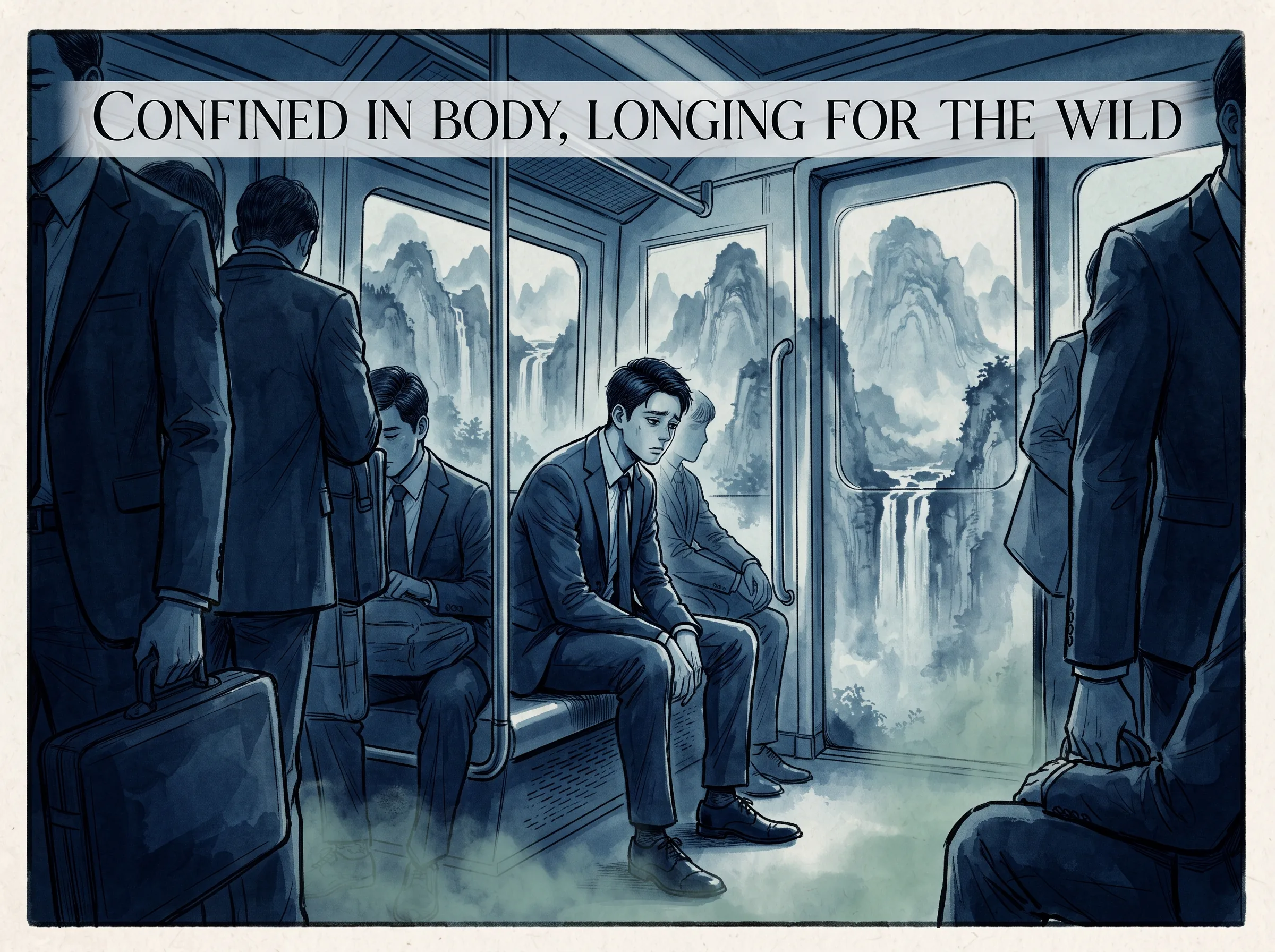
Ancient Chinese wisdom would likely identify this not as a modern problem but as a timeless one. The question is not whether you are on a track. The question is whether you recognize the track — and whether you have learned to move through it with an open mind.
The Ancient Problem: When the World Is Smaller Than Yours
Most people in ancient China could not travel freely. They were bound by duty, poverty, age, family obligation, and the realities of a pre-modern world. The Confucian tradition spoke directly to this constraint: children were expected to remain close to their aging parents, and lengthy travel was discouraged. For the majority of the population, the idea of roaming distant mountains was not a lifestyle choice — it was simply impossible.
Yet these people did not simply accept suffering passively, nor did they resign themselves to a life with no inner dimension beyond their physical circumstances. They developed practices for cultivating spaciousness within constraint.
One of the most striking examples comes from the Southern Dynasties painter Zong Bing (宗炳). He was a man who loved travel and spent years visiting famous mountains and rivers across China. But in his later years, illness confined him to his home. He could no longer go outdoors to experience the landscapes he cherished. Most people in that situation would simply stop pursuing what brought them joy. Zong Bing did something different.
According to the Book of Song (Songshu), he painted the landscapes he had visited on the walls of his room and sat before them, playing the qin (zither), letting his spirit wander through the painted mountains. He is recorded as saying:
"Aging and illness have both arrived. I fear I can no longer see all the famous mountains. Let me cleanse my mind and contemplate the Dao, and travel while lying down." [1]
He also wrote:
"I have painted all the places I have visited upon the walls of my room. I say to people: 'When I play the qin and move my hands across the strings, I wish for all the mountains to echo.'" [1]
This was not resignation. It was creativity turned inward. Zong Bing took a limitation — his body could no longer travel — and transformed it into an opportunity for a deeper kind of travel, one that did not depend on geography at all.
Woyou: Travel Without Moving
The word woyou (卧游) literally means "travel while lying down." But it refers to something much larger than a physical posture. It is the practice of using art, imagination, and inner stillness to transcend physical and social constraints — to experience the world not through distance covered but through depth of perception. Cultivate quiet mindfulness in everyday living through the meditative tea ritual in Stop Solving. Just Drink Tea..
At the heart of woyou is the idea of chenghuai guandao (澄怀观道) — clearing the mind to perceive the underlying Way of things. This phrase, also recorded in the Book of Song in connection with Zong Bing, suggests that true seeing requires a mind freed from clutter: practical concerns, social performance, the constant noise of wanting more [1]. When the mind is still, even a small thing can reveal the whole.
The philosopher Xu Fuguan, in his influential work The Chinese Spirit of Art, elaborated on this idea, explaining that chenghuai guandao involves viewing the world with a calm, empty, and receptive mind — one that is freed from utility and knowledge, and instead opens to a contemplative, aesthetic encounter with reality. In this state, the distinction between the real mountain and the painted mountain begins to dissolve. What matters is not the physical object but the quality of attention you bring to it.
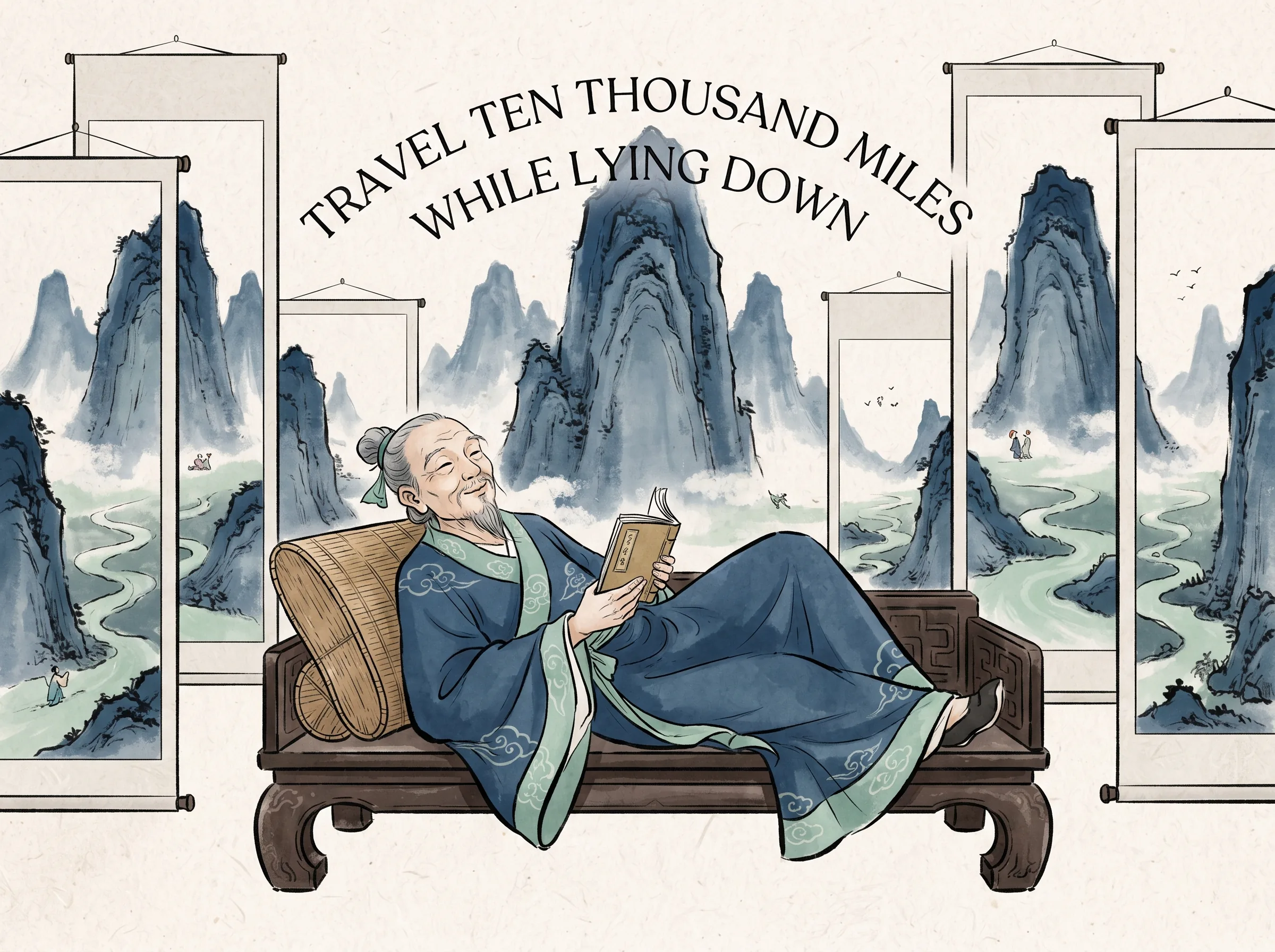
This stands in sharp contrast to much of modern tourism. Modern travel often measures success by distance — how many countries, how many landmarks, how many photographs. Woyou measures success by depth — how deeply you feel, how fully you attend, how much of yourself you bring into the encounter. You can visit a hundred famous places and feel nothing. Or you can sit in your room before a single painting and feel as though you have crossed mountains.
Two Artists Who Refused to Play by the Rules
The practice of woyou was not limited to Zong Bing. Several centuries later, two Ming Dynasty painters applied the same principle in ways that continue to feel remarkably relevant.
Dong Qichang and the Garden That Was a Painting
In Ming Dynasty Suzhou, the elite competed fiercely to build ever-larger gardens — elaborate estates filled with rockeries, ponds, and pavilions. It was a status game, and participation was expensive. Many who could not afford to compete simply stayed out. Others tried harder, pushed themselves further into debt, and lost themselves in the race.
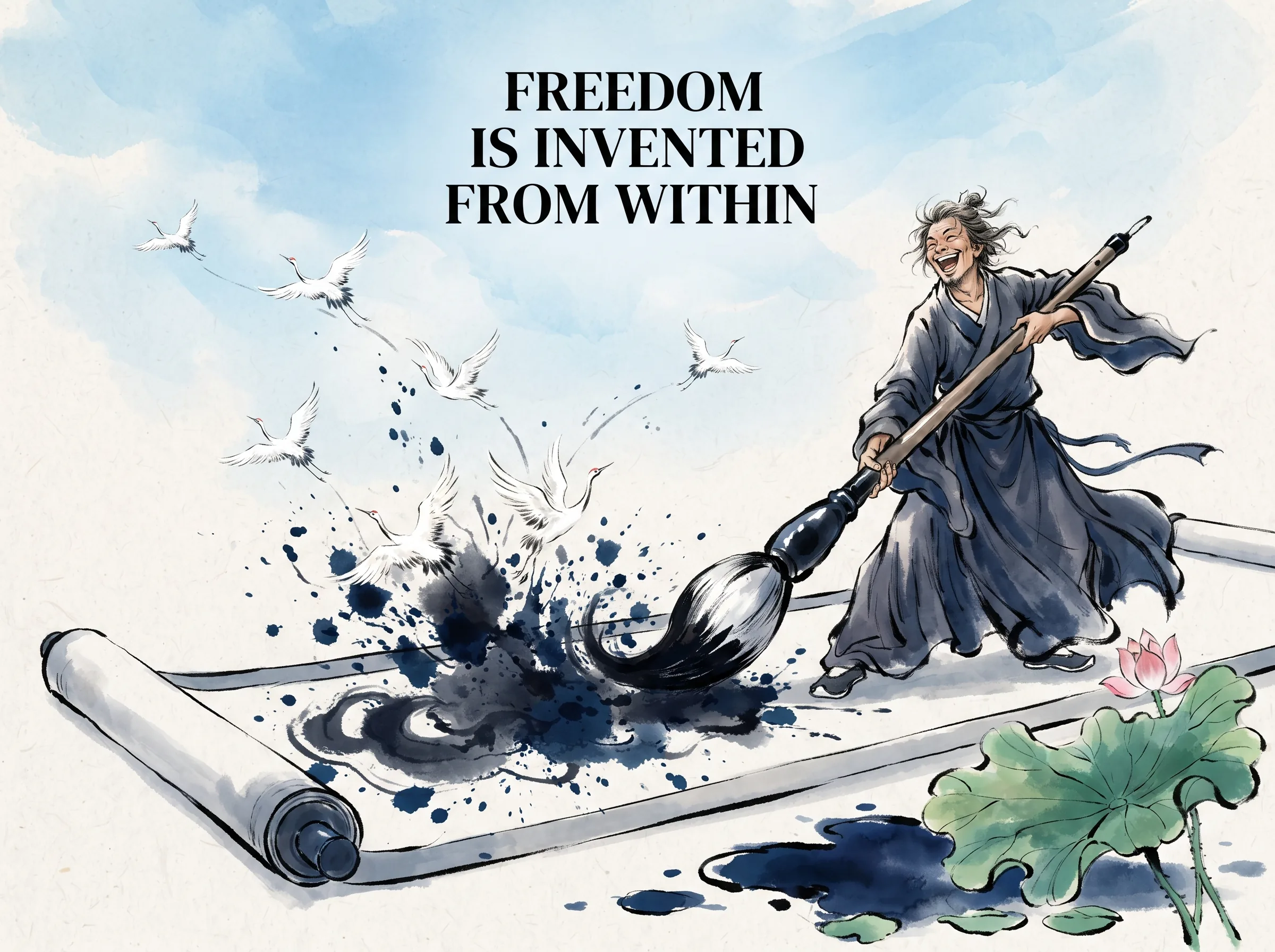
Dong Qichang (董其昌) chose a third path. According to a record known as the Tuzhai Ji (Record of the Rabbit Bush), he wrote that he could not build a garden himself, but he possessed copies of two celebrated landscape paintings — Wang Wei's Wangchuan and Lu Hong's Ten Marks of the Hermitage — which he could wander through in his mind. He reportedly said something along the lines of: "Others have gardens that enter paintings; I have paintings that are themselves gardens."
This was not merely a clever response to financial constraint. It was a genuine act of intellectual and aesthetic rebellion. Dong Qichang refused to play a game whose rules he did not accept. Rather than quitting in anger or pretending the game did not matter, he created a new dimension — one the original game could not touch. He demonstrated that spiritual richness does not require material wealth.
The Confucian and Daoist traditions both valued inner cultivation over external display, and Dong Qichang's approach aligns naturally with that lineage. He showed that a person can be free not by escaping their circumstances but by redefining what freedom means.
Shen Zhou and the Pomegranate
Shen Zhou (沈周), another great Ming Dynasty painter and one of the Four Masters of the Wu School, created a series of album-leaf paintings known as the Woyou Album, now held in the Palace Museum in Beijing [2]. What makes this series remarkable is not just that it exists, but what it contains.
Most people associate woyou with landscape paintings — rolling mountains, misty rivers, distant peaks. But Shen Zhou's album includes not only landscapes but also everyday subjects: a lute, chicks, cattle, vegetables, a split pomegranate. One of the most striking pieces is a painting of a pomegranate cut open, with the seeds exposed. On it, Shen Zhou inscribed a poem:
"Who has split open the pomegranate, so all may see its gems? / It is not that there is nothing to conceal — / all my life I have feared to hide." [2]
This is a radical departure from the expectation that spiritual travel requires grand scenery. A single flower, a single fruit, a single ordinary moment — these are sufficient, if the mind is prepared. The poem expresses something close to what later Buddhist thought called buzhuxiang (不著相), or "not being attached to form" — the insight that the ultimate truth is not confined to any particular appearance. The universe is accessible anywhere, to anyone willing to look closely.
Shen Zhou's pomegranate is also an expression of intellectual honesty. The traditional ideal for a gentleman was to conceal one's brilliance, to appear modest and unassuming. Shen Zhou's pomegranate says something different: a true gentleman's heart should be open, like the sky and the sun, hiding nothing. This is not arrogance. It is clarity.
What This Means for You Today
You will always have tracks. Obligations. Bills. Routines. Aging bodies. Family responsibilities. These are not problems to be solved by escaping to a wilderness — because the wilderness was never somewhere else.
The ancient Chinese practice of woyou offers a different approach. It does not ask you to change your circumstances. It asks you to change your relationship to them. Here are three practical takeaways drawn from this tradition.
Don't Follow the Crowd's Idea of Freedom
When a particular vision of freedom becomes popular — whether it is "life is a wilderness," a specific travel destination, or a career path celebrated by influencers — pause. Ask yourself: am I choosing this because it genuinely resonates with me, or because everyone else seems to be choosing it?
The mistake is not in following a trend. The mistake is in mistaking the trend for freedom. True freedom requires reflection, and reflection cannot be outsourced to algorithms or social media.
Don't Confuse the Surface with the Substance
Shen Zhou's pomegranate teaches this directly. The surface of the painting is a fruit. The substance is a statement about openness, honesty, and the courage to reveal what you carry inside.
In your own life, ask: what am I pursuing for the surface, and what am I pursuing for the substance? If a job, a relationship, or a lifestyle brings peace, it serves you. If it drains you while only looking impressive from the outside, consider whether it is worth maintaining. The surface is easy to perform. The substance is harder to cultivate but more durable.
Cultivate a Rich Inner Landscape
Woyou is not passive. It requires practice. Zong Bing did not simply lie down and wait for inspiration. He painted the mountains he had seen. He played the qin. He trained his mind to enter a state of chenghuai guandao — clarity and receptivity.
You can do something similar. It does not require a studio full of paintings. It requires regular attention to whatever opens your perception: a walk in nature, a piece of music, a conversation, a journal entry, a quiet moment without a screen. The goal is not to escape reality but to meet reality more fully. The more you practice this, the more you will notice that freedom is not a location you reach but a quality of attention you cultivate.
Frequently Asked Questions
Is woyou the same as daydreaming or escapism? No. Daydreaming is unstructured mental wandering. Escapism avoids reality. Woyou is a deliberate practice of cultivating a clear, calm mind so that reality — whether a painted mountain or a pomegranate on a plate — can be perceived more deeply. It engages with reality rather than fleeing from it.
Did ancient Chinese people actually use woyou to cope with physical limitations? The historical record suggests that yes, woyou was practiced by literati and artists who faced physical constraints such as illness, age, or financial limitation. Zong Bing's own writings, preserved in the Book of Song, describe him applying the practice after illness prevented further travel. Later artists like Shen Zhou and Dong Qichang continued and expanded the tradition. However, the specifics of how widespread woyou was among ordinary people remain unclear, as most surviving records come from educated elites.
Can woyou be practiced without any interest in art? Yes. While woyou originated in the context of Chinese painting and poetry, its core principle — cultivating inner spaciousness within external constraint — is not limited to art. Observing nature regularly, practicing mindfulness, reflecting in a journal, or simply learning to attend deeply to ordinary moments are all expressions of the same impulse. Art is one vehicle; the destination is the same.
Is woyou compatible with a busy modern life? Absolutely. Woyou does not require hours of meditation or a separate studio. It can be practiced in brief moments of attention — a few minutes of quiet observation, a walk taken without a destination, a meal eaten without distraction. The practice is defined not by duration but by quality of attention.
Conclusion
Every era has its constraints. Every generation discovers its own kind of prison. For Zong Bing, it was illness. For Shen Zhou, it was filial duty. For many people today, it is economic pressure, geographic limitation, or the invisible tracks of cultural expectation.
Ancient Chinese wisdom does not promise escape. It offers something more durable: the ability to be free within the constraint. As one contemporary reflection on this tradition puts it, we all live in tracks. Only the heart is the wilderness.
If you want to begin practicing woyou, start small. Choose one ordinary thing this week — a plant on your windowsill, the light at dusk, a cup of tea — and sit with it for five minutes without reaching for your phone. Notice what you see. Notice how it feels to attend without a goal. That attention, cultivated repeatedly, is the wilderness you have been looking for, reflecting the enduring wisdom of Chinese Philosophy on Life Paths.
Examine this artistic principle further through the classical aesthetic philosophy of Why Empty Space Feels Most Expensive: The Chinese Art of Leaving Room.
Sources & Further Reading
[1] Primary sources used in this article:
[2] Songshu (宋书), Volume 93 — Biography of Zong Bing, containing the classical passages on "clearing the mind to contemplate the Way, reclining to wander through them" (chéng huái guān dào, wò yǐ yóu zhī, 澄怀观道,卧以游之) and "playing the zither, wishing to make all mountains resound" (fǔ qín dòng cāo, yù lìng zhòng shān jiē xiǎng, 抚琴动操,欲令众山皆响)
[3] Shen Zhou, Album of Reclining Wanderings (石田卧游册) Pomegranate Leaf — Palace Museum, Beijing, containing the classical poem inscription
[4] For further reading:
[5] Xu Fuguan, The Chinese Spirit of Art (徐复观《中国艺术精神》) — A foundational study of the philosophical roots of Chinese aesthetics, including extensive discussion of Zong Bing's concept of chenghuai guandao
[6] Dong Qichang, Record of the Rabbit Brush Retreat (董其昌《兔柴记》) — Contains Dong's reflections on gardens and paintings, though exact original phrasing requires scholarly verification
[7] Shen Zhou's Album of Reclining Wanderings (石田卧游册) – Palace Museum, Beijing — The complete album-leaf series by Shen Zhou, demonstrating that woyou extends beyond landscape to everyday subjects






