
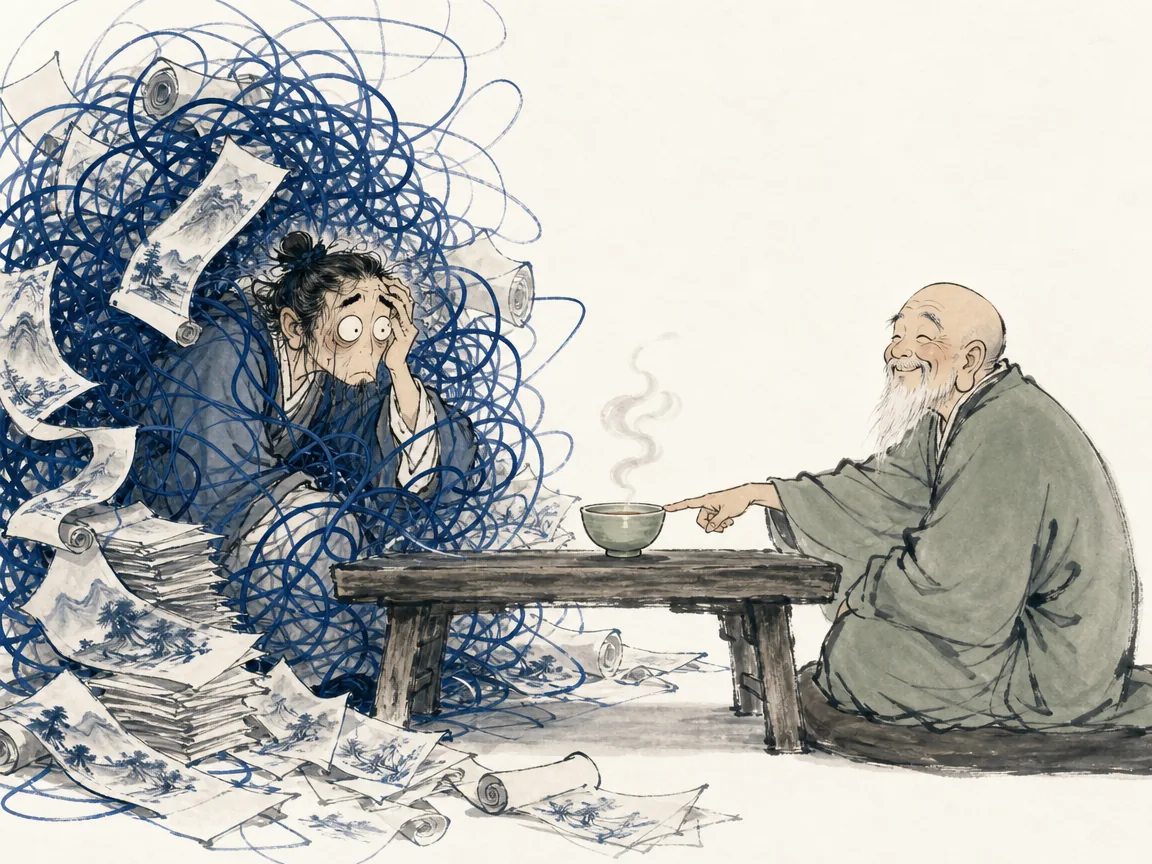
You have been told, again and again, to fix everything. Your anxiety needs a strategy. Your to-do list needs optimization. The state of the world needs your attention, your plans, your relentless problem-solving. But what if the wiser move is far simpler than any of that — and has been for over a thousand years?
An eighth-century Chan master named Zhaozhou had a habit that confused everyone who met him. Visitors would arrive with their questions, their credentials, their life stories. Some had been to the temple before. Some had never been. To all of them, without exception, Zhaozhou said the same three words: drink tea. The temple manager, puzzled, asked why the master gave the same answer to everyone. Zhaozhou called the manager's name, the manager responded, and Zhaozhou said, drink tea [1]—a foundational perspective explored in Stop Solving Just Drink Tea.
It sounds like evasion. It is not. The story, preserved in classical Chan records, points to something we have largely forgotten: that the deepest response to modern overwhelm is not more solving, but returning to what is already in front of us [1].
Stop Solving Just Drink Tea: The Story Behind "Drink Tea"
Zhaozhou Congshen, who lived from 778 to 897 CE during the Tang dynasty, is one of the most quoted figures in Chan Buddhist literature [2]. His recorded sayings appear in collections such as the Recorded Sayings of Master Zhaozhou (Zhaozhou Heshang Yulu, 《赵州和尚语录》) [1]. Among his most famous instructions is “Go drink tea” (chi cha qu, 吃茶去), a phrase he repeatedly directed at monks, lay visitors, and even his own temple staff [1].
The full encounter, as preserved in the textual record, goes like this. Zhaozhou asks a newly arrived monk whether he has been to the temple before. The monk says no. Zhaozhou says, "Drink tea." He asks another monk the same question. This one says yes. Zhaozhou says, "Drink tea." Then the temple manager steps in and asks, "Master, you tell the one who has never been here to drink tea — fine. But why tell the one who has already been here to drink tea as well?" Zhaozhou calls out, "Manager!" The manager answers immediately. Zhaozhou says, "Drink tea" [1].
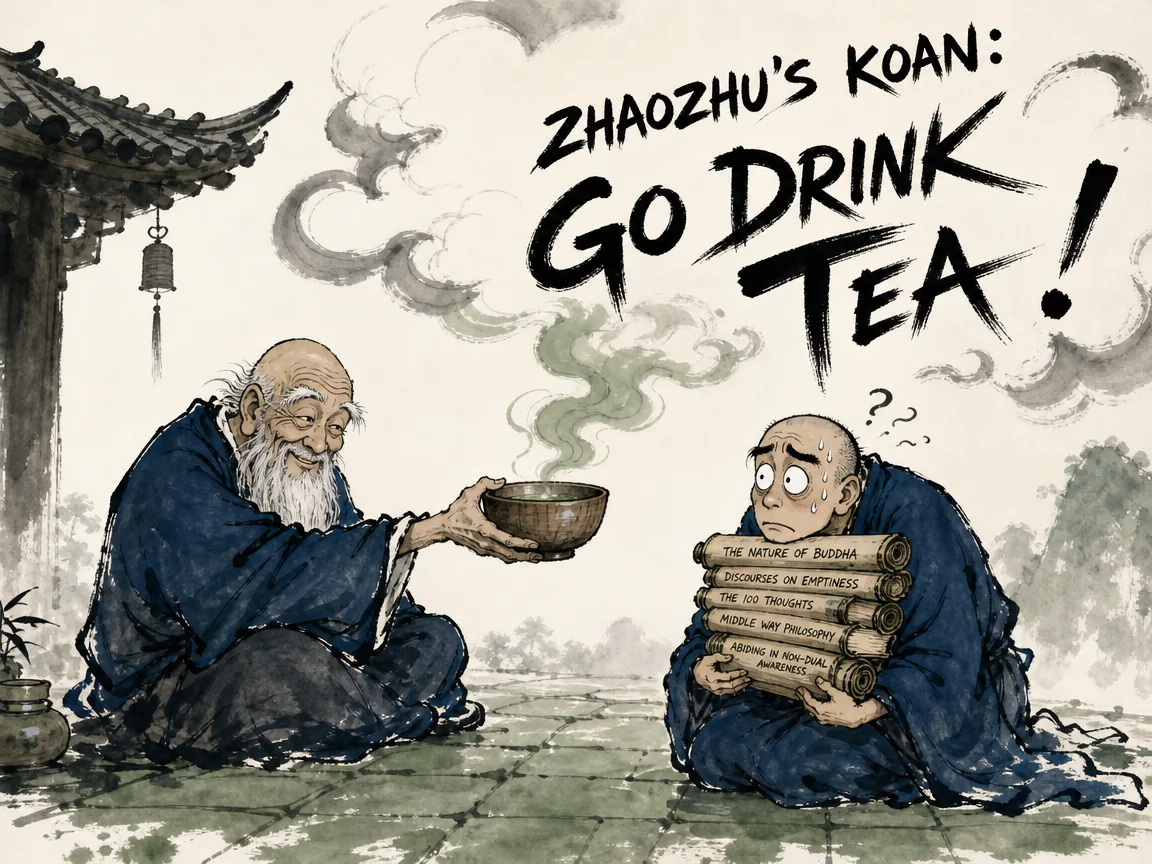
There is no lecture. No philosophical treatise. Just three words, repeated.
The simplicity is deliberate. Zhaozhou is not offering a generic platitude. He is pointing at something that most of us spend our lives running from — the immediate, ordinary moment — and asking us to notice it before we turn it into a problem to be solved.
Breaking the Trap of Category Thinking
One reason Zhaozhou's answer is so unsettling is that it refuses to play along with our habit of categorizing everything. We naturally sort life into pairs: success and failure, past and future, self and other, problem and solution. We ask ourselves, "Was this person here before or not?" and then we expect different answers to follow. The expectation itself is the trap.
In Buddhist psychology, this habitual splitting is sometimes described as the “discriminating mind” (fenbie xin, 分别心): the mental habit of carving experience into competing categories [1]. The Chan tradition does not argue that discrimination is evil. It suggests that when discrimination becomes automatic and exhaustive, it exhausts us. We spend more energy classifying and comparing than actually living.
A parallel insight appears in the Zhuangzi, one of the foundational texts of Chinese philosophy. In the Qijiulao chapter (Discussion on Making All Things Equal), Zhuangzi writes, "Heaven and earth were born together with me, and the hundred things are one with me" [3] [5]. The point is not a metaphysical claim about literal identity. It is an invitation to notice that the boundaries we draw between things — mine and yours, important and trivial, now and later — are often mental constructions rather than features of reality itself. When Zhaozhou gives the same answer to the visitor who has been there and the one who has not, he is enacting, in real time, something Zhuangzi described in words: the rigid divisions we insist on may dissolve when we simply attend to what is happening.
Modern life amplifies this problem. Social media, productivity culture, and the constant stream of comparison feeds train us to sort every experience into rankings and verdicts. Zhaozhou would likely say something very close to "drink tea" — not as dismissal, but as a reminder that the sorting machine in our heads does not need to run every second.
The Ordinary Is the Path
Chan Buddhism has long held that awakening is not reserved for mountaintop retreats or grand spiritual breakthroughs. It is found in walking, eating, sweeping, and drinking tea. This is sometimes expressed through the teaching that the ordinary mind itself is the Way — a principle often associated with the later Chan master Mazu Daoyi in classical sources [5].
Zhaozhou's instruction illustrates this plainly. He does not give a discourse on emptiness. He does not ask the visitor to study sutras. He sends them to do something simple and concrete: make tea, sit, drink it. The point is not that tea is mystical. The point is that the act itself, done fully, is where practice lives. Examine this artistic principle further through the classical aesthetic philosophy of When Everything Is Stripped Away: What Chinese Aesthetics Teaches Us About Inner Structure.
This runs counter to a deeply ingrained modern habit: the belief that meaning will arrive later, once conditions are perfect. We tell ourselves, "When I lose weight, I will be happy." "When I get promoted, I will feel secure." "When things calm down, I will finally relax." But conditions rarely settle. The teaching suggests that waiting for ideal circumstances is itself a form of avoidance — a way of keeping life at arm's length.
Zhaozhou's response cuts through that pattern. The tea is here. The cup is here. The moment is already available. There is nothing to complete before you are allowed to be where you are.
The Present Moment Is Already Enough
The third layer of the koan is perhaps the simplest and the hardest. "Drink tea" is something you can do right now. It requires no prerequisites. It asks nothing of your past or your future. These few minutes of attention are not a break from life — they are life itself, happening in real time.
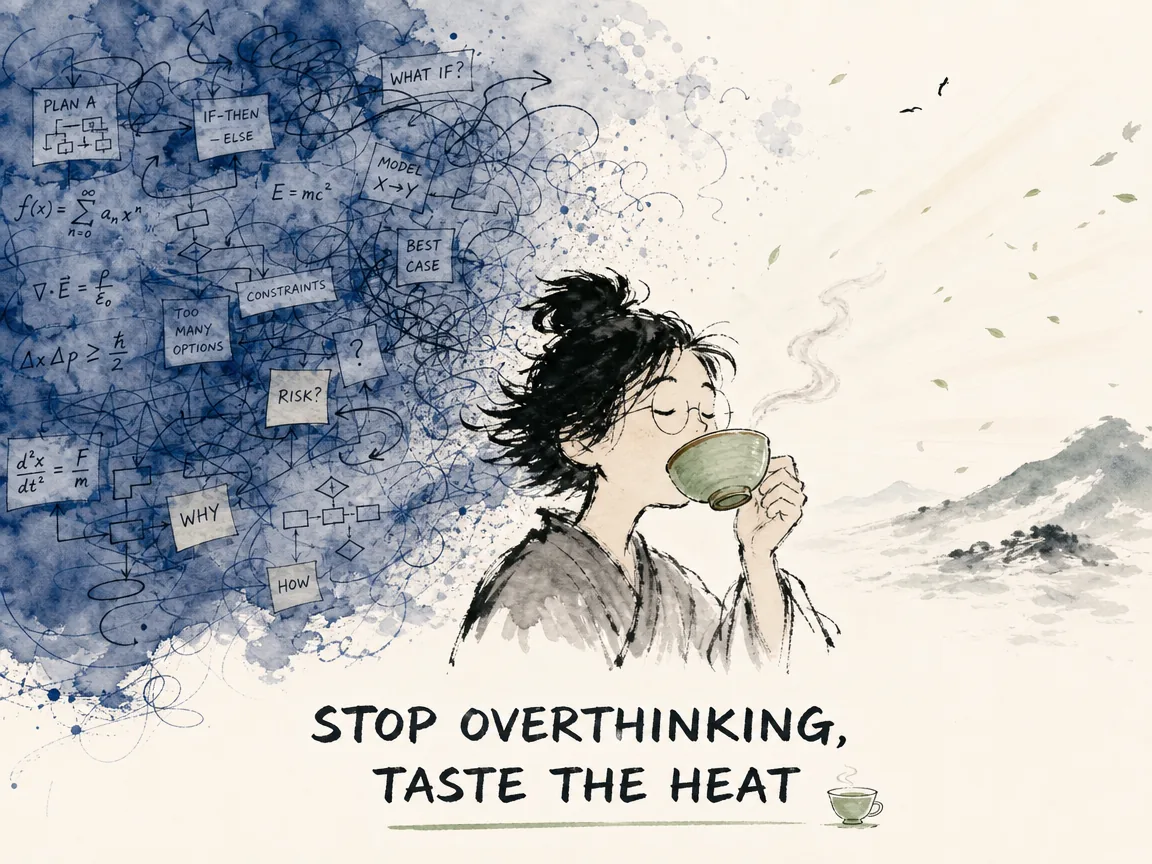
This is what some traditions express as “this very moment is it” (dangxia jishi, 当下即是): the present moment is already sufficient. It does not mean that problems do not exist. It means that the mind's tendency to project every problem into an endless chain of "what ifs" is not the same as actually meeting the problem. Often, the suffering comes not from the situation but from the mental spiral around it.
Modern psychology offers a nearby observation. Mindfulness practices, which involve maintaining attention on the present moment without judgment, have been studied for their effects on anxiety and depression [4]. Research summarized by institutions such as the U.S. National Center for Complementary and Integrative Health notes that mindfulness may be more effective than usual treatments in reducing symptoms of anxiety and depression, though the evidence also carries important caveats — risk of bias in many studies, limited long-term follow-up data, and the fact that not all mindfulness approaches performed equally [4]. The takeaway is cautious rather than celebratory: paying attention to the present moment may help, but it is not a magic eraser, and the research is still evolving.
What Zhaozhou's story adds to this discussion is not a clinical protocol but a lens. The point is not to use tea as a coping technique. The point is to notice that the mind's habit of leaping ahead — planning, worrying, analyzing — often creates more distress than the present situation demands. Returning to the cup is a way of testing that hypothesis for yourself.
Three Ways to Apply This Today
The koan is not meant to be read and filed away. It is meant to be tried. Here are three ways to bring its spirit into daily life.
For anxiety. When your mind races ahead to tomorrow's obligations, pause and attend fully to one simple act. Make tea. Feel the warmth of the cup. Watch the water pour. Listen to the sound. You do not need to clear your mind. You need only to direct it — briefly, gently — toward what your senses can register right now.
For procrastination. Do not wait until you feel ready. Start with one small, immediate action. Write the first sentence. Open the document. Fill the kettle. The story is not that the tea must be perfect. It is that it must happen. Motion often precedes motivation, not the other way around.
For overwhelm. When global events or chronic stress make everything feel unmanageable, return to what is within your hands. This is not escape. It is grounding. You are not ignoring reality; you are refusing to let your nervous system be consumed by a mental simulation of every possible outcome. The tea will not solve the world. But it may restore enough presence for you to act from clarity rather than panic.
What This Teaching Is Not
It is worth saying clearly what Zhaozhou's "drink tea" is not.
It is not toxic positivity. The koan does not say that problems do not exist or that you should smile through hardship. It says that mental spiraling — the endless rehearsing of scenarios in your head — is not the same as addressing what is in front of you. Sometimes the wisest response to a problem is action. Sometimes the wisest response is noticing that the problem you are obsessing over lives mostly in your imagination.
It is not passive resignation. Zhaozhou was not advocating for doing nothing. He was redirecting effort toward what is actually available. The temple manager did not receive an answer to his philosophical question. He received an invitation to participate in the ordinary moment. That is not avoidance. It is a different kind of engagement.
It is not a guarantee. Drinking tea will not cure clinical anxiety, resolve structural injustice, or replace professional help when it is needed. The koan is a pointer, not a prescription. Its value lies in what it reveals about how the mind works — and in the quiet space it creates between stimulus and reaction.
FAQ
Is "drink tea" literally about drinking tea? Not primarily. The tea is a concrete anchor — something you can do with your full attention right now. The instruction points to a broader principle: meeting the present moment directly, without getting lost in categories, comparisons, or fantasies about what should happen next.
Does this mean I should stop trying to solve my problems? No. The teaching distinguishes between genuine action and mental rumination. When a real problem requires a decision, you decide. When the mind is spinning in circles about things you cannot control, the invitation is to step back to what is actually in front of you.
Is this a Buddhist practice or just a life hack? It comes from the Chan Buddhist tradition, rooted in texts and lineages that stretch back over a thousand years. But the underlying observation — that excessive categorization and future-tripping cause suffering — is something many traditions and disciplines recognize, including aspects of modern psychology.
Can I apply this if I am not religious or spiritual? Yes. The koan does not require belief. It invites attention. Whether you approach it as a spiritual practice, a philosophical exercise, or a simple way to pause the mental noise, the core gesture is the same: come back to what is happening now.
Final Thoughts
The wisest people do not stop caring about their problems. They stop believing that every problem must be metabolized by the thinking mind before life can begin. Zhaozhou's "drink tea" is an invitation to trust that the present moment — however ordinary it seems — is already complete enough to meet.
You do not need to wait for clarity. You do not need to solve everything before you allow yourself to be here. Make the tea. Sit with it. Notice what happens when the mind stops chasing the next thing and simply attends to this one.
If this story resonated with you, consider exploring more about how classical Chinese thought meets everyday life. The next article will look at how the Zhuangzi handles the question of control — and what it might mean for anyone who has ever felt overwhelmed by trying to manage everything, reflecting the enduring wisdom of Stop Solving Just Drink Tea.
Examine this artistic principle further through the classical aesthetic philosophy of Contentment in a Culture of More: Ancient Chinese Wisdom for the Never-Enough Trap.
For a deeper comparative examination of these ideas, explore our related study on From Dust to Light: How Ancient Chinese Wisdom Teaches Us to See Beauty in Everyday Life.
Sources & Further Reading
[1] Recorded Sayings of Master Zhaozhou, Volume Two, Including Encounters, Examinations, Verses, and Hymns (《趙州和尚語錄》卷下,并對機勘弁偈頌等) — contains the full “drink tea” koan, including Zhaozhou's exchanges with two visitors and the temple manager.
[2] “Zhaozhou Congshen” (赵州从谂) — provides biographical information on the Chan master, including his dates (778–897 CE).
[3] Zhuangzi, “Discussion on Making All Things Equal” (《莊子·齊物論》) — contains the passage translated as “Heaven and earth were born together with me, and the ten thousand things are one with me” (天地与我并生,而万物与我为一).
[4] Meditation and Mindfulness: Effectiveness and Safety (NCCIH) — summarizes research on mindfulness, noting potential benefits for anxiety and depression while flagging limitations including risk of bias and insufficient long-term data.
[5] Zhuangzi (《莊子》) — lists the Inner Chapters and identifies “Discussion on Making All Things Equal” (Qiwu Lun, 齊物論) as one of the core texts.
Further Reading
- Recorded Sayings of Master Zhaozhou (《趙州和尚語錄》) — for readers interested in exploring Zhaozhou's sayings in their original context.
- Zhuangzi, “Discussion on Making All Things Equal” (《莊子·齊物論》) — for those wishing to read the full chapter on equality and the nature of distinction.
- Meditation and Mindfulness: Effectiveness and Safety (NCCIH) — for a evidence-based overview of what current research says about mindfulness practices.






