
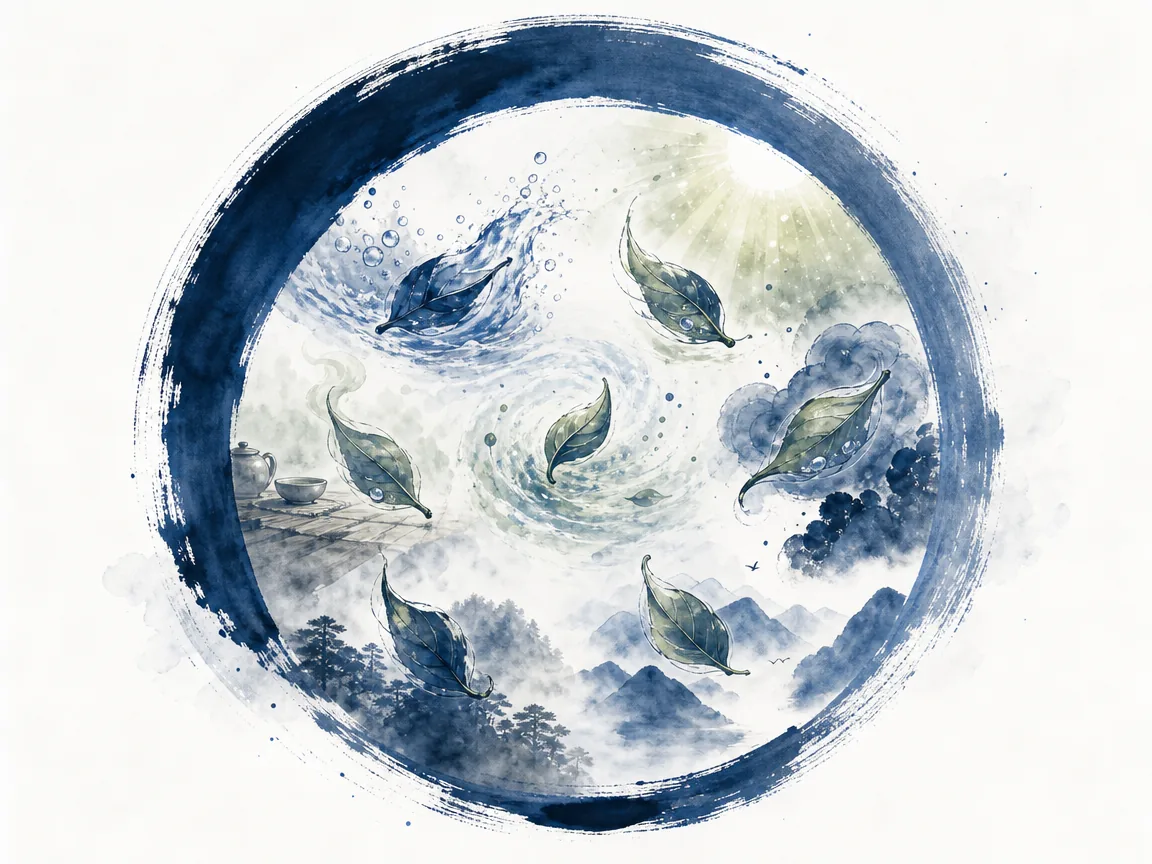
Six Tea Philosophies for Modern Life: The Leaf That Taught a Civilization How to Live
There is a famous confusion that reveals everything about Chinese tea culture. When a Westerner orders "black tea" in China, they receive what the Chinese call "red tea." When they ask for "white tea," they might receive a variety that is botanically green tea. The mismatch is not accidental. Chinese tea classification is not based on how a liquid looks in a cup but on what happens to the leaf after it is picked—on the chemistry of transformation, and on the attitude toward time that each process encodes.
This distinction matters because it points to something deeper. Chinese tea is not merely a beverage; it is a living laboratory of Eastern philosophy. Each of the six major tea types represents a distinct approach to time, change, and self-cultivation. The same leaf, treated differently, becomes six different expressions of wisdom about how to live.
In a world that moves faster every day, where burnout is worn as a badge of honor and patience is often mistaken for laziness, these tea traditions offer something radical: alternative models for being in the world. They suggest that how we handle time, change, and imperfection shapes not just the flavor of our tea but the texture of our lives.
Green Tea — The Discipline of Presence
Green tea is the urgency champion among the six teas. It is classified as a non-fermented tea, and its entire existence is a race against oxidation. Right after picking, the fresh leaves must be exposed to high heat—through pan-firing, steaming, or baking—to halt enzymatic activity and lock in the fleeting freshness of the moment. There is no waiting. No deliberation. The leaf is seized at its peak and preserved through decisive action.
This is the spirit that the tea master Lu Yu captured in the Classic of Tea (Cha Jing, 《茶经》), one of the most influential texts on tea in Chinese history: “Tea is cold in nature and, as a drink, is best suited to people of refined conduct and modest virtue” (“茶之为用,味至寒,为饮,最宜精行俭德之人”) [4]. The term jingxing (精行, “refined conduct”) suggests disciplined and attentive action. Lu Yu was not describing a casual habit but a discipline. The processor must work with complete attention; every movement is deliberate, every second counts. Miss the timing and the harvest is lost.
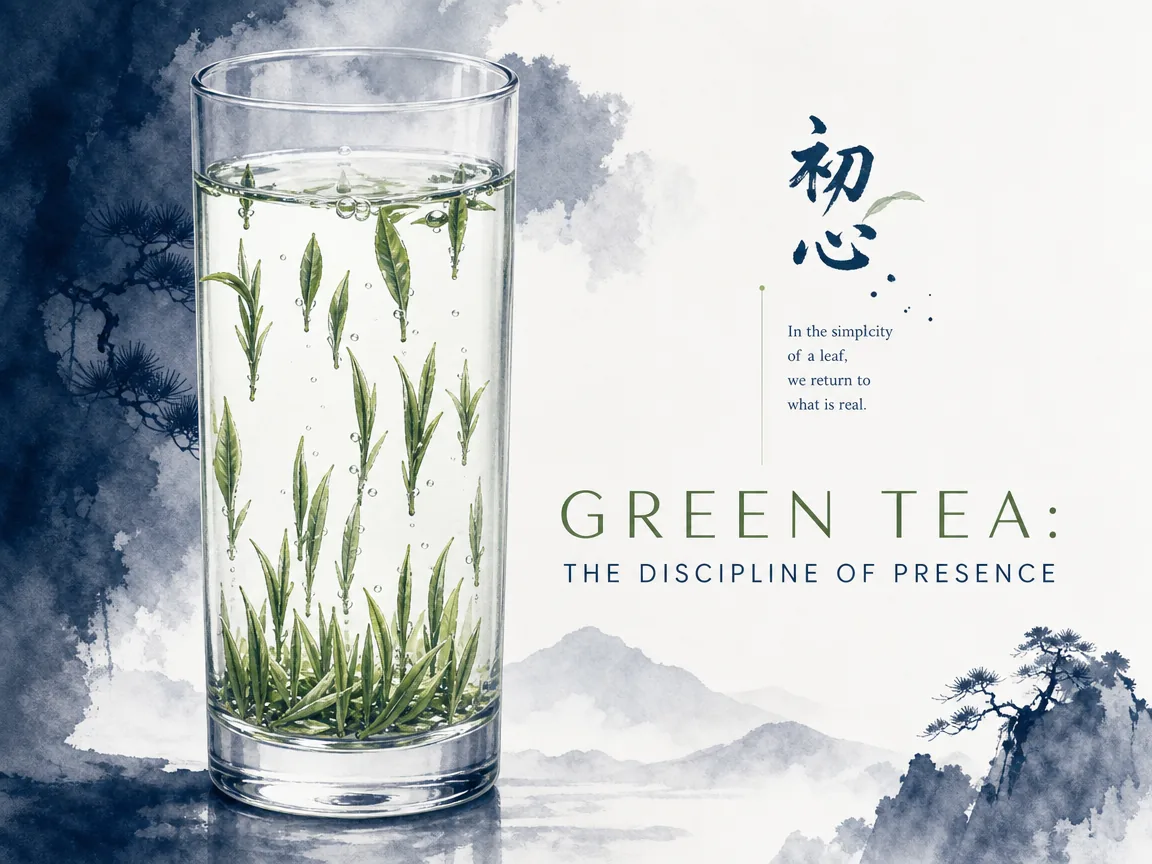
What does this teach us? In an age of distraction, green tea models a kind of spiritual urgency: seize the moment before it passes. Not through anxiety, but through full attention. The tea leaf does not negotiate with time; it meets it directly. Our modern lives are filled with moments of freshness — joy, inspiration, connection — that slip away the moment we look away. Green tea reminds us that presence is not passive. It is a skill that must be practiced with the same precision as a master rolling tea leaves in a hot wok.
Practice: The next time you feel overwhelmed by the pace of your days, try this. Choose one ordinary activity — a morning cup of tea, a short walk, washing a dish — and give it your complete, undivided attention for three minutes. Notice the details: the temperature, the texture, the sound. This is jingxing in miniature: focused action in the present moment, the green tea way.
White Tea — The Patience of Letting Go
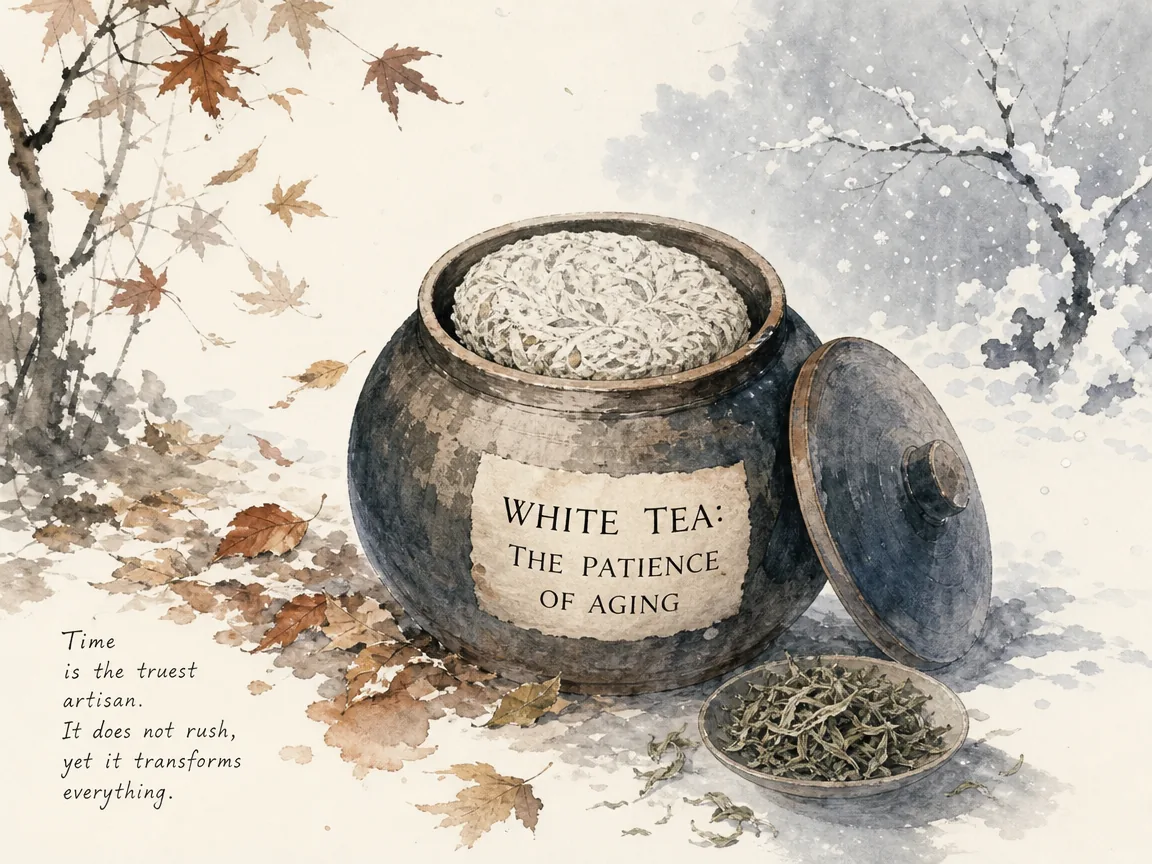
If green tea is urgency, white tea is its opposite. Made from the youngest, most tender buds, often covered in fine white hairs, white tea undergoes the gentlest processing of all the six types. There is no high-heat fixation. No rolling. No forceful intervention. The leaves are simply withered — spread out and left to dry slowly under sunlight and air. This natural wilting allows a small degree of oxidation to occur, but the processor's role is largely one of patience and restraint.
This reflects the Daoist-inspired philosophy of non-contention (bu zheng, 不争)—choosing not to force or compete with the natural course of things. White tea does not struggle against time; it trusts time. What happens during those hours of slow withering is mostly invisible. The leaves lose water, yes, but they also begin a quiet internal transformation. Compounds break down and recombine. What emerges is not the bright, aggressive freshness of green tea but something mellower, sweeter, more layered.
There is a beautiful episode from the Song dynasty that illustrates this spirit. The poet and calligrapher Huang Tingjian grew up near a village in Jiangxi known for its Double-Well tea (Shuangjing cha, 双井茶). When he sent some of this tea to his friend Su Shi—also known by his courtesy name Zizhan (子瞻), one of the greatest literary figures of the period—he included a poem that began: “In my Jiangnan home, we pluck cloud-soft tea; ground into drifting powder, it is finer than snow” (“我家江南摘云腴,落硙霏霏雪不如”) [2]. The friendship between these two men was one of the great intellectual bonds of Chinese literary history, and the tea exchange between them speaks to a certain elegance of understatement—offering the finest thing one has, without grand ceremony. Examine this artistic principle further through the classical aesthetic philosophy of How Ancient Chinese Naming Wisdom Shapes Modern Life.
Some traditions hold that white tea improves with age, expressed in the folk saying “One-year tea, three-year medicine, seven-year treasure” (“一年茶,三年药,七年宝”). While this saying appears in folk culture rather than in classical medical texts, the underlying observation remains worth considering: white tea rewards those who are willing to wait In a culture obsessed with immediacy, white tea whispers a different truth. Some things cannot be rushed. The best outcomes emerge not from force but from patient allowance.
Practice: Identify one area of your life where you are trying to force an outcome — a project, a relationship, a personal goal. For one week, practice the white tea approach: reduce your direct intervention. Create space and let natural processes unfold. You may find that what you were pushing against was actually holding back what you wanted.
Yellow Tea — The Wisdom of Quiet Transformation
Yellow tea sits in the shadow of its more famous cousins. It is the rarest of the six major types, and its defining technique—menhuang (闷黄), literally “sealed yellowing”—is known by only a handful of artisans today. After the initial fixation that stops oxidation, the leaves are wrapped in cloth or paper while still warm. Trapped in this humid, enclosed environment, they undergo a slow, hidden chemical transformation. Chlorophyll breaks down. The leaves turn yellow. The resulting liquor is golden, and the flavor is neither sharp nor astringent but round, mellow, and gently sweet.
This is the philosophy of the hermit in Chinese thought — the one who steps back from the noise not out of escapism but out of a conviction that true refinement happens in stillness. The menhuang process cannot be hurried. The temperature, the moisture, the duration — all must be judged by feel and experience. A master knows when the transformation is complete not by a timer but by the scent and texture of the leaves.
The most famous yellow teas, such as Junshan Yinzhen (“Silver Needles of Junshan,” 君山银针) from Hunan and Mengding Huangya (“Yellow Buds of Mengding,” 蒙顶黄芽) from Sichuan, exemplify this quality. Junshan Yinzhen, when brewed, stands upright in the cup like silver needles—a visual metaphor for the dignity that comes from inner cultivation rather than outward display. Mengding Huangya carries a characteristic warmth, sometimes described as having a gentle corn-like sweetness that comforts rather than startles.
The near-loss of the menhuang technique in our era is itself a parable. In a world that rewards speed and visibility, the willingness to undergo a slow, invisible process of maturation is almost radical. Yellow tea asks us: what are you willing to transform in the dark, where no one is watching?
Practice: Set aside thirty minutes each week for a "yellow tea period" — a block of time with no output goal. No posting, no producing, no performing. Simply read, reflect, rest, or walk. The point is not to fill this time with achievement but to allow the kind of quiet, internal transformation that only happens when we stop performing for an audience.
Oolong Tea — The Art of Balanced Tension
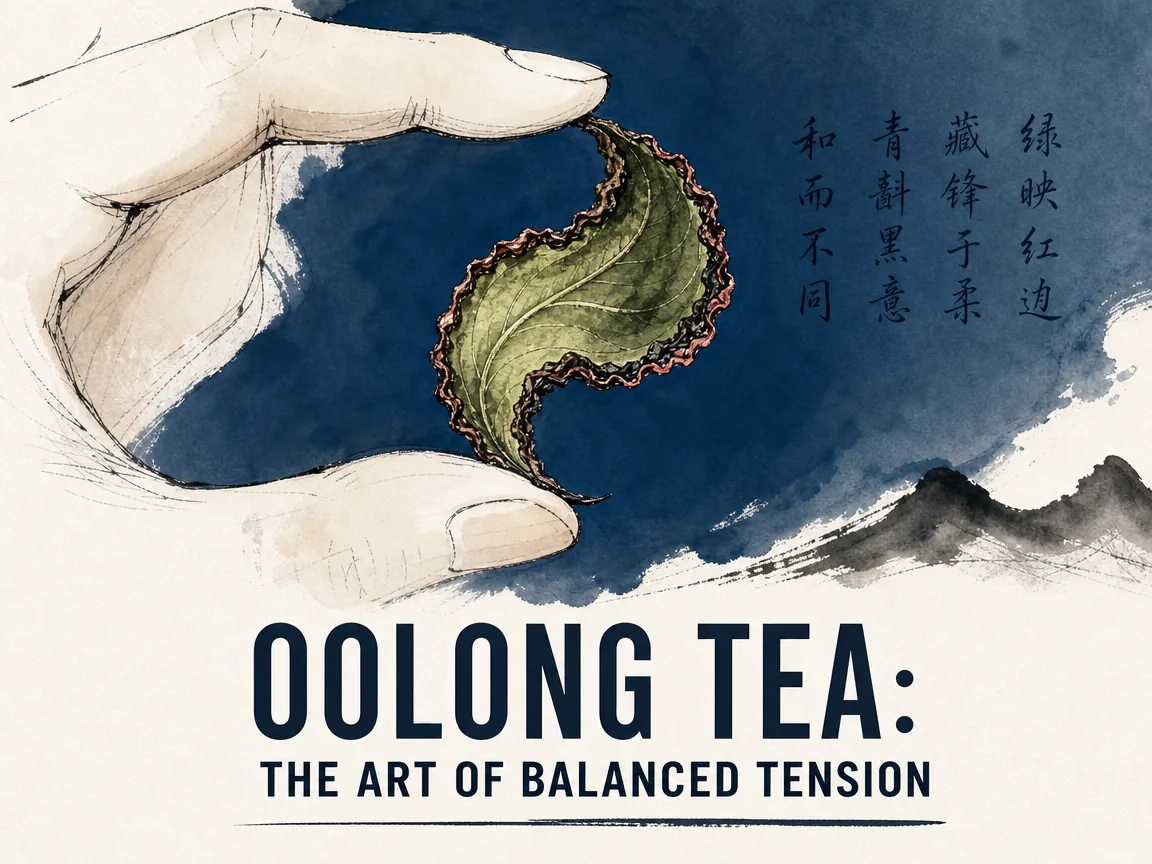
Oolong tea is where Chinese tea philosophy reaches one of its most sophisticated expressions. Classified as a semi-oxidized tea, oolong occupies the space between green and black—neither wholly fresh nor fully oxidized. Its complexity comes from a technique called yaoqing (摇青), or “shaking the leaves,” in which the leaves are repeatedly tossed and rotated on bamboo trays. This causes the edges of each leaf to bruise and rub against one another, initiating oxidation at the margins while the center remains comparatively unoxidized. The result is the celebrated “green leaf with a red rim” (lü ye hong xiang bian, 绿叶红镶边)—a visual signature of a leaf that has been both wounded and preserved.
This is the philosophy of dynamic balance. The bruised edges do not ruin the leaf; they become the source of its distinctive character. In Chinese thought, this echoes the concept of the Doctrine of the Mean (Zhongyong, 中庸)—not a passive compromise between opposites but an active, skillful navigation of tension. The oolong processor does not avoid the bruising; they orchestrate it. Too little shaking and the tea is flat. Too much and it loses its freshness. The art lies in finding the precise point where contradiction becomes complexity.
The Tang dynasty poet Lu Tong captured the experience of drinking such a deeply layered tea in his famous "Song of Seven Bowls," part of a letter thanking a friend for a gift of new tea:
One bowl moistens my lips and throat. Two bowls dispel my loneliness. Three bowls search my parched innards, finding only five thousand scrolls of words. Four bowls bring a light sweat, and all life’s injustices scatter through my pores. Five bowls cleanse flesh and bone. Six bowls open a path to the immortal spirit. A seventh bowl I cannot drink—I only feel a gentle breeze rising beneath my arms.
(一碗喉吻润,二碗破孤闷。三碗搜枯肠,惟有文字五千卷。四碗发轻汗,平生不平事,尽向毛孔散。五碗肌骨清,六碗通仙灵。七碗吃不得也,唯觉两腋习习清风生。)
—Lu Tong, “The Song of Seven Bowls” (卢仝《七碗茶》) [3]
Lu Tong's progression — from physical relief to spiritual transcendence — is not meant to be taken as a literal recipe but as a map of how deeply a well-made tea can move through us. Each bowl represents a layer of sensation and awareness peeling away, until the drinker experiences what might be called a moment of clarity or lightness that transcends the ordinary.
Oolong teaches us that friction, setback, and even pain are not obstacles to a good life but the very conditions that produce depth. The "red edges" are not flaws to hide but marks of having lived, of having been moved by the world. A life without any bruising is a life without complexity.
Practice: Reflect on a recent difficulty or setback in your life. Instead of asking how to avoid or erase it, try asking: what unique quality did this experience add to me? Where did it create depth, empathy, or insight that I would not otherwise have? Write down three specific ways that a past struggle has shaped who you are today. This is the oolong method: letting friction become flavor.
Drinking Philosophy
The six teas of China — green, white, yellow, oolong, black, and dark — form a complete curriculum for living. Each one offers a different relationship to time, transformation, and the self. Green tea teaches presence. White tea teaches patience. Yellow tea teaches the value of quiet, invisible work. Oolong teaches that tension and even wound can be sources of beauty. Black and dark teas, with their deeper fermentation and aging, complete the spectrum with lessons about warmth, generosity, and the long view.
You do not need to choose one philosophy and stick to it. Different seasons of life call for different teas — and different approaches. Sometimes you need the green tea urgency of a deadline met with full attention. Sometimes you need the white tea patience of trusting a process you cannot control. Sometimes you need the oolong wisdom of finding balance precisely where things feel most tense.
The next time you sit down with a cup of tea, consider what kind of tea your current moment is asking you to be. The leaf has already figured out how to live differently through the same material. The question is whether you will listen.
FAQ
Q: Are there really six types of Chinese tea, and how are they classified? Chinese tea is traditionally classified into six major categories based on the degree and method of oxidation and the processing techniques used: green tea, white tea, yellow tea, oolong tea, black tea, and dark tea. The classification reflects not just taste but the philosophical approach embedded in each method of transformation.
Q: What does "fermentation" mean in tea processing? In tea terminology, "fermentation" usually refers to oxidation — the enzymatic reaction that occurs when tea leaves are exposed to oxygen after being picked and processed. Green tea is prevented from oxidizing through heat treatment, while oolong tea undergoes partial oxidation, and black tea is fully oxidized. True microbial fermentation occurs in dark teas like pu-erh, where microorganisms actively transform the leaves over time.
Q: Can I practice these tea philosophies without becoming a tea expert? Yes. The point of these teachings is not to master tea craft but to learn from the logic embedded in it. Any type of tea you enjoy can serve as a reminder of these principles. The discipline of presence, the patience of waiting, the comfort of quiet transformation, and the appreciation of balanced tension are accessible through any cup you choose to drink mindfully.
Q: Is Chinese tea philosophy connected to any specific religion? Chinese tea culture has been influenced by multiple traditions, including Daoism, Confucianism, and Buddhism, but it is not exclusive to any one of them. The practices and philosophies discussed here are part of a broader Chinese cultural heritage that many people engage with as a form of aesthetic and reflective practice, regardless of religious affiliation, reflecting the enduring wisdom of Six Tea Philosophies for Modern Life.
Examine this artistic principle further through the classical aesthetic philosophy of Beyond the Surface: The Chinese Art of Cultivating Invisible Presence.
For a deeper comparative examination of these ideas, explore our related study on Why Your City Feels Noisy — And What Ancient Chinese Wisdom Can Teach Us About Better Design.
Sources & Further Reading
[1] Lu Yu’s Classic of Tea, Chapter 1: “Origins” (《茶经·一之源》) — Original Chinese text
[2] Huang Tingjian, “Sending Double-Well Tea to Zizhan” (黄庭坚《双井茶送子瞻》) — Original Chinese poem and commentary
[3] Lu Tong, “The Song of Seven Bowls” (卢仝《七碗茶》) — Original Chinese poem, translation, and commentary
[4] Lu Yu’s Classic of Tea (陆羽《茶经》) — The foundational text on Chinese tea culture and philosophy
[5] Discussion of Chinese tea philosophy and the six tea types (Bilibili)






