
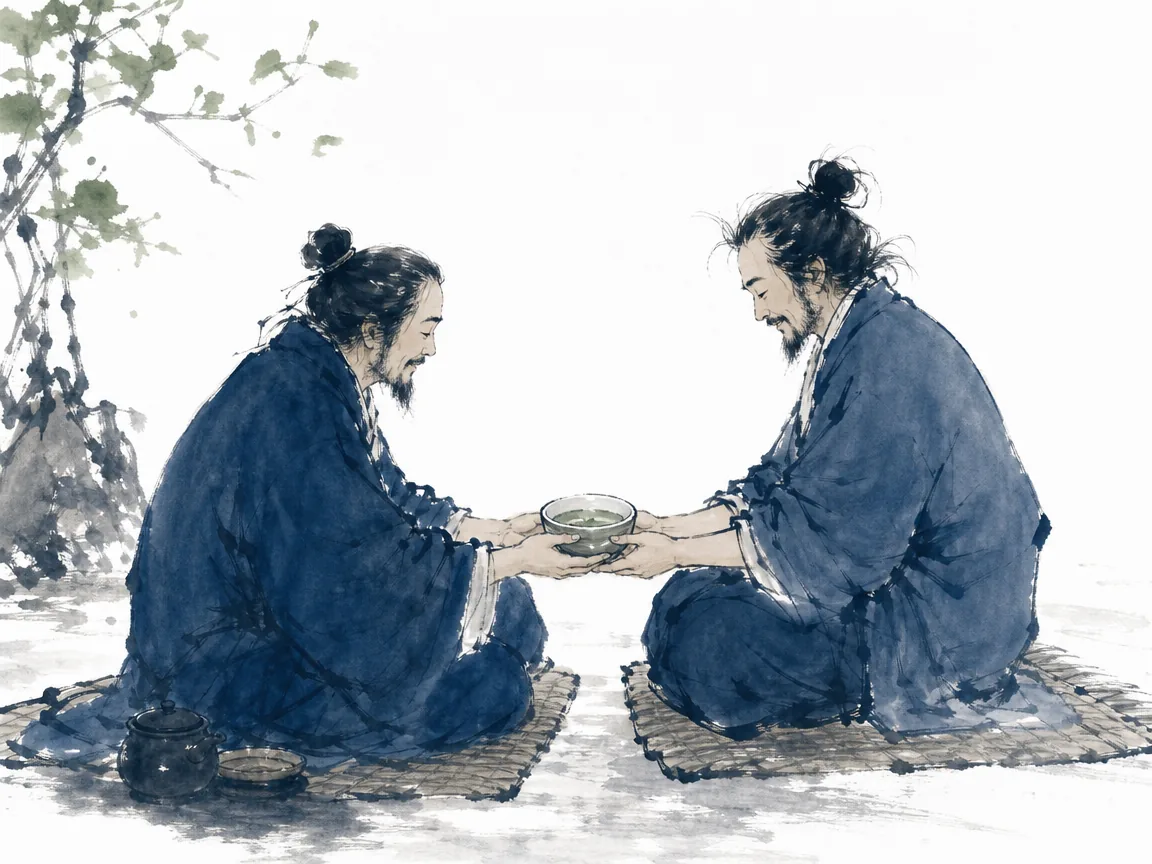
The "first cup of milk tea in autumn" has become a viral tradition on social media. Every year, millions of people post about receiving this drink from friends or partners, treating it as a signal that the season has arrived. It feels warm, connected, celebratory — and yet something about it also feels hollow. Not because milk tea is meaningless, but because when a ritual becomes standardized, when everyone performs the same gesture in the same way, it loses its power to make a moment feel different. We are left asking: if buying the same thing as everyone else doesn't create meaning, what does?
This question is not new. Long before internet trends and branded gift-giving, Chinese tradition understood something essential about ritual. The ancients did not treat ceremony as a purchase. They treated it as an act of creation. Where modern culture often equates ritual with consumption — flowers, diamonds, curated experiences bought off a shelf — classical Chinese practice embedded creativity at the heart of every meaningful occasion. Poems were written to mark farewells. Paintings were composed to welcome the new year. Plum blossom charts were painted petal by petal through the longest days of winter. None of these required money. All of them required attention, intention, and the willingness to make something that could not be bought—a foundational perspective explored in Meaningful Ritual in Ancient China.
What modern life often calls "sense of ritual" (yíshì gǎn, 仪式感) is increasingly supplied by market forces. But the Chinese tradition offers a deeper model: ritual as a space where human creativity meets ordinary time, turning the mundane into something distinct and memorable. This piece explores that tradition, not as nostalgia, but as a practical guide to rebuilding meaning in our own lives.
Meaningful Ritual in Ancient China: What Makes a True Ritual?
A popular retelling of The Little Prince captures the essence of ritual through the fox's explanation: it is what makes one moment different from other moments, what makes one day stand out from the endless chain of days [2]. This definition points to something psychological and deeply human — the need for markers, thresholds, and intentional pauses that break the monotony of routine. Without such markers, life can begin to feel like a continuous, undifferentiated stretch. Ritual, at its core, is the human response to that flattening.
The modern trap is that consumerism has dressed itself in the language of sentiment. A diamond ring is sold not merely as jewelry but as a symbol of love. A bouquet of flowers becomes shorthand for romance. Holiday meals are advertised as expressions of family devotion, even as the products themselves are mass-produced. These gestures are not inherently wrong — people have always used objects to represent feelings. But when ritual becomes indistinguishable from purchasing power, the creative dimension disappears. The result is a culture of copycat ceremonies: the same milk tea, the same gift box, the same photo pose, repeated across millions of feeds until the gesture has been emptied of its personal significance.
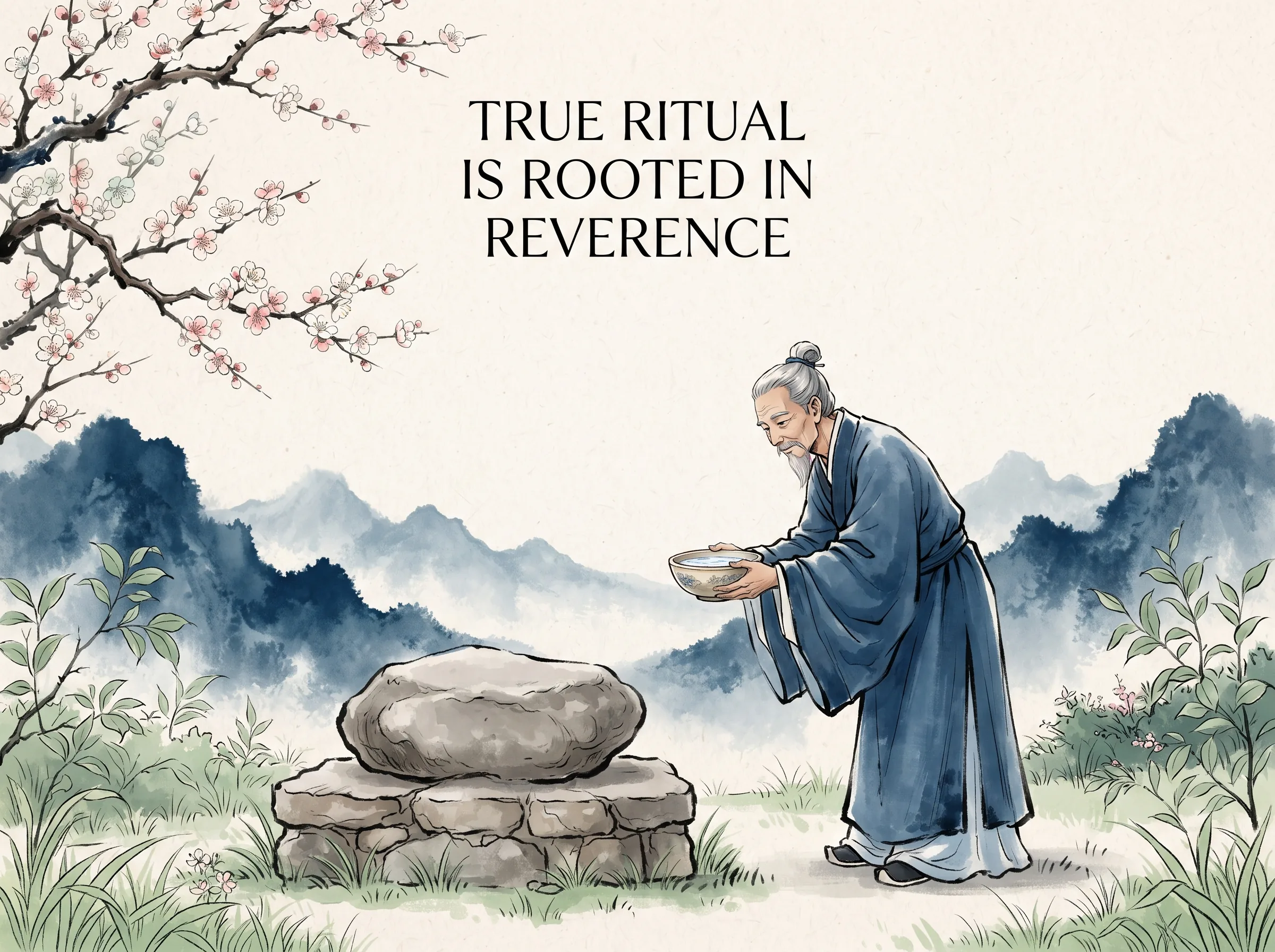
The deeper insight, one that Chinese tradition understood intuitively, is that ritual is not about spending money. It is about intentional creation. The value of a ceremony lies not in what it costs but in what it requires of the person performing it — time, attention, and the willingness to invest oneself in the making of meaning. This is why a handmade gift often carries more weight than an expensive purchased one, and why a personally composed letter can resonate longer than a generic card. Ritual, in its fullest sense, is an act of authorship over one's own experience.
Ancient Chinese Rituals as Acts of Creation
One of the richest archives of creative ritual in human history is the corpus of classical Chinese poetry. Far from being abstract literary exercises, most Tang dynasty poems were composed for specific occasions — farewells, reunions, festivals, birthdays, seasonal transitions. Poetry was the medium through which ordinary moments were lifted into the register of ceremony.
Consider Du Fu's poem Zeng Wei Ba Chushi (To Friend Wei, Hermit), written after twenty years of separation from an old companion [3]. The poem opens with the famous lines: "Life: we seldom meet, / Like stars Shen and Shang, forever apart. / What night is this? We sit together again, / Beneath the same candlelight." The poem does not merely describe a reunion; it enacts one. The act of composing and reciting the poem is itself the ritual — a deliberate, creative gesture that transforms a simple gathering into a moment charged with the weight of decades, loss, gratitude, and survival. Du Fu does not buy anything. He writes something. And in writing, he makes the evening different from all other evenings.
Another well-known example is Wang Wei's poem commonly called Xiangsi (Longing), which begins "Red beans grow in the southern lands. How many branches sprout in spring?" [4] While the poem is popularly read as a declaration of romantic love, it is traditionally understood as a farewell gift given to the famous musician Li Guonian. In this reading, the red beans are not a token of romance but a vehicle for remembering a departing friend — a small, tangible object paired with verse, transforming a scene at the riverbank into a lasting ceremonial exchange. The ritual here is the combination of gift and poem, the merging of material and verbal art into a single act of connection.
Poetry was not the only medium. Painting, too, served as ritual creation. The Palace Museum in Beijing holds Suichao Jiazhaotu, a New Year painting attributed to the Ming emperor Zhu Qizhen (Emperor Xuanzong), depicting Zhong Kui, the guardian spirit who drives away malevolent influences [5]. The painting is not decorative in the casual sense; it is an act of blessing. Elements within the composition — a bat for "fortune everywhere," a branch of cypress and two persimmons forming a visual pun for "a hundred things as you wish" — function as layered invocations for the year ahead. The emperor is not purchasing luck. He is composing it.
Similarly, the tradition of the Xiaohan Tu (Nine-Nines Winter Counting Chart) illustrates how patience itself was ritualized. Beginning at the winter solstice, people would paint a plum blossom with eighty-one petals — nine petals per flower, nine flowers in all — and color one petal each day until the coldest period passed and spring arrived [6]. The practice turned the passage of time into an aesthetic and meditative activity. There was no grand spectacle, no expensive materials. Only a brush, ink, paper, and the daily commitment to mark the passage of days intentionally. The ritual was in the doing, not in the outcome.
Food culture, too, emerged from ceremonial occasions rather than market demand. The round glutinous rice balls eaten during the Lantern Festival (Yuanxiao, the first full moon of the lunar calendar) derive their name and shape from the festival itself — not the other way around [7]. The sticky sweetness of yuanxiao is not a commercial invention; it is the edible expression of a celestial and calendrical moment. Likewise, zongzi — wrapped sticky rice parcels eaten during the Dragon Boat Festival — originated as food tied to a ceremonial day, not as a snack designed for mass consumption [8]. In each case, the ritual preceded the food, and the food carried the memory of the ritual. Examine this artistic principle further through the classical aesthetic philosophy of What Can Ancient Chinese Aesthetics Teach Us About Living a Calmer, More Intentional Life Today?.
The pattern is consistent across these examples: ganyijie — the sense of ceremony — was never about acquiring something. It was about making something. Creativity was the infrastructure of meaning.
The Wisdom of Simplicity
The Daoist tradition offers a principle that cuts directly to the heart of the modern ritual crisis: "Having less yields more; having more creates confusion" — a formulation found in the Daodejing [9]. This is not a call to asceticism but an observation about attention. When a ritual is saturated with expensive objects, elaborate logistics, and high expectations, the effort shifts from presence to performance. The focus moves from the experience itself to the appearance of the experience. Simplicity, in contrast, returns attention to what matters: the quality of awareness brought to the moment.
Consumerist ritual fills space with objects. Creative ritual fills time with meaning. The difference is subtle but decisive. A commercially purchased gift occupies shelf space and may carry emotional resonance for a season. A handwritten note, a shared walk taken with deliberate slowness, a weekly tea brewed in the same cup — these occupy time and memory, and they compound in significance precisely because they cannot be bought. They belong to the person who makes them.
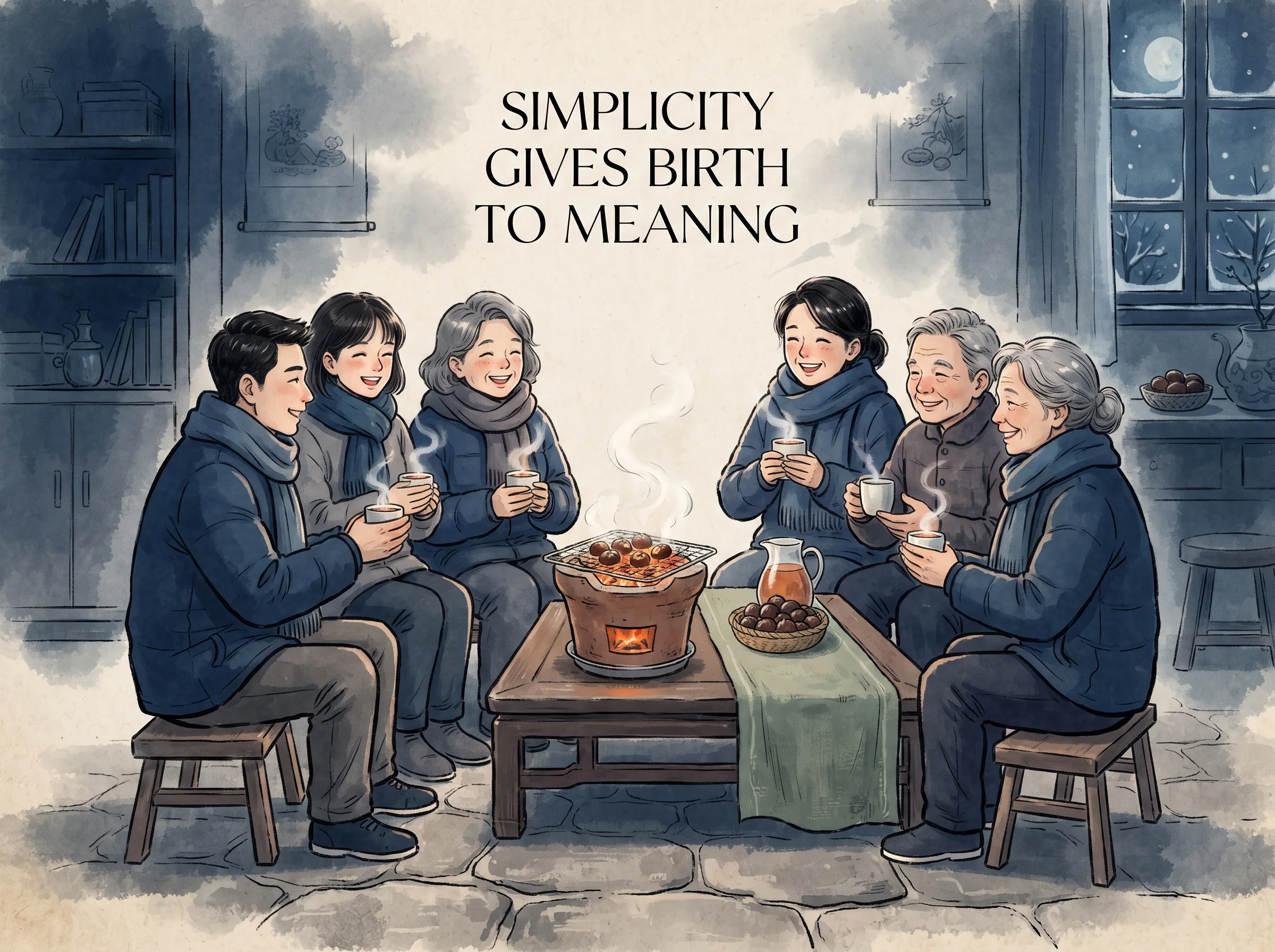
The ancient Chinese examples above share this quality of creative simplicity. Du Fu wrote a poem on paper. Wang Wei offered beans and verse. The painter composed a blessing on silk. The amateur painted one petal per day. None required wealth. All required investment of self. This is the quiet radicalism of the tradition: meaning is not something you acquire. It is something you cultivate.
Bringing This Home: Rituals You Can Actually Create
The question is no longer whether ancient Chinese practices are relevant to modern life, but how their underlying principle — ritual as creation — can be adapted outside the context of classical poetry, imperial painting, or lunar calendars. The answer lies not in replication but in translation.
Start with a handwritten gesture. A note, a sketch, a short text composed by hand carries a different frequency than a message sent by keyboard. The slowness of handwriting forces attention onto the act itself. It is a small ritual of care that costs nothing and can be performed at any time.
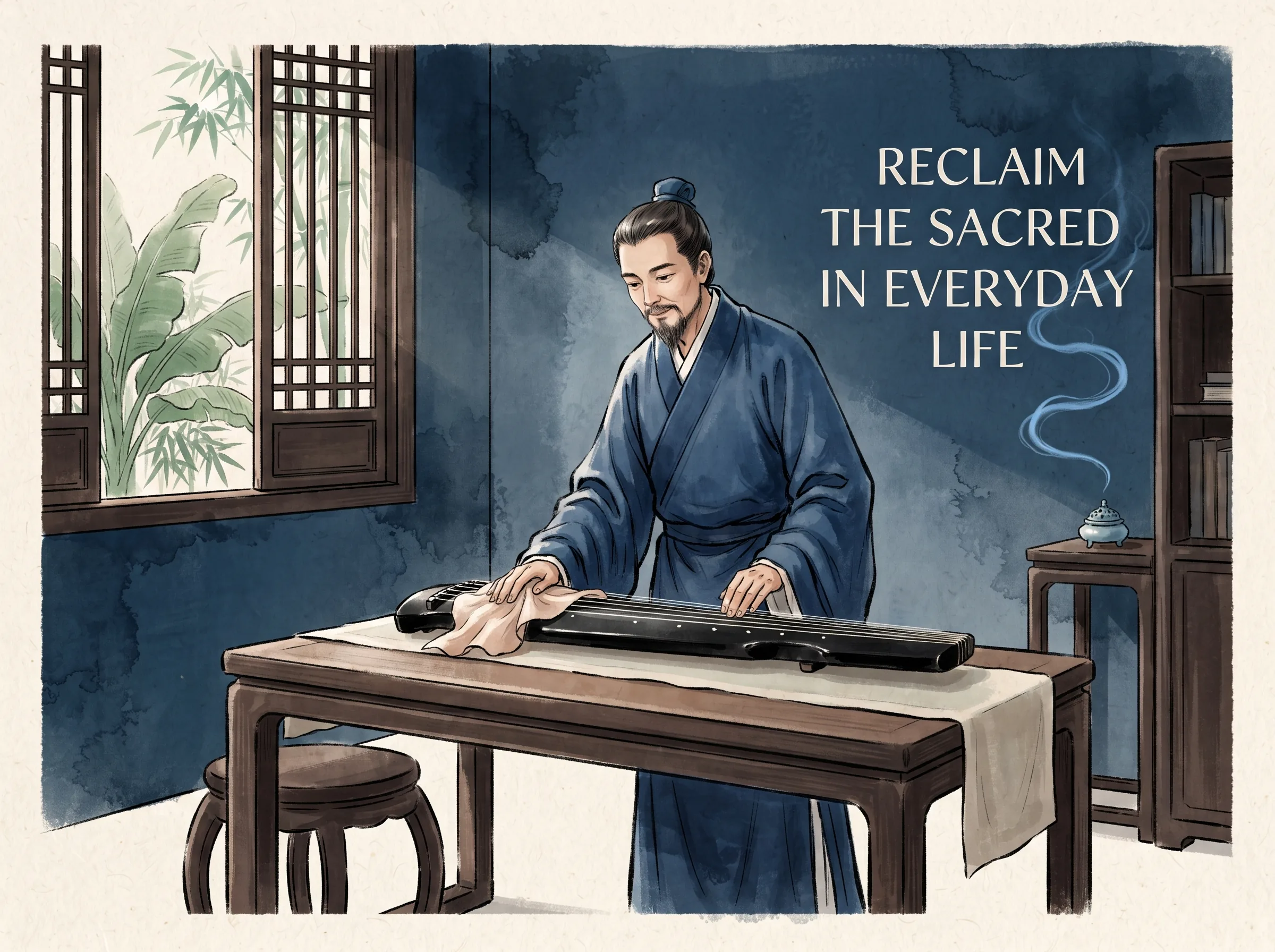
Mark transitions with your own acts. When a season changes, or a chapter of life closes, resist the impulse to simply scroll through whatever trending ritual the internet supplies. Instead, ask: what small act could I perform to make this moment distinct? It might be lighting a candle on the first day of winter. It might be writing a letter to someone you have not spoken to in years. It might be preparing a meal for yourself and a friend on a regular schedule, not because the occasion demands it, but because you choose to mark the passage of time.
Build a personal tradition. Ritual does not need to be annual or grand. A weekly evening walk, a monthly phone call with a parent, a shared breakfast on a particular day — these become rituals through repetition and intention. The key is that they are chosen, not inherited from commercial logic. Once you decide what matters to you, the ritual becomes a statement of values made visible through action.
A reflective question to carry forward: which moment in your life currently lacks a marker of meaning, and what could you create to make it feel different? This is the lasting lesson of Meaningful Ritual in Ancient China.
Examine this artistic principle further through the classical aesthetic philosophy of Why Your City Feels Noisy — And What Ancient Chinese Wisdom Can Teach Us About Better Design.
For a deeper comparative examination of these ideas, explore our related study on Shoulders Behind the Storm: Su Zhe and the Lost Virtue of Fraternal Duty (*tì*, 悌).
Sources & Further Reading
[1] The Little Prince, Chapter 21 — widely cited for the fox's definition of ritual as "what makes one moment different from other moments." Common translations of Antoine de Saint-Exupéry's text.
[2] Du Fu: To Hermit Wei Ba (赠卫八处士) – Wikisource — Du Fu, Zeng Wei Ba Chushi (To Friend Wei, Hermit), lines including "In human life we rarely meet, moving like stars Shen and Shang apart" (rénshēng bù xiāngjiàn, dòng rú shēn yǔ shāng, 人生不相见,动如参与商) and "who knew after twenty years, I would climb your hall again" (yān zhī èrshí zǎi, chóng shàng jūnzǐ táng, 焉知二十载,重上君子堂). Available at
[3] Wang Wei, Xiangsi (Longing; also known in some editions as Jiangshang Zeng Li Guonian), lines "Red beans grow in southern lands, in spring how many branches sprout? Gather them abundantly, for they bring deepest longing" (hóngdòu shēng nánguó, chūn lái fā jǐ zhī. yuàn jūn duō cǎixié, cǐ wù zuì xiāngsī., 红豆生南国,春来发几枝。愿君多采撷,此物最相思。) The traditional attribution of this poem as a farewell to the musician Li Guonian is part of long-standing scholarly commentary, though the exact circumstances of its composition remain a matter of interpretation.
[4] Ming Emperor Xuanzong (Zhu Qizhen), Suichao Jiazhaotu (New Year Auspicious Image), held in the Palace Museum, Beijing. The painting depicts Zhong Kui and contains layered auspicious imagery. Attribution and provenance details are subject to scholarly discussion.
[5] The Xiaohan Tu (Nine-Nines Winter Counting Chart) tradition, particularly the plum blossom variant, is documented in Chinese folk custom studies and museum collections including the Palace Museum. Eighty-one petals, colored daily from the winter solstice, is the commonly described form of this practice.
[6] Yuanxiao (元宵) — the glutinous rice balls associated with the Lantern Festival — are described in historical records of Chinese festival customs. The relationship between the festival name and the food is noted in cultural histories of the holiday.
[7] Zongzi, the wrapped rice food eaten during the Dragon Boat Festival, is a widely recognized element of Chinese festival tradition dating back to at least the Northern Song period. Its association with the Duanwu Festival is well established in cultural scholarship.
[8] Daodejing (Laozi), Chapter 22: "Having less yields gains; having more creates confusion" (shǎo zé dé, duō zé huò, 少则得,多则惑). Standard received text, widely available in multiple scholarly editions and translations.
Further Reading
- Wen Zhenheng, Changwu Zhi (Treatise on Superfluous Things) — a Ming dynasty guide to refined living that discusses the aesthetics of everyday objects, seasonal hanging of paintings, and the cultivation of taste as a form of cultural practice.
- Studies on Tang dynasty poetry and its social functions, including the role of verse in farewell ceremonies, seasonal gatherings, and personal correspondence.
- Research on Chinese folk calendar practices, particularly the Xiaohan counting traditions and their persistence in regional customs.
- Comparative reflections on ritual theory, including works by French philosophers such as Gaston Bachelard and Roland Barthes on the poetics of everyday objects.
FAQ
If I don't know how to write poetry or paint, can I still practice creative ritual?
Yes. The principle is not about artistic talent but about intentional creation. A ritual does not require mastery — it requires presence. A handwritten note, a carefully prepared cup of tea, a walk taken at a deliberate pace: these are all creative acts that mark time differently from routine. The goal is not to produce a masterpiece but to invest a moment with your own attention.
Is it wasteful to give handmade gifts instead of buying thoughtful presents?
No. The value of a handmade gift lies in the time and thought it represents — qualities that cannot be purchased. This does not mean commercial gifts are without merit; a well-chosen store-bought item can certainly express care. But a handmade gesture offers something a purchased item cannot: a trace of the giver's presence in the object itself.
Can ancient Chinese rituals be practiced by someone who does not share the cultural or religious background?
Absolutely. The examples discussed here — writing a poem for a friend, painting a seasonal chart, composing a blessing — are accessible to anyone regardless of cultural background. What matters is not adherence to tradition but the adoption of the underlying principle: that meaning in ritual comes from creation, not consumption. You can adapt the form to your own context while preserving the intent.
How do I know whether my own ritual is meaningful or just another habit?
A meaningful ritual typically involves some element of choice and attention that distinguishes it from automatic behavior. Ask yourself: if no one else were doing this, would I still want to do it? Does it require more than a transaction? Does it make a particular moment feel different from the moments around it? If the answers lean toward yes, you are likely practicing something that carries genuine personal significance.
Ritual does not need to be expensive, complicated, or inherited from tradition to be meaningful. What it needs is creation — the willingness to invest time, attention, and personal effort into a moment so that it stands apart from everything else. The ancient Chinese poets and painters understood this instinctively. They did not wait for occasions to arrive; they made occasions through their art. That model remains available today, not as a relic but as a practical option for anyone who wants their life to feel more deliberate, more distinct, and more their own.






