
Intentional Living in Chinese Philosophy: It's a Way of Living
Modern life surrounds us with constant visual stimulation: screens flashing with notifications, shelves overflowing with purchases, feeds demanding our attention every waking moment. We have learned to consume beauty as we consume everything else — quickly, abundantly, and often without noticing its effect on us. Yet within the Chinese aesthetic tradition, beauty has never been mere decoration. It has been inseparable from a philosophy of living.
Li Zehou's sweeping survey The Path of Beauty traces Chinese aesthetic sensibility from prehistoric times to the late Qing dynasty, showing how every era's artistic expression carried philosophical meaning — Daoist, Confucian, and Buddhist threads woven together across centuries [The Path of Beauty (美的歷程) – National Diet Library Japan]. The book makes clear that to understand Chinese aesthetics is to understand a way of being in the world, not simply a set of visual preferences.
For readers today feeling overwhelmed by noise, consumption, and anxiety, this tradition offers something more useful than another productivity hack. It offers a vocabulary for understanding why calm feels scarce and how it might be reclaimed — not through accumulation, but through restraint.
Emptiness as Possibility
One of the most quietly radical ideas in Chinese aesthetic thought is the value of emptiness. This is not emptiness as lack, but as potential — a space that allows something to breathe.
The Zhuangzi, in its discussion of inner stillness, offers a line that has echoed through centuries of Chinese thought: "Look at that which is empty; the empty room lets in the light, and auspiciousness rests in rest" [Zhuangzi Inner Chapters Man in the World, Associated with other Men – Chinese Text Project]. The passage appears within a dialogue about "fasting the mind" — a practice of clearing mental clutter so that clarity can emerge naturally. The metaphor is architectural but deeply psychological: an uncluttered mind is not an empty one. It is one that can receive rather than resist.
This idea connects to a broader principle often attributed to the Daodejing, which observes that the usefulness of a wheel hub, a clay vessel, or a room lies not in the solid parts but in the spaces they create — the axle hole, the hollow interior, the open doorway [Zhuangzi Inner Chapters Man in the World, Associated with other Men – Chinese Text Project]. The form gives structure; the emptiness gives function. Without the hollow, the vessel cannot hold. Without the door, the room cannot be entered.
In practical terms, this challenges the modern assumption that more is always better. Filling every surface, every hour, every gap of silence with input is a kind of aesthetic overconsumption — one that leaves little room for what actually matters.
Ritual, Order, and the Meaning We Carry
Chinese aesthetic thought does not begin with pure form divorced from purpose. From its earliest expressions, it was closely tied to questions of meaning, order, and how humans relate to one another and to the world.
The concept of li — often translated as ritual propriety — speaks to the idea that structure and form are not constraints but paths toward harmony. In the Confucian tradition, the rituals surrounding music, food, dress, and gathering were never arbitrary. They were ways of cultivating attention, respect, and awareness in daily life. What we choose to surround ourselves with, and how we arrange it, carries implicit meaning.
This insight matters today because our environments speak to us constantly. A desk piled with unread items sends one message; a clear surface with a single meaningful object sends another. A room saturated with artificial light and competing screens creates a different inner state than one shaped by natural rhythm and intentional order. The aesthetic choice is never neutral.
Simplicity and the Uncarved Block
The Daoist tradition, particularly as expressed in the thought of Laozi and Zhuangzi, elevates simplicity as both an aesthetic and a moral ideal. Zhuangzi speaks of pu, the "uncarved block" — a state of natural authenticity before society shapes, sharpens, and complicates us. The raw wood is not inferior because it is unfinished. It is whole. Examine this artistic principle further through the classical aesthetic philosophy of Why Your City Feels Noisy — And What Ancient Chinese Wisdom Can Teach Us About Better Design.
This idea challenges the modern narrative that growth means constant addition — more skills, more possessions, more optimization. Zhuangzi suggests that growth might also mean removal: carving away the excess until what remains is genuine. The aesthetic consequence is an art of restraint, where a single brushstroke can carry as much weight as a dozen.
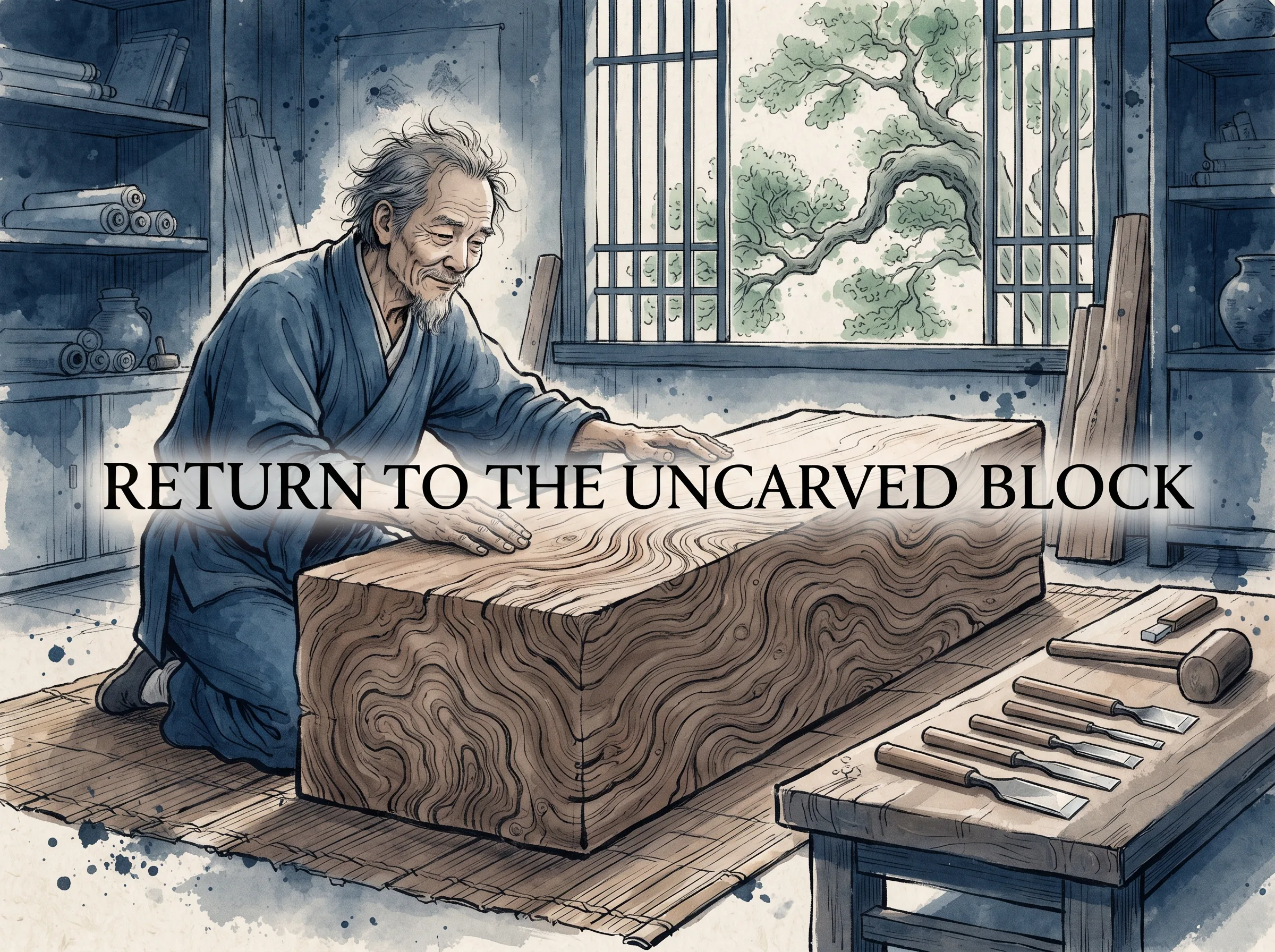
What this means for daily life is deceptively simple: examine what you are adding to your environment, your schedule, and your attention, and ask whether it serves something essential or merely fills space. The uncarved block is not a recommendation to do nothing. It is a reminder that much of what we pursue is added ornament — and that ornament can obscure rather than reveal.
Balance as Dynamic Harmony
Chinese aesthetic thought is deeply attentive to the relationship between opposites. The interplay of yin and yang is not a binary but a flowing balance — contrast without conflict, tension within harmony.
This principle shapes artistic expression in subtle ways. In ink-wash painting, the power of an image often depends not on what is painted but on what is left unpainted — the blank paper becomes part of the composition. In classical garden design, rock and water are arranged not to dominate each other but to enter into conversation. Calligraphy rewards the viewer with a sense of energy held in motion, where bold and delicate strokes exist in the same gesture.
For modern readers, the lesson is not about achieving perfect equilibrium but about learning to hold opposites without anxiety. Ambition and contentment need not cancel each other out. Action and rest can coexist within a single rhythm. The goal is not a static midpoint but a living balance — one that shifts as circumstances shift.
Beauty Across Time
Chinese aesthetic sensibility also offers a distinctive relationship with time itself. There is a long tradition of finding beauty in patina, in the marks of age, in the quiet transformation that comes with natural process. The green corrosion on ancient bronze, the weathered surface of a garden stone — these are not flaws to be corrected but records of presence.
This stands in quiet contrast to the modern cult of the new, where value is attached to freshness and perfection. An aesthetic that welcomes the traces of time asks a different question: What does it mean to age with dignity? To let things change rather than resist change? To find peace not in permanence but in the honest course of things?
The answer is not a rejection of care or maintenance. It is an invitation to loosen the grip on control and to recognize that transformation is not deterioration.
Leaving Space
One of the most directly applicable concepts from this tradition is liubai — the practice of leaving blank space. In painting, blank space is not empty; it is sky, water, mist, or distance made visible. It is the breath between notes. Translated into daily life, liubai asks us to leave gaps — in our schedules, in our attention, in our physical spaces — that allow intention to surface rather than being buried under accumulation.
This does not require a radical lifestyle overhaul. Small shifts can carry real weight: clearing one surface to leave it bare, removing one object from a shelf, scheduling an hour with no agenda, letting a conversation pause without filling the silence. Each of these is an act of aesthetic and psychological hygiene.
From Aesthetic Sensibility to Daily Practice
The question this tradition invites us to consider is not "How do I live beautifully?" in the sense of decoration, but "How do I live with aesthetic sensibility?" — that is, with awareness of form, space, rhythm, and meaning in the choices I make every day.
A few practical steps emerge naturally:
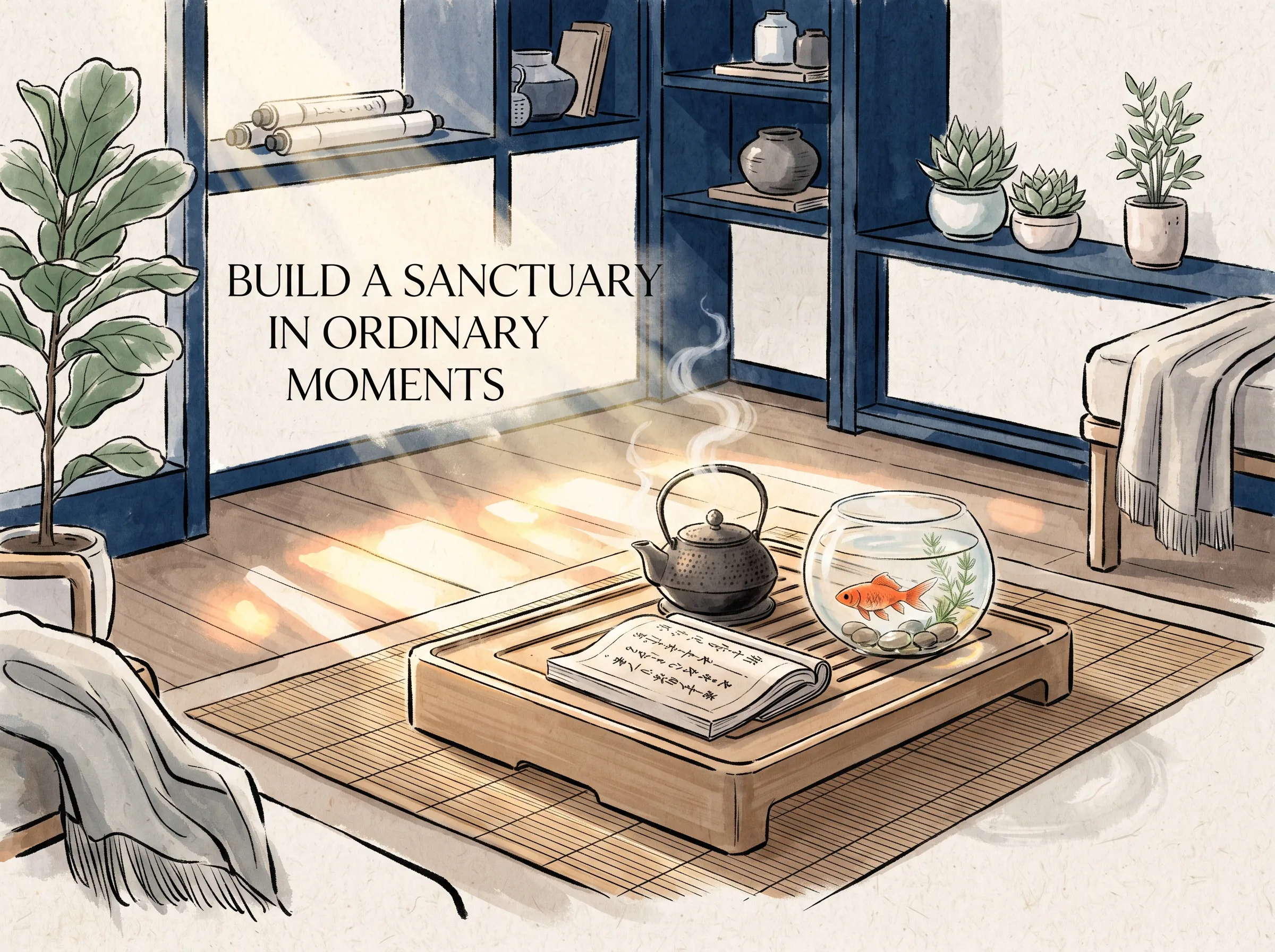
- Curate your environment with intention. Choose fewer objects, but let each one carry meaning. A single well-placed plant or a clear desk can do more for inner calm than a room full of appealing clutter.
- Practice leaving blank space in your schedule. Reserve time without agenda. Let silence exist between tasks. The mind, like the page, needs room to breathe.
- Seek depth over surface appearance. When making daily choices — what to buy, how to arrange a space, what to prioritize — ask not "Does this look good?" but "Does this feel right? Does it carry meaning?"
- Attend to natural rhythm. Notice the seasons. Adjust your pace with them rather than fighting against them. The ancients did not separate aesthetics from the cycles of nature; neither need we.
What Remains
Ancient Chinese aesthetics does not offer a quick fix. It offers something rarer: a way of seeing that, once adopted, quietly reshapes how one lives. The tradition teaches that beauty is not something to acquire but something to cultivate — through restraint, attention, and a willingness to leave space.
The modern world rewards accumulation. This tradition rewards subtraction. Both approaches are valid. The question is which one serves your sense of calm and intention right now.
If you find yourself drawn to this way of thinking, consider beginning with a single day of intentional emptiness: fewer objects, fewer inputs, more room to notice what matters. The rest often follows naturally.
FAQ
Is Chinese aesthetics the same as minimalism? Chinese aesthetic thought shares some surface similarities with modern minimalism — both value simplicity and restraint. However, Chinese aesthetics is rooted in an entire philosophical tradition, including Daoist, Confucian, and Buddhist ideas about harmony, ritual, and the relationship between humanity and the world. Minimalism tends to be a design choice; Chinese aesthetics is a worldview expressed through form.
Do I need to study Chinese philosophy to apply these ideas? Not at all. The principles can be understood and practiced without deep study. Concepts like leaving blank space, choosing simplicity, and paying attention to rhythm are accessible immediately. Study can deepen appreciation, but practice does not require it.
Can these aesthetic principles help with anxiety and overwhelm? Many readers find that applying principles like liubai (leaving blank space) and the appreciation of emptiness provides a helpful framework for reducing mental clutter. These are reflective practices, not substitutes for professional mental health support. If anxiety is persistent or severe, seeking guidance from a qualified professional is recommended.
How does this differ from Japanese aesthetics like wabi-sabi? While Chinese and Japanese aesthetic traditions share historical connections and some overlapping values — such as appreciation for imperfection and natural transformation — they developed within distinct cultural and philosophical contexts. Chinese aesthetics draws from its own lineage of Daoist, Confucian, and Buddhist thought, while Japanese aesthetics developed its own unique expressions. Comparing them can be illuminating, but each tradition stands on its own, reflecting the enduring wisdom of Intentional Living in Chinese Philosophy.
Examine this artistic principle further through the classical aesthetic philosophy of Why “Heaven and Humanity as One” Still Matters: What Ancient Chinese Aesthetics Can Teach Modern Life.
Deepen your understanding of these principles in our reflection on How Ancient Chinese Naming Wisdom Shapes Modern Life.
Sources & Further Reading
[1] The Path of Beauty (美的歷程) – National Diet Library Japan — Li Zehou's The Path of Beauty, recorded as published by Cultural Relics Publishing House (Wénwù Chūbǎnshè, 文物出版社) in 1981
[2] The Path of Beauty (美的历程) – Nanjing Information University Library — Overview describing the book's systematic coverage of Chinese aesthetic thought and artistic style from ancient times to the modern (jìndài, 近代) period
[3] Zhuangzi Inner Chapters Man in the World, Associated with other Men – Chinese Text Project — Original Classical Chinese text containing the "an empty room generates light" (xū shì shēng bái, 虚室生白) passage within the context of inner fasting and mental emptiness
Further Reading
- Li Zehou, The Path of Beauty (Měi de Lìchéng, 美的历程), 1981. A foundational survey of Chinese aesthetic development across millennia.
- Classical Chinese philosophical texts, including the Daodejing and Zhuangzi, offer primary-source context for the Daoist ideas referenced throughout this article.






