
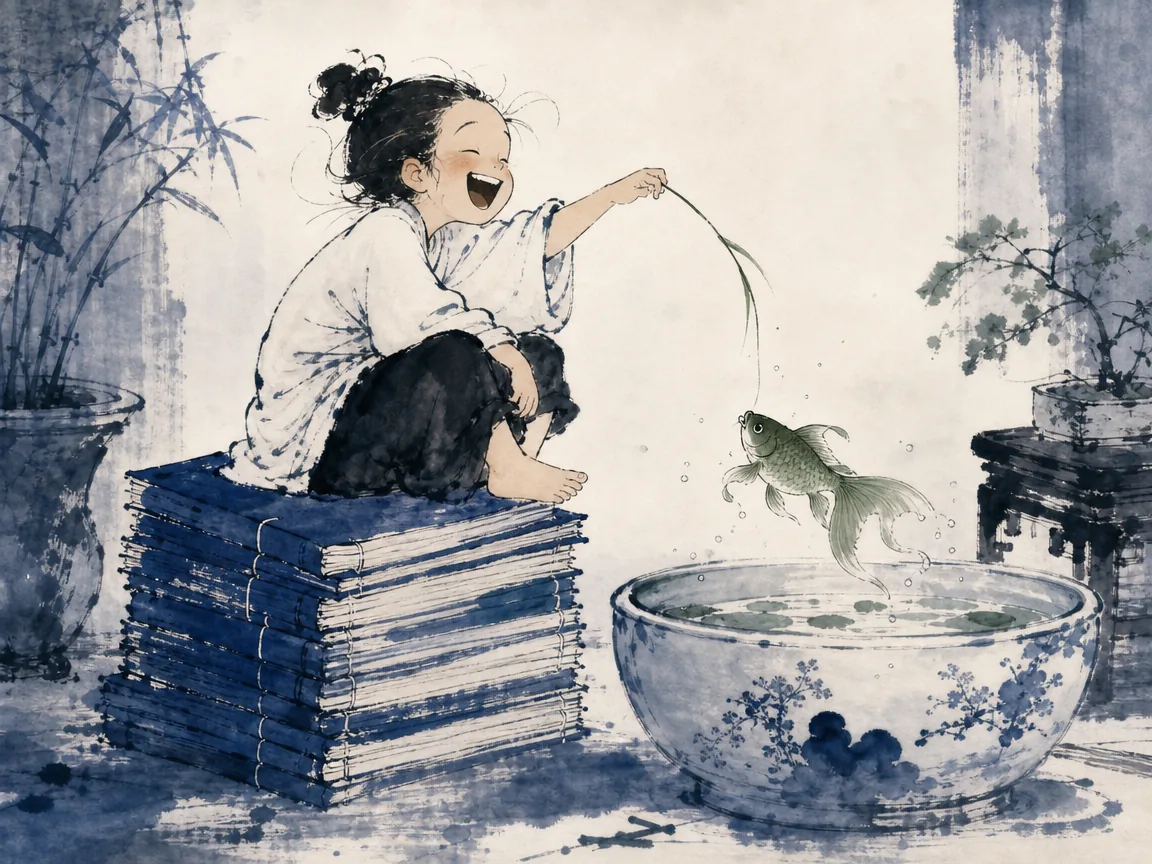
We live in an age that rarely asks a question softly. When a person picks up a paintbrush instead of a keyboard, when a student chooses to play an instrument rather than memorize another formula, when someone simply sits still and watches the sky darken — the first thing many of us feel compelled to ask is: What's the use of it? Can it raise test scores? Can it earn money? Can it get you ahead?
This instinct is so common that we barely notice it anymore. We have made usefulness the default metric for almost everything, and in doing so we have quietly narrowed the range of what counts as valuable. But the question itself — what's the use? — is not neutral. It carries a whole philosophy about what human life is for. And it is a philosophy that has been challenged, gently but persistently, by one of the great traditions of Chinese thought—a foundational perspective explored in Uselessness in Daoist Aesthetics.
The ancient Chinese philosophers did not dismiss practical concerns. They knew that people need shelter, food, and orderly society. But they also saw something that modern life often obscures: when usefulness becomes the only standard, people begin to experience themselves not as human beings but as instruments. They begin to measure their own worth the way a carpenter measures a plank — by whether it serves a function. The question this essay explores is not whether usefulness matters, but what happens to a life when usefulness is the only thing that matters.
Uselessness in Daoist Aesthetics: The Question Nobody Asks Aloud
The modern world rewards speed, productivity, and measurable outcomes. Every hour should be optimized. Every skill should have a return. Every piece of learning should, ideally, lead somewhere quantifiable. In this economy, the question what's the use of it? is not rude — it feels responsible. It feels like good stewardship of time and energy.
But the cost of this single question is subtle. A person who asks it about everything eventually asks it about themselves. What's the use of my curiosity? What's the use of my stillness? What's the use of this feeling I can't name? The logic of pure utility leaves no room for the answers that make life feel like life rather than a series of completed tasks.
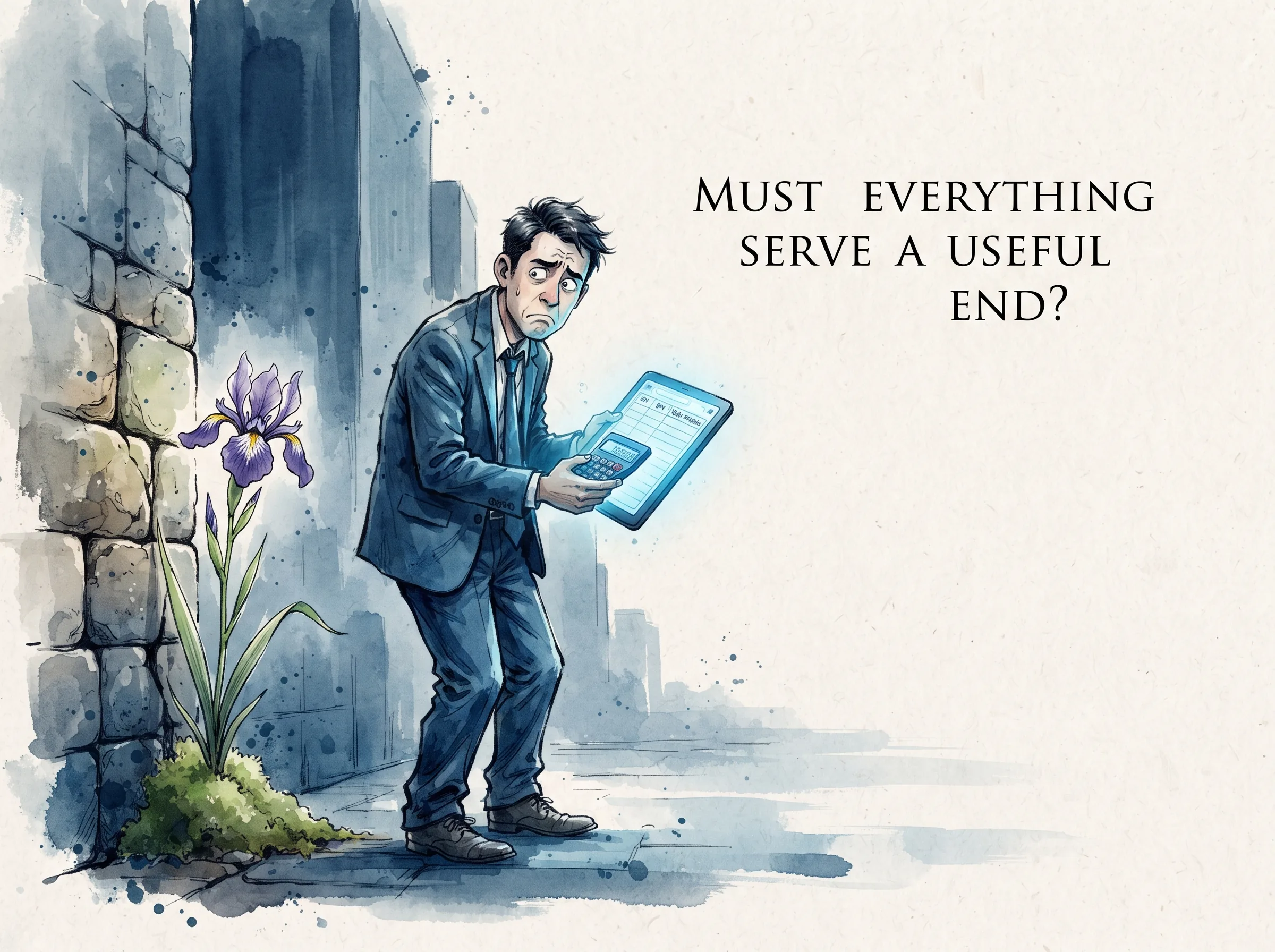
This is not a new anxiety. Two thousand years before the modern workplace, a thinker named Zhuangzi was already asking a version of this question in texts that have come down to us through students and later compilers [3]. His writings are filled with stories of people and objects that fail every practical test — and in failing, reveal something the utilitarian mind misses. He did not argue that usefulness is evil. He argued that it is incomplete. A life measured only by output is a life measured by only one dimension, and that kind of measurement always flattens the world it tries to assess.
Laozi and the Hidden Value of Emptiness
One of the most striking challenges to the cult of usefulness comes from the tradition associated with Laozi, particularly in the Daodejing. The text repeatedly turns ordinary objects inside out to make a philosophical point: what makes a vessel useful is not the clay but the empty space within it. What makes a room livable is not the walls but the open interior between them. The solid part provides the condition; the hollow part provides the function.
This may sound like a riddle, but it is a serious argument about value. The modern instinct is to fill everything — every hour, every mind, every space — because we associate fullness with productivity. But Laozi's tradition suggests that emptiness is not merely the absence of something. It is a positive capacity. Without the empty space in a cup, the cup is just a lump of clay. Without the pause between notes in music, there is only noise. Without stillness, there is only motion without direction.
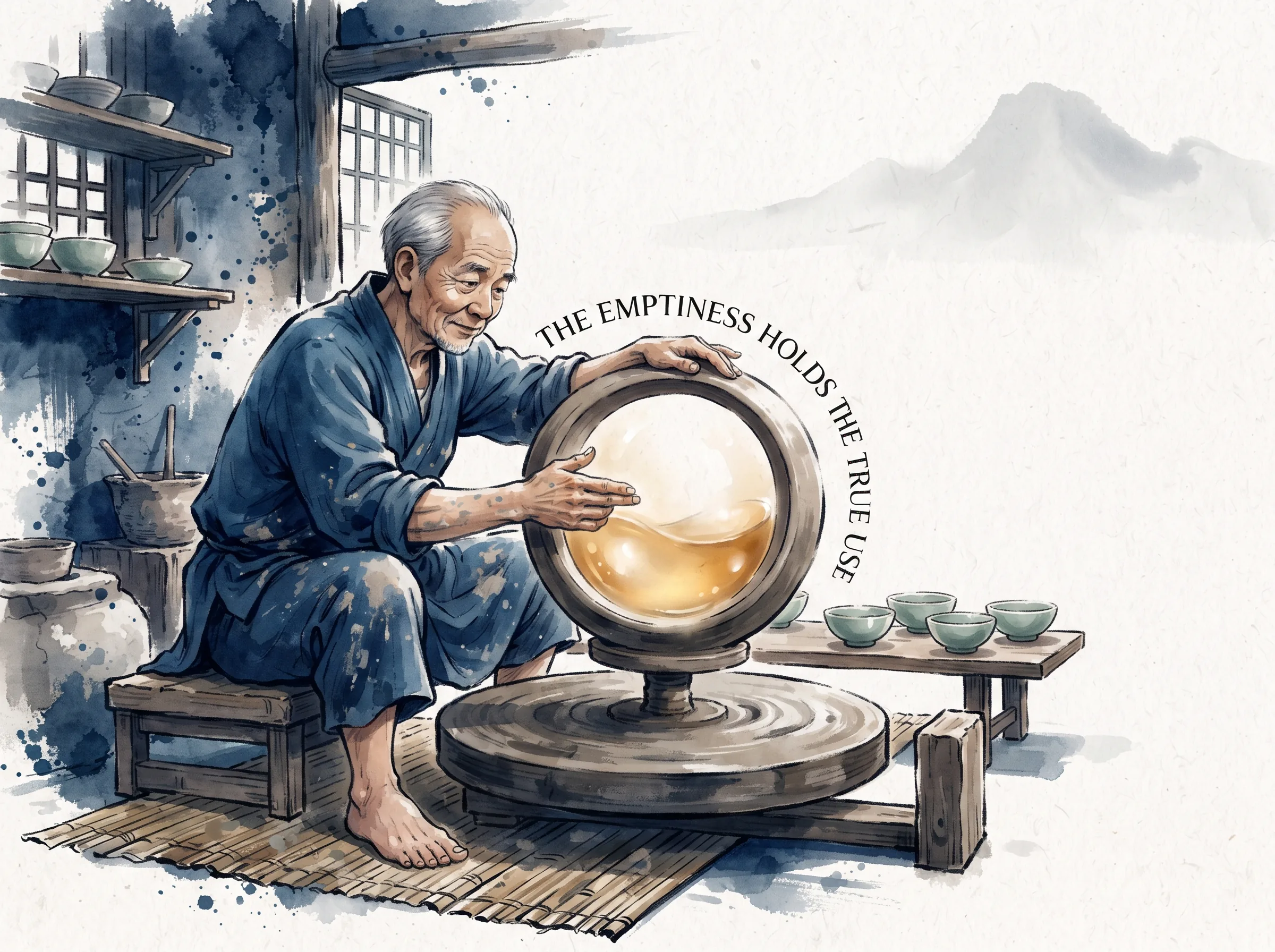
The lesson is not that we should abandon usefulness. It is that we should not confuse usefulness with the only form of value. Emptiness, rest, waste, and silence are not failures of productivity. They are conditions of a life that can actually be inhabited.
Confucius and the Training of Sensitivity
If Laozi warns us about overfilling, Confucius warns us about under-training. He placed aesthetic and musical education at the very center of moral development — not as a luxury, but as essential training for the human interior. Gain deeper perspective on weathering adversity through the poetic resilience explored in Why Your Time Isn’t Late: What Gao Shi and Ancient Chinese Wisdom Know About Timing.
The Analects records that when Confucius heard the Shao music while in the state of Qi, he was so deeply moved that he did not notice the taste of meat for three months, saying he had never imagined music could reach such a height [1]****[2]. This is not a claim that Confucius was a glutton whose attention wandered; it is a claim about the power of aesthetic experience to reshape a person's entire inner life. Music, in the Confucian framework, was not background entertainment. It was a discipline that trained the heart and mind to perceive order, balance, and emotional truth.
Confucius placed this training within a deliberate sequence of cultivation: "Roused by the Odes, set on your feet by ritual, completed by music" [2]. The arts do not come last as decoration. They come last as completion — because the ability to feel, to respond, to perceive nuance is what makes a person fully formed. Technical skill alone is insufficient. A person who can calculate but cannot judge, who can perform but cannot feel, is like a vessel with no opening — structurally complete but functionally useless.
This is profoundly relevant today. We often separate "practical" education from "aesthetic" education, treating the latter as enrichment for those who already have enough. Confucius would have found that hierarchy strange. For him, aesthetic sensitivity was not optional — it was the final stage of becoming a whole person.
What Happens When We Let Go of the Question
Letting go of the demand for usefulness does not mean becoming lazy, impractical, or careless about responsibility. It means recognizing that human life has dimensions that utility alone cannot capture.
A person who can appreciate beauty without needing to monetize it is freer than a person who cannot. A person who can sit with a piece of music and feel something without asking what they will get out of it is practicing a form of attention that the modern world increasingly starves. A person who understands that stillness has value is less likely to burn out in the pursuit of constant optimization.
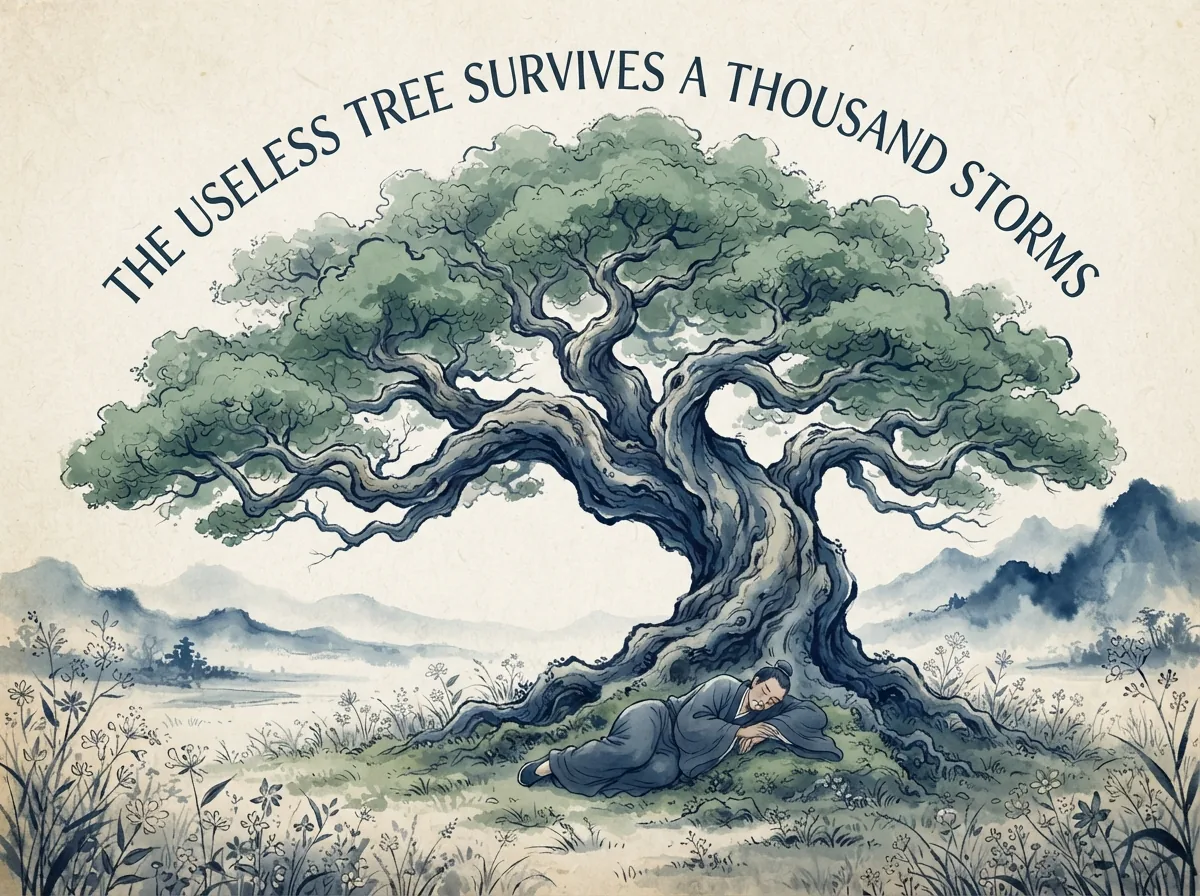
The Chinese wisdom tradition does not offer a quick fix. It offers a reorientation. Usefulness is real. We need tools, skills, and strategies. But usefulness is not the only kind of value. The empty space inside the vessel is real too. The music that moves a person for three months without their noticing meat is real too. The capacity to feel, to judge, to be moved by something that asks nothing in return — these are not inefficiencies. They are the substance of a life worth living.
Practical Suggestions
If the question what's the use of it? feels like it has become too loud in your life, here are a few small ways to create room for other forms of value:
- Practice one "useless" activity weekly. Choose something that has no measurable output — walking without a step goal, listening to music without analyzing it, drawing without trying to improve. Notice what happens to your attention when there is no performance metric.
- Create space for stillness. Set aside ten minutes a day with no input — no phone, no podcast, no task. Sit. The discomfort you feel is not failure; it is the sign of a mind that has forgotten how to be still.
- Revisit music with fresh ears. Listen to a piece of music you have never paid attention to. Do not judge it. Do not compare it to anything else. Just hear it. Let it do what it does without asking what it is for.
- Reflect on the last time you were moved. Write down one moment in recent memory when you felt something — not because it was useful, but because it mattered. Usefulness and meaning are not the same category.
FAQ
Is this tradition saying we should ignore practical goals? No. The Chinese philosophical tradition discussed here does not reject usefulness. It rejects the idea that usefulness is the only kind of value. A life without practical competence is unstable. A life only about practical competence is narrow. The argument is for balance, not abandonment.
Did Confucius really not taste meat for three months? The Analects records this claim [1]****[2]. Whether understood literally or as a literary expression of deep aesthetic absorption, the point stands: Confucius saw music not as background entertainment but as a force capable of reshaping a person's interior life. The exact psychological mechanism is less important than the broader conviction that aesthetic experience has real transformative power.
What about Zhuangzi's stories of useless trees and broken gourds? The specific stories referenced in earlier drafts of this topic — about a crooked tree that carpenters reject or a gourd too large for any container — appear in the Zhuangzi tradition but cannot be verified from the available sources used for this article [3]. What can be stated more cautiously is that texts associated with Zhuangzi and his school repeatedly question the assumption that utility is the sole measure of worth, without necessarily preserving every anecdote in a single verifiable form.
Can this apply to children's education? Yes. The Confucian framework explicitly places aesthetic education at the completion of character formation [2]. The concern is not that children should neglect practical skills, but that they should not develop only practical skills. A child who learns music, literature, or art alongside mathematics and science is being educated in the full range of human capacities, not given a "break" from real work.
Conclusion
The question what's the use of it? is not wrong. It is simply incomplete. It answers one kind of question about a thing and then pretends to have answered all of them. The Chinese wisdom tradition — in the emptiness Laozi honored, in the musical training Confucius placed at the heart of education — offers a different way of seeing. Usefulness matters. But so does the space inside the vessel. So does the music that moves a person beyond what they can explain. So does the willingness to ask a question that has no immediate answer.
The next step is not to abandon usefulness but to make room beside it for the experiences that cannot be measured but can be felt. Start small. Choose one moment this week that has no utility and let it simply be, reflecting the enduring wisdom of Uselessness in Daoist Aesthetics.
Connect these enduring values to the broader cultural heritage explored in How Could a 5,000-Year-Old Civilization Stay United?.
For a deeper comparative examination of these ideas, explore our related study on On True and False Virtue: High Virtue Does Not Cling to Form.
Sources & Further Reading
[1] Analects 7.14 — When the Master was in Qi, he heard the… — Records Confucius hearing the Shao music and his reaction.
[2] Analects, Book 8: Tai Bo (泰伯) §8 – Roused by the Odes, Established by Ritual — Contains the sequence "Roused by the Odes, set on your feet by ritual, completed by music," and cross-references the Shao music passage.
[3] Zhuangzi (Stanford Encyclopedia of Philosophy) — Provides scholarly context on the compilation history of the Zhuangzi text and its attribution.
[4] Further reading (not cited as evidence in this article):
[5] Zhuangzi (various English translations, e.g., by Burton Watson or Victor Mair) — For readers interested in Zhuangzi's broader questioning of utility.
[6] Daodejing (various English translations, e.g., by Robert Henricks or David Hall and Roger Ames) — For the general theme of emptiness and non-action.
[7] The Analects ( translations by D.C. Lau or Edward Slingerland) — For broader Confucian perspectives on education and self-cultivation.






