
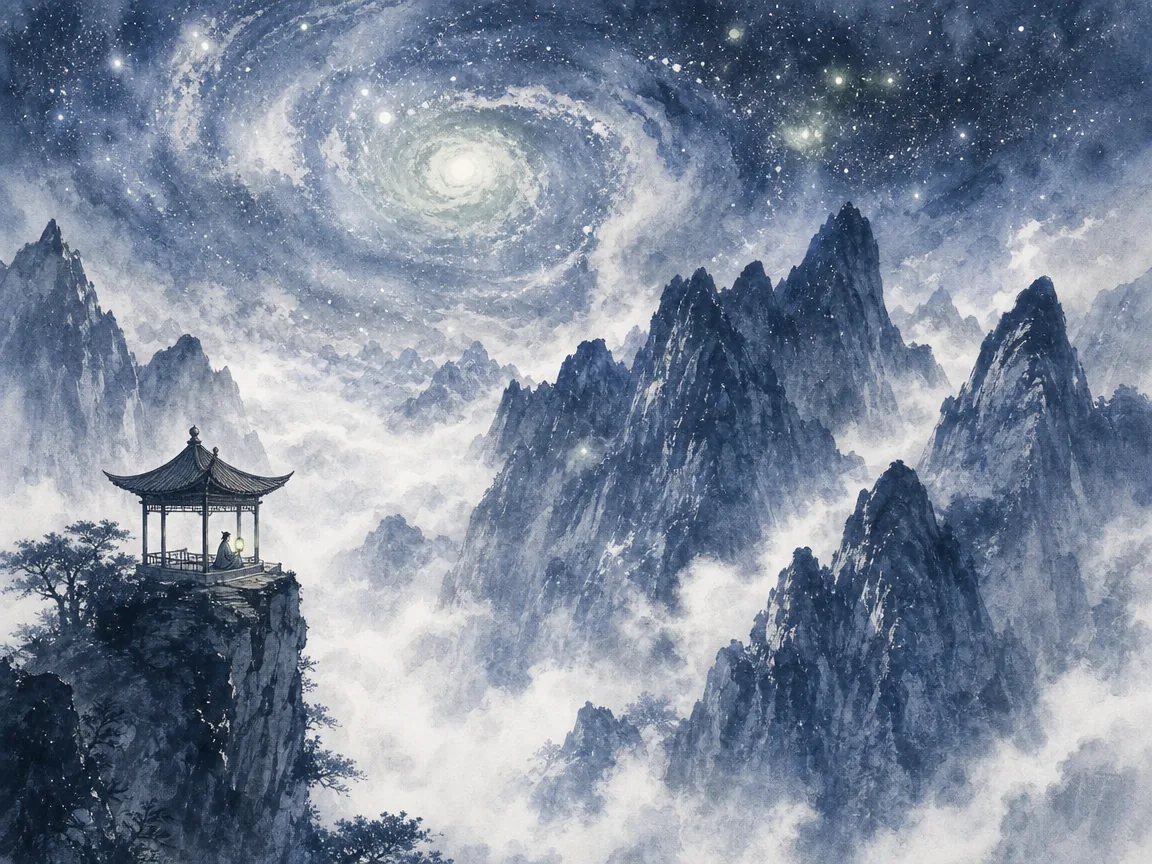
When you look at a Chinese landscape painting, you may notice something unusual: the mountains tower above, mist drifts across endless distance, and somewhere near the bottom edge — so small you almost miss them — two figures walk along a path or sit in a boat. Human beings appear, but barely. They are not the heroes of the picture. They are guests in a world far larger than themselves.
This deliberate smallness has puzzled many Western viewers. In our own landscape tradition, from the Renaissance onward, the human observer is usually placed at the center. Perspective lines converge toward our eye. Nature exists to be admired, possessed, or conquered. Chinese landscape art (shānshuǐ, 山水), by contrast, places humanity on the periphery and asks us to feel something quieter than affection: reverence. Not fear, not indifference, but a deep and steady awe before a cosmos that precedes us and will outlast us—a foundational perspective explored in Awe in Chinese Landscape Painting.
This is not emotional coldness. It is a philosophical stance with real psychological consequences. For readers living in an age of burnout, climate dread, and the relentless pressure to be the center of one's own universe, this ancient aesthetic offers a radical alternative. What if peace does not come from mastering the world, but from learning to stand lightly within it?
Awe in Chinese Landscape Painting: The Visual Grammar of Smallness
Chinese landscape painters developed a visual language that systematically dissolved the human ego from the picture plane. Mountains dominate the composition. Rivers cut through valleys. Clouds and mist separate layers of distance, creating a world that feels alive but impersonal. Within this vastness, human figures appear as tiny specks — travelers, monks, fishermen, scholars on retreat — never larger than a few brushstrokes.
This is not accidental. Artists used what later theorists would call the "three distances" — not as fixed viewpoints but as ways of moving the eye through the painting, encouraging the viewer to wander rather than fixate. The effect is gentle disorientation. You do not command the scene; you enter it. You become a participant, not a conqueror.
In the West, landscape emerged alongside techniques of measurement and control. The invention of linear perspective in Renaissance Italy placed a single viewing eye at the center of a mathematically ordered world. Nature became an object to be framed, measured, and owned. Chinese painters worked from a different instinct. Their tradition did not ask, How can I master this view? It asked, How can I stop trying to be the master?
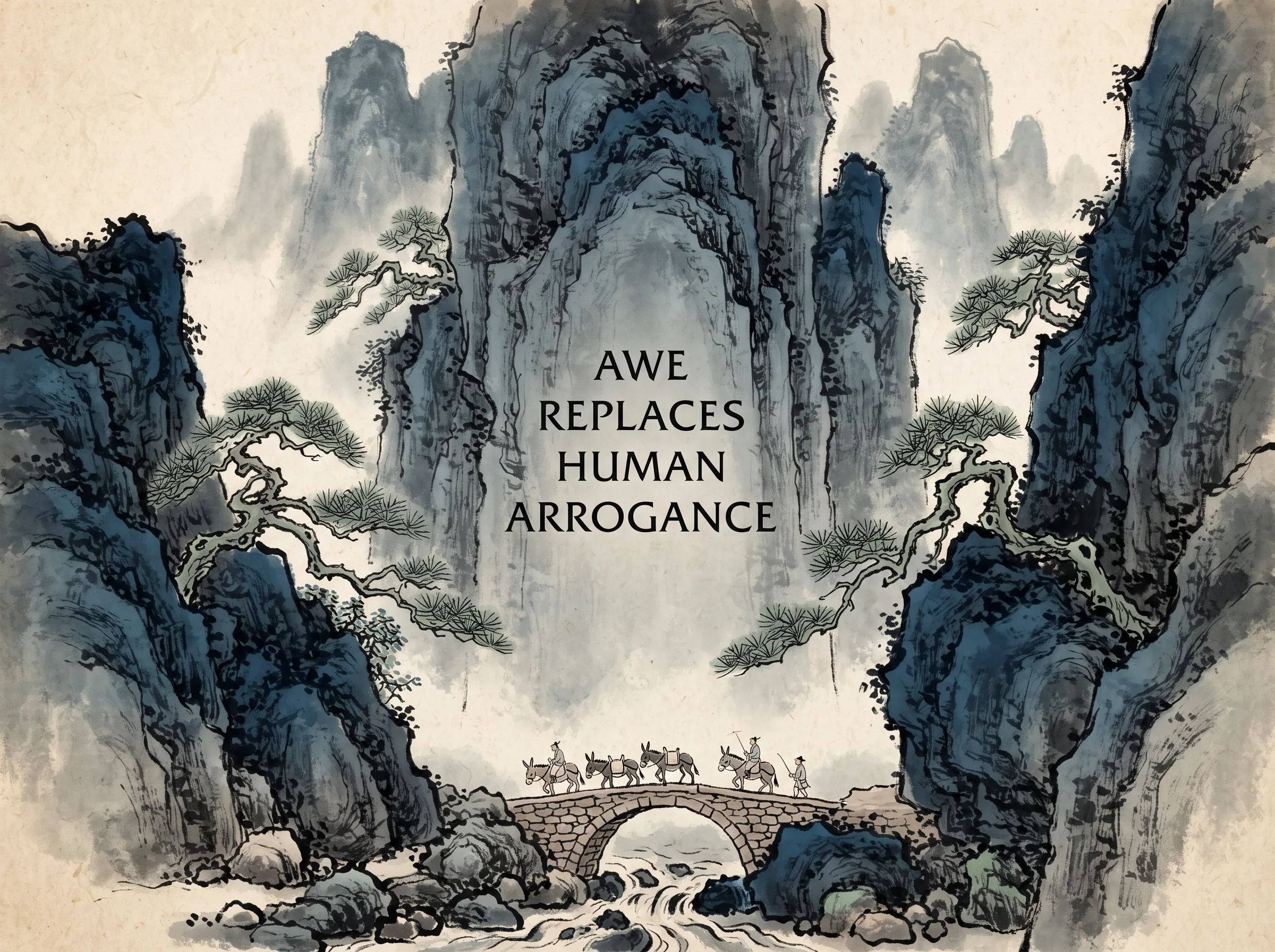
Neither approach is inherently superior. But they answer a different question: Where do I belong? Chinese landscape says you belong inside the order, not above it.
The Daoist Roots: Mountains and Rivers Embody the Invisible Way
The philosophical foundation for this tradition was laid in the fifth century by a man named Zong Bing (宗炳, 375–443). He wrote what is widely considered China's first treatise on landscape painting, and in it he offered two ideas that would shape the genre for over a millennium.
The first is often summarized as "mountains and rivers embody the visible form of the Dao". The Dao, in Laozi's sense, is the natural order that underlies everything — infinite, nameless, older than any human ambition. It cannot be grasped directly. But it shows itself in the world: in the weight of a mountain, the flow of a river, the silence between clouds. To paint landscape, therefore, was not to copy scenery. It was to trace the outline of something sacred.
The second idea is more personal. Zong Bing grew old and ill, unable to climb the mountains he had spent his life visiting. Rather than give up his spiritual practice, he painted the landscapes he had seen on the walls of his room and sat before them, traveling inward through the images [1]. This practice — sometimes called "traveling while reclining" — was never about escapism. It was a method of returning to the order that held everything together, including the self.
A related line from his treatise, preserved in later transmissions, speaks of the sage who "contains the Dao and responds to things" and the refined person who "clears the mind to savor images" [1]. The implication is clear: looking at landscape is not passive entertainment. It is an act of inner preparation — a way of ordering your own mind by aligning it with the order outside it. Gain deeper perspective on weathering adversity through the poetic resilience explored in When Everything Falls Apart: What Tang Dynasty’s Poet Wei Yingwu Can Teach Us About Starting Over.
This is very different from the Western Romantic tradition, where awe before nature often reinforces human grandeur through struggle. In the Chinese tradition, awe dissolves the ego into a larger whole. The feeling is not I triumph over nature but I am part of something that does not need me at all.
Turbulent Times and Quiet Mountains
Chinese landscape did not emerge in an era of peace and prosperity. It took shape during one of the most fractured periods in Chinese history — the Wei-Jin era (roughly the third to sixth centuries), marked by political collapse, warfare, and mass displacement. As northern elites fled south after the fall of Luoyang, they encountered an unfamiliar geography: mist-shrouded hills, river networks, rain-soaked valleys that resisted the ordered, geometric logic of the northern plains.
This geographic disorientation became a spiritual reorientation. If the political world no longer made sense, perhaps the cosmos still did. Scholars and artists turned away from courts and toward mountains. They sought not escape but anchoring — a stable reference point outside the chaos of human affairs.
This pattern repeated itself across Chinese history. The Tang poet Wang Wei retreated to his countryside estate after the Anshi Rebellion and found in landscape a space for contemplative stillness. The Song dynasty, facing constant military pressure from northern neighbors, produced monumental paintings of towering peaks that seemed to embody an unshakable cosmic order — readings some scholars connect to the rise of Neo-Confucian philosophy, though the direct link between specific paintings and specific thinkers remains debated.
What ties these moments together is not a single doctrine but a recurring insight: when the human world becomes unstable, turning toward landscape — toward something vast and patient — can restore a sense of proportion. The self shrinks, and in shrinking, it stops bearing the unbearable weight of being the center of everything.
The Empty Pavilion: A Quiet Act of Dignity
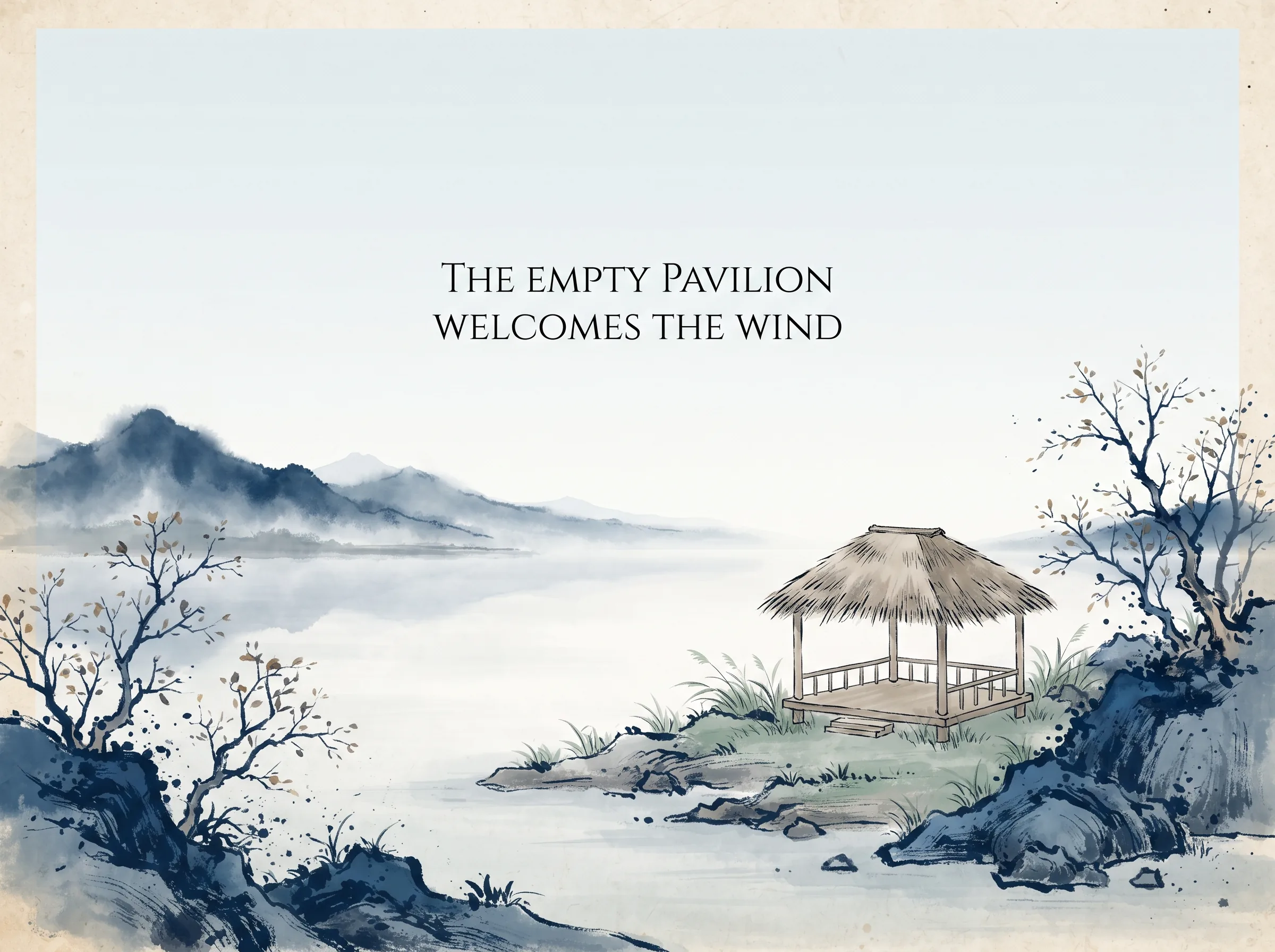
By the fourteenth century, the tradition of landscape had taken a striking turn. The great sweeping mountains of the Song gave way to sparse, almost austere compositions — bare banks, a few leafless trees, a stretch of water, and above it all, an empty pavilion or shelter with no figure inside.
The artist most associated with this style is Ni Zan (倪瓒, 1301–1374). After the Mongol conquest and the ensuing turmoil, Ni Zan abandoned his family estate and spent nearly two decades drifting on the lakes around Taihu. His paintings from this period, such as the Rongxi Studio scroll dated 1372, show exactly this vocabulary: minimal brushwork, pale ink, and those hauntingly vacant structures [2].
Why empty shelters? In Ni Zan's context, they were not decorative choices. They were statements. When the world became corrupt or unlivable, withdrawing from it was itself a moral act. The empty pavilion said: I will not participate. I will not compromise. I will preserve my inner cleanliness by refusing to fill the space with presence.
Readers sometimes mistake this for pessimism. But the tradition frames it differently. Stepping away is not surrender — it is a form of dignity. It is the refusal to let the outer world dictate the terms of your inner life. And it carries a practical wisdom that remains urgently relevant: sometimes the most courageous thing you can do is remove yourself from a situation that demands your full emotional investment.
What This Ancient Awe Teaches Us About Modern Anxiety
Modern anxiety is, in many ways, a crisis of centrality. We are told — by social media, by consumer culture, by the very architecture of our cities — that we are the protagonists of reality. Our productivity determines our worth. Our visibility determines our existence. When we fall behind, when we are unseen, when we fail to control outcomes, we experience this as existential threat.
Chinese landscape offers a different answer. It suggests that peace comes not from achieving centrality but from relinquishing it. The tiny figures in these paintings are not diminished by their smallness — they are liberated from the burden of being the main character. A mountain does not care whether you succeed. A river does not measure your worth. And this indifference, properly understood, is deeply comforting.
The practical question this raises is simple: What would it feel like to stop trying to control what cannot be controlled?
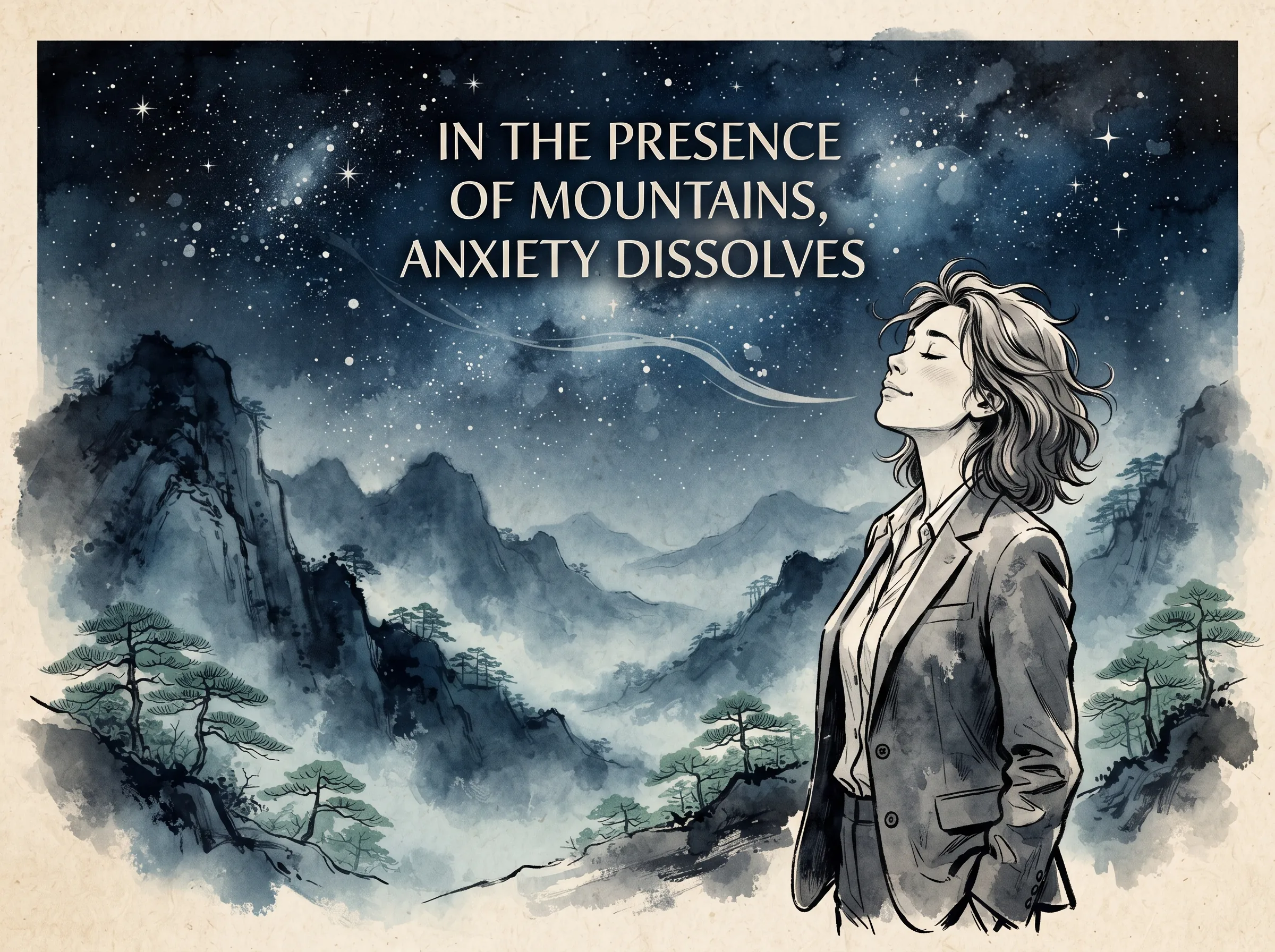
A Chinese painter's answer would be to step back. Let the mountain be the mountain. Sit in the empty pavilion — metaphorically, psychologically — and watch the clouds move without needing to direct them. Smallness is not defeat. It is relief.
This does not mean passivity in the face of injustice. Ni Zan did not withdraw because he lacked courage; he withdrew because he had too much. What the tradition offers is a distinction between battles worth fighting and the exhausting compulsion to be responsible for everything. You can care deeply about climate, about community, about justice — and still recognize that not every outcome rests on your shoulders. The cosmos has been turning long before you arrived and will continue long after you leave.
Consider a brief reflective exercise. Imagine your current worries — deadlines, relationships, financial stress, global anxieties — placed inside a vast landscape painting. See them rendered small, set against mountains that have stood for millennia. Notice what happens to their intensity. Not because they are unimportant, but because they are finally seen in proportion.
FAQ
Q: Does Chinese landscape painting truly exclude love and affection? A: Not entirely — Chinese art includes many traditions that express tenderness toward nature, especially in flower-and-bird painting, where plants and animals serve as vessels for personal feeling and moral symbolism. But in the landscape (shān shuǐ) tradition specifically, the dominant mode is reverence rather than romance. This reflects a philosophical choice: when facing the cosmos, affection alone feels insufficient. Awe carries more weight.
Q: Is this idea limited to Daoism, or does Confucianism contribute as well? A: Both traditions play a role, though their emphasis differs. Daoist thought — especially the concept of the Dao as an impersonal, flowing order — provides the metaphysical foundation for seeing landscape as sacred. Confucian and later Neo-Confucian thought contributed the ethical dimension: the idea that studying nature helps cultivate moral character and social harmony. The two currents often overlap in practice.
Q: Can this ancient perspective really help with modern anxiety, or is it just historical curiosity? A: The tradition was never purely aesthetic — it was always practical. Zong Bing painted landscapes to ease the distress of illness and aging. Ni Zan emptied his pavilions to preserve sanity under political oppression. The underlying mechanism is psychologically recognizable: anxiety thrives on the belief that everything depends on us. Landscape painting invites a corrective — the realization that much of what we worry about exists on a timescale and at a scale far beyond our individual control.
Q: How is this different from Western "sublime" experiences in nature? A: The Romantic sublime — think of Caspar David Friedrich's solitary figures before stormy seas — also evokes awe. But it typically reinforces human subjectivity: the individual confronts nature and feels the grandeur of their own capacity to feel. Chinese landscape awe works differently. It does not celebrate the viewer's emotional intensity; it dissolves the viewer into the scene. The goal is not to feel profoundly human but to remember you are part of something that does not require your profundity.
Final Thought
Chinese landscape painters did not distrust human feeling. They trusted something larger. In placing tiny figures inside towering mountains, they were offering a quiet correction to a fundamental human impulse: the urge to make ourselves the measure of all things.
For readers navigating an age of algorithmic self-optimization, environmental uncertainty, and the constant pressure to perform, this correction may be exactly what is needed. Not resignation. Not indifference. But a deep, steadying recognition that you do not need to carry the world — you only need to find your place within it.
The next time you feel overwhelmed, consider this simple reframe: Am I trying to be the mountain, when I was never meant to be? Let the mountain be the mountain. Your only task is to walk beside it, reflecting the enduring wisdom of Awe in Chinese Landscape Painting.
Gain deeper perspective on weathering adversity through the poetic resilience explored in When the Emperor Says No: What Liu Yong Taught Us About Redefining Success.
Deepen your understanding of these principles in our reflection on When the World Closes the Door: What Ancient Chinese Wisdom Says About Your Next Move.
Sources & Further Reading
[1] Zong Bing: "Preface on Landscape Painting" (画山水序) Interpretation — Zong Bing: "Preface on Landscape Painting" (Huà Shānshuǐ Xù, 画山水序) Classical Text and Commentary
[2] Ni Zan: Rongxi Studio (倪瓒容膝斋图) – Palace Museum — Ni Zan: Rongxi Studio (容膝斋图) Background and Brushwork Style
Further Reading (延伸阅读)
- Xu Zhiyuan interview with art historian Joan Stanley-Baker (徐小虎) on cosmic order in Chinese landscape painting
- Cultural Geology series, Ep. 13: In-depth analysis of the historical philosophy of Chinese landscape painting (山水画)






