
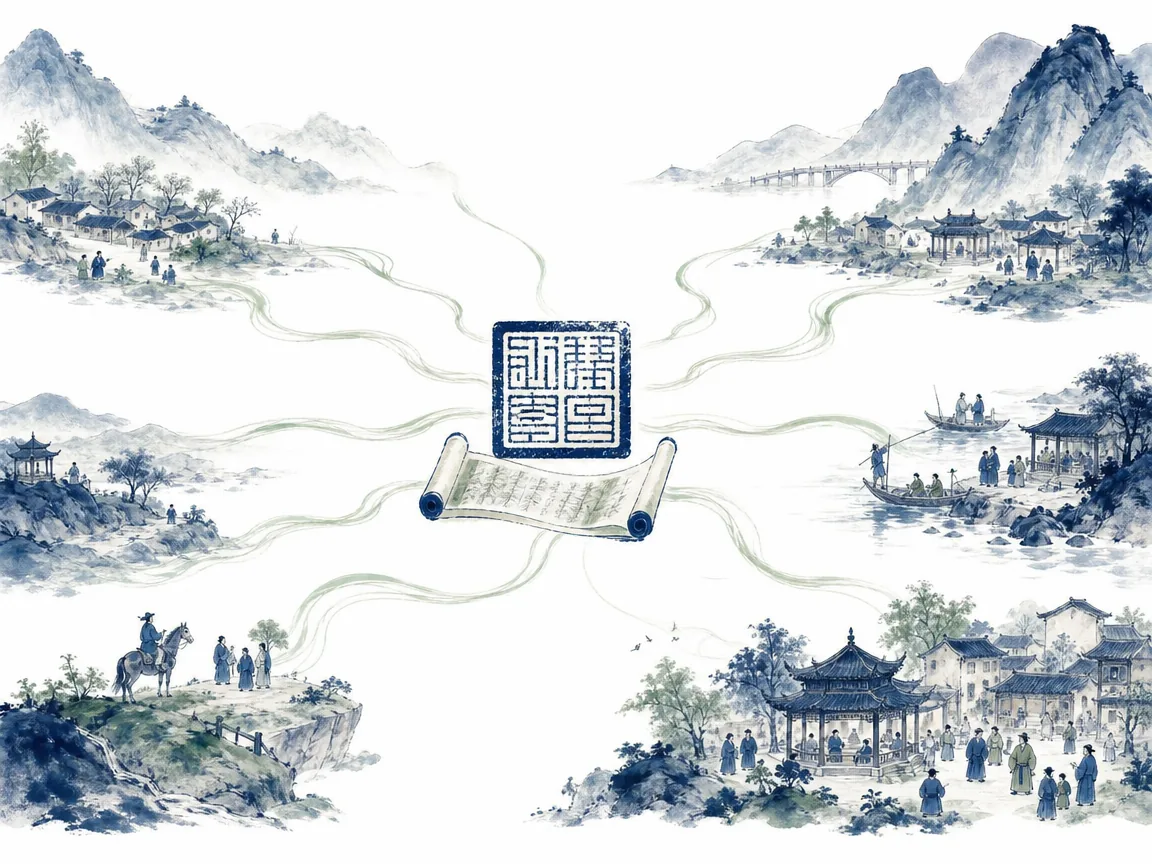
In his 1993 essay "The Clash of Civilizations," Samuel Huntington famously wrote: "Civilizations are dynamic; they rise and fall, they divide and merge. And, as any student of history knows, civilizations disappear and are buried in the sands of time" [Civilizations: What Sets Them Apart and Why They Disappear — Huntington, 1993]. By that logic, it should not be surprising that the four great ancient civilizations — Egypt, Babylon, and the Indus Valley alongside China — would not all survive to the present day. Yet one did. And that fact has led some observers to question whether China fits the conventional definition of a nation-state at all. The American political scientist Lucian Pye, writing in Foreign Affairs in 1990, observed that "China is a civilization pretending to be a state," a formulation Huntington himself later quoted and discussed [1], [4]. This idea captures something many international readers find puzzling: how does a political entity endure across millennia of dynastic change, foreign conquest, and internal upheaval — while other ancient civilizations vanish entirely?
The answer, many scholars suggest, does not lie in ethnicity, bloodlines, or even a single ruling dynasty. It lies in something deeper and more durable: a shared cultural identity built around common symbols, a unified written language, and a coherent system of moral and social philosophy. Where other civilizations depended on territorial conquest or religious uniformity to hold their populations together — and tended to fragment once those forces weakened — Chinese civilization developed mechanisms of cohesion that could survive the fall of empires. The result was not a static society but a remarkably resilient one, capable of absorbing shocks, integrating new ideas, and reconstituting itself across cycles of division and reunification—a foundational perspective explored in Chinese Cultural Wisdom.
Understanding this process is not an exercise in nationalism or historical exceptionalism. It is, rather, an invitation to consider a fundamental question that applies far beyond China's borders: what binds large, diverse communities together across generations? In an era marked by polarization, institutional distrust, and debates over national identity in countries around the world, the Chinese experience — as interpreted through its own philosophical tradition — offers a lens through which to examine how cultural identity and shared values can function as the invisible architecture of a civilization.
Chinese Cultural Wisdom: Why Did China Survive When Other Ancient Civilizations Vanished?
The contrast between China and the other great early civilizations is striking. Ancient Egyptian civilization, with its monumental pyramids and hieroglyphic writing, flourished along the Nile for three millennia before fading into memory. Mesopotamian civilization — home to cuneiform script, the Code of Hammurabi, and the legendary city of Babylon — rose and fell multiple times, ultimately absorbed by successive empires. The Indus Valley civilization, centered on cities like Harappa and Mohenjo-Daro, disappeared from the historical record around 1900 BCE, its script still undeciphered. China, by contrast, maintains a continuous written record stretching back over three thousand years, and its cultural self-understanding has never been severed, even during periods of foreign rule or political fragmentation.
This is not to claim that Chinese history was uninterrupted or harmonious. Scholars such as Zhang Weiwei have noted that China's history is far less continuous and unified — and its relations with minority peoples far less harmonious — than some optimistic narratives suggest [1]. The empire experienced devastating civil wars, devastating floods, Mongol conquest, Manchu rule, and centuries of ideological debate among competing schools of thought. What endured was not a specific dynasty or even a fixed set of borders, but a cultural framework — a way of reading the world, a set of texts, a writing system, and a vocabulary of moral and political concepts — that could outlive the regimes that wielded it.
The question, then, is not simply why China survived, but what held it together. If ethnicity alone cannot explain it — China has always been multiethnic — and if political unity repeatedly broke down, what provided the glue? The answer, most historians agree, points to culture: specifically, a shared written language, a canon of classical texts, and a philosophical tradition that linked personal conduct to social order. These were not the inventions of a single ruler or a momentary policy decision, but the products of a long, cumulative process spanning centuries. They formed a network of meaning that allowed people who spoke mutually unintelligible languages, who lived in different climates and economies, and who belonged to different ethnic groups, to imagine themselves as part of the same cultural world.
The First Key: Writing as the Soul of Cultural Identity
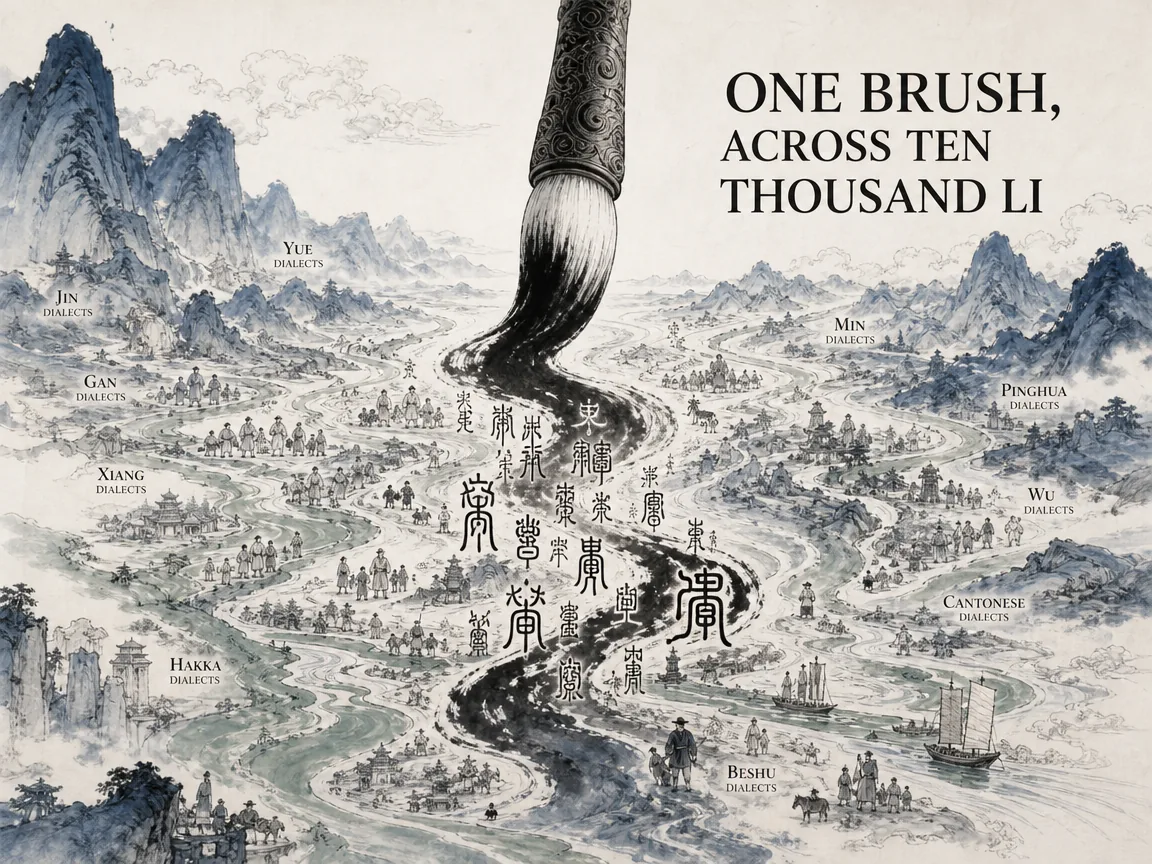
Perhaps the single most important factor in China's cultural continuity is the unification of the written language. In 221 BCE, the king of Qin conquered the other six major states and became Qin Shi Huang, the First Emperor of a unified China. Among his most consequential acts was the standardization of the written script — known in Chinese as "uniform script across the realm" (shū tóng wén, 书同文). Prior to this, the various states had developed their own regional forms of characters, and communication across the newly united realm depended on a shared system of symbols that could transcend spoken dialects.
This was not merely an administrative convenience. In a vast agricultural empire where most people were illiterate and oral communication between regions was difficult, a unified writing system created a powerful sense of cultural belonging. A farmer in the north and a merchant in the south could not understand each other's speech, but both could read and write the same characters. The written word became a bridge across geographic and linguistic distance — a shared medium through which literature, law, history, and philosophy circulated throughout the empire.
The connection to Chinese philosophical thought is significant. Confucius placed enormous importance on language and naming. In the Analects, he argued that if names are not correct, language does not accord with the truth of things; if language does not accord with the truth of things, affairs cannot be carried to success [6]. The idea was not merely that words should match reality, but that a shared symbolic order was a prerequisite for social harmony. Later thinkers expanded on this, developing the concept of ritual propriety (lǐ, 礼) as the system of shared practices and symbols that creates social cohesion. As the Analects states: "In the application of ritual propriety (lǐ, 礼), harmony is esteemed the most valuable" [6]. Harmony, in this view, is not achieved by erasing differences but by providing a common framework — a shared code — through which diverse people can coexist.
Writing functioned as exactly that kind of framework. It reduced the costs of governing a vast territory, allowed legal codes and classical texts to be disseminated across regions, and created a class of literate elites who shared a common cultural foundation. Even when dynasties fell and empires fragmented, the written characters remained. Regional powers could wage war, but they could not easily abolish the writing system that underpinned their legitimacy.
The Second Key: Unified Values Through Shared Philosophy
A shared writing system was necessary but not sufficient. To sustain a civilization across millennia, a people also need shared ideas — a common vocabulary of values, a coherent understanding of what constitutes a good life and a just society. This is where Confucian philosophy played a decisive role.
Beginning in the Han Dynasty (206 BCE – 220 CE), Confucian texts became the intellectual backbone of the state. While the claim that the Han court completely excluded other schools of thought is an oversimplification — the Stanford Encyclopedia of Philosophy notes that "it is not quite right, to say that in the Han, philosophy becomes the purview of the state" [3] — it is undeniable that Confucian classics occupied (zhànjù le, 占据了) a central position in education and official ideology. The establishment of the Imperial Academy and the increasing emphasis on Confucian texts in the selection and training of officials meant that the empire's ruling class was united around a common set of moral and political principles.
This principle was later institutionalized through the civil service examination system, which matured during the Sui and Tang dynasties and persisted in various forms until 1905. The examinations tested candidates on their knowledge of Confucian classics, requiring them to compose essays in a standardized literary style and to demonstrate familiarity with the same canonical texts regardless of their regional origin. A scholar from the snowy north and a scholar from the rice fields of the south would study the same books, memorize the same passages, and interpret the same classics through largely the same framework. Examine this artistic principle further through the classical aesthetic philosophy of Why Do We Keep Asking If Something Is Useful?.
The result was a remarkable degree of cultural and ideological integration across an enormous and diverse territory. The examination system did not create uniformity of thought — indeed, centuries of scholarly debate produced some of the most sophisticated intellectual traditions in world history — but it did create a shared intellectual universe. Officials and scholars belonged to a cultural community that transcended local loyalties and regional identities.
This is precisely what the Confucian concept of "harmony without uniformity" (hé ér bù tóng, 和而不同) describes. The Analects records Confucius saying: "The gentleman aims at harmony, not at uniformity; the petty man aims at uniformity, not at harmony" [4]. Harmony, in this sense, does not require everyone to think identically. It requires a common framework within which differences can be expressed and resolved. For a civilization as vast and diverse as China, that framework was essential.
From Family to Nation: The Confucian Logic of Collective Responsibility
One of the most distinctive features of Confucian thought is its gradualist logic — the idea that large-scale social order grows naturally from small-scale personal practice. The Great Learning (大学), one of the Four Books of the Confucian tradition, articulates this progression with remarkable clarity:
"When things were investigated, knowledge was extended to its utmost. When knowledge was extended to its utmost, sincere thoughts were produced. When thoughts were sincere, the mind was made rectified. When the mind was rectified, the person was cultivated. When the person was cultivated, the family was regulated. When the family was regulated, the state was governed. When the state was governed, the whole world was at peace" [5].
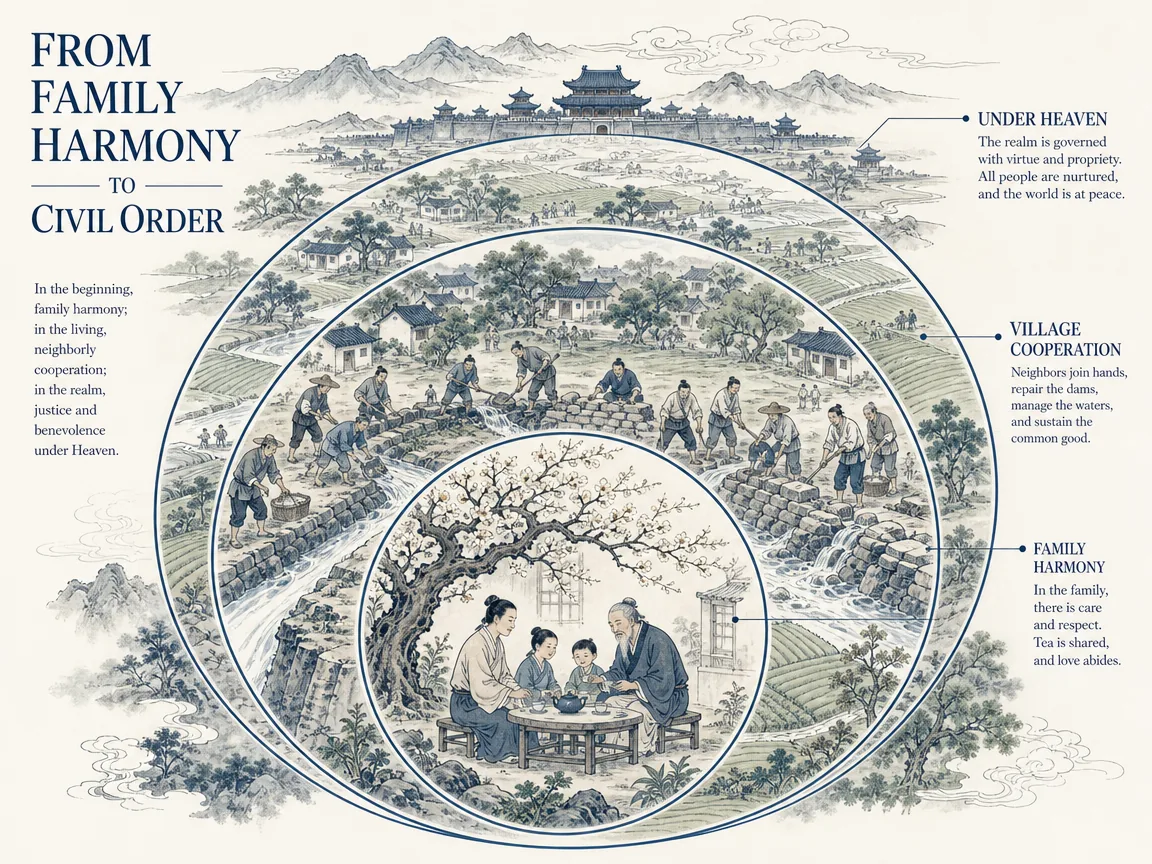
This sequence — self-cultivation, family regulation, state governance, and world peace (xiū shēn, qí jiā, zhì guó, píng tiān xià, 修身、齐家、治国、平天下) — is not merely a philosophical abstraction. It represents a profound reorientation of how human responsibility is understood. In many Western traditions, the relationship between the individual and the state is conceived as a contract between separate parties. In the Confucian vision, the individual, the family, the state, and the world are not separate spheres but concentric circles of expanding care and responsibility. The self is not an isolated atom; it is a node in a network of relationships that extends outward from the family to the kingdom to the whole world.
This worldview has practical implications. When a crisis strikes — a flood, a famine, an invasion, a pandemic — the Confucian framework encourages people to see themselves as part of a collective project rather than as individuals negotiating their own safety in isolation. The story of Yu the Great taming the floods, which dominates the Chinese imagination in ways that the biblical story of Noah does not dominate Western thinking, illustrates this point: the hero does not escape the disaster but works collectively to solve it.
Modern events have echoed this pattern. During the Wenchuan earthquake of 2008, volunteers and supplies streamed from across the country to the affected region. When the COVID-19 pandemic reached China in early 2020, medical teams and relief materials were dispatched from provinces nationwide to Hubei. These responses are not unique to China — solidarity in crises is a universal human impulse — but they take on a particular cultural texture in a context where the ethical language of mutual obligation runs deep and has been reinforced over millennia.
This does not mean that every Chinese person acts with selfless devotion to the collective. Individualism, corruption, and self-interest have always existed alongside the ideal. What the Confucian tradition provides is a moral vocabulary and a set of aspirations that orient public discourse and shape institutional expectations. It offers a framework within which questions of duty, responsibility, and the common good can be meaningfully discussed — a framework that has, for much of Chinese history, been the default language of political and ethical life.
Why This Matters for Modern Readers
The story of Chinese civilization's endurance is not primarily a matter of historical curiosity. It speaks directly to a question that occupies people in many countries today: how do we build and sustain a sense of shared purpose in societies that feel increasingly fragmented?
Many nations today are struggling with the erosion of common ground. Political polarization, the decline of shared institutions, and the rise of identity-based movements have left many people wondering whether large-scale communities can hold together without some unifying element. The Chinese experience — viewed through its own intellectual tradition — suggests that one powerful source of cohesion is not coercion or force but a shared cultural identity rooted in common symbols, practices, and values.
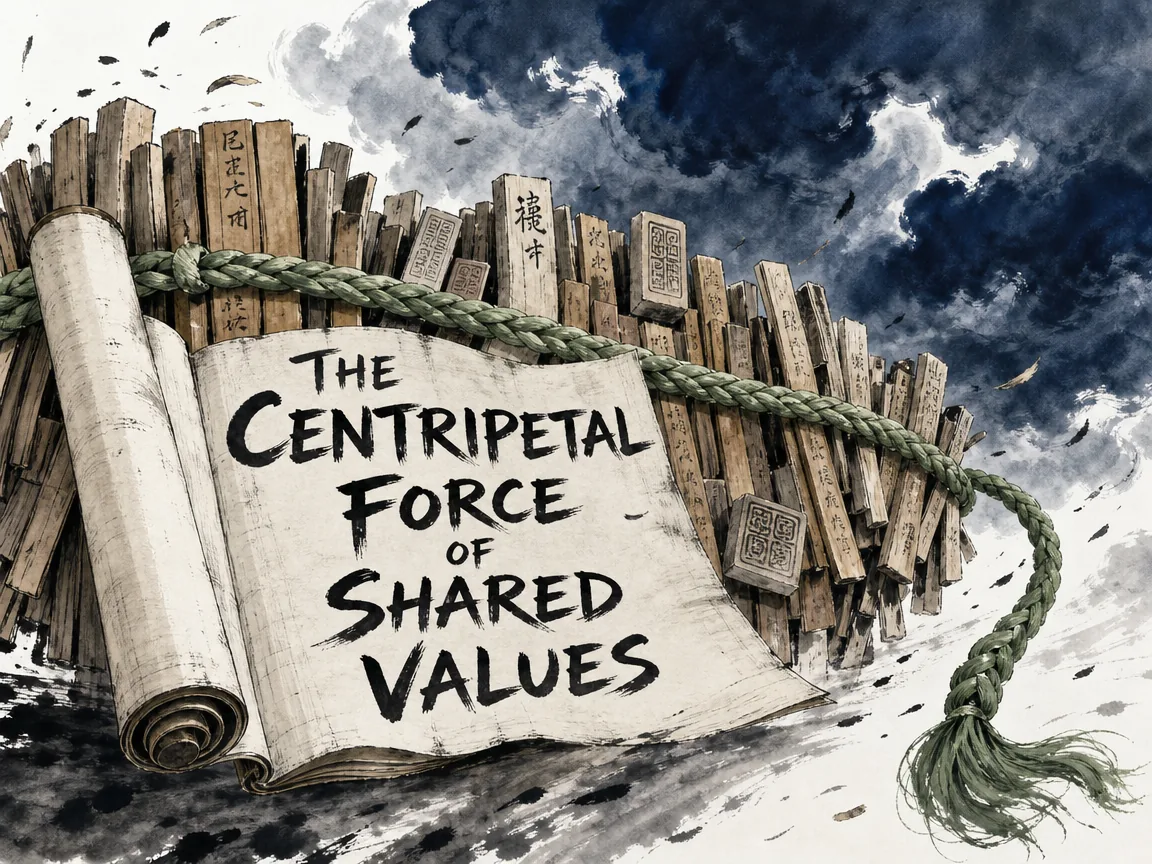
This insight can be translated into practical reflection without requiring anyone to adopt Chinese philosophy or identify as Chinese. The underlying question is universal: what creates a sense of belonging in a community? The Confucian answer points toward several elements that are transferable across cultures.
First, shared symbols and practices matter. A common language — not merely a tool for transaction but a vessel of meaning — allows people to share stories, histories, and aspirations. Second, a framework of mutual responsibility can transform the relationship between individuals and their communities. When people see themselves as connected to others through networks of obligation and care, collective action becomes more natural and less dependent on external enforcement. Third, the ideal of harmony without uniformity offers a model for managing diversity: unity does not require everyone to be the same, but it does require a common framework within which differences can coexist.
These principles are not exclusive to any one civilization. Every enduring society has developed its own versions of shared symbols, mutual obligations, and norms for handling difference. But the Chinese tradition — with its five millennia of continuous reflection on these questions — offers one of the richest and most systematically developed sets of resources.
For the modern reader, the takeaway is not that China is uniquely superior, but that cultural identity and shared values are real forces in history. They can be built, maintained, and strengthened. They can also be neglected and eroded. The civilizations that lasted were not those with the strongest armies or the largest territories, but those that solved the harder problem of creating meaning and belonging across generations.
FAQ
Is it true that China has maintained an unbroken civilization for 5,000 years? The idea of an unbroken, fully continuous Chinese civilization is a subject of scholarly debate. Some historians note that China's history is far less continuous and unified than some narratives suggest, with significant periods of fragmentation, foreign rule, and internal conflict [1]. However, there is no doubt that China maintains one of the world's oldest continuous cultural traditions, with a written record stretching back over three thousand years and philosophical concepts that remain relevant today.
Did Qin Shi Huang really create China's cultural unity? Qin Shi Huang (259–210 BCE) is credited with standardizing the written script, weights and measures, currency, and axle widths after conquering the other warring states. The unification of writing, in particular, is widely regarded by historians as a foundational act of cultural integration. However, the full effects of these policies unfolded over centuries, and later dynasties — especially the Han — played an equally important role in shaping the cultural framework that sustained Chinese civilization.
What is the Confucian concept of "harmony without uniformity"? The phrase "harmony without uniformity" (hé ér bù tóng, 和而不同) appears in the Analects (Zilu, 子路), where Confucius contrasts the noble person, who seeks harmony while allowing differences, with the petty person, who seeks uniformity while sowing discord [4]. It is an invitation to build communities that can accommodate diversity without demanding conformity — a principle that remains relevant in pluralistic societies today.
How can ordinary people apply these ideas in their own lives? The Confucian path from self-cultivation to world peace begins with small, everyday practices: refining one's character, nurturing healthy family relationships, contributing to one's community, and taking responsibility for one's role in larger social systems. The framework does not require grand gestures; it asks people to recognize that their personal conduct is connected to the wellbeing of the whole. In practical terms, this might mean investing in local community ties, engaging in dialogue across differences, or reflecting on how one's own actions contribute to the common good.
Summary
Chinese civilization's remarkable endurance is not explained by blood, religion, or military power alone. It rests on a deeper foundation: a shared cultural identity built around a unified writing system, a common philosophical tradition, and a vision of social order that connects the personal to the collective. The Confucian insight that harmony does not require uniformity — and that the path from self-cultivation to world peace passes through family, community, and state — offers a timeless framework for understanding how diverse peoples can belong to something larger than themselves.
For modern readers navigating an age of fragmentation and uncertainty, the lesson is both simple and profound: lasting unity begins not with borders or force, but with shared values, mutual responsibility, and a commitment to building common meaning. The question is not whether any civilization is destined to last forever — civilizations are dynamic, and they can decline [2] — but what we can do, in our own communities and lives, to strengthen the bonds that hold us together, reflecting the enduring wisdom of Chinese Cultural Wisdom.
Examine this artistic principle further through the classical aesthetic philosophy of What Confucius Meant by *Lǐ* (礼): Appropriateness Over Hierarchy.
For a deeper comparative examination of these ideas, explore our related study on When the Path Is Blocked: What Classical Chinese Wisdom Teaches About Frustrated Ambition.
Sources & Further Reading
[1] Civilizational State — China Media Project. Discusses the "civilizational state" concept and Lucian Pye's formulation that "China is a civilization pretending to be a state"
[2] Huntington, Samuel P. (1993). "The Clash of Civilizations?" — Foreign Affairs. The essay in which Huntington discusses civilizational identity and quotes Pye's formulation about China
[3] Philosophy in Han Dynasty China — Stanford Encyclopedia of Philosophy. Examines the relationship between state, institutions, and philosophy in Han China, noting that philosophy did not become entirely the purview of the state
[4] Analects / Zilu (論語/子路第十三) — Wikisource. Contains the passage "The gentleman aims at harmony, not uniformity; the petty man aims at uniformity, not harmony" (jūnzǐ hé ér bù tóng, xiǎorén tóng ér bù hé, 君子和而不同,小人同而不和)
[5] Classic of Rites / Great Learning (禮記/大學) — Wikisource. Contains the sequential passage on self-cultivation, family regulation, state governance, and world peace (xiū shēn, qí jiā, zhì guó, píng tiān xià, 修身、齐家、治国、平天下)
[6] Analects / Xue'er (論語/學而第一) — Wikisource. Contains the passage "In the application of ritual propriety, harmony is prized" (lǐ zhī yòng, hé wéi guì, 禮之用,和為貴)
Further Reading
-
Pye, Lucian W. (1990). "Spirit of Chinese Politics." Foreign Affairs. The original essay where Pye introduced the "civilization pretending to be a state" concept.
-
The Analects of Confucius — Multiple English translations available, including those by D.C. Lau and Edward S. Creel.
-
The Great Learning (大学) and The Doctrine of the Mean (中庸) — Core Confucian texts exploring the relationship between self-cultivation and social order.






