

We have all felt it: the strange clarity that arrives only after you have left. The city you grew up in, the neighborhood you walked past every day, the small café where nothing ever seemed to change — these places exist in the background of ordinary life. You do not notice them until they disappear from your daily sight. Then, suddenly, they are everywhere. They appear in dreams, in the smell of rain on familiar pavement, in the taste of a dish you thought you had forgotten. This is the paradox of home: we often do not truly find it until we are no longer standing inside it.
Modern life makes this paradox sharper than ever. We move for work. We study abroad. We become digital nomads, constantly relocating between cities and time zones. Technology lets us stay connected, but connection is not the same thing as rootedness. We carry our phones, our playlists, our social media profiles — but the ground beneath our feet keeps shifting. In a world that prizes mobility and reinvention, something essential feels quietly lost—a foundational perspective explored in Chinese Philosophy on Finding Home.
Chinese philosophy has long wrestled with this tension. It does not solve it by telling us to stay put. Instead, it offers a different way of understanding what it means to belong — one that does not require a fixed address, only a conscious relationship with where we come from and where we are going.
Chinese Philosophy on Finding Home: The Distance That Reveals
There is a reason hometowns become visible through absence. Proximity blinds us. When a place is your everyday reality, you see only its inconveniences: the traffic, the noise, the limits of what it offers. You do not see the shape of the whole. Only when you step away does the pattern emerge — the way the light fell on the street where you learned to ride a bike, the rhythm of seasons you once took for granted, the people who shaped your earliest sense of self.
This insight is not purely modern psychology. It echoes something Zhuangzi understood well: we often need distance from a situation to see it clearly. The mind is like a still pond — when we are too close to the surface, our reflection is distorted by our own agitation. Step back, and the water calms. The image becomes legible.

For people living mobile lives today, this is both a comfort and a challenge. The comfort is that the feeling of missing home is not a sign of failure or weakness. It is a natural cognitive and emotional response to dislocation. The challenge is that modern narratives often tell us to simply leave the past behind and build something new. Chinese thought offers a different path — not one of rejection, but of carrying forward.
Roots and Return: How Chinese Thought Understands Belonging
Chinese philosophy does not treat rootedness as a single point on a map. It treats it as a direction — a trajectory that moves through time as much as through space.
The image of fallen leaves returning to their roots — luò yè guī gēn (落叶归根) — captures this instinctively. A tree does not choose to shed its leaves toward the ground. It is simply the nature of things. The leaves fall where they began because the roots remember them. This is not a literal claim about botany, but a way of describing something we all feel: the deep intuition that where we come from continues to shape us, even when we travel far.
This intuition also explains a paradox many immigrants and expatriates know well: the closer you get to home, the more anxious you feel. The Tang poet Song Zhiwen captured this in a line that remains one of the most honest expressions of that tension — "As I draw near to home, my heart grows more timid, afraid to ask those I meet what has become of it" (jìn xiāng qíng gèng qiè, bù gǎn wèn lái rén, 近乡情更怯,不敢问来人) [1]. The longing is real. So is the fear. Home is not only a place of comfort; it is also a place of judgment, of memory, of everything you hoped and failed to be. To return is to confront yourself.
Chinese philosophical tradition does not shy away from this complexity. It does not promise that rooting yourself will erase the pain of displacement. Instead, it suggests that the very act of remembering — of holding your origins in mind — is itself a form of belonging.
The Idea of Authentic Origin
There is a concept in traditional Chinese medical and botanical thought that helps clarify why origin matters: the idea that a plant's character is inseparable from the land and knowledge that shaped it. Some materials note that this thinking about authentic regional sources has been discussed in scholarship, with different scholars placing its formal articulation at different points in history, including the Tang dynasty or later. What matters philosophically is not the exact date, but the intuition behind it: something cultivated in a particular place carries something of that place within it.
This is not mystical thinking. It is an observation about environment, adaptation, and continuity. A plant grown in one soil will differ from one grown in another. The difference is not accidental. It is built in. Connect these enduring values to the broader cultural heritage explored in When Institutions Fail: What Can Chinese Xia Philosophy Teach Us About Personal Justice and Moral Responsibility Today?.
The same logic applies to people. We are shaped by climates we once breathed, by languages we first heard, by foods our families cooked, by the unspoken rhythms of a place we called home. These influences are not decorative. They are structural. They form the architecture of who we are.
When we leave home, we do not leave these influences behind. We carry them as a kind of inner geography — a map written in memory, taste, habit, and sensation. The question is not whether we can escape our origins. The question is whether we can learn to read them.
Carrying Your Hometown Within You
The Chinese word for hometown — gùxiāng (故乡) — contains within it the idea of a place that is both behind and ahead of you. It is where you came from, but it also points toward where you are headed. This is not a contradiction. It is a way of understanding life as continuous rather than fragmented.
A person who moves to a new country does not become a different person because of the move. They become a person who carries multiple layers of experience. Their accent may soften. Their palate may expand. Their sense of humor may adapt to new social codes. But underneath all of that, certain responses remain unchanged: the smell of a particular spice that triggers a childhood memory, the sound of rain on a roof that reminds you of a house you no longer live in, the comfort of a dish your grandmother made on cold evenings. These are not nostalgic luxuries. They are evidence of continuity.
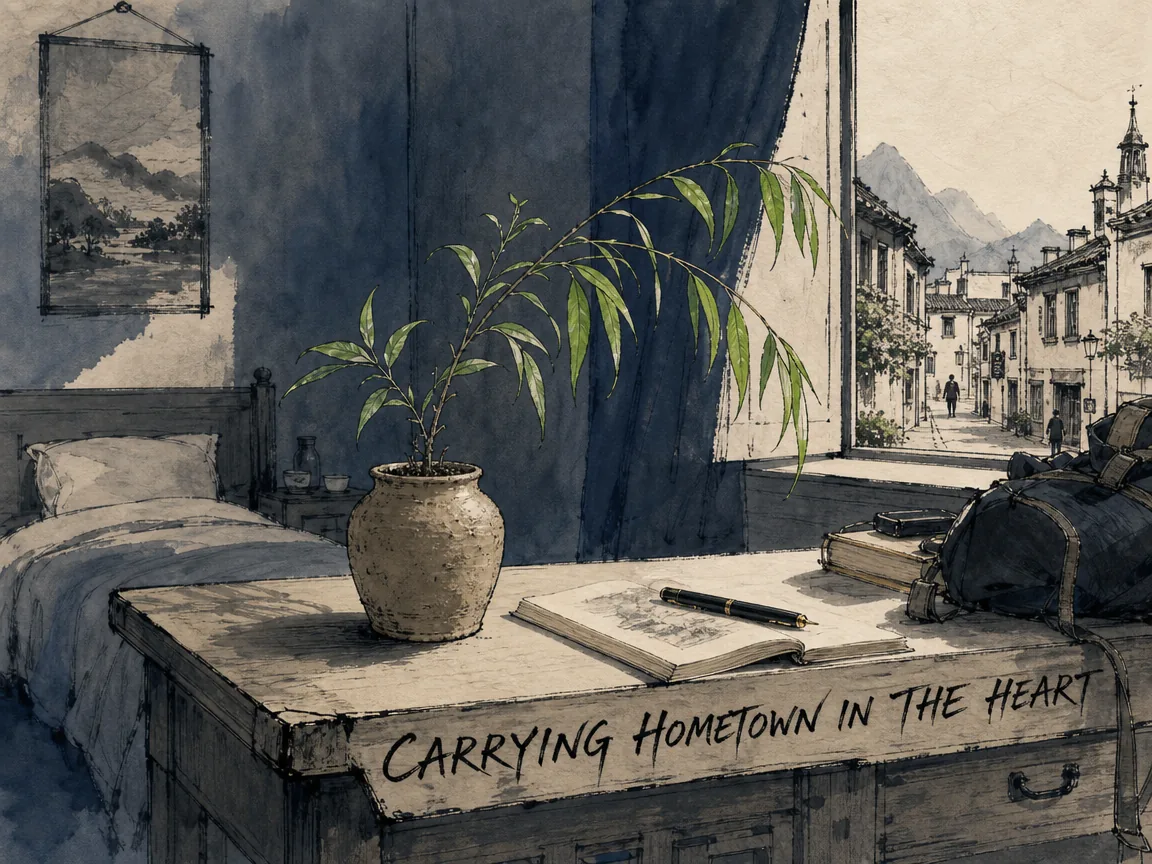
Chinese thought suggests that belonging is not a location you reach, but a relationship you maintain. You can maintain that relationship even across oceans. You do not need to be physically present in your hometown to honor it. You honor it by remembering what it taught you. You honor it by carrying its values, its ways of seeing, its quiet wisdom into the places you now call home.
This perspective also reframes the experience of displacement. Moving is not a betrayal of your origins. It is an extension of them. The roots you carry are not chains. They are compasses.
The Modern Challenge: Rootlessness Disguised as Freedom
Contemporary life presents a particular difficulty: it often confuses movement with progress. We are told that changing cities, changing careers, changing identities is a sign of vitality. Staying put is painted as stagnation. This narrative is appealing because it promises freedom — freedom from the constraints of the past, from expectations, from the weight of history.
But freedom without rootedness can become a kind of lightweight floating. You move easily, but you do not settle deeply. You collect experiences, but you do not accumulate meaning. Over time, this can produce a subtle but persistent sense of homelessness — not the physical kind, but the existential kind. You are somewhere, but you do not feel like you belong there. And you are no longer sure where you belonged before.
Chinese philosophy offers a corrective without demanding that you stop moving. Daoism teaches that flexibility and rootedness are not opposites. A reed bends in the wind without breaking because it is anchored. A tree that tries to resist the wind entirely may snap. The wise approach is to be flexible in form while remaining grounded in essence. You can adapt to new climates — cultural, professional, geographic — without losing the core of who you are.
Confucianism adds another dimension: the importance of remembering where you come from. To honor your origins does not mean you must return to them. It means you carry them with integrity. When you know your roots, you move forward with direction rather than drift.
The challenge of our age is not to choose between mobility and rootedness. The challenge is to practice both simultaneously — to move through the world with openness while staying connected to what shaped you.
Practical Wisdom: How to Live With Your Roots
You do not need to write a letter to your hometown or take a pilgrimage to prove that you remember it. Rootedness is practiced in small, daily acts of attention.
Notice what your body already knows. What smells remind you of home? What songs make you feel suddenly young? What dishes bring back faces you have not seen in years? These are not accidents. They are signals from a part of you that has never stopped keeping track of where you came from. Pay attention to them.
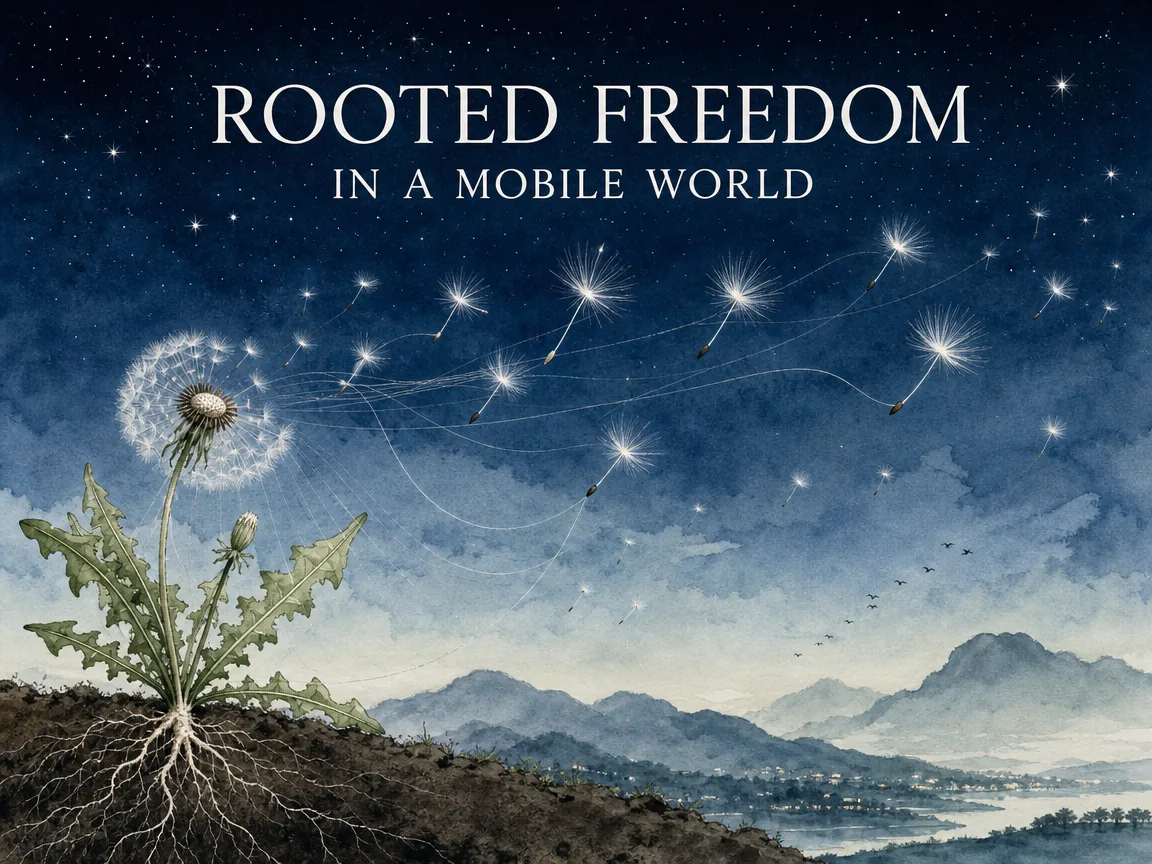
Build local roots without abandoning distant ones. Belonging is not a zero-sum game. You can learn to love your new city — its streets, its people, its seasonal rhythms — while still honoring the place that raised you. The two loyalties can coexist. In fact, they enrich each other. The perspective you bring from your hometown makes your new home more meaningful. The experiences you gain in your new home make your hometown more beautiful in memory.
Think about your own version of authentic-region produce (dàodì yàocái, 道地药材) — the idea that authenticity comes from the relationship between a thing and the conditions that formed it. Your "authentic region" is not only the geography of your birth. It is also the relationships, traditions, and practices that have shaped you. These can be cultivated anywhere. A kitchen where you cook the food of your upbringing. A community of people who share your values. A practice of reflection that keeps your origins alive in your daily life.
Ask yourself a simple question: what has your hometown taught you that you still carry? It might be a work ethic. A way of treating guests. A sense of humor. A tolerance for hardship. A reverence for family. Whatever it is, it is part of your inner compass. It has guided you to where you are now. And it will continue to guide you wherever you go next.
Frequently Asked Questions
Can I feel rooted if I have never lived in one place for very long?
Yes. Rootedness does not require years of physical presence in a single location. It requires intentionality — the deliberate practice of remembering, honoring, and integrating the places and people that have shaped you. Some of the most rooted people are those who have moved the most, precisely because they have learned to carry their origins with them rather than leave them behind.
Is missing home a sign that I made the wrong decision to leave?
Not necessarily. Missing home is a sign that home mattered to you. It is a form of love, not failure. The question is not whether you should have stayed, but how you can honor what you left while fully engaging with what you have found. Both feelings can be true at once.
How do I balance honoring my origins with embracing my new life?
The two are not in competition. You honor your origins by letting them inform the way you live now — your values, your relationships, your approach to challenges. You embrace your new life by allowing it to expand what you already know, not replace it. Think of your roots as the foundation of a house, not the walls that confine it.
What if I feel disconnected from my hometown because it has changed so much?
This is one of the most common experiences of people who leave and return. Places change. People change. The hometown you remember may no longer exist in the same form. This does not mean your connection was imaginary. It means that belonging is not solely about geography. It is also about memory, imagination, and the meaning you assign to where you came from. You can honor the hometown of your past while making room for the hometown of your present.
Closing Thoughts
Home is not only a place you left behind. It is also a place you carry within you. Chinese philosophy offers a gentle but powerful reminder: rootedness is not the opposite of movement. It is the quality that gives movement meaning. You do not need to stop traveling to feel at home. You need only to remember where you came from — and let that memory become part of how you live wherever you are.
If this topic resonates with you, consider exploring how other Chinese philosophical traditions understand belonging, change, and the art of living well in uncertain times. The conversation is far from over — and it may be more relevant to your life now than ever before, reflecting the enduring wisdom of Chinese Philosophy on Finding Home.
To explore these themes from another angle, read our related reflection on Why Winning Too Hard Can Destroy You: What Sun Tzu’s Art of War Teaches About the Hidden Cost of Initiative.
For a deeper comparative examination of these ideas, explore our related study on What Can Du Fu’s Lifelong Failures Teach Us About Finding Meaning in Disappointment?.
Sources & Further Reading
[1] Song Zhiwen: "Crossing the Han River" (渡汉江) – Guwen Island (古文岛)
Further reading
- Zhuangzi — selections on perspective, freedom, and the nature of boundaries
- Confucian Analects — passages on filial piety, remembrance, and moral continuity
- Daoist texts on wuwei (non-action) and natural alignment
- Studies on the concept of authentic-region medicinal herbs (dàodì yàocái, 道地药材) in traditional Chinese medicine
- Research on diaspora identity and the psychology of belonging in mobile populations







[…] Du Fu died aboard a small river boat, an enduring witness to displacement and longing; for a wider philosophical reflection on finding rootedness in an unstable world, see Why Do We Only Truly Find ‘Home’ After Leaving It? What Chinese Philosophy Can Teach Us …. […]