
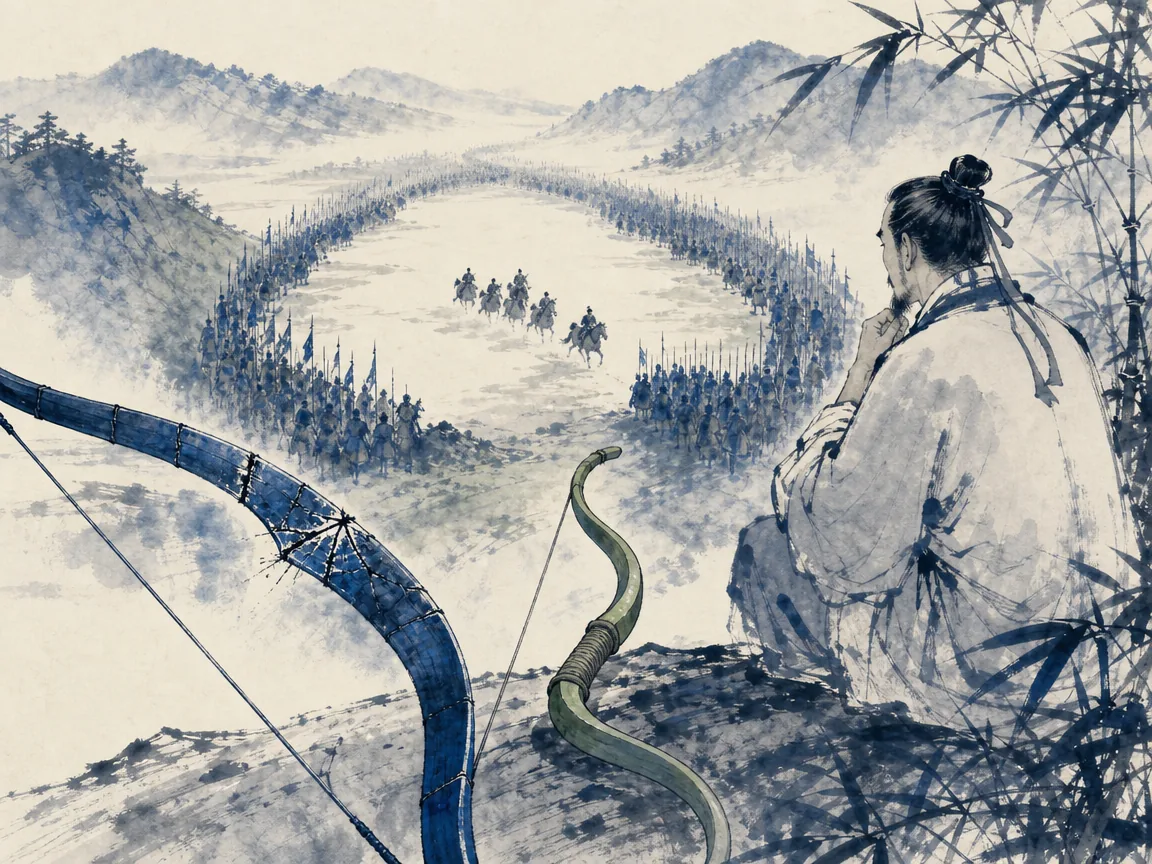
A steel beam that bites too hard snaps at its center. In the first two installments of this series, we explored how to define a situation and compress an opponent's available choices. Those are powerful moves — defining the battlefield and narrowing your adversary's options can make victory feel inevitable. But Sun Tzu, in his Jūn Zhēng (Military Contention, 军争) chapter, pivots with a quiet but devastating sentence: turn adversity into strategic advantage (yǐ huàn wéi lì, 以患为利). The catch? Every point of pressure you apply to your opponent costs real resources. The deeper question is not how to seize initiative, but how to hold it without breaking yourself first.
This is the paradox that most strategy guides skip over. Initiative is not infinitely valuable. When the pursuit of control stretches beyond your system's actual capacity, it stops being an advantage and becomes the very thing that collapses you first. Sun Tzu warns that the difficulty of contesting advantage lies precisely in this reversal — turning hardship into benefit only works when your system holds enough reserve to absorb failure [1]. If it does not, the detour he praises is not a clever path around difficulty; it is a delayed collapse—a foundational perspective explored in Sun Tzu Chapter 21 Strategy.
Sun Tzu Chapter 21 Strategy: Three Layers of Resource Stretch
Most people see only the surface layer of what overextension looks like. They think of money running out — capital, supply chains, inventory, the visible and quantifiable stuff. That is the outer ring, and it is the easiest to measure and the easiest to misread.
Beneath that lies the organizational layer: decision quality, coordination costs, the health of key personnel. This layer is invisible until the people holding it together are gone. A company can still process invoices and send memos while its decision-making apparatus has quietly degraded.
The deepest layer — and the most dangerous — is cognitive. Judgment accuracy, priority recognition, grip on reality. This layer degrades silently and irreversibly. As behavioral neuroscience research reviews (学术综述) show, conditions of work overload produce higher subjective cognitive load, lower performance scores, and increased error rates, particularly under multitasking demands [3]. The critical warning applies equally to armies and organizations: the system is still making big decisions even as its judgment is failing. You haven't run out of money; you've run out of clarity. Your hands are still moving even after your mind is saturated.
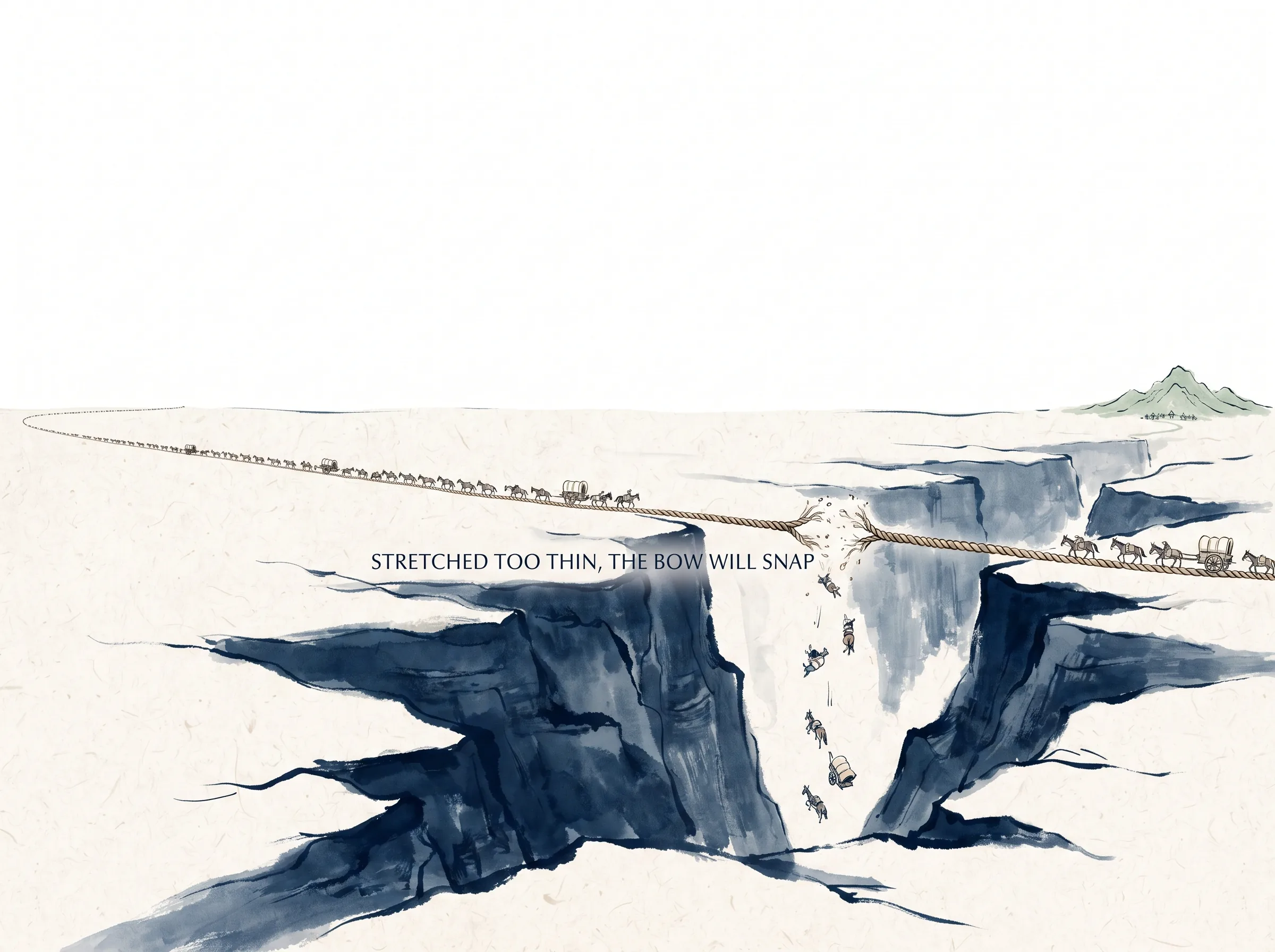
Sun Tzu understood this physically. The Jūn Zhēng chapter spells out the cost of overreach in blunt terms: when an army marches to seize advantage, not all troops arrive; when it sheds its baggage to move faster, it loses its supplies. Forces that compete over thirty li arrive only two-thirds strong; those pushing fifty li suffer the loss of their commander, and only half arrive [1]. An army without supplies, without grain, without reserves perishes [1]. These are not metaphorical observations. They describe a real hierarchy of depletion — from the visible (equipment) through the structural (organization) to the vital (the capacity to judge).
Continue with the deeper interpretation and practical application.
ChiDestiny members get access to the full analysis, modern applications, and the growing Chinese Wisdom Library.
FAQ
Q: Can an organization recover from cognitive-layer stretch, or is the damage permanent?
A: Cognitive degradation under sustained overload is reversible if the overload is removed in time. Research on work overload indicates that performance declines and error rates increase under high cognitive load, but these effects are conditional on the load being present [3]. Removing the excessive demands — reducing multitasking, restoring sleep, simplifying decision pipelines — allows judgment capacity to recover. The danger is that organizations rarely recognize they are in this state until it is too late, because the impairment of judgment means they cannot accurately assess their own impairment.
Q: How do you distinguish between legitimate expansion and overextension?
A: The key diagnostic is carrying capacity, not ambition. Ask whether your system has sufficient buffers — financial, organizational, and cognitive — to absorb a setback without cascading failure. Donella Meadows identifies buffer size relative to flow as one of the most effective places to intervene in a system [4]. If your buffers are thin and your flows are accelerating, you are likely overextended regardless of how promising the opportunity looks.
Q: Does Sun Tzu recommend passivity or caution?
A: No. Sun Tzu recommends calibrated aggression. The Jūn Zhēng chapter teaches that initiative is valuable but costly, and that the art of contesting advantage lies in understanding those costs before you pay them [1]. The recommendation is not to avoid action but to act only when your system can sustain the action and its inevitable failures.
Q: What role does antifragility play in avoiding collapse?
A: Antifragility — the capacity to gain from disturbance — is the opposite of the fragile overextension described here. An antifragile system does not merely survive pressure; it becomes stronger through it. Nassim Taleb's framework distinguishes this from resilience, which only absorbs stress, and fragility, which breaks under it [4]. Building antifragility requires deliberate exposure to manageable stressors and the retention of enough slack to learn from them rather than be consumed by them, reflecting the enduring wisdom of Sun Tzu Chapter 21 Strategy.
To explore these themes from another angle, read our related reflection on Shaping the Battlefield: How Ancient Chinese Strategy Teaches You to Design Your Competitor’s Choices.
For a deeper comparative examination of these ideas, explore our related study on How Sun Tzu’s ‘Empty and Full’ Teaches You to Make Opponents Waste Their Strength.
Sources & Further Reading
[1] The Art of War (《孙子兵法》) – Chinese Wikisource — Primary source for Sun Tzu's Jūn Zhēng chapter text, including the passage on turning adversity into advantage (yǐ huàn wéi lì, 以患为利) and warnings about strategic overextension.
[2] Die Ardennenoffensive 1944/45 – Bundesarchiv — Historical account of the 1944 Ardennes offensive, its planning, and the factors leading to its failure.
[3] The role of AI and team topologies in enhancing decision-making flexibility by reducing cognitive overload – PMC — Scientific literature review (学术综述) on cognitive overload, workload, and performance degradation under multitasking conditions.
[4] Leverage Points: Places to Intervene in a System – The Donella Meadows Project — Meadows' framework on system leverage points, including the role of buffers and stabilizing stocks.
[5] Further Reading (not cited as direct evidence in this article):
[6] Nassim Taleb, Antifragile: Things That Gain from Disorder — For the fragile/resilient/antifragile typology referenced in the article.
[7] Donella Meadows, Thinking in Systems: A Primer — Expanded treatment of systems thinking and buffer dynamics.
[8] Daniel Kahneman, Thinking, Fast and Slow — For the cognitive load and judgment under overload framework referenced in the article.






