

Most people understand "moving first" as simply being faster — striking before the opponent, grabbing resources, occupying ground, and setting the pace of conflict. In business, in negotiations, in daily competition, we are taught that the first mover advantage belongs to whoever acts quickest and most aggressively. This intuition feels right. Speed is visible. Force is legible. It is easy to mistake momentum for strategy.
But the ancient Chinese strategists asked a different question — one that cuts beneath the surface of speed and force. If you define the situation before the opponent does, what can they actually do? If they can still choose freely, then your first move has not truly taken effect. This is the deeper lesson of the Art of War: the first move is not about physical advantage or early action. It is about structural compression — reshaping the conditions so that the opponent's "free choices" naturally lead to outcomes you have already designed—a foundational perspective explored in Sun Tzu Chapter 20 Strategy.
This is not a theory of manipulation. It is a theory of clarity. The person who moves first in this deeper sense is the one who sees the shape of the board before the pieces are set in motion. What follows is an exploration of how this ancient insight works, why it matters, and what it teaches us about winning — and about the hidden cost of trying to win.
Sun Tzu Chapter 20 Strategy: Beyond Speed
In Chinese strategic thought, the concept of xiān shǒu (first initiative, 先手 — literally "first hand" or proactive move) carries a meaning far richer than the English phrase "to move first" suggests. In conventional usage, xiān shǒu (先手) means acting ahead of the opponent, seizing initiative, and gaining the upper hand through speed or force. But when Sun Tzu and later strategic commentators return to this concept, they push past the surface reading and ask: once the board is set, how much freedom does the opponent actually retain?
A widely circulated strategic maxim frames the point sharply: what the opening move truly takes away is the rival's optionality (先手真正夺走的,是对手的选择权 — "The essence of initiative is not seizing territory; it is depriving the opponent of the freedom to choose"). Whether this exact phrasing appears verbatim in any surviving chapter of the text is uncertain; what is certain is that the idea — that the first move is about constraining the opponent's options, not merely occupying space — runs through classical Chinese strategic thought [2].
The difference between two kinds of first moves can be illustrated simply. In a consumptive first move (xiāohào-shì, 消耗式), you occupy a position and the opponent responds by opening a new front or finding a parallel route. You both expend energy. The advantage is real but shallow — measured in territory, time, or resources, not in structure. In a suppressive first move (yāzhì-shì, 压制式), you do not necessarily occupy the most valuable ground. Instead, you reshape the landscape of possible responses so thoroughly that every reasonable option the opponent considers has already been anticipated and accounted for.
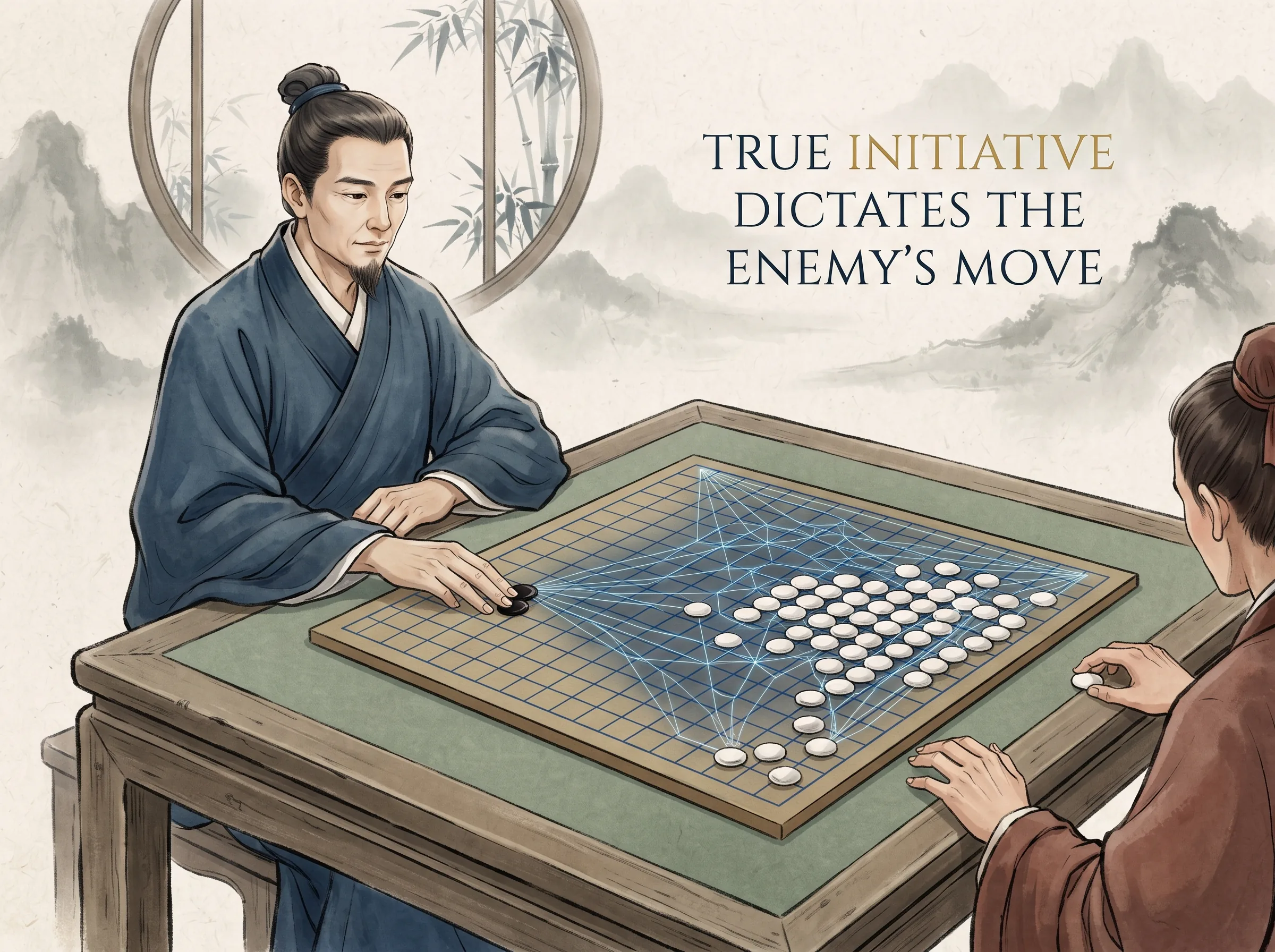
From a modern angle, we might say: the consumptive first mover fights within the existing structure of the game. The structural first mover changes the structure itself.
This is not a new idea in Western strategic theory either. Carl von Clausewitz wrote about the primacy of the defensive in certain circumstances, arguing that the defender enjoys an inherent advantage because they can shape the terms of engagement [2]. What classical Chinese strategy adds is not a competing conclusion but a different emphasis — a focus on choice architecture as the primary instrument of strategy, rather than on firepower, troop numbers, or positional dominance alone.
Continue with the deeper interpretation and practical application.
ChiDestiny members get access to the full analysis, modern applications, and the growing Chinese Wisdom Library.
FAQ
Q1: Is "moving first" always about being the fastest to act?
No. Speed can be advantageous, but the deepest form of first-mover advantage is structural, not temporal. It is about defining the conditions of the contest before the opponent has a chance to respond — so that their responses, however prompt, operate within boundaries you have already set.
Q2: Can this approach be used ethically, or does it require manipulation?
The framework describes how strategic advantage works, not whether it should be used in every situation. Using structural advantage to protect legitimate interests, create stable environments, or prevent worse outcomes is a defensible application. Using it to harm others unfairly or to create deceptive conditions crosses an ethical line. The distinction lies in intent and consequence, not in the technique itself.
Q3: Why does the Art of War emphasize choice compression over direct confrontation?
Because direct confrontation is costly. Every battle that is fought is a battle that must be won — and winning costs resources, time, and risk. If the same outcome can be achieved by shaping the conditions so that the opponent chooses the path you prefer, the cost of victory is dramatically reduced. This is not cowardice. It is efficiency.
Q4: What is the risk of overestimating your own structural advantage?
The greatest risk is the belief that control is permanent once achieved. Structures decay. Ecosystems shift. What compresses an opponent's choices today may open new possibilities tomorrow if you fail to maintain the capacity that sustains your position. The Art of War repeatedly warns that overreach — the failure to recognize the limits of your own capacity — is as dangerous as any external threat.
Conclusion: From "Am I Strong Enough?" to "How Many Choices Do They Have?"
The shift from speed-based strategy to structure-based strategy is, in many ways, a shift in perspective rather than a shift in tactics. It asks you to stop asking, "How can I win this confrontation?" and start asking, "What shape does this game take, and who gets to define that shape?"
Ancient Chinese strategic thought does not promise that you can control everything. It promises something more modest and, in many ways, more useful: that the person who understands the structure of choice has an advantage over the person who only understands the mechanics of force. Speed wins battles. Structure wins wars.
The next time you find yourself in a competitive situation — whether in business, in personal decisions, or in any context where outcomes matter — consider this question: If I were to step back and look at the board from outside the contest, how many choices does my opponent really have?
The answer may surprise you. And the act of asking the question may be the first move, reflecting the enduring wisdom of Sun Tzu Chapter 20 Strategy.
To explore these themes from another angle, read our related reflection on Why Winning Too Hard Can Destroy You: What Sun Tzu’s Art of War Teaches About the Hidden Cost of Initiative.
For a deeper comparative examination of these ideas, explore our related study on How to Stop Deciding Who Is Useful and Who Is Not — Laozi on True Judgment.
Sources & Further Reading
[1] The Battle of Sedan — napoleon.org. Historical account of the 1870 battle, including details on the French encirclement and command changes during the engagement.
[2] Daniel Kahneman – Biographical — NobelPrize.org. Overview of Kahneman's contributions to behavioral economics, including Prospect Theory and the study of cognitive biases in decision-making.
[3] U.S. v. Microsoft: Court's Findings of Fact — U.S. Department of Justice, Antitrust Division. Legal document detailing the court's findings on Microsoft's market position, application ecosystem, and barriers to entry for competing operating systems.
[4] Further Reading (not cited as evidence in this article):
[5] The Art of War by Sun Tzu — classical Chinese military treatise, various translations and commentaries available.
[6] Thinking, Fast and Slow by Daniel Kahneman — exploration of System 1 and System 2 thinking and their implications for decision-making.
[7] On War by Carl von Clausewitz — Western strategic theory complementary to and distinct from Chinese strategic thought.







[…] As Chinese civilization developed, the dragon's meaning shifted again. It became associated with imperial authority, with the Mandate of Heaven, with the idea that certain rulers embodied cosmic order on earth. Eventually, in some accounts, even the emperor's lineage was said to descend from dragon blood. But this political appropriation did not erase the dragon's earlier associations. The creature remained tied to water, clouds, and transformation. It carried both meanings at once. To explore these themes from another angle, read our related reflection on Moving First: How Ancient Strategy Teaches Us to Shape the Board, Not Just the Battle. […]
[…] To explore these themes from another angle, read our related reflection on Moving First: How Ancient Strategy Teaches Us to Shape the Board, Not Just the Battle. […]