
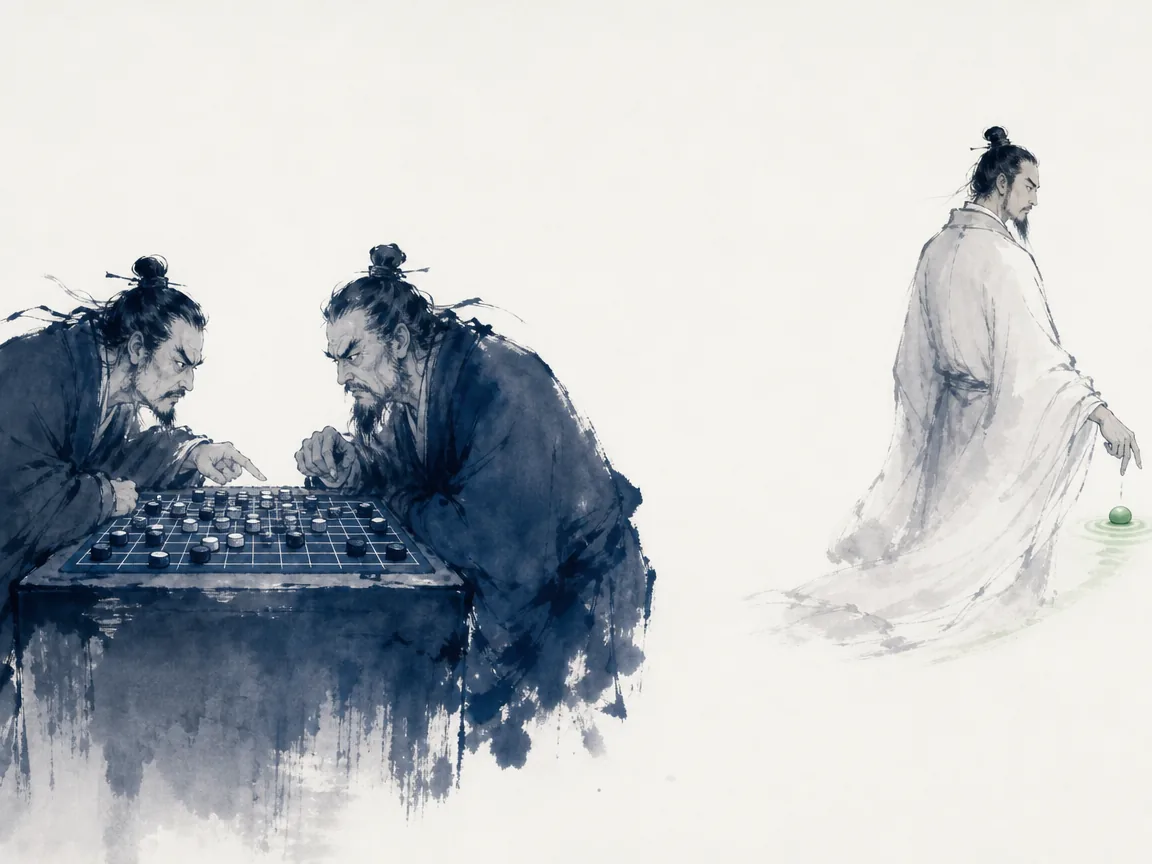
We live in a culture that celebrates speed. "First-mover advantage." "Seize the moment." "Don't wait — action is everything." Across workplaces, relationships, and personal goals, the underlying message is nearly universal: whoever acts fastest holds the upper hand. React quickly. Decide immediately. Move before the opportunity disappears. It feels like wisdom. It often feels true.
But there is a quiet trap hiding inside this advice. Moving fast doesn't necessarily mean you are in control. It may simply mean you are responding quickly — and responding to someone else's setup. Running faster inside a circle someone else drew is still running inside that circle. The speed is real. The freedom is not—a foundational perspective explored in Sun Tzu on Initiative.
This distinction matters more than we often admit. In career negotiations, relationship disagreements, and the daily decisions that shape our lives, the instinct is to react — to answer the email, concede the point, chase the next opportunity. Yet some of the most consequential moments in history, and in ordinary life, turn not on who acted fastest, but on who defined the terms of the contest itself. Ancient Chinese strategic thought offers a different way of understanding initiative — one that is especially relevant when the world rewards haste.
Sun Tzu on Initiative: What the Art of War Says About Initiative
The Art of War (Sunzi Bingfa, 《孙子兵法》) — traditionally attributed to Sun Tzu and widely regarded as one of the foundational texts of Chinese strategic thinking — contains a chapter specifically devoted to the dynamics of competition, known as the chapter on Military Contention (Junzheng, 军争篇) [1]. In it, Sun Tzu challenges the commonsense equation between speed and advantage. The most famous formulation runs: "In war, the way is to avoid what is strong and to strike at what is weak" — but the equally important passage for our purpose comes earlier:
Jun zheng zhi nan zhe, yi qu wei zhi, yi huan wei li. "The difficulty of military contention lies in making the tortuous direct, and the advantageous disadvantageous." [1]
This sounds paradoxical at first. How can a long, winding route be the shortest path? How can a hardship become an advantage? The answer, Sun Tzu suggests, depends on something deeper than pace: it depends on who controls the conditions under which the competition unfolds. The passage is immediately followed by a more concrete description of the principle in action:
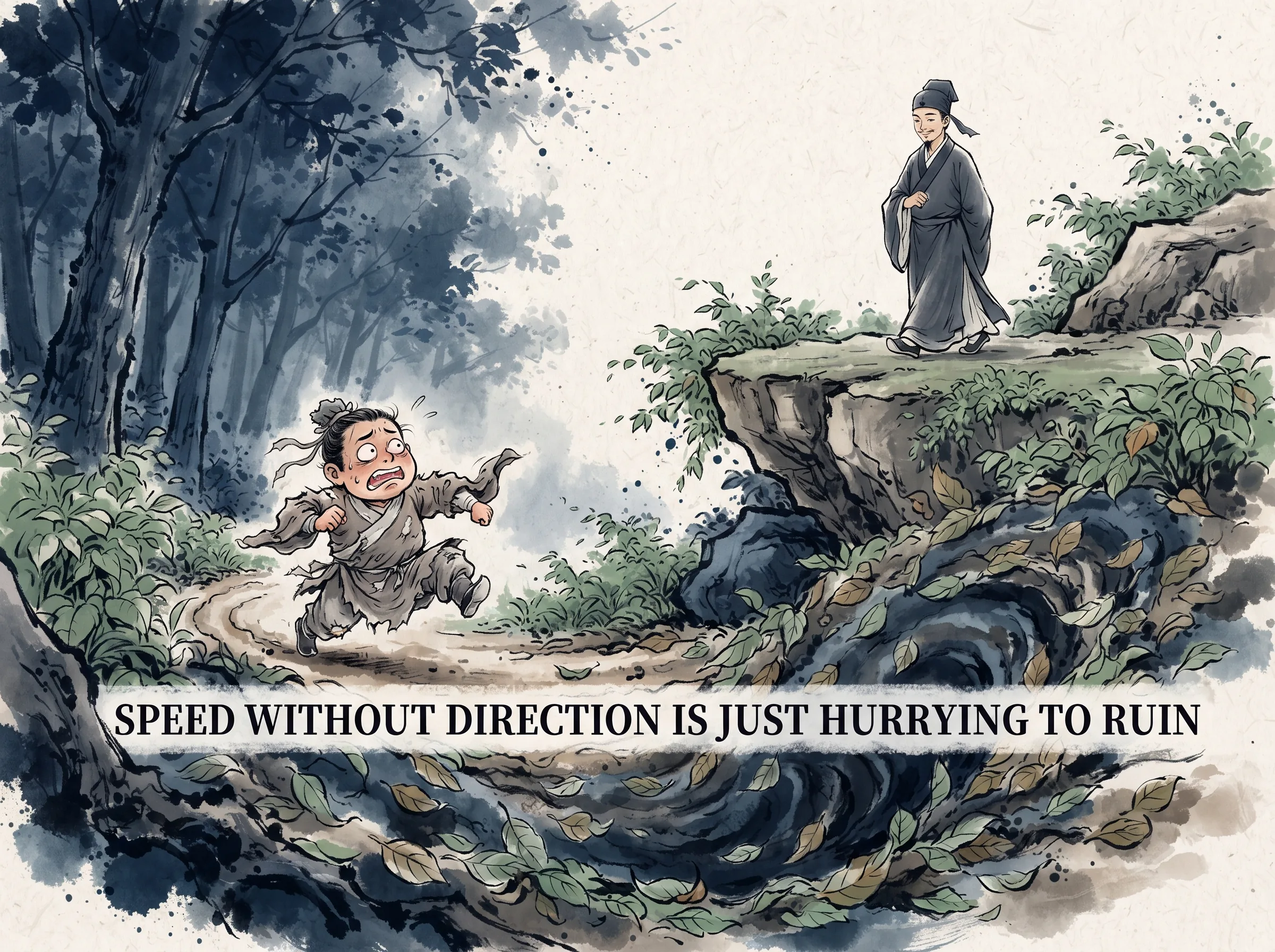
Gu qu qi tu, er you zhi yi li, hou ren fa, xian ren zhi, ci zhi qu zhi ji zhe ye. "So the craftful leader manipulates others by presenting them with advantages, and by altering their expectations. He may set out later than others but arrive before them — this is the meaning of understanding the dynamics of the tortuous and the direct." [1]
The strategy is not to race. It is to shape the race itself — to determine the terms, the terrain, the timing, and the rules that everyone else must then navigate. The person who sets the frame does not need to move first. They need to move deliberately, and to ensure that their opponent is always responding to something the strategist has already chosen.
Continue with the deeper interpretation and practical application.
ChiDestiny members get access to the full analysis, modern applications, and the growing Chinese Wisdom Library.
FAQ
Is the idea that "initiative is about definition, not speed" actually from the Art of War? The Art of War does not use the modern phrase "initiative is definition." However, the chapter on Military Contention (Junzheng) contains the well-known passage "making the tortuous direct, and the advantageous disadvantageous," which has been widely interpreted by commentators across centuries as expressing precisely this principle — that strategic advantage comes from shaping conditions rather than merely moving quickly [1].
Does this mean acting fast is always wrong? No. Speed has its place, and Sun Tzu himself acknowledged that rapid movement can be essential in certain circumstances. The point is that speed without strategic definition is incomplete. The fastest runner on the wrong track is still running the wrong track.
Can this kind of thinking be applied outside of competitive or adversarial situations? Yes. While the Art of War is a military text, its insights about framing, timing, and context have been applied to business strategy, negotiation, leadership, and personal decision-making. The core idea — asking who defines the situation and whether the definition still fits — is broadly applicable.
How is this different from simply being patient or avoiding action? Patience and deliberate reflection are valuable, but this approach goes further. It is not about delaying action indefinitely; it is about ensuring that whatever action you take is oriented toward a frame you have consciously examined, rather than one you inherited passively.
Summary
Acting fast feels like control, but it often is not. True initiative — the kind that sustains rather than merely reacts — depends less on speed than on the ability to see and shape the conditions of a situation before committing to it. The Art of War teaches this through the principle of "making the tortuous direct," reminding us that the shortest path to advantage is not always the most obvious one [1]. History, from the campaign at Fancheng to the quiet struggles of modern life, offers repeated examples of people who won battles within frames they did not choose and lost wars as a result [2].
The practical path forward is not complicated, though it is not always easy. Pause. Ask who set the terms. Check whether the situation has changed since you last examined it. Consider whether you can redefine the problem before you invest in solving the wrong one. And remember: wisdom includes knowing when to accept the frame as it is, and when it is worth reshaping.
If this perspective resonates with you, consider carrying one simple question into your next challenging moment: Am I operating on terms I chose, or terms someone else set? That single question may be the most strategic move you make all day, reflecting the enduring wisdom of Sun Tzu on Initiative.
To explore these themes from another angle, read our related reflection on Why Knowing What to Do Isn’t Enough: Sun Tzu’s Hidden Lesson on Adaptation.
For a deeper comparative examination of these ideas, explore our related study on How Collapse Is Never Sudden: Sun Tzu’s Warning for Modern Systems.
Sources & Further Reading
[1] Sunzi Bingfa (The Art of War) — Wikisource — Contains the received Chinese text of the Art of War, including the chapter on Military Contention (Junzheng, 军争篇), which includes the passage ("以迂为直,以患为利", "turning the devious into the direct and turning adversity into advantage") and related strategic principles. ()
[2] Sanguozhi, Volume 36 (Records of the Three Kingdoms, Biography of Guan Yu) — Wikisource — Contains the historical account of Guan Yu's campaign at Fancheng (建安二十四年), the flooding that led to Yu Jin's surrender, and the subsequent loss of Jing Province to Sun Quan's forces.
Further Reading (Not Cited in Body)
- Griffith, Samuel B. (trans.). The Art of War. Oxford University Press. A widely available English translation with scholarly notes.
- Bleiler, Richard E. The Art of War: Ancient Chinese Military Classics. Dover Publications. An accessible edition with historical context.
- Fairbank, John K. & Goldman, Merle. China: A New History. Harvard University Press. Provides broader historical context for the Three Kingdoms period.






