
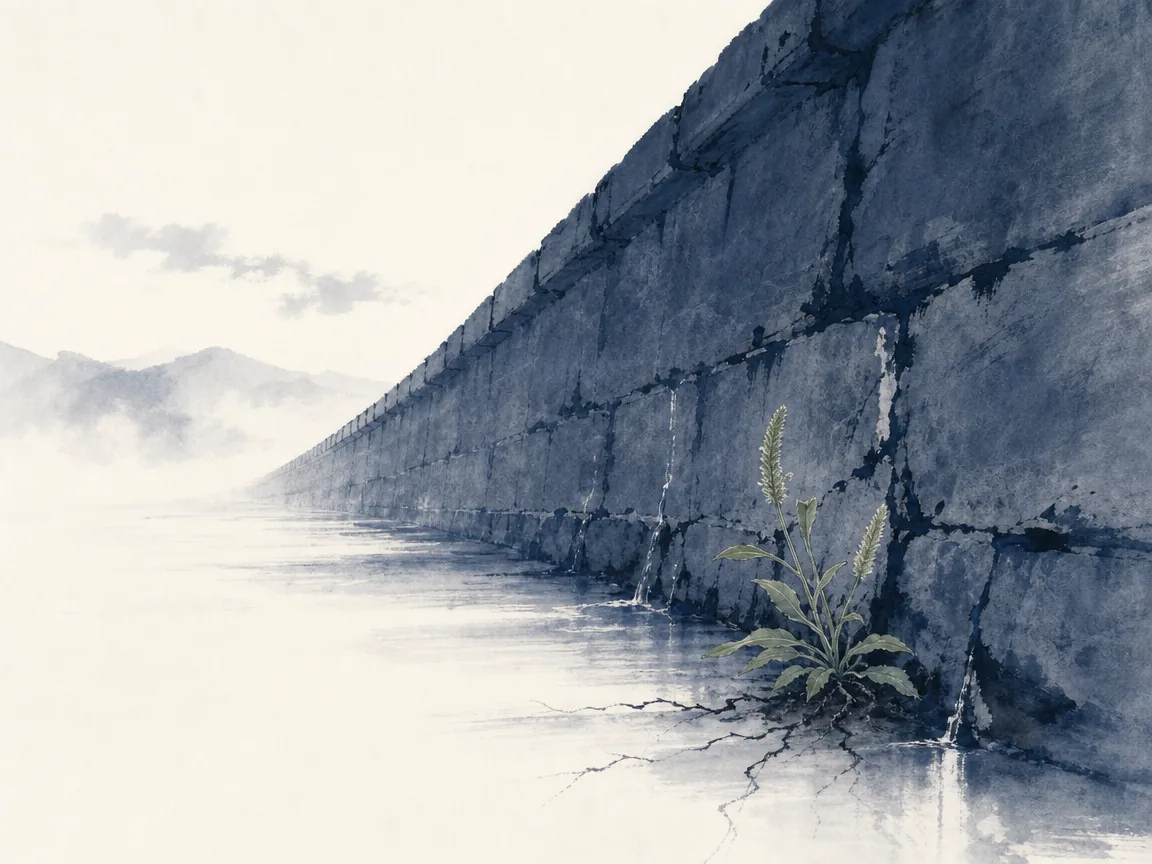
Most people experience collapse as a single, shocking moment — a company filing for bankruptcy, a team fracturing in public, a long-held routine imploding overnight. But the decisive failure you witness is rarely the cause. It is the final visible point of a long hidden process, one that has been running quietly for months or years beneath the surface.
Sun Tzu's Bingfa (《孙子兵法》), one of the oldest military treatises in world history, understood this principle with unusual clarity. Written roughly two and a thousand five hundred years ago, its chapters do not merely describe how to win battles; they describe how systems fail long before anyone calls them broken. In particular, the chapter traditionally known as Xingjun (《行军篇》, On the March) offers a disciplined method for detecting disorder while it is still small enough to repair—a foundational perspective explored in Sun Tzu Chapter 24 Strategy.
This is not a lesson reserved for generals or CEOs. It applies to any system you maintain — a team you work with, a household you share, a personal habit you rely on. When you understand how collapse chains its stages, you stop waiting for emergencies and start recognizing the earliest signs that something is quietly shifting.
Sun Tzu Chapter 24 Strategy: The Three Stages of Structural Collapse
Collapse, as Sun Tzu observed, is not an event. It is a sequence. Across many different eras and industries, the pattern repeats with remarkable consistency: first information becomes unreliable, then discipline loosens, and finally a localized breakdown triggers a chain reaction that the system can no longer absorb.
Stage One — Information Distortion
In any functioning system, information must flow both ways. Good news travels up; bad news must travel up as well. When that second channel narrows — when reports are filtered, refined, or silently softened to look favorable — the system loses its ability to see itself clearly.
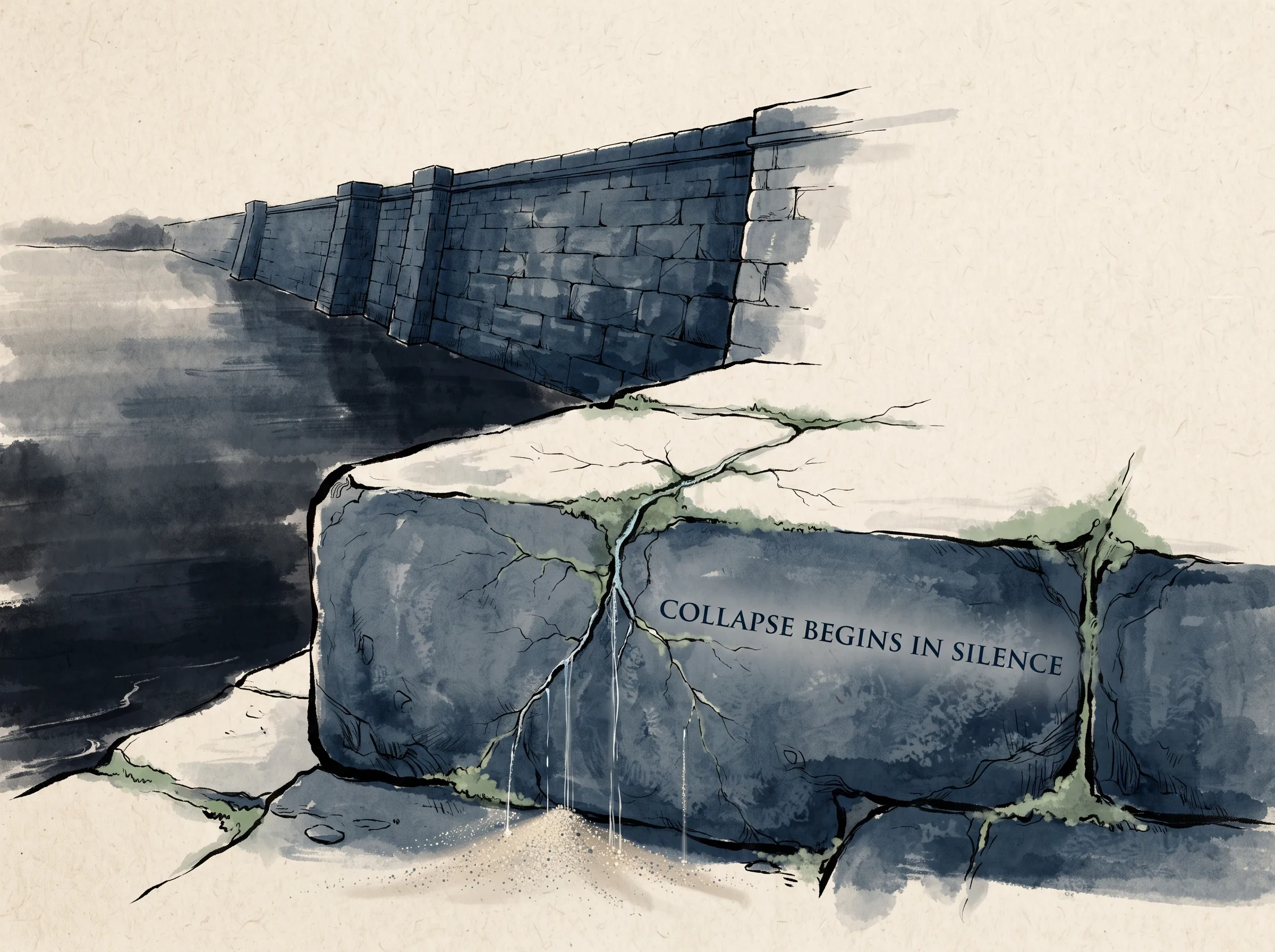
The dangerous feature of this stage is how normal it feels. Leaders still receive updates. Dashboards still glow green. Meetings proceed on schedule. Nobody has announced a crisis. The distortion is gradual enough that it reads as routine, which is precisely why it goes uncorrected for so long.
Stage Two — Discipline Loosening
Once information is imperfect, the next layer to erode is the boundary between what is acceptable and what is not. Exceptions begin to multiply. "This time it's different" becomes the operating rule. What looks like flexibility is actually declining resilience.
Sun Tzu wrote in the Xingjun chapter that an effective command structure requires both mutual understanding and clear boundaries — a principle often summarized by the phrase "command them with cultural benevolence, unify them through martial discipline" (lìng zhī yǐ wén, qí zhī yǐ wǔ, 令之以文,齐之以武). When the martial discipline (wǔ, 武) component — the shared commitment to standards and consequences — weakens, the system does not become freer. It becomes fragile. The first signal of this weakening is rarely an open violation. It is the growing number of permitted exceptions.
Continue with the deeper interpretation and practical application.
ChiDestiny members get access to the full analysis, modern applications, and the growing Chinese Wisdom Library.
FAQ
Does Sun Tzu actually discuss organizational collapse in the Art of War?
Sun Tzu does not use modern terms like "entropy" or "systemic failure." However, the Xingjun (On the March) chapter provides a systematic method for reading early warning signs and maintaining structural discipline before visible crisis appears. The three-stage collapse model presented here is a contemporary synthesis inspired by those observations, not a direct quote from the text.
How reliable is the People's Crusade example for understanding modern systems?
The People's Crusade of 1096 is a historically documented movement. Peter the Hermit led early participants who reached Constantinople before the organized princely armies departed, and their subsequent defeat in Anatolia is recorded in crusade histories [2]. The three-stage pattern applies as an interpretive framework; specific casualty figures and some details remain uncertain in the historical record.
Can these principles apply to individuals, not just organizations?
Yes. The same structural dynamics — information filtering, boundary erosion, and localized failure spiraling into broader breakdown — operate at the personal level. Stress accumulation, neglected recovery, and ignored warning signs follow an analogous pattern.
What is the single most important habit to build for early detection?
Regular, honest self-diagnosis using the three questions above. Not when things feel urgent, but while they still feel manageable. The earlier you check, the cheaper the repair.
Summary and Next Steps
Collapse rarely arrives suddenly. It arrives sequentially — through distorted information, loosened discipline, and finally a local failure that the weakened system cannot absorb. Sun Tzu's Xingjun chapter teaches that the skillful commander does not wait for visible disaster. He learns to read the environment while disorder is still small enough to correct.
The practical takeaway is simple but demanding: build habits of honest perception and consistent boundary maintenance before you need them. Ask the three diagnostic questions regularly. Notice when exceptions multiply. Pay attention when bad news stops arriving.
The next step is not to wait for a crisis. It is to install a routine — weekly or monthly — where you and your team review information flow, exception rates, and local self-correction capacity. Small investments in early detection prevent far larger costs later, reflecting the enduring wisdom of Sun Tzu Chapter 24 Strategy.
To explore these themes from another angle, read our related reflection on Why You Miss the Warning Signs — And How Sun Tzu Predicted It 2,500 Years Ago.
For a deeper comparative examination of these ideas, explore our related study on When Chaos Works for You: The Chinese Strategy for Thriving in Uncertainty.
Sources & Further Reading
[1] Kesis Pierre | Crusades Research Atlas — Documentation of the People's Crusade, Peter the Hermit's leadership role, and the 1096 defeat at Civetot.
[2] Client Challenge — Academic exploration of decision-making under uncertainty and cognitive load in organizational contexts.
Further Reading
- The Art of War (《孙子兵法》), Chapter 10: Xingjun (《行军篇》, On the March) — Classical Chinese military text offering systematic observation methods for reading early signs of disorder.
- Daniel Kahneman, Thinking, Fast and Slow — Dual-process theory describing System 1 and System 2 thinking and their roles under pressure.
- Nassim Nicholas Taleb, Antifragile: Things That Gain from Disorder — Framework for understanding how systems respond to stressors and disturbances.
- Manual of Jin History (《金史》/靖康之耻 scholarship) — Historical analysis of systemic collapse during the Jin-Song conflicts, often referenced in discussions of organizational decay.






