
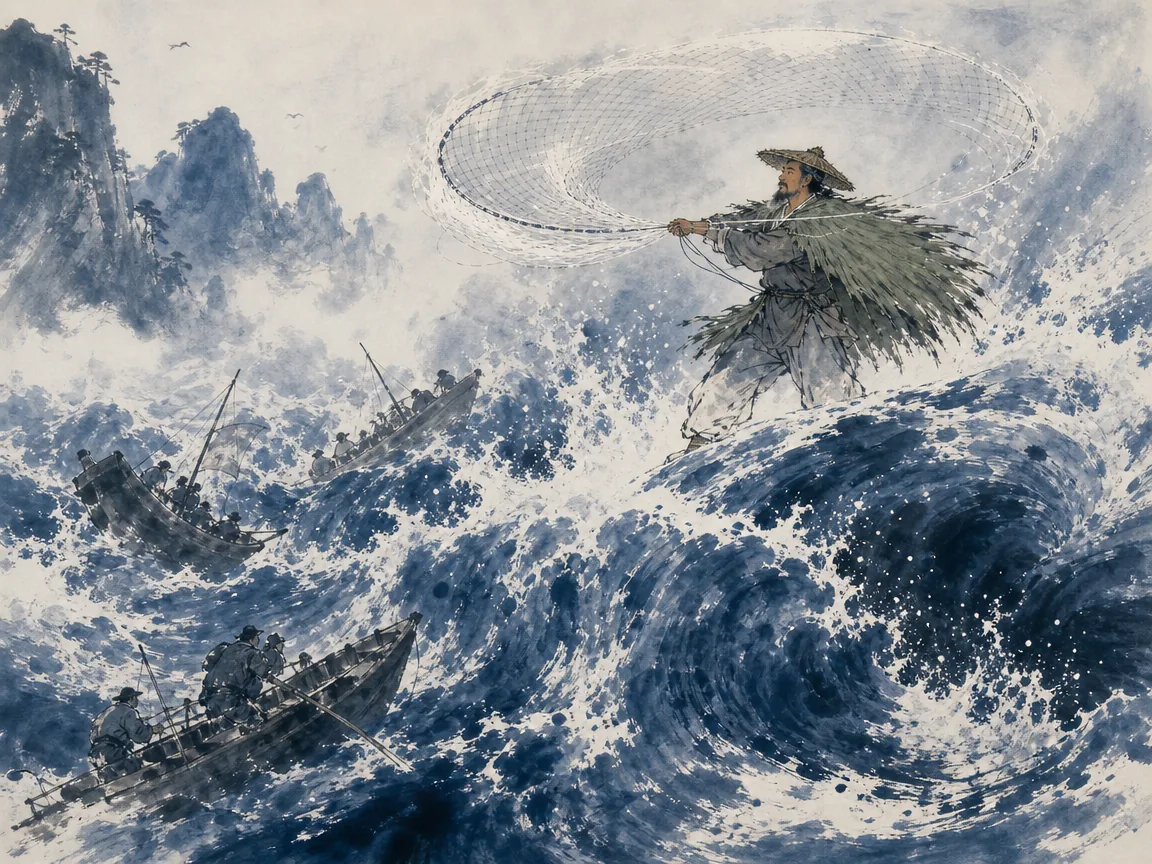
Some of the most enduring passages in Chinese strategic thought come from a chapter of the Art of War that seems, at first glance, to be about something entirely different. In the Fire Attack chapter, Sun Tzu warns that a ruler must never launch a campaign out of anger, and a general must never engage in battle out of resentment. He writes this not because he dislikes fire, but because he understands something deeper: when turmoil arises, the first question is not how hard you can strike, but where you are standing.
The same insight echoes through other strands of ancient Chinese thought. The tradition of shun shi — aligning with the grain of reality rather than pushing against it — appears in Daoist philosophy, where the emphasis falls on reading the current of events and moving with it instead of fighting it. These traditions do not promise that chaos will disappear. They suggest something more practical: that volatility itself is neither good nor bad, and that what matters is the position you occupy when it moves—a foundational perspective explored in Sun Tzu Chapter 28 Strategy.
This article draws on that strategic logic to explore one question: how can you structure your career, your finances, and your thinking so that uncertainty works in your favor rather than against you? The answer does not require prophecy, luck, or an unusual tolerance for risk. It requires a different architecture.
Sun Tzu Chapter 28 Strategy: Why We Misread Volatility
Human beings are not naturally equipped to think clearly about volatile environments. When something unexpected happens — a layoff, a market swing, a sudden industry shift — the mind tends to treat disruption as a pure threat. The psychologist Daniel Kahneman's research on how people evaluate gains and losses has been widely discussed in behavioral economics, including Nobel recognition for the work that led to prospect theory [3]. One of the findings that keeps showing up across studies is that people tend to feel the sting of a loss more sharply than they feel the pleasure of an equivalent gain. This pattern does not mean people are irrational; it means the brain evolved to treat potential threats as urgent.
That instinct becomes a strategic liability in times of rapid change. When volatility arrives, three common errors tend to appear together.
The first is overestimating the damage. Disruption feels threatening, so the natural response is to retreat, tighten defenses, and wait for things to stabilize. The problem is that stability rarely returns to the old shape. The window where competitors are vulnerable and markets are shifting often closes while people are still busy preparing for the wrong kind of future.
The second error is underestimating the upside. Attention locks onto what might go wrong, and the openings created by upheaval become invisible. When a new technology emerges or a dominant firm stumbles, space appears — sometimes quickly, sometimes quietly. Those who miss it tend to enter later, when the landscape has already solidified around new winners.
The third error is the most subtle: treating asymmetric volatility as if it were symmetric. Some changes hurt you; others help you. When both are managed the same way — cut back, conserve, play safe — you end up hedging against the gains alongside the losses. What was once a potentially favorable uncertainty becomes a purely defensive posture.
Taken together, these errors produce a familiar outcome: people exhaust themselves preparing to avoid losing, while the people who actually benefit from change are the ones who allowed themselves to be exposed to it in the first place.
Continue with the deeper interpretation and practical application.
ChiDestiny members get access to the full analysis, modern applications, and the growing Chinese Wisdom Library.
Frequently Asked Questions
Can ancient Chinese strategy really help with modern career and financial uncertainty?
Classical texts were written for different contexts, so direct translation is not the point. The value lies in underlying structures — ideas about positioning, emotional regulation, and asymmetric exposure — that apply across eras. Read them as conceptual tools rather than instruction manuals.
Is the barbell strategy the same as being conservative or reckless?
No. A barbell position is neither purely cautious nor purely aggressive. It combines strong downside protection with limited but meaningful upside exposure. The middle ground it avoids is the area where risk and reward appear balanced but neither extreme is reached.
Does this mean I should ignore traditional planning and risk management?
Not at all. Positioning complements planning; it does not replace it. The point is to recognize that some uncertainties cannot be planned away and to build structures that survive and potentially benefit from them.
What if I cannot afford to take any asymmetric risks?
The framework is scalable. Even small adjustments — preserving a reserve, developing one portable skill, keeping a low-cost option open — can shift exposure in a more favorable direction. The principle applies to positioning, not just scale, reflecting the enduring wisdom of Sun Tzu Chapter 28 Strategy.
To explore these themes from another angle, read our related reflection on How to Know When Not to Fight: Ancient Chinese Wisdom for Escaping Losing Battles.
For a deeper comparative examination of these ideas, explore our related study on Why “Winning Every Battle” Can Lose the War.
Sources & Further Reading
[1] Fire Attack: The Art of War (《孙子兵法·火攻篇》) — Classical text containing the Fire Attack chapter passage on emotional discipline in strategy.
[2] Peninsular War | National Army Museum — Historical account of British naval and land operations during the Napoleonic era.
[3] Daniel Kahneman – Biographical – NobelPrize.org — Biographical record of Kahneman's contributions to behavioral economics and prospect theory.
[4] [Tail Risk Constraints and Maximum Entropy]— Academic paper by Taleb and colleagues describing the barbell payoff structure.
Further Reading
- Nassim Nicholas Taleb, Antifragile: Things That Gain from Disorder — A broader exploration of how systems can benefit from volatility.
- Daniel Kahneman, Thinking, Fast and Slow — An accessible overview of cognitive biases including loss aversion.
- Sun Tzu, The Art of War — Classical strategic text; recommended in modern translations for readability and commentary.






