
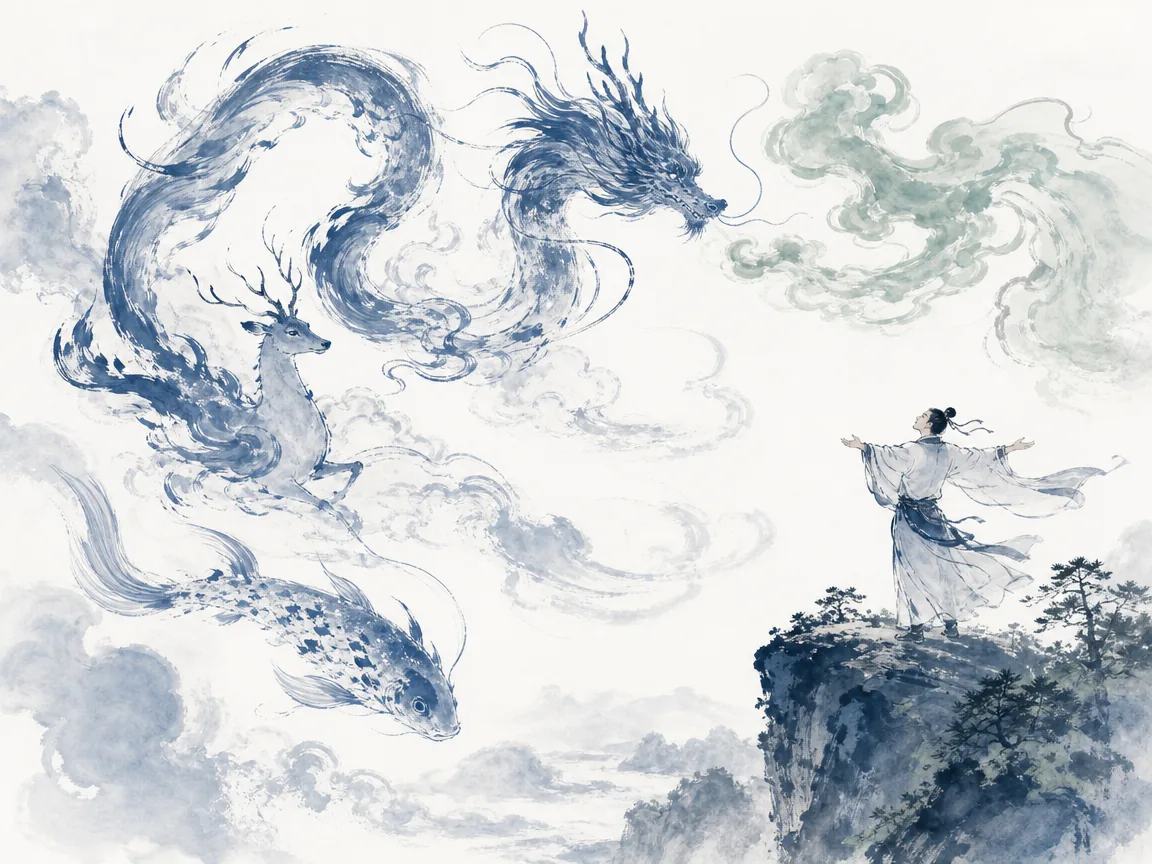
You may have noticed how exhausting it feels to keep reinventing yourself. A new job, a new city, a career pivot, a relationship shift—each one seems to demand that you shed who you were and become someone new. Somewhere along the way, many of us internalized a quietly Western idea: that change is either progress or loss, that stability means staying the same, and that a true identity must be fixed like stone. But what if there is another way of understanding who we are—one that does not require us to choose between adaptation and authenticity?
The ancient Chinese dragon offers exactly that alternative. It is a creature that has never had a single fixed form. It appears in jade as far back as five thousand years ago, in shell arrangements that predate them, in imperial banners, in folk temples, and today on screens and streets across the world. Some scholars have noted that it absorbed features from snakes, horses, deer, dogs, and fish over centuries. Rather than shrinking from that fluid history, Chinese tradition treated it as precisely what made the dragon powerful. Its endurance came from its capacity to change—a foundational perspective explored in Chinese Dragon Philosophy.
This may sound like a simple metaphor, but it rests on real philosophical traditions. Classical Chinese thought, particularly Daoist and Confucian streams, understood change not as chaos or threat but as the rhythm of existence itself. The Yijing (Book of Changes) describes stages of a dragon—emerging, soaring, retreating—not as random events but as movements within a pattern. To live well is not to resist the pattern but to learn it. For anyone today trying to hold onto a coherent sense of self while everything around them shifts, that is a remarkably practical idea.
Chinese Dragon Philosophy: The Dragon Was Never Fixed
We often imagine the dragon as an ancient, unchanging symbol—like a logo passed down unchanged through millennia. But that impression is itself a later invention. The earliest dragon-like figures in China look nothing like the serpentine, antlered, clawed creature most people picture today. At sites such as Xishuipo in Henan, archaeologists have found shell arrangements dated to roughly six thousand years ago that depict a long, sinuous creature. Later, during the Hongshan culture, artisans carved compact jade dragons with curled bodies. These early dragons differed significantly from one another. They were not yet unified into a single visual standard.
What we now call the "dragon" is better understood as a long process of cultural synthesis. The scholar Wen Yiduo argued, in his study Fuxi Kao, that the dragon took a snake-like body as its core and gradually incorporated features from other animals—hooves, antlers, scales, claws—into a composite figure. Whether or not that theory is accepted in every detail, the broader point is clear: the dragon's image accumulated and adapted over time. It was not invented once and then frozen; it was repeatedly reimagined.
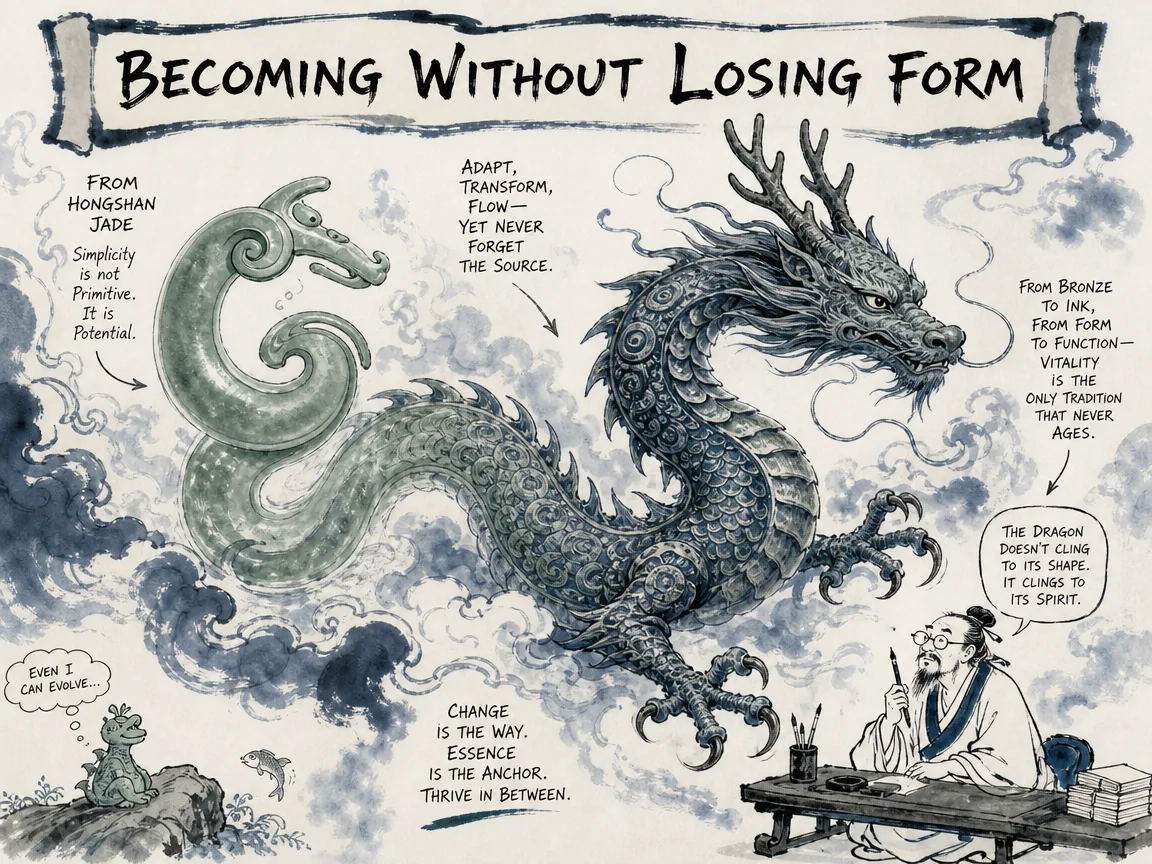
This history is important for our question about identity. We tend to believe that a strong self must have a clear, consistent origin—a single story that explains who we are. But the dragon model suggests something different: that identity can be cumulative. A person, like a cultural symbol, can absorb new experiences, roles, and relationships without losing coherence. The core does not have to be fixed in shape to remain recognizable. In fact, rigidity may be more dangerous than flexibility. A self that cannot adapt breaks under pressure; a self that can reshape itself endures.
From Natural Force to Cosmic Pattern
The dragon did not begin as a symbol of empire or ethnicity. It emerged from a relationship with natural forces that were unpredictable and overwhelming. Early agricultural societies in the Yellow River valley depended on monsoon rains, river floods, and seasonal cycles. Water could sustain a harvest or destroy it. It was impossible to control, impossible to ignore. The dragon, in its earliest functions, was closely connected to water, clouds, and the atmospheric changes that determined whether communities would thrive or starve.
This connection is preserved in classical texts. The Shuowen Jiezi (An Etymological Explanation of Chinese Characters), one of the oldest Chinese dictionaries, describes the dragon as capable of disappearing and appearing, growing fine and large, short and long—ascending to heaven at the spring equinox and hiding in the depths at the autumn equinox. That is not merely poetry. It encodes an observation about natural cycles and a way of thinking about them. The dragon represents a force that moves according to rhythms humans can learn to read but cannot simply command.
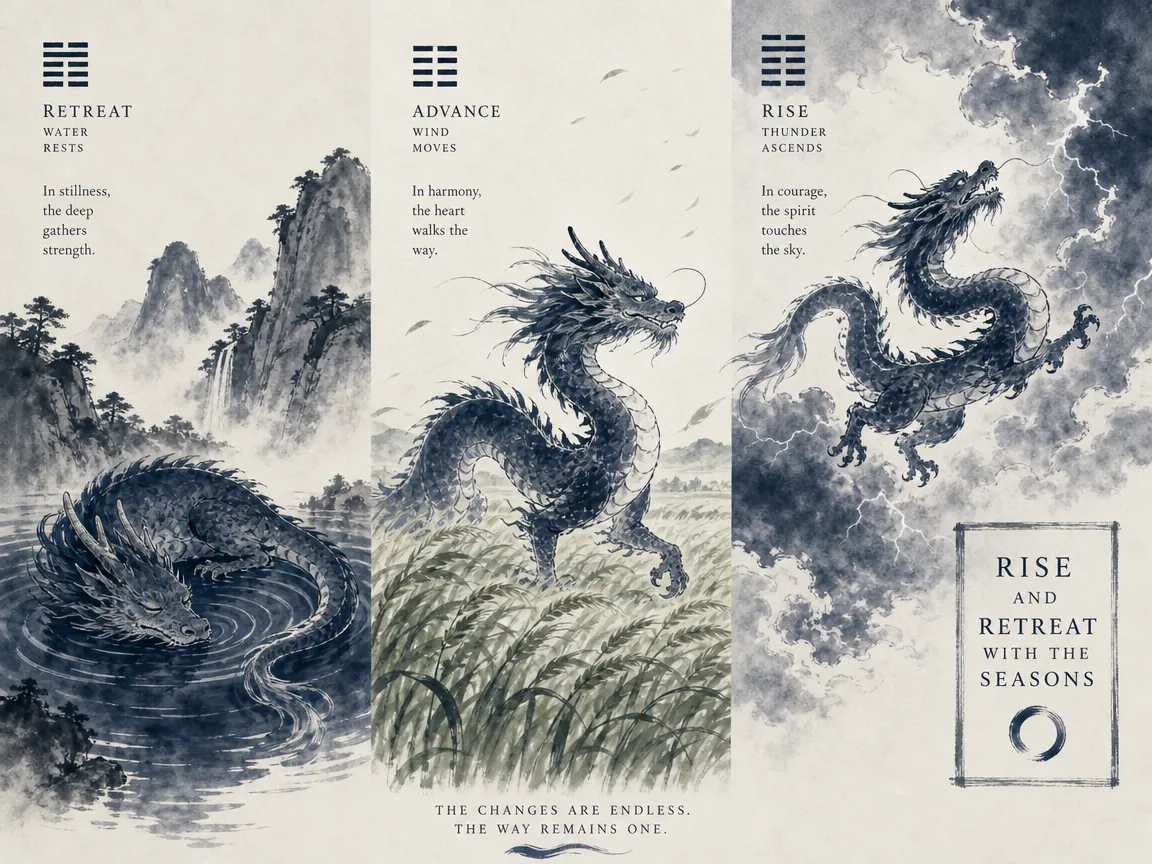
The Yijing extends this logic into human life. The Qian hexagram uses dragon imagery across its lines—hidden dragon, dragon in the field, soaring dragon, dragon that has flown too high—to map different moments of opportunity and caution. The message is not that change is arbitrary; it is that change follows patterns, and wisdom lies in recognizing which pattern you are in. This is a far cry from the fantasy of total self-control. It asks something more honest: how do you respond skillfully to what is already happening?
For modern readers, the lesson is practical. A stable identity in a changing world does not mean building walls against change. It means learning to read the current season—knowing when to act, when to wait, when to climb, when to retreat. The self that masters this timing is more resilient than the self that simply resists transformation.
Dragon and the Art of Becoming
As Chinese civilization developed, the dragon's meaning shifted again. It became associated with imperial authority, with the Mandate of Heaven, with the idea that certain rulers embodied cosmic order on earth. Eventually, in some accounts, even the emperor's lineage was said to descend from dragon blood. But this political appropriation did not erase the dragon's earlier associations. The creature remained tied to water, clouds, and transformation. It carried both meanings at once. To explore these themes from another angle, read our related reflection on Moving First: How Ancient Strategy Teaches Us to Shape the Board, Not Just the Battle.
This duality is philosophically significant. In Daoist thought, exemplified by texts attributed to Laozi and Zhuangzi, the highest good is compared to water—flexible, yielding, yet shaping everything it touches. Zhuangzi's writings dwell on transformation, on the way boundaries between self and world, life and death, certainty and doubt, are porous and shifting. Identity, in these traditions, is not a possession but a practice—an ongoing responsiveness to circumstances rather than a defensive grip on a fixed definition.
Confucianism offers a related but distinct perspective. It emphasizes moral constancy alongside situational adaptability. A person of integrity does not abandon their principles because conditions change; they find the right way to express those principles within whatever situation they face. The dragon embodies both impulses: change without losing essence, constancy without rigidity.
When we apply this to the question of identity, the practical implication becomes clearer. Many people today feel unstable because they have been taught to look for a single, permanent version of themselves—a career, a label, a lifestyle—and then feel lost when that no longer fits. The dragon model suggests a different approach: identity as a set of core orientations (what matters to you, what kind of person you want to be) rather than a fixed script. Your values can remain steady while your methods, roles, and expressions evolve. You are not abandoning yourself when you change; you are practicing a different season of yourself.
Reading the Season
One way to cultivate this skill is to pause regularly and ask not "Who am I?" but "What moment am I in?" The Yijing encourages precisely this kind of diagnostic reflection. Are you in a phase where preparation and patience serve you better than action? Where visibility and initiative are appropriate? Where success requires caution? Treating life as a series of seasons rather than a single destination can reduce the anxiety that comes from feeling like you must always be becoming something new.
Who Inherits the Dragon Today?
The dragon's history did not stop with imperial China. In the twentieth century, it underwent another major transformation. The concept of Zhonghua minzu (the Chinese nation) was articulated by thinkers such as Liang Qichao in the early 1900s, as China confronted the challenges of modernity and colonial pressure. The dragon, once closely tied to the emperor, began to serve as a symbol of a broader collective identity.
Then, in 1978, the singer-songwriter Hou Dejian released the song "Children of the Dragon" (Long de Chuanren), which helped popularize the phrase among Chinese-speaking communities worldwide. As one source notes, the term as a concept was first "sung into" public awareness through that song in 1978, though the underlying sentiment—that Chinese people share a cultural lineage—has deeper historical roots stretching back over two thousand years.
This last shift is perhaps the most relevant for our question. The dragon went from being the exclusive emblem of one family's claimed divine lineage to a shared cultural symbol embraced by a vast and diverse population. It changed hands without losing its recognizability. In many ways, that is exactly how living traditions work: they are not inherited as sealed packages but reclaimed and reinterpreted by each new generation.
For readers outside that specific cultural context, the deeper lesson remains accessible. If a symbol can be redefined across centuries without ceasing to be itself, then personal identity can also survive major reinventions. You are not betraying your past by adapting to your present. You are participating in the same kind of continuous transformation that has always sustained meaningful traditions.
Practical Wisdom for Building a Change-Resilient Identity
The dragon model offers several concrete practices for anyone navigating constant change:
1. Separate your core from your form. Identify what you consider non-negotiable—your values, your commitments, the kind of person you want to be—and treat those as your dragon's essence. Everything else—job title, living situation, social role—is like the dragon's ever-changing shape. Neither invalidates the other.
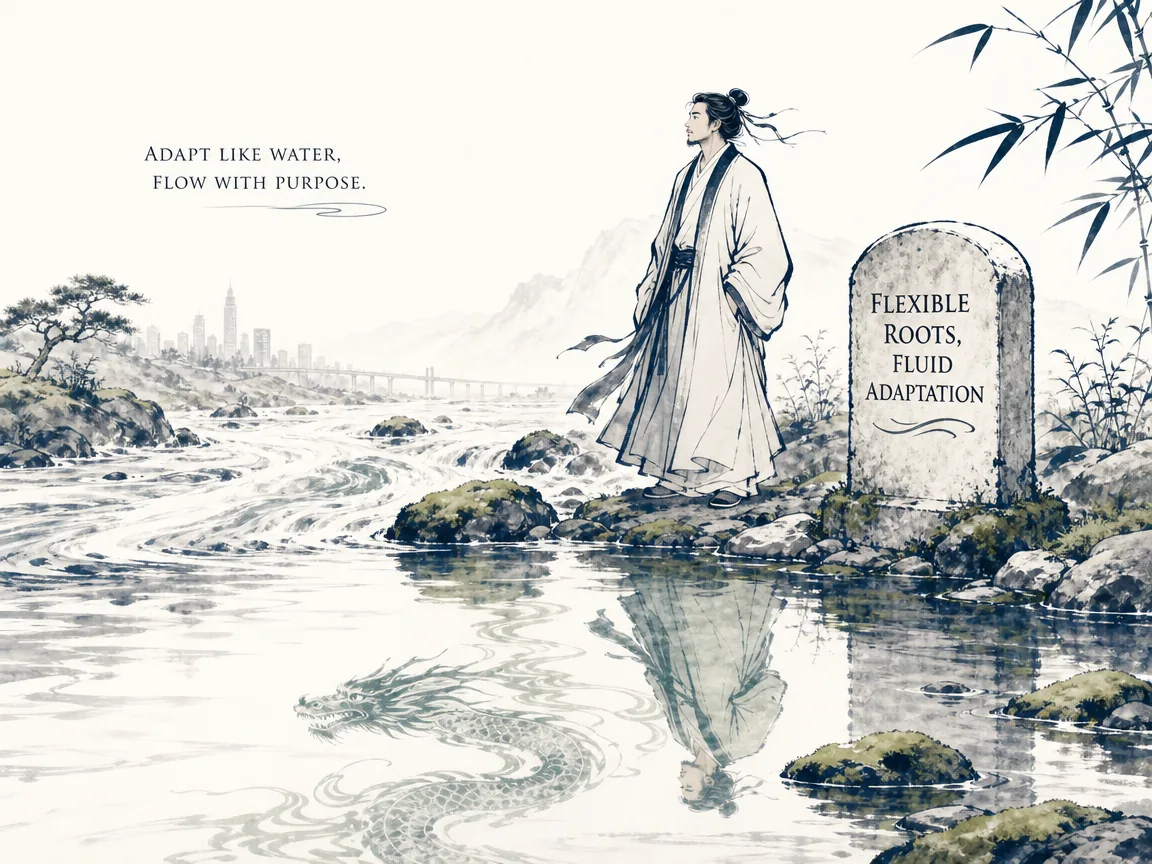
2. Learn to read timing. Before making a major decision, ask what season you are in. Is this a time for emergence or retreat? For action or patience? The Yijing framework is not about fate; it is about attentive assessment. When you align your moves with the conditions around you, you reduce friction and build confidence.
3. Practice incremental synthesis. The dragon did not acquire all its features at once. Neither do identities form overnight. Allow new experiences to integrate gradually. You do not need to decide who you are; you need to remain open to who you are becoming.
4. Redefine inheritance as participation, not ownership. The dragon was never owned by any single dynasty or family. Similarly, your sense of belonging does not require you to lock yourself into a single label. You can honor your roots while remaining free to adapt.
FAQ
Q: Isn't having a flexible identity the same as having no identity at all?
A: Flexibility and emptiness are not the same thing. A flexible identity has core orientations—values, commitments, a sense of what matters—but does not insist that those orientations must be expressed through one fixed set of roles or lifestyles. The dragon always remains a dragon, even as its features shift. The danger is not change; it is losing touch with what makes you recognizable to yourself.
Q: Doesn't classical Chinese thought actually value stability over change?
A: Classical Chinese philosophy holds both in tension. Confucianism emphasizes moral constancy and ritual continuity. Daoism emphasizes flow and non-resistance. The Yijing is literally called the Book of Changes, yet its purpose is to reveal the patterns underlying change—suggesting that stability is found in understanding rhythm, not in stopping motion. The tradition does not treat change and stability as opposites; it treats them as complementary.
Q: Can I apply this dragon model without embracing Chinese philosophy or culture?
A: Yes. The dragon is offered here as a metaphor, not a religious or cultural requirement. What matters is the underlying insight: that enduring identity does not require rigidity. You can draw on any tradition, personal experience, or reflective practice that helps you see change as something you can navigate skillfully rather than something that destroys you.
Q: How do I know when I've changed too much or lost myself?
A: This is one of the hardest questions, and there is no universal formula. One useful check is to ask whether your current choices still align with your deeper values. Another is to notice whether you feel internally coherent or fragmented. If you sense a loss of alignment, the dragon model does not tell you to cling to the past; it tells you to recenter on what remains essential and let the rest adapt again.
Conclusion
The Chinese dragon teaches a quiet but profound lesson: endurance does not require permanence of form. It requires continuity of essence. Across millennia, the dragon has taken on new shapes, absorbed new meanings, served different purposes—yet it has never stopped being recognizable as the dragon. That is not a coincidence. It is the result of a culture that understood change not as the enemy of identity but as its condition.
For anyone living through periods of upheaval—whether personal, professional, or societal—this model offers a different way forward. Rather than asking how to preserve a fixed self, you can ask how to cultivate a responsive one. Your values can remain steady. Your methods can adapt. Your story can continue without requiring you to repeat the past.
If this perspective resonates with you, consider exploring how classical Chinese texts like the Yijing or the writings of Laozi and Zhuangzi frame change, timing, and self-cultivation. These traditions offer rich practical wisdom for navigating a world that refuses to stand still, reflecting the enduring wisdom of Chinese Dragon Philosophy.
Examine this artistic principle further through the classical aesthetic philosophy of Why Chinese Painting Chooses Awe Over Love — And What It Teaches Us About Modern Anxiety.
Deepen your understanding of these principles in our reflection on Did Yuan Zhen Write His Poetry for Art—or for Power?.
Sources & Further Reading
[1] "Descendants of the Dragon" and "Descendants of Dragon and Phoenix" ("龙的传人"与"龙凤传人") — China News Service (中新网) – — Covers the 1978 origin of the song "Children of the Dragon" and the historical evolution of the dragon as a cultural symbol.
[2] Shuowen Jiezi (An Etymological Explanation of Chinese Characters) — Classical dictionary entry describing the dragon's capacity for transformation.
[3] Yijing (Book of Changes), Qian Hexagram — Contains the dragon imagery across its lines, mapping phases of hidden, emerging, soaring, and overstretched states.
[4] Wen Yiduo, Fuxi Kao — Scholarly work proposing that the dragon evolved as a composite creature absorbing features from multiple animals.
[5] Liang Qichao, Lun Zhongguo Xueshu Sixiang Bianqian Zhi Dashi (1902) — Early articulation of the concept of Zhonghua minzu (the Chinese nation).






