
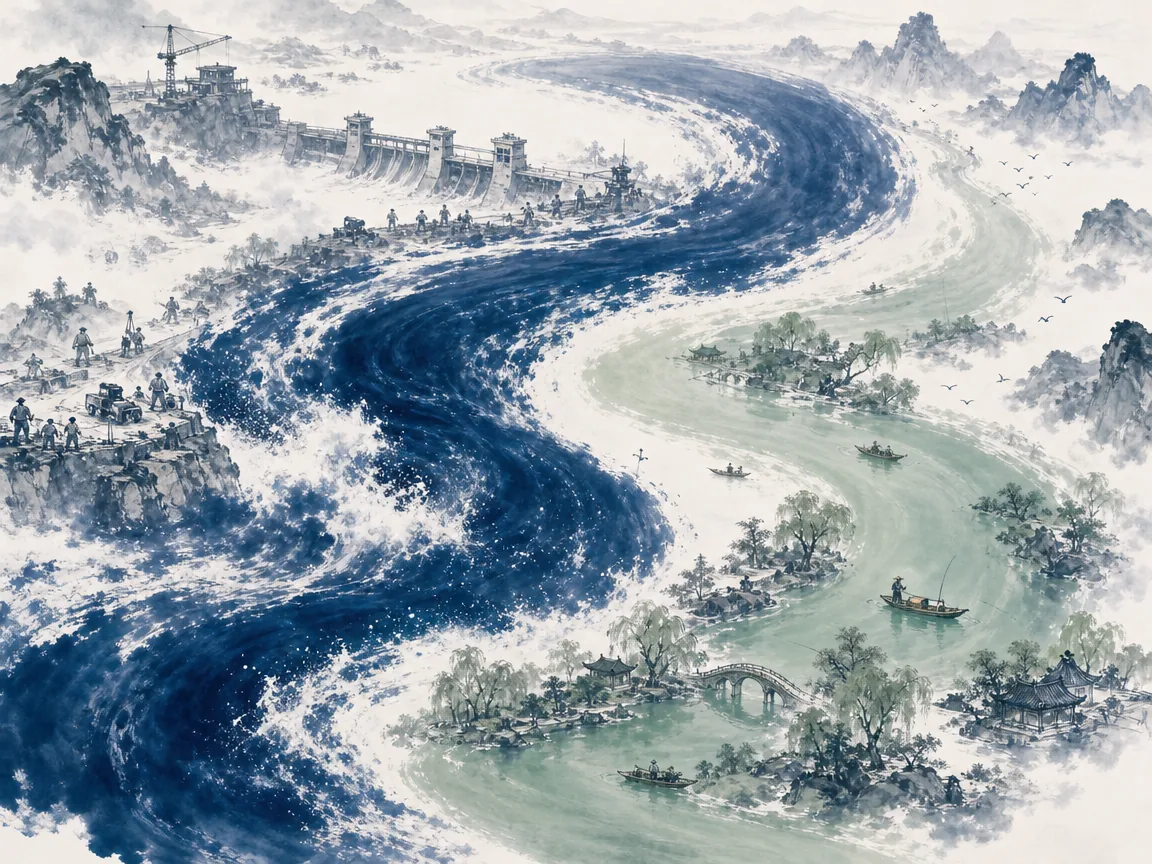
China cannot be understood through a single character. Its civilization is not shaped by one river but two — the Yellow River and the Yangtze River — flowing from different geological origins, carrying different waters, demanding different forms of human life. And yet both rivers feed the same land. Both are indispensable. The culture that grew between them refuses to choose one way of being over the other.
This may seem like an observation about geography, but it is really an observation about balance. How many of us feel pulled between two competing visions of a good life — one measured by duty, achievement, and the weight of responsibility, and the other by peace, beauty, and the simple presence of being? The Chinese tradition offers no simple answer to this tension. Instead, it offers something more useful: a model for holding both poles at once—a foundational perspective explored in Two Rivers of China Philosophical Symbolism.
The Yellow River, heavy with silt and prone to catastrophic flooding, demanded that people organize, cooperate, and submit individual desire to collective survival. From its violent temperament emerged a civilization that valued order, hierarchy, and the sacred duty to something larger than oneself. The Yangtze River, clear and braided with tributaries, connected cities, gardens, and wetlands into a dense network of daily life. From its gentler flow emerged a culture that treasured retreat, poetry, landscape, and the intimate texture of ordinary time. Neither river is China alone. Only together do they make a whole.
Two Rivers of China Philosophical Symbolism: Two Rivers, Two Temperaments
The Yellow River carries sediment across the Loess Plateau and into the North China Plain at such volume that its bed rises faster than the surrounding land. When the levees breach, they do not simply flood — they change course entirely. Historical records describe devastating shifts that erased cities and drowned thousands, forcing communities into repeated reconstruction. This is a river that demands total attention. It cannot be ignored, negotiated with, or lived alongside casually. It requires collective intervention on a massive scale: digging canals, building dikes, coordinating labor across vast distances.
Such conditions naturally produce a political culture oriented toward large-scale organization. The authority that can marshal resources to tame the Yellow River gains legitimacy. The fear of chaos — the fear of what happens when the dikes fail — becomes a foundational moral emotion. Across millennia, this temperament shaped Confucian ethics, bureaucratic statecraft, and the literary tradition that places the individual within sweeping historical tectonics.
The Yangtze, by contrast, is not a single channel but a network. It branches into lakes, feeds wetlands, connects with smaller rivers, and moves through fertile basins where rice cultivation thrives on seasonal rhythm rather than emergency response. Life along the Yangtze was not organized primarily around disaster prevention but around flow — using waterways for transport, managing irrigation through gradual adjustment, and building settlements that grew organically along natural corridors.
Archaeological evidence from the Liangzhu site in the Yangtze Delta shows that even five thousand years ago, societies in this region undertook large-scale hydraulic engineering projects (dàxíng shuǐlì gōngchéng, 大型水利工程) of extraordinary complexity, requiring coordinated planning and sustained communal effort [3]. The difference is not that the Yangtze region lacked organization — it possessed deep forms of cooperation — but that its relationship to water was fundamentally different in texture. One demanded confrontation; the other invited adaptation.
These two environmental realities produced two enduring ways of being. The Yellow River taught that survival depends on structure, sacrifice, and shared purpose. The Yangtze taught that survival also depends on flexibility, aesthetic awareness, and attention to the quality of everyday experience. China inherited both lessons. Most people living today inherit something similar, even if their geography is different.
What the Yellow River Teaches Us
The Yellow River civilization is often described — sometimes simplistically — as the cradle of Chinese political order. Its floods were too violent and too frequent to allow for loose, decentralized living. A household could not build a dike. A village could not dredge a changed channel. The response to the Yellow River was always collective, and the authority that managed that response became the source of political legitimacy.
This does not mean that every ruler who claimed the Mandate of Heaven actually tamed the floods. It means that the narrative of flood control — the myth of Yu the Great diverting the waters — became the foundational story of Chinese governance. The archetype is clear: the legitimate ruler is the one who organizes people against chaos, who places the needs of the whole above the convenience of any single person.
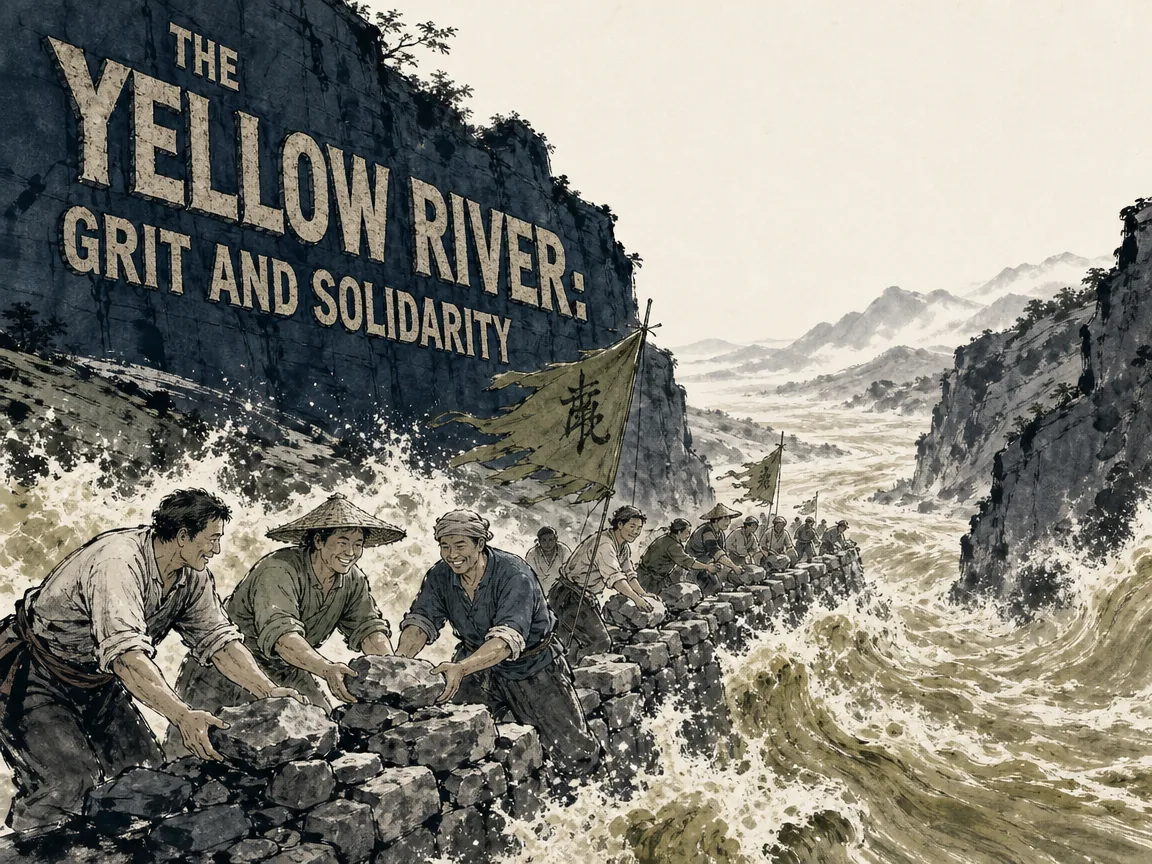
That archetype echoes through centuries of Chinese literature and thought. The poems of Du Fu, writing during the An Lushan Rebellion, carry the weight of a world torn apart: "My country is shattered — mountains and rivers remain; / In spring the city sees grass and trees deep." These lines do not complain about personal hardship. They place personal suffering inside a collapsing cosmos. The individual matters, but only as part of the larger fabric. Gain deeper perspective on weathering adversity through the poetic resilience explored in How Fan Zhongyan Found Purpose Beyond Himself: Ancient Wisdom for Modern Burnout.
This is the Yellow River mindset distilled into verse: the self is real, but it is embedded. Duty, responsibility, and historical continuity are not abstract ideals — they are survival strategies encoded into culture. When climate crisis, economic instability, or community collapse demands that we put something larger than ourselves first, we are operating in Yellow River territory. The wisdom there is real and necessary. The danger is when that wisdom becomes the only wisdom, and every moment of rest is interpreted as moral failure.
What the Yangtze River Teaches Us
The Yangtze civilization tells a different story — not a counter-story, but a complementary one. Where the Yellow River demanded resistance, the Yangtze invited negotiation. The southern waterways were managed through a thousand small adjustments: rice paddies fed by branching streams, villages positioned along natural channels, boats connecting markets that had no road access.
This environment cultivated a literary and spiritual tradition centered on retreat, observation, and the sensuous detail of daily life. The poet Tao Yuanming, who abandoned official service to return to farming, became a lasting symbol of choosing a quieter path over public ambition. His writings celebrate the simplicity of rural existence — tending fields, drinking wine, watching clouds — not as an escape from responsibility but as a different expression of it.
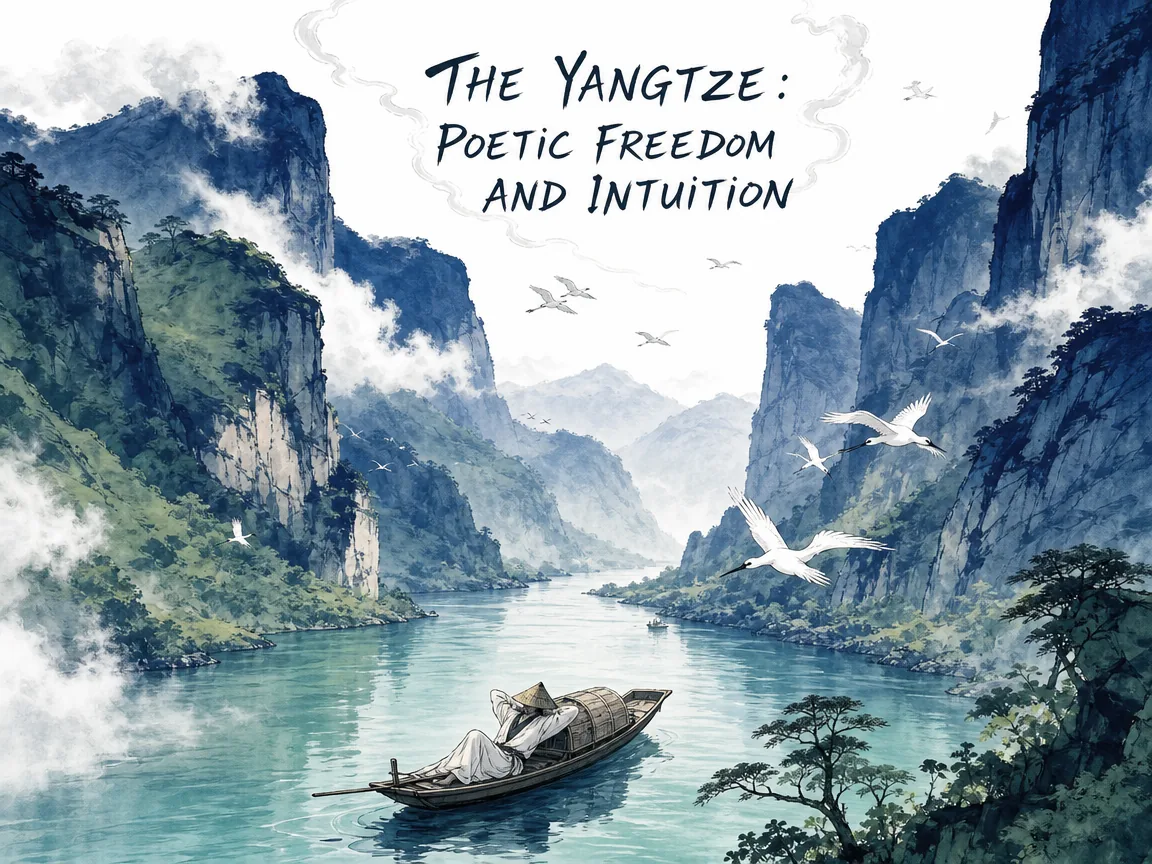
By the Tang and Song dynasties, the economic center of gravity had shifted decisively southward, and with it, new forms of cultural life flourished. Poetry celebrated the mist over Jiangnan lakes, the sound of rain on temple roofs, the solitary figure on a boat moving through evening fog. The aesthetic here is not indulgence but calibration: a recognition that a fully human life requires moments outside the grand narrative, where meaning is found not in achievement but in attention.
Wang Wei's landscapes, Liu Yong's urban verses, and countless later works trace a tradition in which personal cultivation — the refinement of perception, the deepening of relationships, the practice of artistic sensitivity — is not secondary to public duty but essential to it. This is the Yangtze insight: that order without beauty becomes sterile, and responsibility without rest becomes self-annihilation.
The risk of this tradition, of course, is drift — the loss of larger purpose, the seduction of comfort into apathy. But a civilization that has carried both rivers for five thousand years understands that neither risk is fatal when the other is present.
The Deeper Pattern: Neither Can Survive Alone
The Grand Canal, constructed and expanded over centuries, is perhaps the most literal manifestation of this Chinese principle. It forced the Yellow River world and the Yangtze world into continuous exchange. Northern grain and military supplies moved south; southern revenue and agricultural surplus flowed north. Neither region could have sustained the empire alone. The Canal was not a natural feature — it was an artificial act of will, a declaration that division was unacceptable and connection was necessary.
This pattern — the refusal to let either pole dominate — appears repeatedly in Chinese thought. The Daoist concept of yin and yang describes a universe where opposites are interdependent, neither superior, neither complete alone. The Confucian ideal of he (harmony) does not mean uniformity; it means the productive tension of different elements held together. Even in statecraft, the orthodox tradition has consistently warned against the extremes of rigid legalism and ungrounded relativism, advocating instead for a middle path that adapts to circumstances.
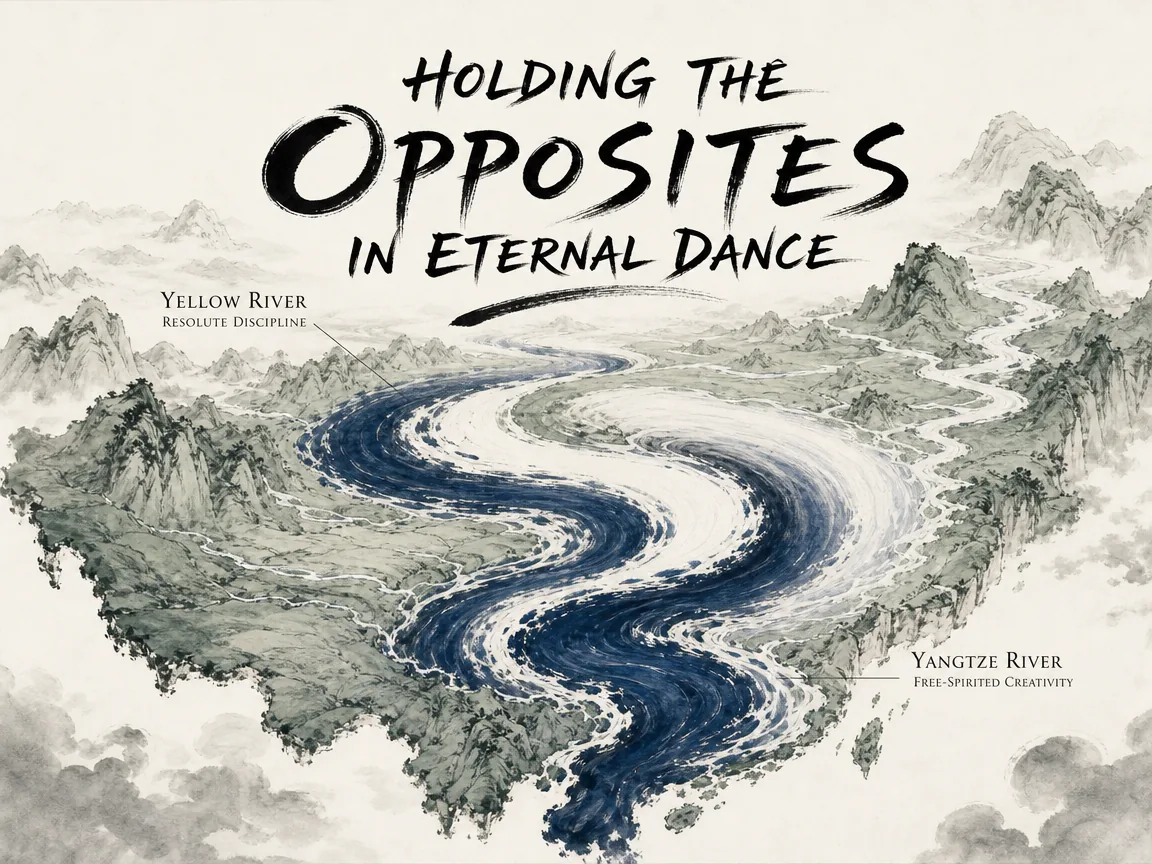
A Ming-dynasty drama captures this beautifully. In Ming Dynasty 1566, the aging Emperor Jiajing observes of the two rivers: "The Yangtze is clear, the Yellow River is turbid… the Yangtze flows, and the Yellow River flows too" ("Chángjiāng shuǐ qīng, Huánghé shuǐ zhuó… Chángjiāng zài liú, Huánghé yě zài liú", 长江水清,黄河水浊……长江在流,黄河也在流). The point he makes is not about which river is better, but about the impossibility of choosing. "One cannot favor the clear water and discard the muddy, nor abandon the muddy because it is impure" ("zhǐ néng bù yīn shuǐ qīng ér piān yòng, yě zhǐ néng bù yīn shuǐ zhuó ér piān fèi", 只能不因水清而偏用,也只能不因水浊而偏废). What matters is that both continue to flow, both continue to nourish.
This is a remarkably practical frame. We do not need to resolve the tension between ambition and peace, duty and freedom, structure and flexibility. We need only learn to recognize which river our life is following at any given moment — and ensure the other is not left to dry up.
What This Means for You Today
You do not need to live near a river to feel the pull of these two temperaments. They exist inside almost anyone who has ever wrestled with the question of how to live well. The Yellow River voice asks: What are your obligations? What must you build, maintain, protect? Who depends on you? The Yangtze voice asks: Where is your joy? What moves you? What would you do if no one were watching?
Both questions matter. The problem arises when one speaks so loudly that the other goes unheard.
If your life runs primarily on Yellow River logic — if you measure yourself by output, responsibility, and the size of what you carry — then the Yangtze lesson is not a luxury. It is a requirement. When does beauty enter your week? When do you sit with someone without agenda? When do you do nothing that produces anything measurable? These are not distractions from the serious work of living. They are what make the work sustainable.
If your life runs primarily on Yangtze logic — if you value solitude, aesthetic experience, and personal freedom above institutional demands — then the Yellow River lesson is equally necessary. What larger structure gives your life context? Whom do you serve beyond your own comfort? What happens to you when the personal retreat becomes permanent withdrawal? Purpose without responsibility dissolves. But responsibility without purpose exhausts.
The practical insight is this: awareness of the two rivers is itself the first step toward balance. Notice which one your life is following when things are hard. Notice which one you have been ignoring until something broke. The goal is not to split your time evenly between duty and peace — it is to cultivate the sensitivity to know which river your life needs to draw from right now.
Closing Thought
China's civilization is not a single character but a compound — forged by two rivers that could not agree on what water should look like, yet proved that disagreement was not a flaw but a feature. The Yellow River gives the world structure. The Yangtze gives it soul. Neither makes sense without the other.
A well-lived life works the same way. You will not find balance by choosing between ambition and peace, responsibility and freedom, building and resting. You find it by recognizing that both are real, both are necessary, and both are yours to tend — like two rivers, different colors, flowing toward the same ocean.
FAQ
Is the Yellow River really more "dangerous" than the Yangtze? The Yellow River earns this reputation from its extremely high sediment load, which raises the riverbed above the surrounding plain and makes breaching and course-changing a recurring historical threat. The Yangtze is larger in volume and length but flows through more varied terrain with less sudden catastrophe. Both present challenges; they simply demand different kinds of human response.
Did ancient China ever try to eliminate one of these temperaments? Yes, repeatedly. Periods of extreme Legalist centralization leaned heavily into Yellow River-style order, often at the cost of individual life and cultural richness. Periods of fragmentation and southern cultural flourishing leaned into Yangtze-style retreat, sometimes neglecting larger political coordination. Chinese political philosophy consistently warned against both extremes, seeking a dynamic equilibrium rather than a fixed solution.
Does this two-river model apply only to China? The specific geography is Chinese, but the underlying pattern is universal. Every civilization balances competing values — security and freedom, collective good and individual flourishing, tradition and innovation. What makes the Chinese version distinctive is its willingness to keep both values alive simultaneously, rather than resolving the tension through ideological elimination.
How is this different from the concept of "yin and yang"? Yin and yang is a broader philosophical framework describing complementary opposites in nature, the body, and society. The two-river model is a concrete historical and geographical application of that same intuition — showing how a particular landscape produced a particular culture that refused to choose between opposing ways of life. One is the principle; the other is its lived expression, reflecting the enduring wisdom of Two Rivers of China Philosophical Symbolism.
To explore these themes from another angle, read our related reflection on Why Wars Begin When No One Can Say “Enough”.
Deepen your understanding of these principles in our reflection on When Institutions Fail: What Can Chinese Xia Philosophy Teach Us About Personal Justice and Moral Responsibility Today?.
Sources & Further Reading
[1] Earliest hydraulic enterprise in China, 5,100 years ago – PMC — Peer-reviewed archaeological study documenting the Liangzhu hydraulic system in the Yangtze Delta, demonstrating sophisticated water management and central planning in ancient southern China.
[2] Original video transcript — Bilibili lecture by Liangzhou (凉州), ["How the Yellow and Yangtze Rivers Shaped Two Distinct Chinese Temperaments" (黄河长江,如何塑造两种截然不同的中国性格?)] — Cultural analysis of how the Yellow River and Yangtze River shaped complementary Chinese temperaments, including the quoted passage from the television drama Ming Dynasty 1566.
[3] Earliest hydraulic enterprise in China, 5,100 years ago – PMC






