
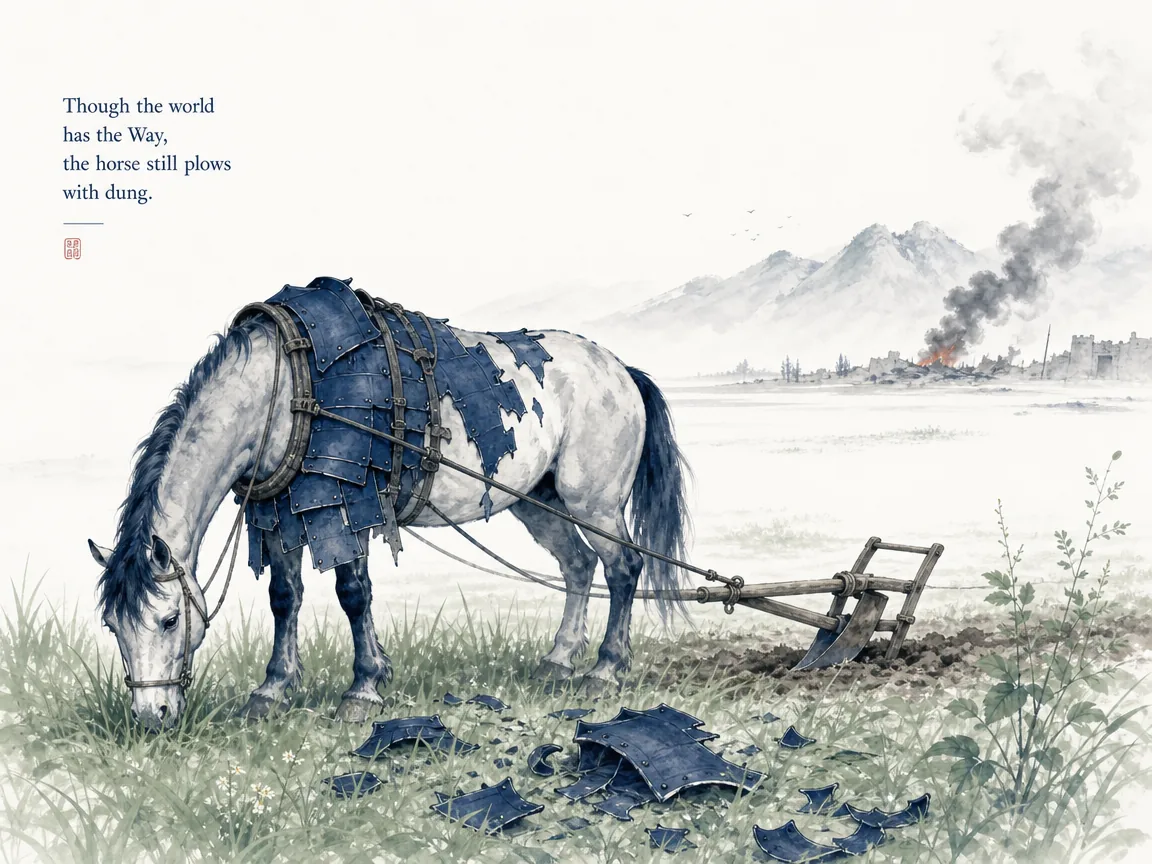
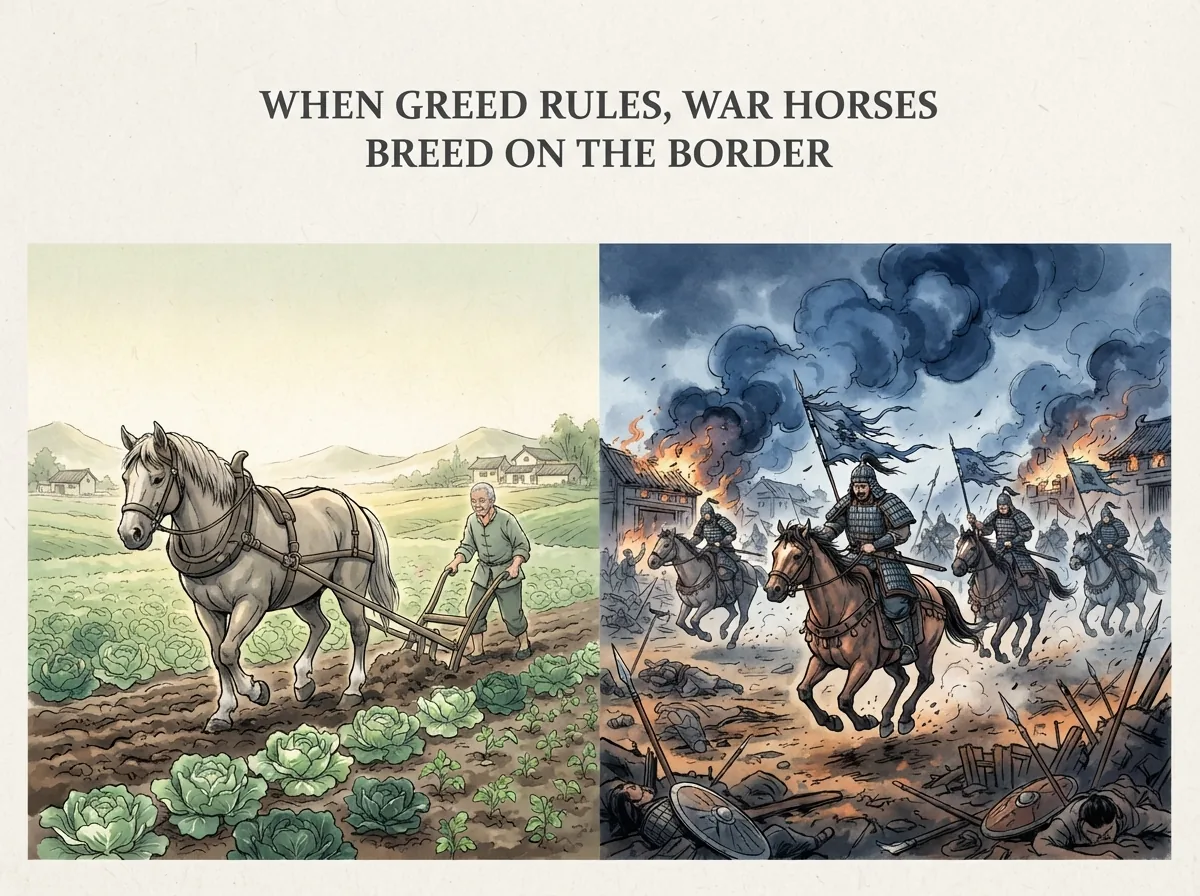
The ancient Chinese text known as the Tao Te Ching asks us to notice something unexpected: what a society does with its horses reveals more about its political health than any speech or treaty. When a civilization is well ordered, warhorses are retired from service and put to work fertilizing fields. When it is not, military mares give birth in the suburbs—because the land around cities has become too occupied by war to support ordinary farming, and the breeding of new warhorses has merged with the machinery of conflict itself. The image is disarmingly simple, almost pastoral. Yet it carries a precise diagnosis of how societies move from peace toward endless expansion.
Laozi follows these two pictures not with military analysis or strategic advice, but with a statement about desire: "Nothing exceeds showing objects of desire; nothing exceeds not knowing when one has enough; nothing exceeds craving possession". The chain from visible temptation to insatiable demand to the imperative to take is, for him, the deeper architecture behind organized violence. War rarely begins because resources are scarce. It begins when a community loses the capacity to judge what is sufficient—a foundational perspective explored in Daodejing Chapter 46.
This is not a claim that wars are caused by individual greed alone. Personal ambition stays contained; institutionalized ambition mobilizes entire populations. When a desire structure lacks an internal stopping rule, taxation, conscription, agricultural redirection, and cultural narratives of glory all bend toward the same direction. Resources that once sustained life are gradually rerouted into the machinery of expansion—and the line between preparation and practice blurs until there is almost no line at all.
Daodejing Chapter 46: The Passage That Links Horses to Desire
The most commonly referenced version of this passage reads: "When the world follows the Way, swift horses are turned back to manure the fields. When the world does not follow the Way, war horses breed in the suburbs" The final line in earlier manuscripts adds: "Nothing exceeds showing objects of desire; nothing exceeds not knowing when one has enough; nothing exceeds craving possession" Later transmitted versions sometimes compress this, beginning directly with the passage about dissatisfaction and possession. All three versions agree on the core observation: war is not a random eruption but the visible symptom of a social order that has lost its scale for enough.
The contrast between the two kinds of horses matters because both depict the same animal serving opposite purposes. A horse can pull a plow or carry a soldier; it can fertilize a field or stand in a stable reserved for campaigns. Which direction the animal takes tells us where the society's priorities actually live. Words about peace are easy; resource allocation is honest. When a community consistently channels its best energy toward securing more—more territory, more advantage, more security measured against shifting benchmarks—it has already chosen, quietly and cumulatively, the conditions that make war likely.
Peace, in this reading, is not the absence of strength. It is the deliberate choice not to convert available power into predation. A society that has mastered the art of stopping is rarer, and more remarkable, than one that has simply stopped fighting.
From Desire to Institutionalized Expansion
The three stages Laozi names—arousal of desire (kě yù, 可欲), not knowing contentment (bù zhī zú, 不知足), and the urge to acquire (yù dé, 欲得)—form a dynamic chain rather than three separate flaws. First, certain objects are elevated into status markers; they become the benchmark by which people measure worth. Then the standard for "enough" dissolves, because every acquisition becomes the launchpad for the next demand. Finally, the desire to acquire hardens into a rule that action must follow, and external boundaries—physical, moral, or political—lose their force.
When this chain operates inside a single person, the consequences may be limited to personal imbalance. When it operates inside institutions that control armies, budgets, and entire populations, the consequences scale outward. Individual greed cannot easily fund a campaign; an institution that adopts greed as policy can. Tax revenues are redirected. Farmers become soldiers. Narratives that once celebrated cultivation now celebrate expansion. The machinery of war develops its own inertia: once built, it requires justification, and that justification multiplies. The original purpose—security, resources, prestige—gradually disappears beneath the logic of continuing the process.
Laozi does not argue that every desire is dangerous. The text explicitly distinguishes between genuine need and manufactured ambition Hunger caused by excessive taxation is not a problem of insufficient desire but of too much extraction: the classic passage on this point observes plainly that people starve because rulers take too much in taxes The critique in Daodejing Chapter 46 is aimed at those who command armies and redirect national resources, not at those struggling to meet basic needs. Applying "know when enough is enough" primarily to ordinary people while excusing elite expansion would invert Laozi's intent. For the word-for-word source text and commentary, consult the complete classical translation and commentary of Moderating Desire: When War Horses Breed in the Countryside.
Continue with the deeper interpretation and practical application.
ChiDestiny members get access to the full analysis, modern applications, and the growing Chinese Wisdom Library.
Sources & Further Reading
[1] Classical sources consulted
[2] Laozi (Silk Text Edition, 老子/帛書本) – Wikisource (維基文庫) — Mawangdui silk-text manuscript of the Tao Te Ching, including Chapter 46 with the threefold formulation on desire.
[3] Tao Te Ching – Section 75 — Transmitted edition (tōngxíng běn, 通行本) Chapter 75, on rulers' excessive taxation as the cause of popular hunger.
[4] Readings not cited as evidence
[5] Chapter 3 of the Tao Te Ching (“Not displaying objects of desire keeps people’s minds from becoming restless”)—referenced for context on the concept of keyu (“objects of desire”), but not used as direct textual support for the article.
[6] Chapter 30 and Chapter 31 of the Tao Te Ching — referenced for the tradition's general anti-war orientation; specific claims about their exact wording were not independently verified in the source material used here.
[7] Scholarly commentaries on the interpretation of fen in Chapter 46—an acknowledged point of debate. Given the unresolved textual issues, the article does not adopt a single definitive translation.






