
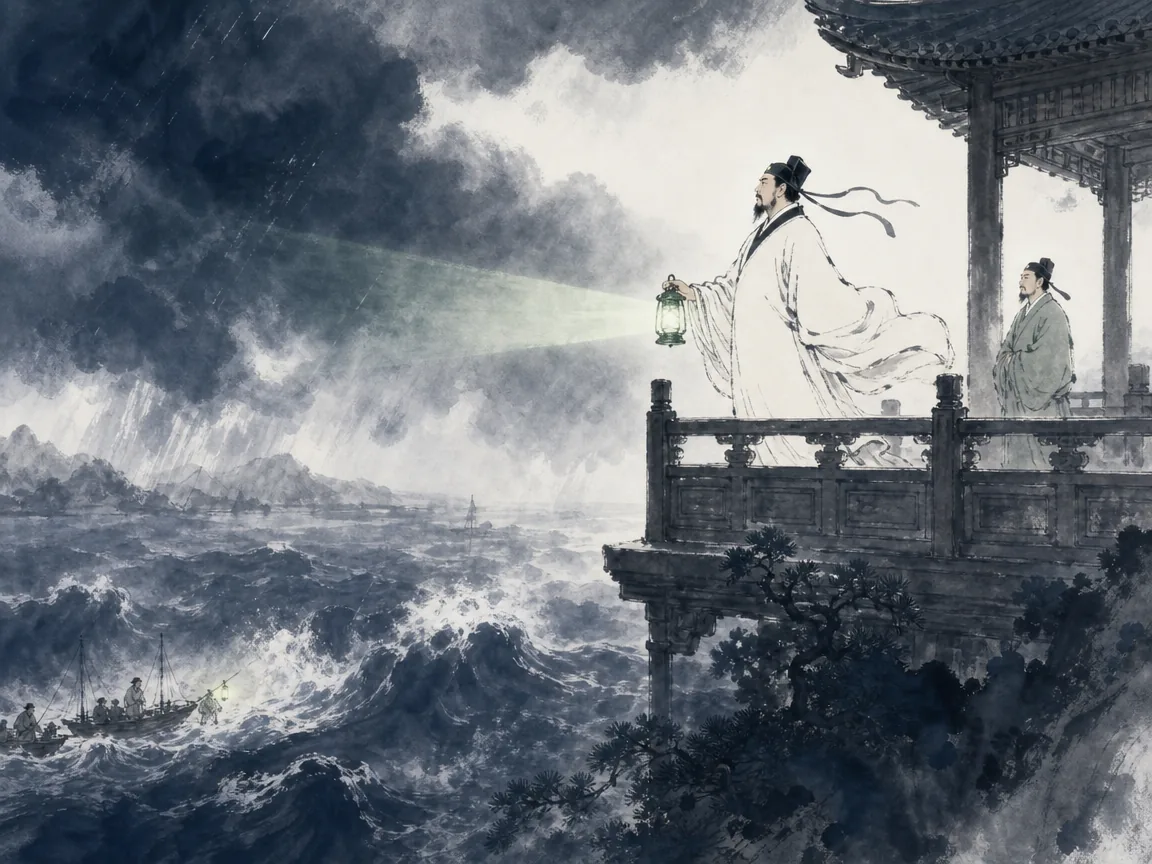
At twenty-three, Fan Zhongyan learned he was not who he had been told. Raised since childhood in the household of his mother's second husband, he had gone by a different surname, studied in relative obscurity, and quietly pursued the path of a scholar-official. When an argument with his half-brother reduced him to the words “illegitimate child,” something in him snapped—not into bitterness, but into resolve. He left that house, returned to his mother, and set out alone to study at Yingtian Academy (应天书院) [1]. What followed was a life that would stretch over decades of exile, frontier defense, political reform, and literary achievement—all driven by a single, stubborn question: how can I be useful to the world?
Fan Zhongyan's most famous line—“Worry before the world worries, and enjoy only after the world enjoys” (先天下之忧而忧,后天下之乐而乐)—is often quoted as poetry. But it was born in hardship, not comfort. He wrote those words in 1046 while exiled again, far from the capital, having already watched his reforms collapse and his career unravel twice [2]. The sentiment reads less like an aspiration and more like a strategy—a way of staying grounded when external circumstances offer nothing stable to hold onto. That is precisely why it still speaks to people today—a foundational perspective explored in Fan Zhongyan Purpose Beyond Self.
Modern burnout is rarely caused by a single catastrophe. It is the slow erosion of meaning: the gap between what we are doing and why we are doing it. Fan Zhongyan's life offers a different model — not the pursuit of balance, but the pursuit of purpose. He did not avoid suffering; he gave it direction.
Fan Zhongyan Purpose Beyond Self: A Hard Beginning That Shaped a Lifetime
Fan Zhongyan's father died when he was two years old [1]. His mother, unable to sustain them alone, remarried a man named Zhu and moved to another household. For years, Fan lived under a different name — Zhu Yue (朱说) — studying quietly, keeping his origins hidden. The turning point came in his early twenties, when a family dispute forced the truth into the open [1]. Rather than retreat into resentment, he used the revelation as fuel. He bid his mother farewell, traveled to the Yingtian Academy, and committed himself to study with an intensity that would define the rest of his life.
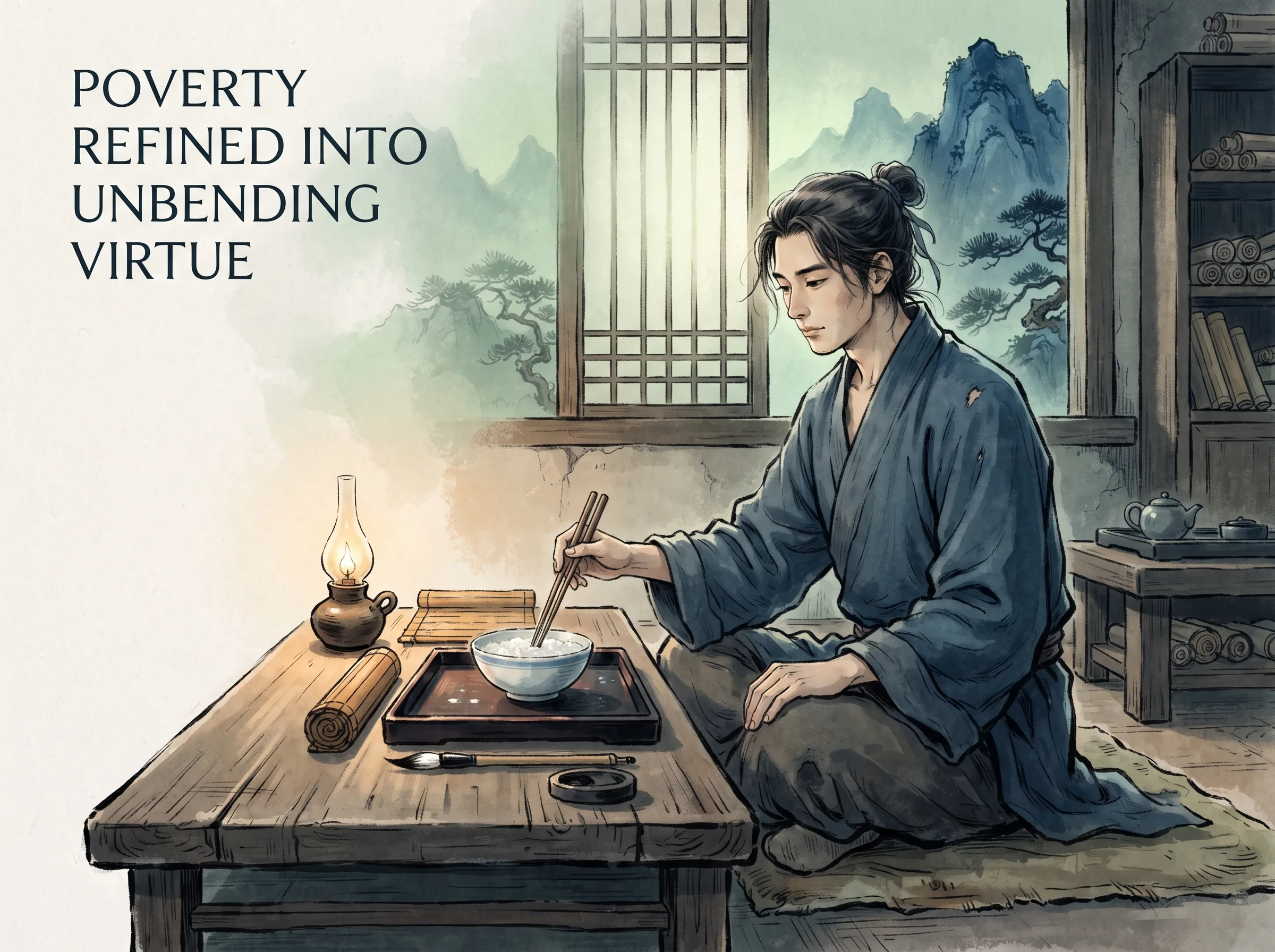
The conditions were harsh. To survive on almost no money, he boiled a single pot of porridge each day, let it cool until it solidified, cut it into four portions, and ate two portions at a time with pickled vegetables. He did not complain. General people could not endure such hardship, he wrote, but he found no difficulty in it. When the local magistrate heard of his diligence and sent him rich food, he declined — not out of pride, but because he understood that slipping into luxury would soften his discipline.
This is not a story of suffering glorified. Fan Zhongyan did not seek hardship for its own sake. What matters is how he responded to it: he did not let adversity become an excuse for bitterness or withdrawal. Instead, he let it clarify his aim. The goal was never personal comfort. It was competence — the kind of competence that could serve something larger than himself.
Practical takeaway: Hardship does not automatically produce purpose. What matters is the direction you give it. When you face something painful or unfair, ask not "Why is this happening to me?" but "What does this make clear to me?" Purpose is not found by avoiding difficulty; it is found by refusing to let difficulty be the end of your story.
The Choice Between Good Minister and Good Doctor
As a young student, Fan Zhongyan was asked about his ambition. He answered simply: if he could not become a good minister, he would become a good doctor. At first glance, these seem like very different professions — one of governance, one of healing. But for Fan, they shared the same root: relieving suffering. A minister cures a society; a doctor cures a body. Both address pain. Neither is chosen for prestige.
Later, when the emperor passed through his city in a grand procession and everyone rushed to the streets to glimpse the imperial display, Fan stayed behind and kept reading. When asked why, he replied that he would have time to see the emperor in due course — meaning, he would earn the right to serve through substance, not spectacle This is the same instinct that drove his original choice: the work matters more than the audience.
Modern ambition often confuses visibility with value. We measure success by titles, salaries, followers, and recognition. Fan Zhongyan measured it differently. His early decision to choose service over status was not naive — it was strategic. A person who knows their deeper aim is harder to distract. When the world offers you a banquet, you can decline without guilt if your hunger is for something else.
Practical takeaway: Before accepting the next opportunity, ask yourself: does this move me toward the kind of work I would do even if no one noticed? Not every choice needs to be dramatic, but checking your motive against your purpose is a quiet practice that prevents slow drift.
Integrity Without a Team: Speaking Truth Alone
Fan Zhongyan did not build power by building alliances. He built it by refusing to look away.
When Empress Dowager Liu (刘太后) held the regency and Emperor Renzong (宋仁宗)—already nineteen—remained sidelined, most officials stayed silent. Fan submitted a memorial urging her to return power to the young emperor [1]. The memorial was ignored, and he was promptly reassigned to a provincial post [1]. He did not learn to be quiet. From afar, he continued to write—criticizing palace construction, questioning policy, reminding the court of its responsibilities.
His most famous act of defiance came during a dispute with the senior minister Lü Yijian (吕夷简). Fan presented the emperor with a diagram of official appointments, accusing Lü of favoritism and cronyism [1]. Lü responded by accusing Fan of forming a faction and sowing discord between ruler and minister [1]. The result was predictable: Fan was dismissed and sent to govern Raozhou [1]. Connect these enduring values to the broader cultural heritage explored in The Rivers of China: How Two Waterways Teach Us to Hold Opposing Values at Once.
Rather than repent, Fan wrote a reply to a friend who had urged him to keep his mouth shut and live peacefully. In Rhapsody on the Spirit Crow (Lingwu Fu; 《灵乌赋》), he chose a different line: “Better to cry out and die than to live in silence” (宁鸣而死,不默而生) [3]. The sentiment—that speaking truth is itself a form of life, and that silence is a kind of death—became one of the most quoted lines in Chinese intellectual history.
This is not advice for the faint-hearted. Standing alone has costs. But Fan's point was not that isolation is noble; it was that compromise with what you know to be wrong is a slower, more total loss. He did not join factions because he belonged to principles. That is a distinction that matters in any organization, any team, any era.
Practical takeaway: You do not need to make a dramatic stand every day. But when you notice yourself staying quiet about something you know is wrong, pay attention. Small silences add up. The practice is simple: name the thing, even quietly, even once. Integrity is built in moments, not manifestos.
Reform That Failed — But Lived On
In 1043, Fan Zhongyan was recalled to the capital and given real authority. He launched a series of reforms aimed at fixing a bureaucracy that promoted officials largely by seniority rather than ability. His proposals were adopted, at least in part, and edicts were issued [1]. Then, within a year, the whole effort unraveled. He was removed from power and exiled once more.
The reform movement is known in history as the Qingli Reforms (庆历新政). Whether it began precisely in the third year of the Qingli era cannot be confirmed from the available sources. What is clear is that one of its central features was reforming the promotion system—and that this touched the interests of powerful people. When a fellow reformer expressed concern that Fan's decisive actions might bring temporary sorrow to individual families, Fan's response was memorably blunt: it is better that one family weeps for a time than that an entire province suffers. The “province” here roughly corresponds to a modern prefecture-level region; the point was not casual cruelty but the calculus of public responsibility.
The reforms failed. Fan did not win. But he also did not recant. The historian Zhu Xi later observed that from his days as a student, Fan regarded the world as his own responsibility, and that his resolve never wavered. That consistency — across exile, recall, failure, and exile again — is what made his example lasting.
Holding the line does not guarantee victory. But it guarantees something else: you will not lose yourself in the attempt. In a culture that measures success by outcomes, Fan Zhongyan offers a quieter metric — Did you stay true to what you thought was right? That question is available to anyone, at any level of influence.
Practical takeaway: Invest in causes that matter even if you cannot see them succeed. Not every effort needs a visible return. Ask yourself: if I knew this would fail publicly, would I still do it? If the answer is yes, you have found something worth pursuing.
The Border and the Pen: Two Sides of the Same Resolve
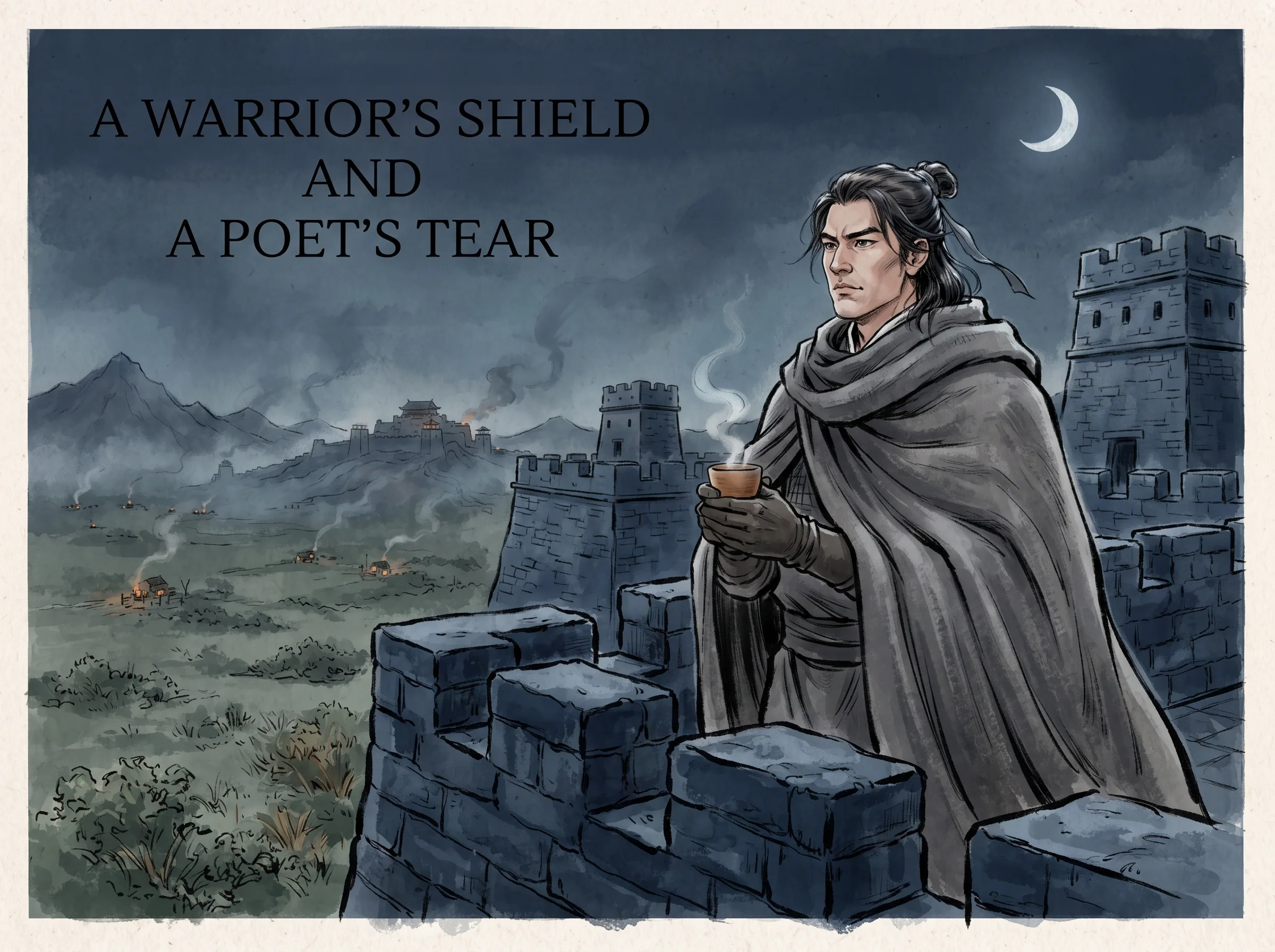
In 1040, Western Xia forces attacked the northern frontier, and panic spread through the capital. The emperor recalled Fan Zhongyan, now in his fifties, to help defend the region. He did not arrive as a theorist. He arrived as a commander who reorganized troops, built fortifications, and won the respect of opponents.
One of his most notable achievements was the construction of Dashun City. Anticipating that the enemy would contest the site, he secretly sent his son and a native officer to occupy the ground first, then followed with his own forces [1]. The soldiers were initially disoriented, but once they reached the site, Fan gave clear orders and the walls were raised in ten days [1]. When Western Xia troops arrived with thirty thousand cavalry, they found a prepared position and withdrew after a skirmish [1]. After Dashun City was built, nearby strongholds that had previously raided the region dared not approach, and attacks on the Huanqing area decreased significantly [1].
It was during this period that Fan wrote what is now considered one of the greatest frontier poems in Chinese literature, Fisherman's Pride: Autumn Thoughts (Yu Jia Ao: Qiu Si; 《渔家傲·秋思》). The poem describes the desolate beauty of the borderland, the loneliness of command, and the exhaustion of soldiers who cannot yet return home. Whether every detail in popular retellings of the poem's composition is accurate is harder to confirm, but the work itself—attributed to Fan and preserved in the literary tradition—captures something true about the life of someone who held both the brush and the sword.
The integration of action and reflection is not a modern invention. Fan Zhongyan showed that leading and writing, defending and contemplating, are not opposites but complementary expressions of the same commitment. A person who only thinks without acting risks empty idealism. A person who only acts without thinking risks blind force. Both are needed.
Practical takeaway: Develop both sides of your capacity — the disciplined action and the reflective pause. If your work demands only one mode, deliberately cultivate the other. A journal, a walk, a conversation with someone outside your field — these are not distractions from purpose. They are investments in it.
"Worry Before, Enjoy After" — Meaning in Context
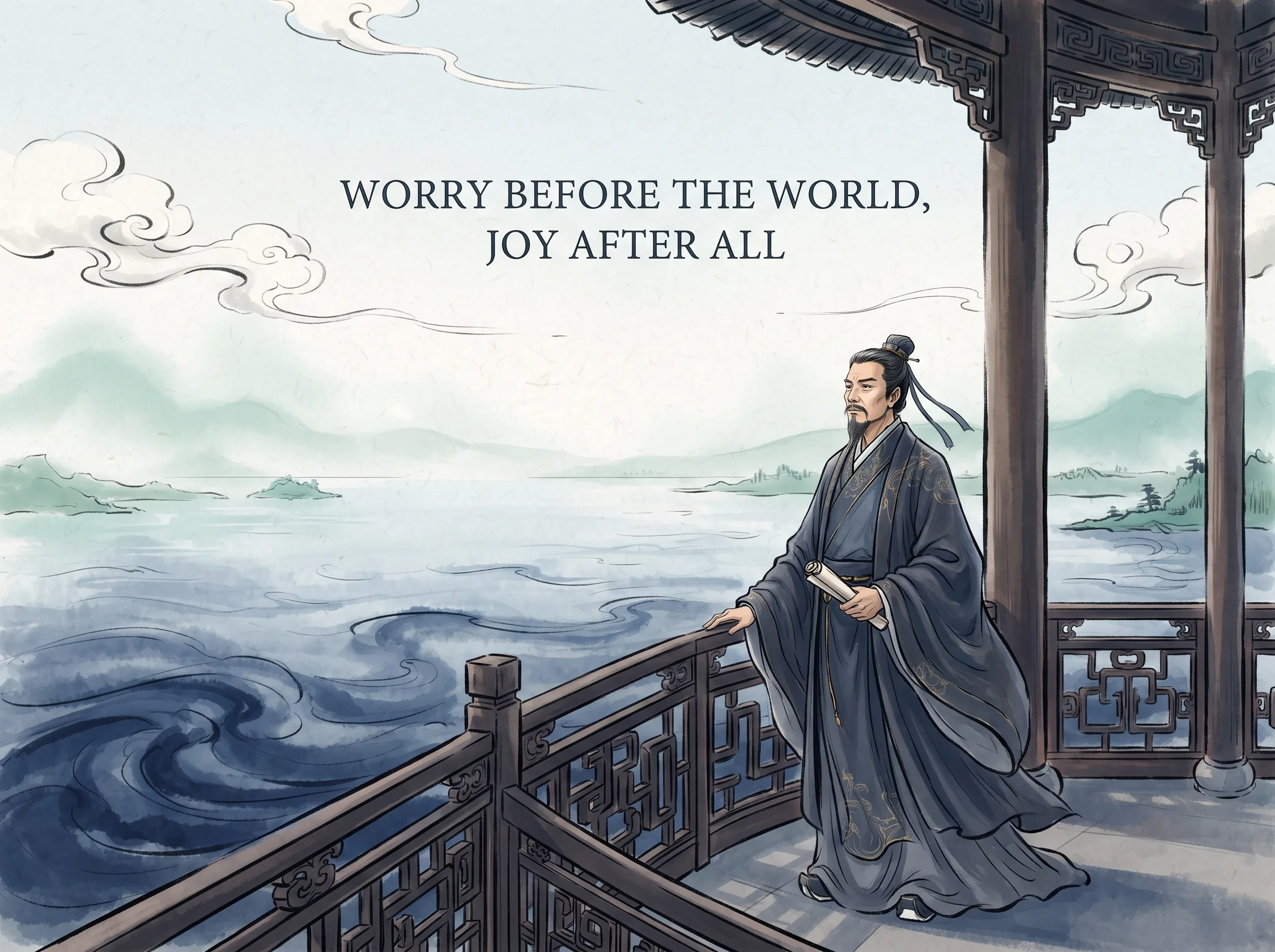
The famous couplet “To worry before the world worries, and to enjoy only after the world enjoys” (先天下之忧而忧,后天下之乐而乐) comes from Record of Yueyang Tower (Yueyang Lou Ji; 《岳阳楼记》), written in 1046 [2]. Fan was in exile at the time. He had never actually visited Yueyang Tower. His friend Teng Zijing (滕子京), also exiled and then governing the area, had just rebuilt the tower and sent Fan a painting of its autumn scenery, asking him to write a commemorative piece. Fan composed the essay from imagination and memory, and in doing so produced one of the most enduring statements of purpose in Chinese thought.
The essay begins by describing the tower and the lake, then moves to a philosophical meditation. Fan observes that two kinds of people react differently to their circumstances: those who lose office grieve, and those who gain it celebrate. Both are trapped — one by loss, the other by gain [2]. The ancient humane persons he admired transcended both reactions [2]. Their stability did not depend on external conditions.
“Not delighted by material gains, not saddened by personal losses” (不以物喜,不以己悲) [2]. This is not emotional detachment. It is emotional independence. Fan is not saying that joy and sorrow are illusions. He is saying that anchoring your well-being to things outside your control—promotions, criticism, market conditions, public opinion—is a recipe for instability. The alternative is to anchor yourself in something you can choose: your direction, your commitments, your service.
For modern readers, this offers a practical framework. When life swings between success and setback, the question is not "How do I maintain happiness?" but "What am I serving that remains steady regardless of my circumstances?" The answer does not need to be grand. It can be as simple as doing honest work, caring for your family, contributing to your community, or creating something that outlasts you. Fan Zhongyan's answer was larger — the welfare of the world — but the structure of the thought is accessible to anyone.
Practical takeaway: Identify your anchor. Write it down. It might be your craft, your relationships, your principles, or your commitment to reducing suffering in some corner of the world. When events shake you, return to it. Not as an escape from feeling, but as a compass for direction.
FAQ
Was Fan Zhongyan really as outstanding as later historians claimed? He received the posthumous title "Wenzheng," widely regarded as the highest honor bestowed on a scholar-official in Chinese history, and later figures such as Zhu Xi praised his consistency. Whether every claim about his excellence is fully substantiated by surviving records is a matter historians continue to examine.
Did Fan Zhongyan write Fisherman's Pride: Autumn Thoughts (Yu Jia Ao: Qiu Si; 《渔家傲·秋思》) during his frontier service? The poem is attributed to Fan Zhongyan and fits the period of his western frontier assignment, but detailed verification of its composition circumstances is difficult from the available sources. It is widely read as a product of that experience.
What exactly did Fan mean by “worry before, enjoy after” (先忧后乐)? It is a statement about the order of priorities, not a prescription for perpetual suffering. Fan argued that a person anchored in public purpose is less likely to be destabilized by personal fortune or misfortune [2]. The goal is resilience, not self-punishment.
Is Fan Zhongyan's story relevant to people outside of East Asia? The specific historical details are rooted in Song dynasty China, but the underlying question — how to live with purpose when circumstances are difficult — is universal. The structure of his reasoning is accessible regardless of cultural background.
Conclusion
Fan Zhongyan's life was not easy. He experienced poverty, exile, political defeat, and the constant risk of angering those in power. Yet he did not become cynical, nor did he retreat into private comfort. He found a way to carry his suffering into service, and in doing so, he created a model of purpose that has survived for nearly a thousand years.
The lesson is not that you must become a reformer, a general, or a celebrated writer. The lesson is simpler: find something larger than yourself, and let it guide your choices. When ambition and exhaustion collide — as they often do — purpose is the answer that does not tire.
If this resonates with you, consider starting small. Choose one area of your life where you can act from purpose rather than reward. It might be your work, your relationships, or a cause you support. The direction matters more than the distance. And if you would like to explore more stories like this, Chidestiny publishes weekly reflections on how ancient Chinese wisdom can help you navigate modern life, reflecting the enduring wisdom of Fan Zhongyan Purpose Beyond Self.
Gain deeper perspective on weathering adversity through the poetic resilience explored in Shoulders Behind the Storm: Su Zhe and the Lost Virtue of Fraternal Duty (*tì*, 悌).
For a deeper comparative examination of these ideas, explore our related study on How 23 Years of Exile Made the Poet Who Wouldn’t Bend.
Sources & Further Reading
[1] History of Song, Volume 314 (Song Shi; 《宋史·卷三百一十四》), Wikisource
[2] Record of Yueyang Tower (Yueyang Lou Ji; 《岳阳楼记》), Wikisource
[3] Rhapsody on the Spirit Crow (Lingwu Fu; 《灵乌赋》), Wikisource
[4] In Memory of Miss Liu Hezhen (Ji'nian Liu Hezhen Jun; 《纪念刘和珍君》), Wikisource
Further Reading
- Academic histories of the Qingli Reform period (庆历新政相关研究)
- Classical and modern commentary on Record of Yueyang Tower (《岳阳楼记》历代评注)
- Lu Xun's full essay In Memory of Miss Liu Hezhen (鲁迅《纪念刘和珍君》原文), for comparison with the Lingwu Fu tradition






