
Beauty and Wisdom in Chinese Art: The Gift Made From Makeup
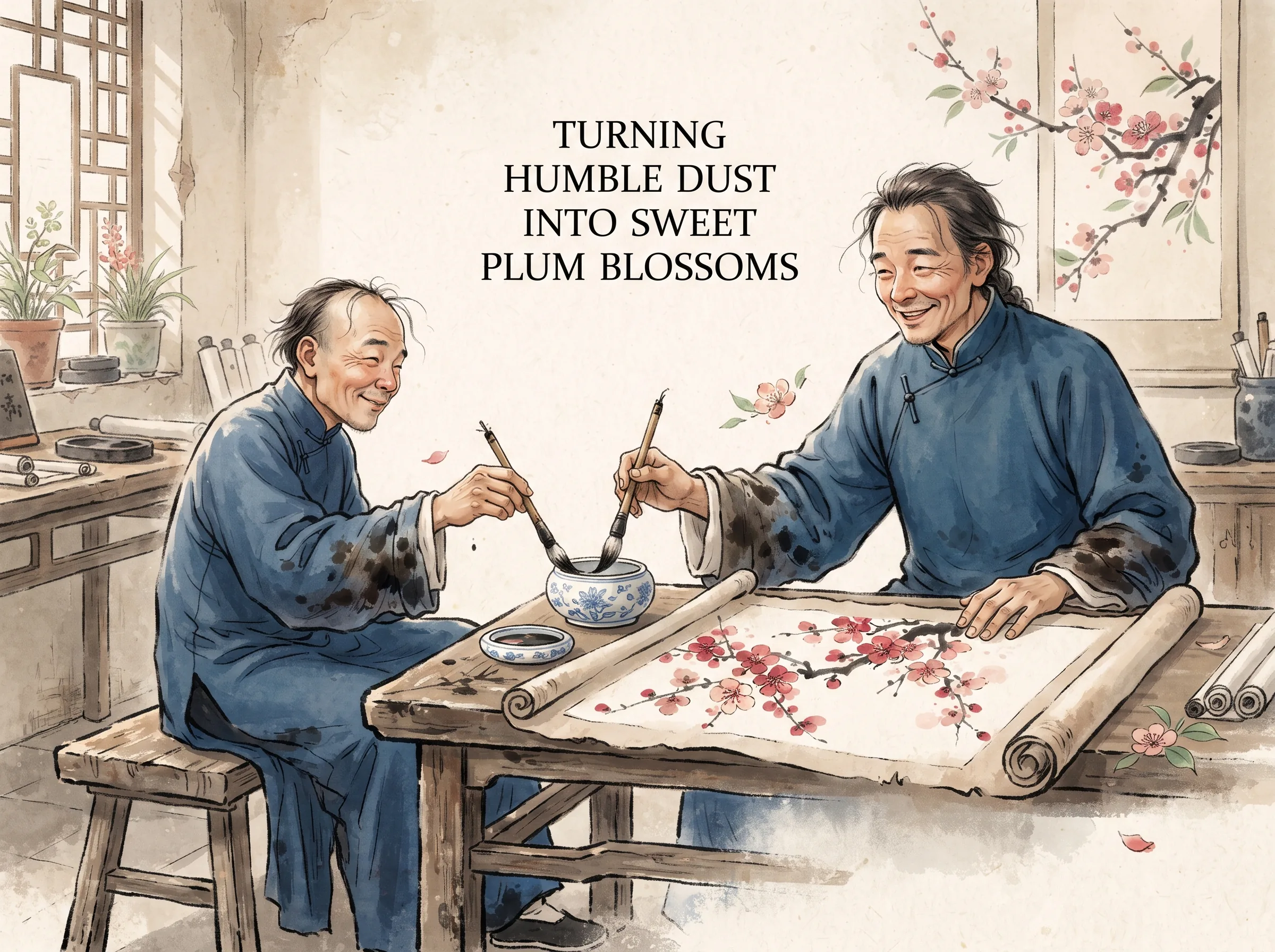
In the 1760s, an artist named Jin Nong painted a hanging scroll of plum blossoms and sent it to a close friend who was taking a second wife. What makes this painting remarkable is not merely its visual elegance but the materials from which it was made. According to Jin Nong's own inscription, he executed the work using two unconventional pigments: rouge for the blossoms and eyebrow darkener for the branches [2]. He was painting with cosmetics — substances normally reserved for the private sphere of feminine adornment — and transforming them into an object of lasting artistic value.
The painting, now known as Plum Tree in Flower and held in a major American museum, functions on at least two levels at once. It is beautiful. It is also practical: a timely, clever, deeply personal gift for a friend navigating a significant social occasion. Jin Nong was not hiding beauty away in a spiritual realm untouched by worldly concerns. He was weaving beauty into the fabric of human relationship, using materials that carried intimate associations and a sense of occasion perfectly matched to the occasion of marriage.
This single painting — and the story behind it — challenges one of the most persistent stereotypes about Chinese art and the culture that produced it. It invites us to reconsider what classical Chinese wisdom might still have to teach us about creativity, utility, and the ways art can serve the people we care about.
Shattering the "Aloof Literati" Stereotype
There is a popular image of the traditional Chinese literatus that has survived into the present day. In this image, scholar-artists are detached, ethereal figures who exist beyond the reach of commerce and social obligation. They are portrayed as hermits perched in mountains, cultivating an aloof purity that scorns material wealth and social climbing. This stereotype often carries an implicit lesson for modern readers: if you want to be a "real" artist, you should be willing to suffer, stay pure, and remain isolated from the demands of everyday life.
But the historical record tells a different story. Jin Nong himself, celebrated as one of the Eight Eccentrics of Yangzhou, lived in a world of complex social networks, economic pressures, and practical negotiations [2]. His collected writings contain frank reflections on material life. He described exchanging a cherished inkstone for rice and recording that he copied Buddhist scriptures for payment, earning a bolt of silk for each volume completed [1]. These were not the quiet musings of someone removed from worldly concerns. They were the words of a working artist who understood the necessity of earning a livelihood.
The friendship between Jin Nong and the prominent salt merchant Jiang Chun illustrates this reality even more clearly. Jiang Chun, the chief representative of the Lianghuai salt merchants, was one of the wealthiest men in eighteenth-century China. He hosted imperial inspections, maintained close relations with the Qianlong Emperor, and funded publications of literary collections [2]. Rather than despising such worldly success, Jin Nong participated in it. He sent Jiang Chun paintings, poems, and calligraphy — not merely as acts of romantic inspiration but as thoughtful contributions to a mutual relationship built on shared cultural values.
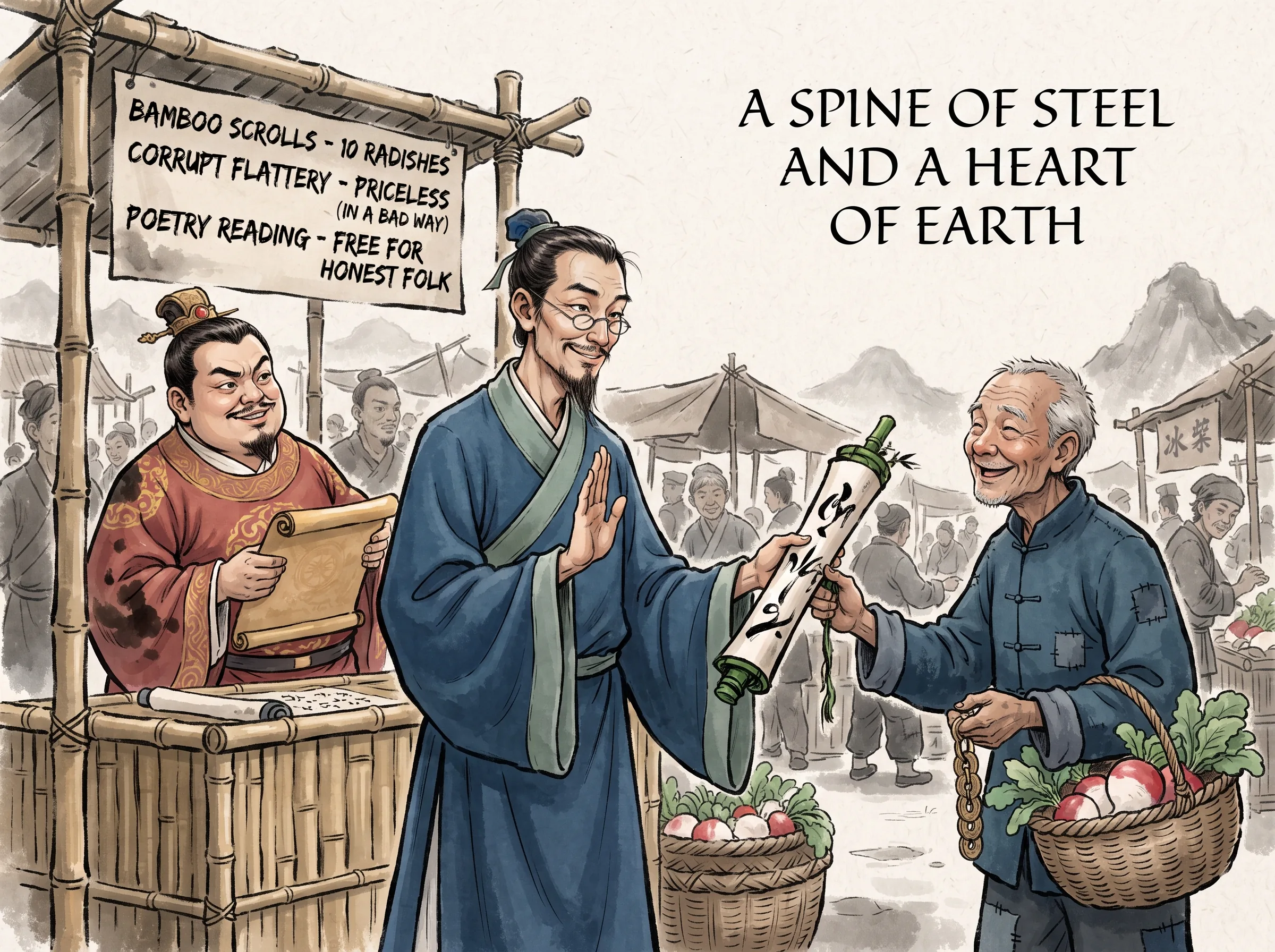
This partnership reflects a concept sometimes described as ru shang, or the Confucian merchant — someone who combines commercial success with cultural cultivation and moral refinement. Jiang Chun was not simply a rich man trying to buy status. He was a patron who understood that cultural capital could elevate a household, a community, and a legacy. The literati painters of his circle were not outsiders looking in. They were active participants in a social ecosystem where art, relationships, and practical life were deeply intertwined.
The Banquet Story: Wit as Cultural Capital
A well-known anecdote from Qing-era sources captures the social dynamics of this world in vivid detail. One version of the story, later adapted by the writer Wang Zengqi, describes a banquet hosted by a salt merchant at a pavilion in Yangzhou. The guests played a poetic game that required each participant to recite a line containing the characters for "fly" and "red." When it came time for the merchant to contribute, he had no classical verse to offer. In a moment of improvisation, he declared: "Willow catkins flying in, every petal red."
The room erupted in laughter. Willow catkins are white, not red. The merchant had walked into a logical trap and knew it. But Jin Nong intervened. Rather than letting the merchant face humiliation, Jin Nong recited a poem that began: "At the Twenty-Four Bridges (Èrshísì Qiáo, 二十四桥), twenty-four winds blow; leaning on the railing, I recall the old Jiangdong. The setting sun reflects across the peach-blossom crossing, and willow catkins fly in, every petal red" (liǔxù fēilái piànpiàn hóng, 柳絮飞来片片红).
According to the story, Jin Nong presented this as a line from a Yuan dynasty poet, rescuing the merchant from embarrassment. The merchant, overwhelmed with gratitude, gifted Jin Nong a substantial sum the following day [2]. Cultivate quiet mindfulness in everyday living through the meditative tea ritual in Why Do Machines Need Efficiency, But Humans Need “Uselessness”?.
Several historians and literary scholars have noted that the poem Jin Nong recited was likely his own composition rather than a genuine Yuan dynasty text. What matters for our purposes is not the factual accuracy of every detail but the cultural logic the story reveals: cultivated knowledge, quick wit, and the willingness to protect another person's dignity could be converted into tangible social and material reward. This is what some contemporary analysts would call the transformation of cultural capital into practical benefit.
The story also illuminates a broader feature of eighteenth-century Chinese social life. Artistic refinement was not a luxury reserved for the contemplative few. It was a form of social currency — something that could be deployed to navigate difficult situations, build relationships, and demonstrate generosity of spirit. Jin Nong did not recite his poem to display superior learning for its own sake. He used it to preserve the harmony of a shared moment. In doing so, he modeled a classical ideal: that true cultivation is always oriented toward others.
Modular Creativity: Why One Symbol Could Serve Many Occasions
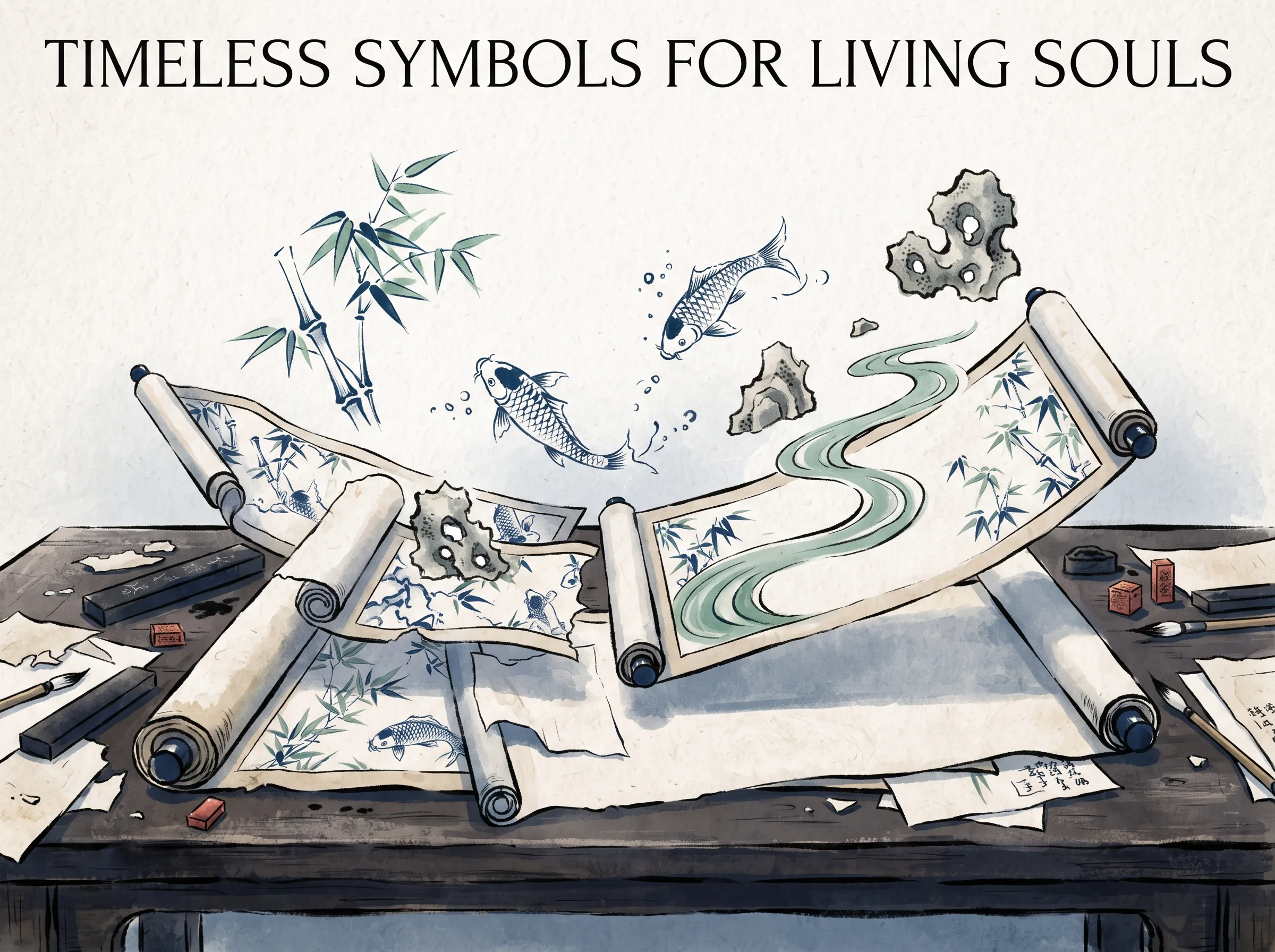
Jin Nong's plum blossom paintings offer another window into the practical wisdom embedded in traditional Chinese art. Literati painters often worked within a limited set of recurring subjects — plums, orchids, bamboo, lotus — and developed a modular approach to composition. Rather than attempting to reinvent the visual language with every new commission, they refined a small vocabulary of forms that could be combined, rearranged, and recontextualized across different occasions.
A single motif like plum blossoms carried multiple symbolic meanings simultaneously. In one context, it could express resilience in the face of hardship. In another, it could suggest vitality, fertility, or new beginnings — associations that made it entirely appropriate for a wedding gift. In a third context, the same flower could convey elegant detachment and personal integrity. Because plum blossoms operated across so many registers of meaning, a single visual language could serve a wide range of social situations without losing its coherence.
This modularity was not a limitation. It was a sophisticated solution to a practical problem: how do you create meaningful art that is both personally expressive and socially adaptable? The literati painters answered by developing a shared symbolic vocabulary that their friends and patrons could understand intuitively. When Jin Nong painted plum blossoms for Jiang Chun's second marriage, he was not merely decorating a wall. He was speaking in a language his friend would recognize — one that conveyed warmth, celebration, and affection without requiring long explanations.
For modern readers, this approach offers a useful model. We often treat creativity as if it must either be pure self-expression or mass-produced commodity. Classical Chinese practice suggests a third option: develop a small set of versatile skills or symbols, master them through repetition, and then adapt them to serve different relationships and moments throughout your life. A skilled cook can prepare different meals from the same repertoire of techniques. A writer can reuse structural patterns across genres. A musician can draw on established modes to meet the demands of different occasions.
What We Have Lost — and What We Can Reclaim
One of the consequences of separating art from daily life is that many contemporary art students learn technical skills but do not develop the broader cultural literacy that defined the classical tradition. In the literati model, a painter was expected to be a calligrapher, a poet, and a thinker — a multidimensional cultivator rather than a narrow specialist. The inscriptions on Jin Nong's paintings demonstrate this integration: his brushwork, his poetic sensibility, and his understanding of social occasion were inseparable.
Modern gift-giving has experienced a parallel narrowing. Handwritten letters, home-crafted objects, and creatively prepared meals have largely been replaced by standardized transactions: gift cards, online orders, prepaid envelopes. There is nothing inherently wrong with convenience, but when gift-giving becomes purely transactional, it loses the capacity to communicate something uniquely personal.
Classical Chinese wisdom does not demand that everyone become a master painter. What it suggests is that any skill offered with genuine care can become a vessel of aesthetic and practical beauty. A carefully poured cup of coffee, a bowl shaped on a pottery wheel, a home-cooked meal prepared for someone you love — these acts share the same underlying principle as Jin Nong's cosmetic pigments: the transformation of ordinary materials into something meaningful through attention and intention.
You do not need to master cinnabar or eyebrow darkener to apply this insight. You need only recognize that creativity is not confined to galleries and studios. It is available in any domain where you are willing to invest time, attention, and care. The goal is not to produce a masterpiece by conventional standards. The goal is to create something that reflects the relationship between giver and receiver — something that could not have been obtained at a store.
Art as a Way of Living, Not Just a Product
Jin Nong's world reminds us that beauty and usefulness are not opposing forces. The classical Chinese perspective does not require us to choose between spiritual elevation and worldly engagement. Instead, it models integration — the idea that art can serve relationships, commemorate life events, and convey goodwill without abandoning its aesthetic qualities.
For modern readers navigating a culture that often separates the sacred from the commercial, the pure from the practical, this tradition offers a liberating alternative. The question is not whether art should be useful or whether utility should be beautiful. The question is how each of us can bring our particular skills and sensibilities into the lives of the people we care about — not through grand gestures alone but through small, deliberate acts of creative generosity.
Jin Nong painted plum blossoms with rouge and eyebrow darkener because he understood that the materials of everyday life could become the materials of art when guided by care and intention. His painting was not merely an object to be admired in a museum. It was a message in pigment and ink: I see you, I celebrate this moment in your life, and I have offered something that could only come from me.
That is a standard worth considering — not as a demand, but as an invitation to think differently about what art can be and how it can serve the relationships that make life worth living.
FAQ
Was the painting actually made with real cosmetics? According to Jin Nong's inscription on the work, he used rouge and eyebrow darkener as pigments. This claim appears in the traditional record, though some details surrounding the painting's history and attribution remain subjects of scholarly discussion.
Who was Jiang Chun, and why was he important to Jin Nong? Jiang Chun was a leading salt merchant in eighteenth-century Yangzhou and a close patron and friend of Jin Nong. He sponsored literary publications and maintained a refined cultural salon, reflecting the Confucian ideal of combining commercial success with artistic cultivation.
Is the banquet poem story historically accurate? The anecdote about Jin Nong rescuing a merchant at a banquet appears in Qing-era notes and was later adapted by the modern writer Wang Zengqi. Some scholars believe the poem Jin Nong recited was his own composition rather than an authentic Yuan text. The story's value lies less in its factual precision than in what it reveals about the social role of artistic cultivation.
What is "modular creativity" in Chinese art? Modular creativity refers to the practice of working with a limited set of recurring motifs — such as plum blossoms, orchids, and bamboo — and adapting them across different occasions through varied combinations and contextual meanings. This approach allowed artists to produce meaningful works efficiently while maintaining symbolic richness, reflecting the enduring wisdom of Beauty and Wisdom in Chinese Art.
Examine this artistic principle further through the classical aesthetic philosophy of Why the Weakest Dynasty Painted the Strongest Landscape.
Sources & Further Reading
[1] Dongxin Xiansheng Ji, Volume 3 (冬心先生集) – Shidian Guji — Includes Jin Nong's own reflections on exchanging possessions for rice and copying scriptures for payment, providing direct evidence of his material circumstances.
[2] "Every Petal Red: How Jin Nong Turned White Willow Catkins into Gold" (柳絮飞来片片红) – Sohu Culture — Records the banquet anecdote involving Jin Nong's improvised poem and its role in the social dynamics of eighteenth-century Yangzhou literary culture.
Further Reading
- James Cahill, The Painter's Practice: How Artists Lived and Worked in Traditional China — Offers a broader art-historical context for understanding the economic and social realities of literati painters.
- Lothar Ledderose, Wan Wu: The Chinese Art of Making Things — Explores the concept of modularity and standardized production in Chinese artistic practice.
- Wang Zengqi, "Jiangdong Xing" (《京东兴》) — A modern literary adaptation of the banquet anecdote, available in Chinese.






