
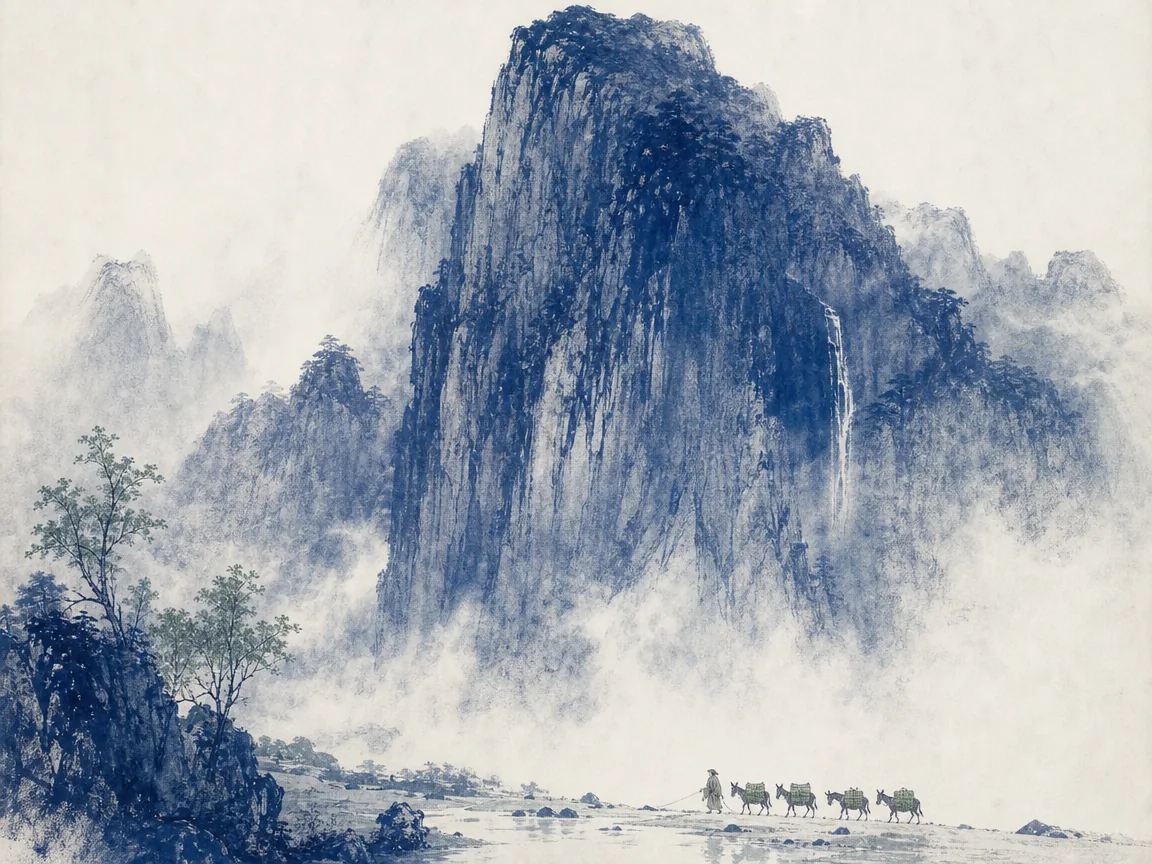
A dynasty that could never secure its borders produced the most complete vision of permanence in Chinese cultural imagination. The Northern Song faced constant military pressure, shifting alliances, and an eventual invasion that scattered its capital and ended its rule. Yet from precisely this era came A Thousand Li of Rivers and Mountains (Qianli Jiangshan Tu), a handscroll whose luminous mineral pigments have survived nearly a millennium, and an aesthetic sensibility—so refined that it still shapes how the world imagines Chinese elegance. The same period also gave us Ru ware porcelain, the Slender Gold calligraphy style, and a way of seeing landscape that continues to define Chinese artistic tradition.
This paradox is worth sitting with, especially now. We live in an age where institutions feel fragile, climates shift unpredictably, and the future often seems harder to hold than the past. When stability feels out of reach, it is easy to assume that only strong, secure foundations can produce anything lasting. But the Northern Song suggests another possibility: that beauty, meaning, and even a kind of permanence can emerge most vividly precisely when outward power is uncertain—a foundational perspective explored in Song Dynasty Landscape Painting.
The question this essay explores is not purely historical. It is about what we can learn from a civilization that, facing impermanence at every level, chose to answer with radical clarity of vision. The painting is not a record of what was; it is a statement about what the artists believed deserved to endure. Understanding how that vision works may offer a quiet compass for anyone trying to build something meaningful in their own uncertain times.
Song Dynasty Landscape Painting: Beauty Born from Fragility
The Northern Song (960–1127) is often remembered in popular narratives as a period of military weakness. It lost territory to northern nomadic confederations, negotiated uneasy peace treaties, and ultimately fell to the Jurchen Jin invasion in 1127. Yet the dynasty is equally—if not more—remembered for extraordinary cultural achievement. The imperial court cultivated painting academies, sponsored ceramic experimentation that produced some of the most admired porcelain in history, and refined calligraphic and poetic forms that remain reference points centuries later.
Why does aesthetic intensity often peak in eras of political vulnerability? One explanation, offered by Chinese intellectual tradition itself, is that when external security cannot be guaranteed, attention turns inward—toward cultivation, refinement, and the creation of objects that embody a vision of order. This is not a claim that suffering produces beauty in a simple causal sense. Rather, it suggests that when the world outside feels unstable, the impulse to create something that looks like stability can become intensely urgent.
In the case of the Northern Song, this impulse produced a particular kind of landscape painting that did not merely depict nature but sought to capture what nature should be: complete, harmonious, enduring. The mountains in these paintings are not photographed realities. They are assembled ideals—places where water flows continuously, peaks rise in balanced relationships, and human life appears integrated rather than dominant. This is a landscape not as it happens to be, but as a civilization wishes it to persist.
For modern readers, the parallel is sobering but not discouraging. Creative flourishing does not require perfect conditions. It requires a sustained commitment to making something coherent, even when the surrounding world does not reward coherence. The Song painters worked within court structures that could withdraw patronage at any moment. They did not paint less beautifully because of that uncertainty. They painted with greater care.
Qianli (千里): Not Distance, but Time
A Thousand Li of Rivers and Mountains is approximately 51.5 centimeters tall and nearly 1,192 centimeters long—close to twelve meters of silk [1]. It cannot be taken in at a single glance. To experience it is to unroll it slowly, section by section, over minutes or even hours. What the painting offers is not a view but a journey.
This is intentional. The Chinese aesthetic tradition developed a specific way of thinking about how a viewer moves through a landscape painting. The painter Guo Xi, active in the eleventh century, described three ways of seeing mountain space: looking up from below to perceive height (gao yuan), peering from the front into depth (shen yuan), and gazing from a near mountain toward a distant one (ping yuan) [1]. These are not photographic perspectives. They are experiential ones—each describing a different relationship between the observer and the world.
The scroll format extends this principle across time. As the viewer moves along the handscroll, the scene shifts continuously. A forest gives way to a river crossing. A mountain peak rises and then recedes. A figure crosses a bridge and disappears around a bend. The painting does not present a single moment frozen in space; it presents a sequence of moments distributed across length. The whole exists only through the act of moving through it.
This design carries a philosophical implication that resonates well beyond art history. Life, in a similar way, cannot be grasped all at once. From a distance, we may imagine our lives as complete pictures—careers, relationships, achievements arranged in a narrative arc. But when we actually live, we only ever experience one section at a time. The past is already rolled up. The future has not yet unrolled. What we possess is the present segment: this conversation, this difficult week, this small decision that feels trivial in isolation but matters in context.
The painting teaches patience with this fact. It does not promise that the whole will ever be visible at once. It promises only that if you keep moving, you will encounter more of it.
Qinglü (青绿): The Color of What We Hope Will Last
The most striking feature of A Thousand Li of Rivers and Mountains is its color. Unlike the ink-wash landscapes that would dominate later Chinese painting, this work is rendered in vivid mineral pigments—azurite blue (shi qing) and malachite green (shi lv), ground from actual stone [2]. These are not colors that fade easily. They are colors that come from the earth itself, prepared through laborious processes of mining, washing, grading, and layering.
What makes this material choice philosophically significant is that the painting is literally made from the substance of mountains. The artist crushed stone to create pigment, then used that pigment to depict stone. The landscape on the silk contains its own geology. This is not representation in the ordinary sense; it is transformation. Earth becomes image becomes enduring color.
The result is a landscape that exists outside the normal cycle of seasonal change. In reality, Chinese mountains are not perpetually blue-green. They shift with weather, altitude, vegetation, and time of day. But in the painting, the colors are intensified beyond natural observation into something that resembles an ideal—a vision of what landscape should look like if it were allowed to remain permanently vibrant. Gain deeper perspective on weathering adversity through the poetic resilience explored in Song Dynasty Poets: Ancient Wisdom for Modern Uncertainty.
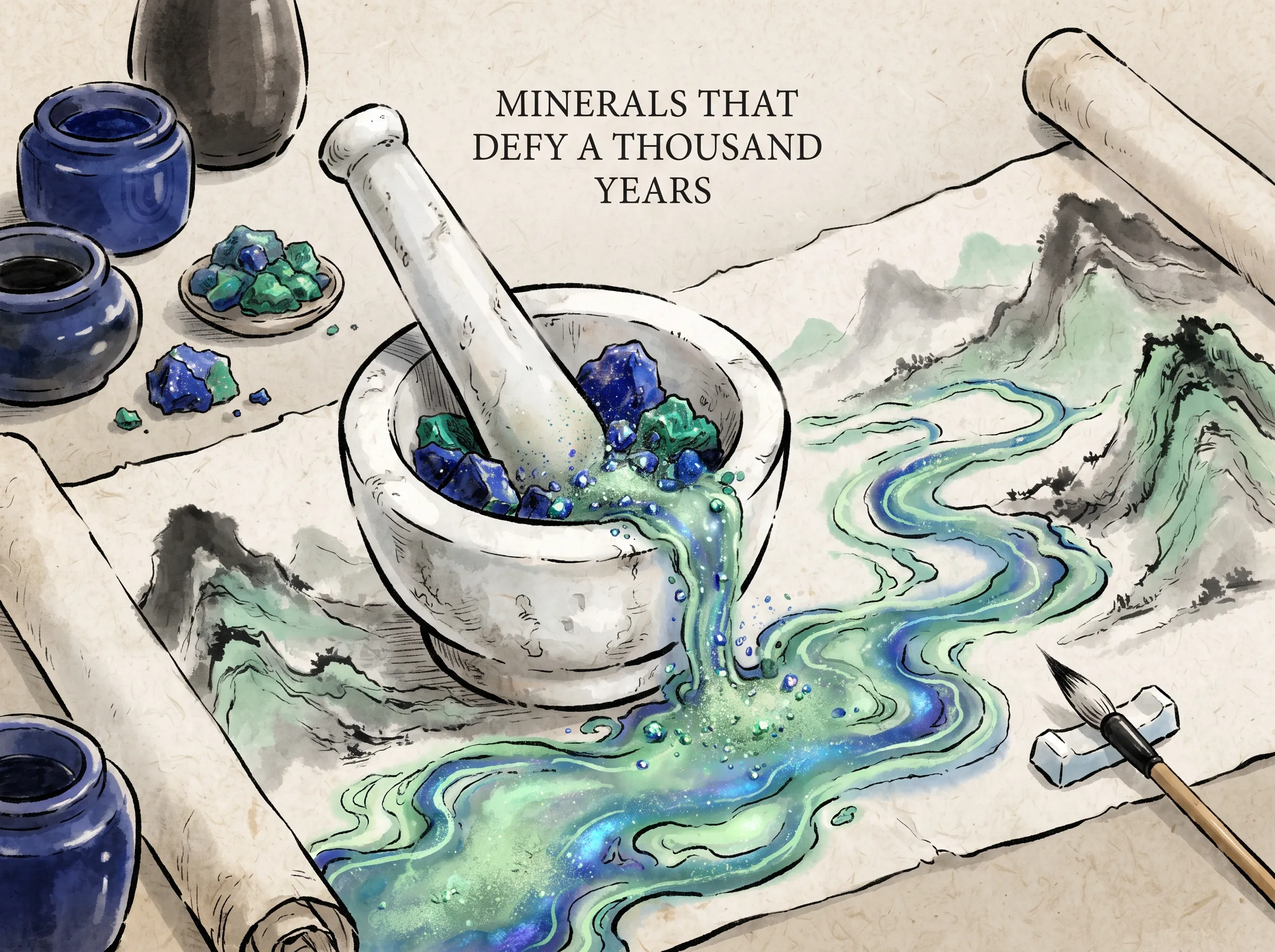
This tension between the spontaneous (ziran, ‘naturalness’; 自然) and the cultivated ideal is central to how Chinese aesthetic thought understands art. The artist does not simply copy nature; the artist distills nature's essence into a form that can withstand time. The pigments themselves—mineral, inorganic, ancient—carry a symbolism of permanence that organic dyes cannot match.
For readers navigating uncertainty, the lesson is subtle but practical. When external conditions are unstable, the question becomes not "How do I control what happens?" but "What can I cultivate that does not depend on favorable conditions?" The Song painters could not guarantee the survival of their dynasty. But they could choose materials that would outlast it. They could compose compositions that held together across centuries of handling. They could invest in work whose value was not tied to immediate political circumstances.
This is not a call to fatalism. It is a reminder that permanence and fragility can coexist. A civilization can fall while its art endures. An individual life can be disrupted while the meaning created within it persists.
The Young Artist and the Weight of Legacy
According to traditional records, Wang Ximeng (Wang Xi Meng) painted A Thousand Li of Rivers and Mountains at the age of eighteen, completed it within roughly half a year under the guidance of Emperor Huizong's court, and then disappeared from historical record [3]. No reliable account of his later life survives. In a culture that valued artistic contribution as a form of immortality—where creating enduring work was considered one path to transcending mortality—his biography is unusually fragmentary [4].
The painting is his only surviving voice. Everything else about him is lost. And yet, from that single act, he entered the canonical stream of Chinese art history and remained there for nearly a thousand years.
This raises a quiet question that may feel uncomfortable but is worth sitting with: what do we leave behind when our personal story is incomplete? Most people imagine legacy as something accumulated over a long, documented life—a body of work, a reputation, relationships that outlast you. But Wang Ximeng suggests a different pattern. Sometimes the most durable thing a person leaves is not the sum of their biography but a single concentrated act of making.
The Chinese concept of li yan (establishing words or works that outlive the body) is part of a broader framework of immortality that also includes establishing virtue and establishing merit [5]. These three paths were historically understood as alternatives when political power or personal longevity could not guarantee permanence. Artistic creation occupies one of these spaces. It does not require a long life. It requires a focused one.
This is not romantic. It is structural. Every person who creates something meaningful—whether a painting, a piece of writing, a raised child, a community project, a craft—enters the same channel that Wang Ximeng entered. The work may outlive the story that surrounded it. The story may be fragmentary. The work remains.
“After Walking a Thousand Li, One Becomes One’s Own Landscape” (走过千里,自成江山)
The closing insight of the source material offers a phrase that has circulated widely in contemporary Chinese reflection: "After walking a thousand li, one becomes one's own landscape" (zou guo qian li, zi cheng jiang shan) [6]. This is not a quotation from any classical text. It is a modern paraphrase—a distillation of ideas that run through Chinese philosophical tradition rather than a line from a specific ancient author.
Still, the idea it expresses is deeply rooted. The concept of jiang shan (‘rivers and mountains’; 江山)—literally "rivers and mountains"—traditionally refers to territory, statehood, or the political order of a civilization. But it can also be understood metaphorically as the inner geography that a person accumulates through lived experience. The paths you have walked, the difficulties you have crossed, the perspectives you have gathered—these form a landscape within you that is as real as any map.
This connects to two traditions that the Song dynasty inherited and reinterpreted. Confucian self-cultivation (xiu shen, ‘self-cultivation’; 修身) emphasizes that moral character and inner order are built gradually, through sustained engagement with the world, not through sudden revelation or solitary insight. Zhuangzi's vision of free wandering (xiao yao you, ‘free wandering’; 逍遥游) describes movement through the world with inner ease—not escape from it, but a particular quality of attention that makes movement itself liberating.
Both traditions share an understanding that the self is not a fixed entity but an accumulated one. You are not what you begin as. You are what you have traveled through.
For modern readers, this offers a reframing of what it means to build something lasting. It is not always about producing a single monument. It is about developing an inner geography that can hold complexity—the kind of internal structure that allows you to move through uncertainty without collapsing into cynicism or rigidity. The painting shows us that a landscape does not need to be uniform to be coherent. It needs variety, rhythm, depth, and a sense that the whole is greater than any single section.
What the Song Still Teaches Us: Practical Reflections
The Northern Song did not survive. Its borders were lost. Its capital fell. But A Thousand Li of Rivers and Mountains preserved a vision of what that civilization hoped to endure: completeness, brightness, connection, permanence. The rivers and mountains in the painting do not change with seasons. They do not decay. They are not falseness—they are the act of holding an ideal against time.
This is not a prescription for ignoring reality. It is a recognition that reality has two dimensions: what happens to us, and what we make from what happens. The Song painters could not control the first dimension. They invested everything in the second.
Here is how that principle might translate into practice for someone living in uncertain times:
Identify your mineral pigments. What is the raw material of your life—your experiences, observations, relationships, struggles—and how can it be refined into something that outlasts the moment? Consider what you are already processing that could become a stable form: writing, making, teaching, building, caring.
Think in scrolls, not snapshots. When planning a project, a career path, or a creative endeavor, ask whether you are designing something meant to be consumed all at once or something meant to be experienced gradually. The most durable work often reveals new layers over time rather than delivering a single satisfying impression.
Accept partial visibility. You will not see the whole of your life at any given moment. You will not understand how current difficulties fit into a larger pattern until later. This is not a failure of perception; it is the structure of experience. The painting teaches you to trust the process of unfolding rather than demanding a complete view.
Cultivate inner geography deliberately. The landscapes within you—your values, your relationships, your skills, your memories—accumulate whether you attend to them or not. Choose, consciously, which terrain you are building. Small daily practices of attention, reflection, and creation are the stones from which an enduring inner landscape is composed.
Make work that does not depend on favorable conditions. The Song painters chose mineral pigments specifically because they would survive. Ask yourself: what in your life is made to endure beyond current circumstances? What would still have value if everything around you changed?
These are not guarantees of permanence. Nothing is. But they are strategies for creating meaning that can outlast the conditions that produced it—which is, perhaps, the most realistic definition of lasting there is.
FAQ
What is A Thousand Li of Rivers and Mountains, and why is it considered significant in Chinese art?
A Thousand Li of Rivers and Mountains is a Northern Song handscroll painted in vivid mineral pigments on silk. It is regarded as one of the masterworks of Chinese landscape painting and a defining example of the qing lu (blue-green) landscape tradition. Its significance lies not only in its visual splendor but in what it represents: a civilization's most complete artistic vision of an enduring, harmonious natural order.
Who was Wang Ximeng, and what do we know about him?
Wang Ximeng is traditionally identified as the painter of A Thousand Li of Rivers and Mountains. According to historical records, he was a young artist who worked within the imperial painting academy and received guidance from Emperor Huizong. He completed the scroll in his late teens and then disappeared from surviving historical accounts. The scarcity of biographical detail has contributed to the painting's aura, but much of what is said about his later life remains undocumented [3].
What does the term jiang shan (‘rivers and mountains’; 江山) mean in Chinese culture?
Literally meaning "rivers and mountains," jiang shan is a culturally rich term that can refer to territory, statehood, or the political order of a civilization. It can also carry a metaphorical sense—the inner landscape that a person accumulates through lived experience, values, and reflection. The term bridges the external and the internal in a way that English has no single equivalent for.
How can someone without a background in Chinese art appreciate this painting?
The most accessible entry point is to understand that the scroll is designed to be experienced over time, not viewed all at once. Watching a video or reading about the viewing experience can help. Equally important is recognizing that the painting is not attempting realism—it is expressing an ideal. Once you understand that the artist chose colors and compositions to convey permanence and harmony rather than accurate topography, the work becomes easier to engage with on its own terms.
Summary and Next Steps
The Northern Song produced its most luminous art in an era of profound uncertainty. A Thousand Li of Rivers and Mountains stands as testament to the possibility that a civilization facing impermanence can respond not with retreat but with visionary clarity. The painting teaches that permanence is not the absence of fragility but the presence of something crafted to outlast it—that the colors chosen from the earth itself can speak across centuries, and that a young artist's single concentrated act can become a shared cultural inheritance.
For modern readers, the takeaway is neither nostalgic nor escapist. It is practical. The conditions of your life may be uncertain. But within those conditions, you can choose what materials to work with, what kind of attention to give, and what vision to commit to form. The landscape you build may not be monumental in the conventional sense. But if it is made with care and oriented toward something that outlasts the moment, it will belong to you in a way that nothing temporary ever can.
Consider beginning with a small practice: identify one thing you are currently experiencing that you would like to transform into something enduring. It does not need to be grand. It needs only to be real. Then ask yourself what form it might take if you treated it not as a passing episode but as a stone waiting to become part of a lasting composition.
Sources & Further Reading
- [1] — Primary source for the three distances (gaoyuan, shenyuan, pingyuan) framework in Chinese landscape theory.
Further Reading
- Palace Museum (Beijing), collection records on A Thousand Li of Rivers and Mountains — For official museum documentation on the painting's provenance, dimensions, and conservation history.
- Xuanhe Huapu (Catalogue of Paintings in the Xuanhe Reign) — Imperial catalog compiled under Emperor Huizong, containing records of court artists including Wang Ximeng.
- Translations and commentary on Guo Xi's Linquan Gaozhi — For deeper understanding of Song dynasty landscape aesthetics and spatial theory, reflecting the enduring wisdom of Song Dynasty Landscape Painting.
For broader philosophical context, consult our related exploration on Why Chinese Painting Chooses Awe Over Love — And What It Teaches Us About Modern Anxiety.
Deepen your understanding of these principles in our reflection on Beyond the Aloof Genius: How Chinese Art Blends Beauty and Practical Wisdom.
Sources & Further Reading
[1] Guo Xi, Linquan Gaozhi (Adages of Forests and Streams), "Shanshui Xun" (On Landscape and Water)






