
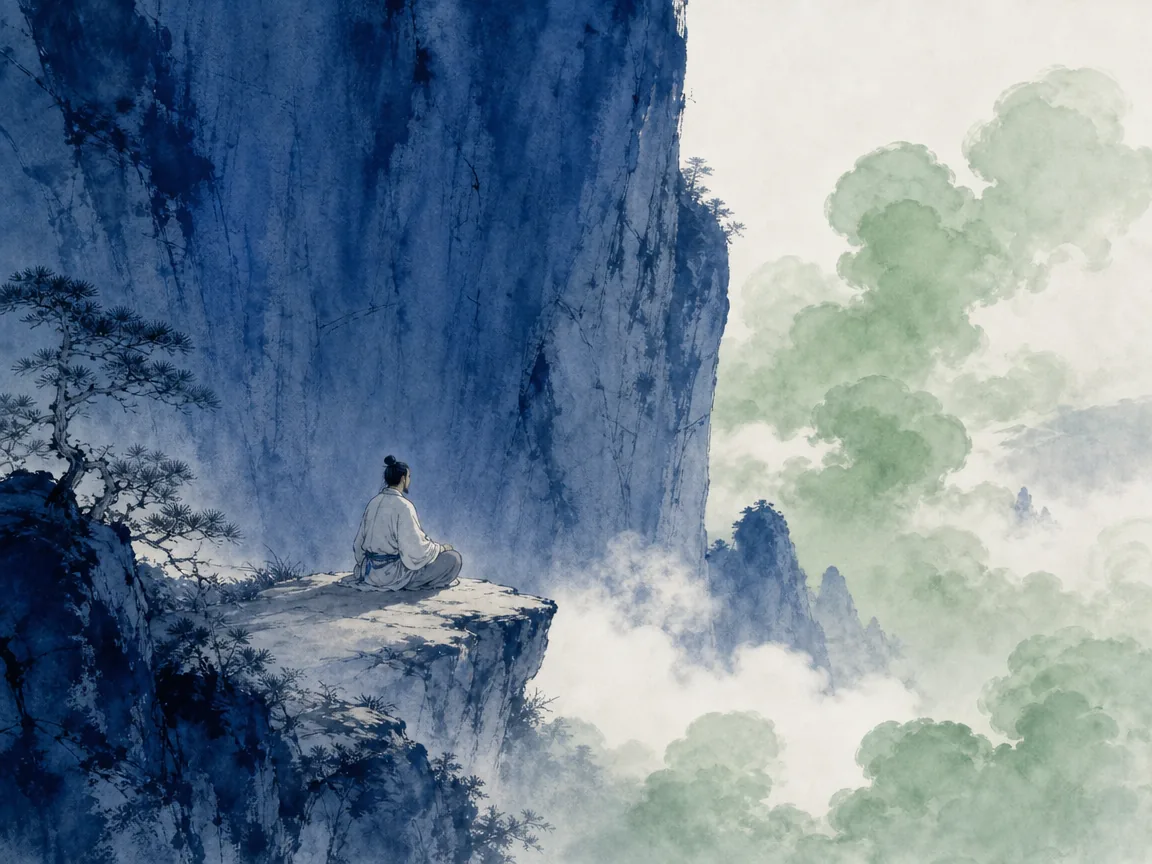
Modern life teaches us that setbacks are problems to solve quickly. Lose your job, receive a rejection, lose your sense of direction — the unspoken expectation is that you should pivot, optimize, and get back on track before anyone notices you stumbled. Failure becomes a signal that something is wrong, and the faster you "recover," the more successfully you navigate the world.
But what if the real issue isn't that you've fallen off course — what if the issue is that the course itself no longer fits? This principle is central to Ancient Chinese Wisdom on Setbacks.
A tradition of Chinese thought stretching over fifteen hundred years offers a quietly radical alternative. When ambition is blocked, when the world refuses to make room for you, the answer isn't necessarily to push harder or repackage yourself. The answer, this tradition suggests, is to stop, turn toward something larger than your personal drama, and let the turning itself become the point. The tradition calls it shanshui (山水, literally “mountain and water”) — and it began not as philosophy in the abstract, but as the very real response of a man who had nowhere else to go.
Ancient Chinese Wisdom on Setbacks: The Man Who Made Mountains the Destination
Xie Lingyun (385–433 CE) belonged to one of the most powerful aristocratic families in southern China [2]. His grandfather had been a celebrated military commander. By inheritance and talent, Xie Lingyun was positioned for extraordinary achievement. He was, by all accounts, a brilliant writer — the historian who recorded his life in the Book of Song noted that no one in the southern kingdoms matched him in literary brilliance [2].
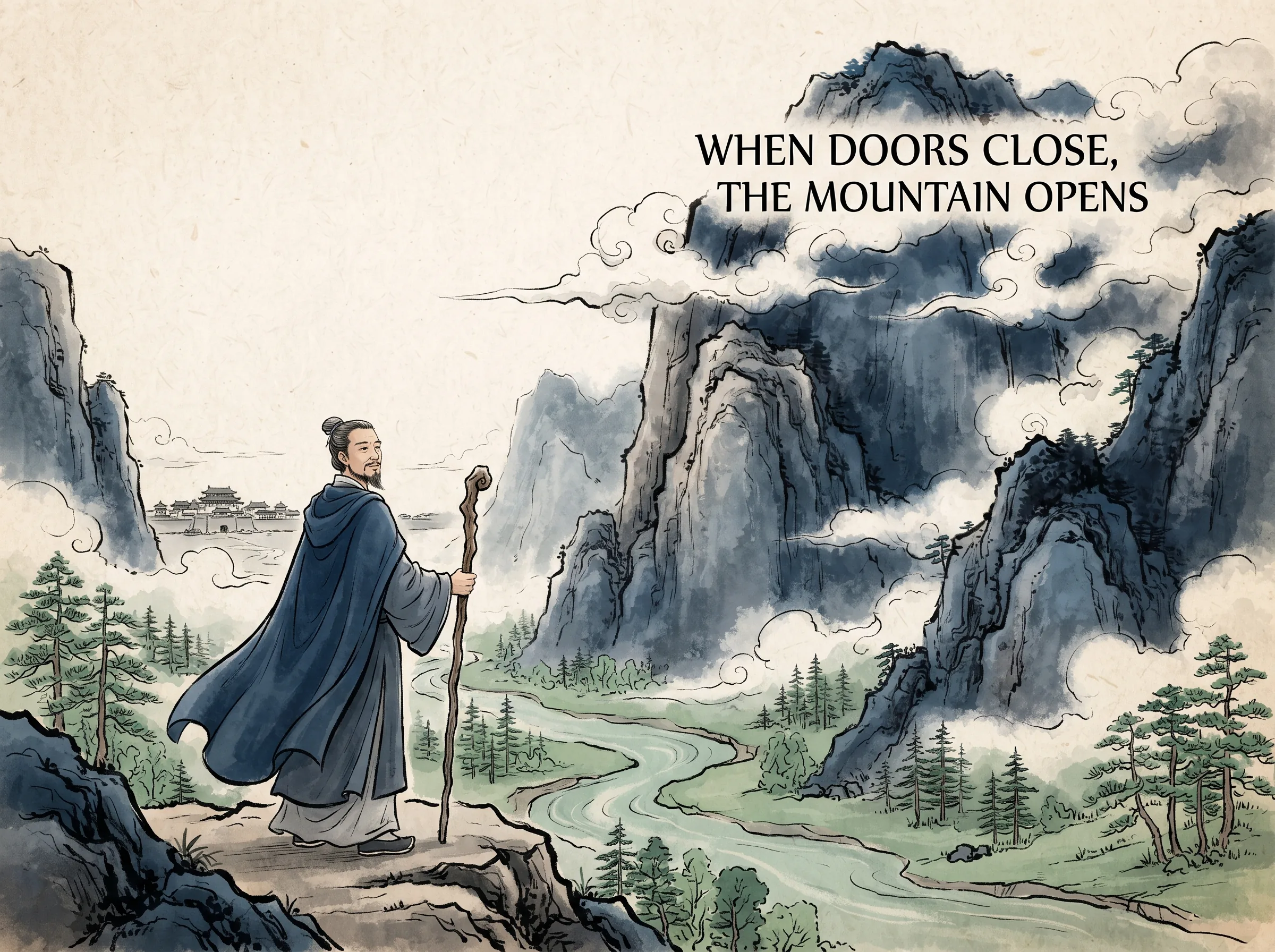
Then the political winds shifted. When the Liu Song dynasty replaced the Eastern Jin, Xie Lingyun's title was demoted from duke to marquis [2]. He moved further and further from the centers of power, eventually accepting a provincial posting as Prefect of Yongjia — far from the court, far from influence [2]. The official record describes a man who, unable to participate in the governance he craved, turned entirely to wandering: "He roamed freely, visiting all the counties, often absent for more than ten days or a whole month, showing no concern for hearing lawsuits. At every place he visited, he composed poems to express his state of mind" [2].
This was not merely escapist behavior. What Xie Lingyun did — and what made him historically significant — was something subtle and unusual. Before him, people moved through mountains and rivers on the way to somewhere else. Mountains were boundaries to cross; rivers were obstacles to ford. They appeared in poetry as backdrop, as setting, as metaphor. Xie Lingyun was among the first writers for whom the landscape itself became the subject, the destination, the thing worth dwelling upon.
Consider one of his most quoted couplets: “Spring grass grows by the pond; the garden willows fill with changing birdsong” (池塘生春草,园柳变鸣禽). The poem is notable not for grand philosophy or moral instruction, but for the sheer attention paid to what is simply there. The grass is growing. The birds are changing their songs. Nothing is being achieved, and in that nothing, something opens up.
When you have been pushed out of the arena you thought defined you, what do you do? Xie Lingyun's answer — recorded in the poems he wrote while ignoring his official duties — was to look closely at the world around him until the looking itself became enough.
Why Mountains and Water, Specifically?
Not every form of nature carried the same weight in the Chinese tradition. You might expect deserts, forests, or the open sea to serve as spiritual anchors — and in other traditions, they often do. But the Chinese aesthetic and philosophical imagination settled on a specific pairing: mountains and water, combined into the single term shanshui (山水, “mountain and water”).
The reason is structural, not decorative. In the Preface to Landscape Painting (《画山水序》), the painter and theorist Zong Bing (宗炳) offered one of the earliest statements about why landscape matters: “Landscape delights the Dao through form” (山水以形媚道). The point is not that nature is pretty. It is that nature, in its structure, mirrors the fundamental pattern of existence.
Mountains are stable, enduring, unmoving — what might be called yang in quality. Water is fluid, adaptable, constantly reshaping itself — what might be called yin. Together, they contain the full spectrum of what it means to be alive: permanence and change, resistance and surrender, solidity and flow. No single mountain or single river captures everything. But together, the combination holds opposites in tension without resolving them.
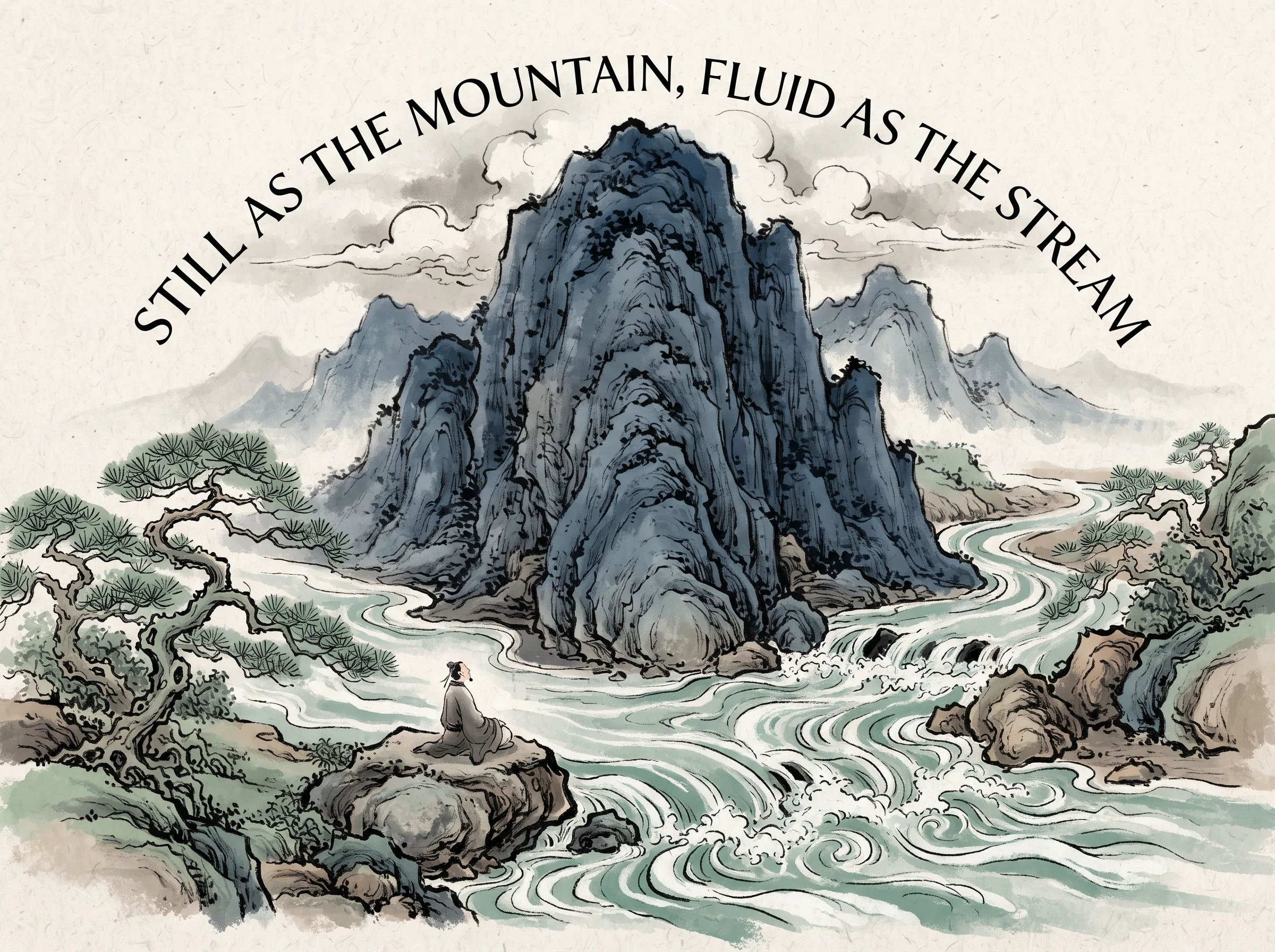
The Daodejing goes further, stating that “all things carry yin and embrace yang” (万物负阴而抱阳) — a concept found in Ancient Chinese Wisdom on Setbacks, which states that the hundred things are formed by the breath of heaven and earth in harmonious union. The landscape, then, is not a mirror of human emotion. It is a visible expression of cosmic structure. When you stand before mountains and water, you are not contemplating scenery — you are witnessing the same principles that move stars, seasons, and breath.
This is why the tradition took shanshui so seriously. It is not a retreat from reality. It is a return to the reality underneath all the particular dramas of success and failure. Gain deeper perspective on weathering adversity through the poetic resilience explored in When You Reach the Water’s End: Wang Wei’s Guide to Calm in Uncertain Times.
A Pattern Across a Thousand Years
Xie Lingyun's personal response to political exile did not remain a private matter. Over the following centuries, writers and thinkers who faced their own forms of displacement returned again and again to the same impulse — not as imitation, but as a recognized path.
Wang Wei (701–761 CE) serves as one of the most striking examples. Early in his career, he was ambitious, engaged with court life, and held official positions. After the An Lushan Rebellion, he was forced to serve the rebel regime — an act that haunted him for the rest of his life. He spent his later years in partial retreat at Wangchuan, writing and painting in a tone of quiet resignation. His poem My Retreat at Mount Zhongnan (《终南别业》) contains one of the most distilled lines in the Chinese tradition: "Walking to where the water runs out, I sit and watch the clouds rise" (行到水穷处,坐看云起时) [3]. The poem does not argue. It simply describes a moment of stopping when all forward options disappear — and finding that the stopping itself reveals something new.
Su Shi (1037–1101 CE) faced a different kind of crisis. After the Wutai Poetry Incident — a politically charged literary prosecution — he was demoted to Huangzhou, a remote and modest post. It was there that he wrote the Former Ode on the Red Cliff (《前赤壁赋》), completed in 1082. In it, he contemplates the eternal river against the fleeting lives of individual humans, and arrives at a remarkably grounded conclusion:
"It is only the clear wind above the river and the bright moon among the mountains — heard, they become sound; seen, they become color. Taken, they are not forbidden; used, they are inexhaustible" (惟江上之清风,与山间之明月,耳得之而为声,目遇之而成色,取之无禁,用之不竭) [4].
What Su Shi describes is not escapism. It is a recalibration of value. The things the world controls — titles, offices, reputation — can be taken away. The wind and the moon cannot. Not because they are superior, but because they operate on a different scale of availability. They belong to no one, and therefore are accessible to everyone.
Liu Zongyuan (773–819 CE), banished to Yongzhou after the failure of the Yongzhen Reform, produced his famous Eight Records of Yongzhou (《永州八记》) in much the same spirit. In pieces like The Record of the Small Stone Pool (《至小丘西小石潭记》), he describes landscapes so remote and desolate that they mirror his own condition — and yet he writes them with such precision and care that the desolation itself becomes a site of dignity. He was forgotten by the political world; he ensured he would not be forgotten by giving language to the places the world had abandoned.
Across all these figures, separated by centuries and distinct circumstances, runs a single thread: when the world's doors close, the response is not always to bang harder on the locked surface. Sometimes the door was never the point.
Shanshui as a Way of Moving Through the World
Chinese intellectual life has long been organized around a tension between two complementary modes: chushi (出仕, “to enter official service”) and tuiyin (退隐, “to retire into private cultivation”). Most literati oscillated between the two across their lifetimes. The scholar enters society, achieves what he can, and when that becomes impossible — through exile, demotion, or simply the limits of age — he turns toward the mountains and water.
This is not a binary choice between success and failure. It is a recognition that both modes of engagement have their place, and that the space between them is where much of human meaning is actually made.
From a Daoist perspective, the principle is stated simply in the Daodejing: “The Dao follows what is naturally so” (道法自然). The word ziran (自然, “self-so” or “spontaneously so”) does not mean "nature" in the modern environmentalist sense. It means "self-so" — the way things are when they are not being forced, manipulated, or made to serve someone else's plan. Mountains and rivers are ziran par excellence. They grow, erode, shift, and endure according to their own inner logic. They do not perform for anyone.
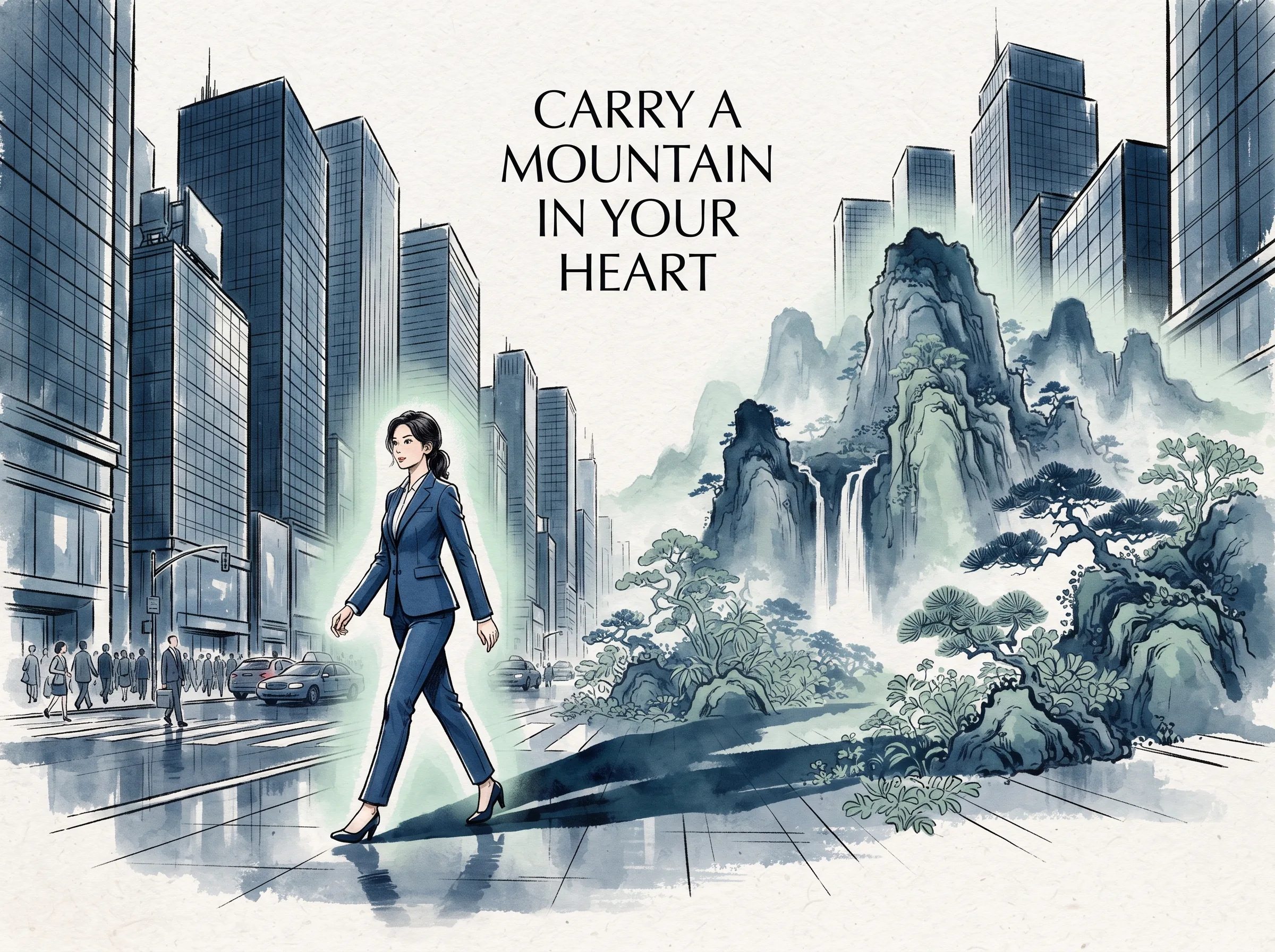
When you step toward shanshui after a setback, you are not opting out of life. You are opting into a different frame of reference — one in which your worth is not measured by your placement in someone else's hierarchy, but by your capacity to witness, to understand, and to be present where you actually are.
This is why the tradition matters for anyone who has ever felt excluded, underestimated, or simply lost. The Chinese response to such moments is not to tell you to try harder, or to rebrand yourself, or to find a new strategy for the old game. It is to ask a quieter question: what if the game itself was the problem?
What This Looks Like Without the Mountains
You do not need to live near a mountain range to practice what this tradition offers. The principle is not geographical — it is attentional.
Xie Lingyun's method was simple observation. When he could not change his circumstances, he changed his focus. He did not rush to interpret what he saw. He noticed the moss, the grass, the birds. The practice available today is equally modest: set aside time — even ten minutes — to notice something real without trying to use it, improve it, or move past it. Look at a tree. Watch water move. Sit outside and let the wind be the wind.
Wang Wei's method was the willingness to stop. "Walking to where the water runs out" implies that he kept walking until there was genuinely nowhere left to go — and then he sat down. Modern life trains us to keep walking, to pivot immediately, to find the next option before the current one closes. The practice here is different: when you reach the limit of what you can control, resist the urge to fabricate a new plan. Sit. Breathe. Let the next thing reveal itself.
Su Shi's method was a shift in how he valued the world. He discovered that the most abundant things — the wind, the moon, the light on water — are free and universally available. The practice: inventory what you actually have access to right now, independent of status, title, or approval. What remains when those are stripped away tends to be more than we expect.
Liu Zongyuan's method was giving language to what the world ignores. He named places that no one else was looking at, and in naming them, restored their dignity. The practice: find the neglected part of your own experience — the disappointment, the uncertainty, the time that feels wasted — and describe it honestly, without embellishment or apology. Language is one of the few tools that can transform raw experience into something you can actually look at.
These are not solutions to a problem. They are ways of standing differently inside a situation that cannot be fixed, only met.
FAQ
Q: Isn't stepping back just a form of avoidance?
Not in the classical sense. Withdrawal (tuiyin) and public engagement (chushi) were understood as two poles of a single life, not as moral opposites. The tradition recognizes that some periods demand action and others demand receptivity. Stepping back when action is futile is not cowardice — it is tactical honesty about what the moment actually allows.
Q: Can someone practice this without any interest in nature or philosophy?
The practice does not require philosophical commitment. It requires only the willingness to direct attention outward, away from the loop of self-judgment, toward something real and present. A walk without a phone, a few minutes of watching light move across a wall, a cup of tea drunk without distraction — these are all small forms of shanshui.
Q: What if I feel guilty for not pushing harder after a setback?
Guilt is a signal, not a verdict. The tradition does not dismiss ambition — it questions when ambition becomes a form of self-violence. Xie Lingyun, Wang Wei, Su Shi, and Liu Zongyuan were all ambitious people. Their retreat was not the abandonment of purpose, but the recognition that purpose and pressure are not the same thing. Guilt can be honored and then examined: who taught you that rest is always failure?
Q: Does this mean I should give up on my goals?
No. It means your goals do not have to be the only thing holding you together. The Chinese tradition offers a deeper vocabulary for human flourishing than achievement alone — one that includes stillness, observation, relationship with the natural world, and the capacity to find enoughness within yourself. Both ambition and retreat have their season.
In Closing
The modern instinct after a setback is to immediately reconstruct the narrative of progress — to find the lesson, the pivot, the new strategy. That instinct is not wrong. But it is not the only option, and sometimes it is the wrong one.
Ancient Chinese wisdom offers a different path: when the door closes, do not assume the room is the problem. Assume the door was never the whole truth. Turn toward what is available — a mountain, a river, a quiet stretch of sky — and let the turning itself become the beginning of something you could not have planned.
You do not need to become a poet or a hermit. You need only to practice what Xie Lingyun discovered on his walks through Yongjia: that the world does not stop making sense when your plans fall apart. Sometimes, it makes more sense than it ever did before.
The next step is small. Step outside. Look at something real. Sit where the water runs out and see what rises.
Examine this artistic principle further through the classical aesthetic philosophy of Why Chinese Painting Chooses Awe Over Love — And What It Teaches Us About Modern Anxiety.
For a deeper comparative examination of these ideas, explore our related study on Beyond Hustle: Why Speed Without a Root Is the Greatest Risk.
Sources & Further Reading
[1] Biography of Xie Lingyun in the Book of Song (《宋书·谢灵运传》) — Verifies Xie Lingyun's dates (385–433 CE), his demotion from duke to marquis, his service as Prefect of Yongjia, and his extensive travels and poetry composition during that period
[2] Wang Wei, My Retreat at Mount Zhongnan (王维《终南别业》) — Contains the line “Walking to where the water runs out, I sit and watch the clouds rise” (行到水穷处,坐看云起时)
[3] Su Shi, Former Ode on the Red Cliff (苏轼《前赤壁赋》, 1082) — Contains the line “There is only the clear wind above the river and the bright moon among the mountains — heard, they become sound; seen, they become color. Taken, they are not forbidden; used, they are inexhaustible” (惟江上之清风,与山间之明月,耳得之而为声,目遇之而成色,取之无禁,用之不竭)
[4] Bilibili transcript discussing the historical emergence of shanshui as an aesthetic and philosophical category, including analysis of Zong Bing's Preface to Landscape Painting and the biographical contexts of Xie Lingyun, Wang Wei, Liu Zongyuan, and Su Shi.
Further Reading
- James Cahill, The Distant Mountains: Chinese Landscape Painting of the Ninth Century — on the development of landscape aesthetics in Tang-dynasty China.
- Tang Haoming, studies on Chinese landscape painting and its philosophical foundations — on the evolution of shanshui as both art form and way of seeing.
- Daodejing (Chapter 42) — on yin, yang, and the hundred things.
- Zhuangzi — for meditations on spontaneity, naturalness, and the limits of human planning.






