
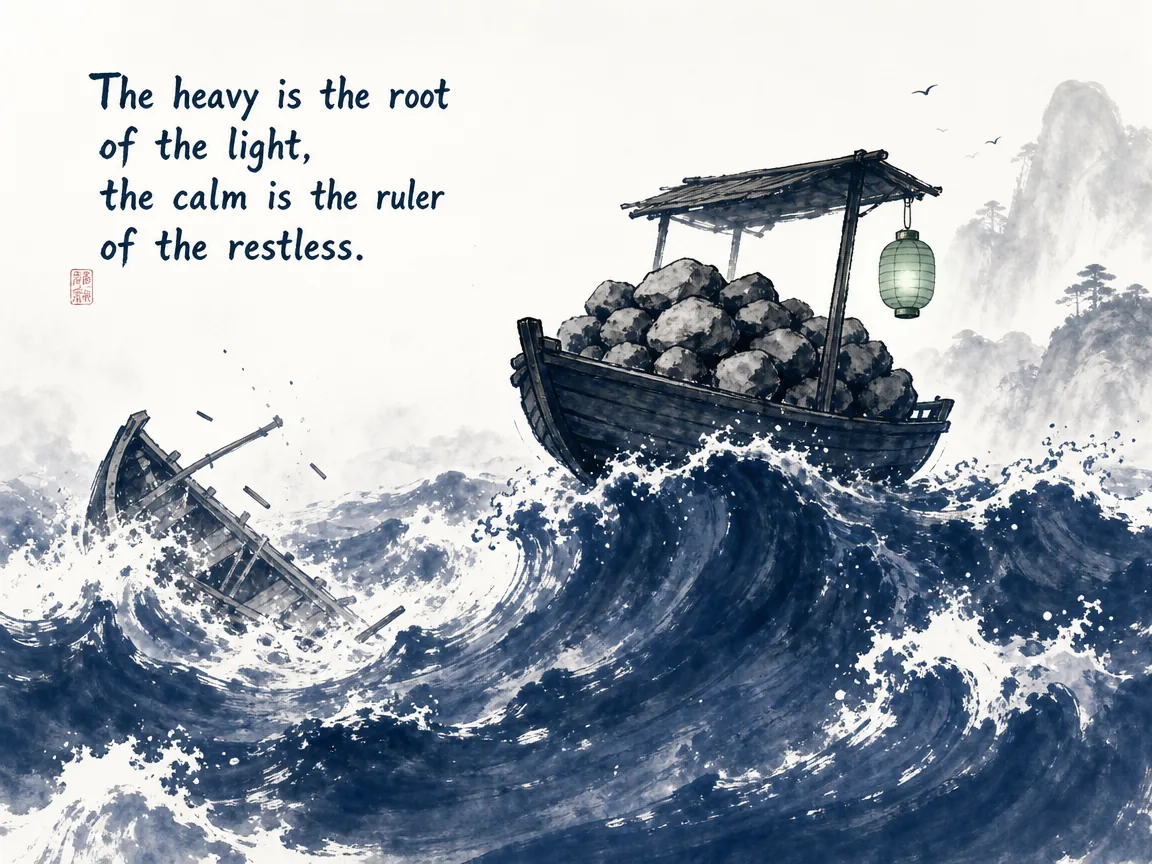
Modern life rewards velocity. A fast reply earns praise. A quick pivot signals adaptability. The algorithm favors those who post first, ship first, and move before others finish thinking. We have built an entire cultural narrative around the belief that speed is synonymous with success—that staying still means falling behind, and shedding weight is the path to freedom. Yet something quietly unravels as this culture tightens its grip: the faster we move, the more disorienting the landscape becomes. Ambition expands faster than maturity. Wealth outpaces wisdom. Influence grows without steadiness. The question is not how fast you can move, but what you carry that keeps you from being swept away.
Two thousand years ago, a philosopher named Laozi offered a different vocabulary for this condition. In the sixth chapter of the Daodejing—traditionally the twentieth-sixth—he wrote words that still cut through the noise of every age that rushes itself: "Weight is the root of lightness; stillness is the master of restlessness." He did not counsel laziness or retreat. He warned that speed without an internal anchor turns ambition into drift. The sage, he observed, travels all day without departing from his supplies. He enters brilliance and remains unshaken. Those with great power who act lightly bring disaster upon themselves. Lightness without root is drifting. Restlessness without a master is losing command of one's own life—a foundational perspective explored in Daodejing Chapter 26.
This is not a manifesto against movement. It is a diagnosis of what happens when the instrument of our decisions outgrows the wisdom that guides them—and a practical framework for building the structural weight that lets you move quickly without losing yourself.
Daodejing Chapter 26: The Trap of Moving Too Fast
The cultural narrative of our time is relentless: lighter is freer, faster is better, hesitation is failure. In a gig economy where your next income stream might appear or disappear in a notification, and in attention cycles engineered to reward the quick and penalize the patient, slowness feels like risk. This narrative resonates precisely because it mirrors daily experience for millions of international readers navigating career pivots, algorithm-driven platforms, and the quiet erosion of long-term commitments by short-term incentives.
The hidden cost rarely appears in the moment of decision. It emerges later, when external expansion—wealth, status, visibility—far outpaces internal maturity. A founder raises capital and doubles headcount before establishing operational discipline. An influencer gains reach without developing a sustainable creative process. A professional accumulates titles while neglecting relationships, health, or financial margin. Nothing is wrong with each of these achievements individually. The problem is structural: the heavier the load, the more fundamental the foundation must be to carry it. Speed does not automatically generate the capacity to sustain speed. Ambition does not automatically cultivate wisdom. Power does not automatically produce judgment.
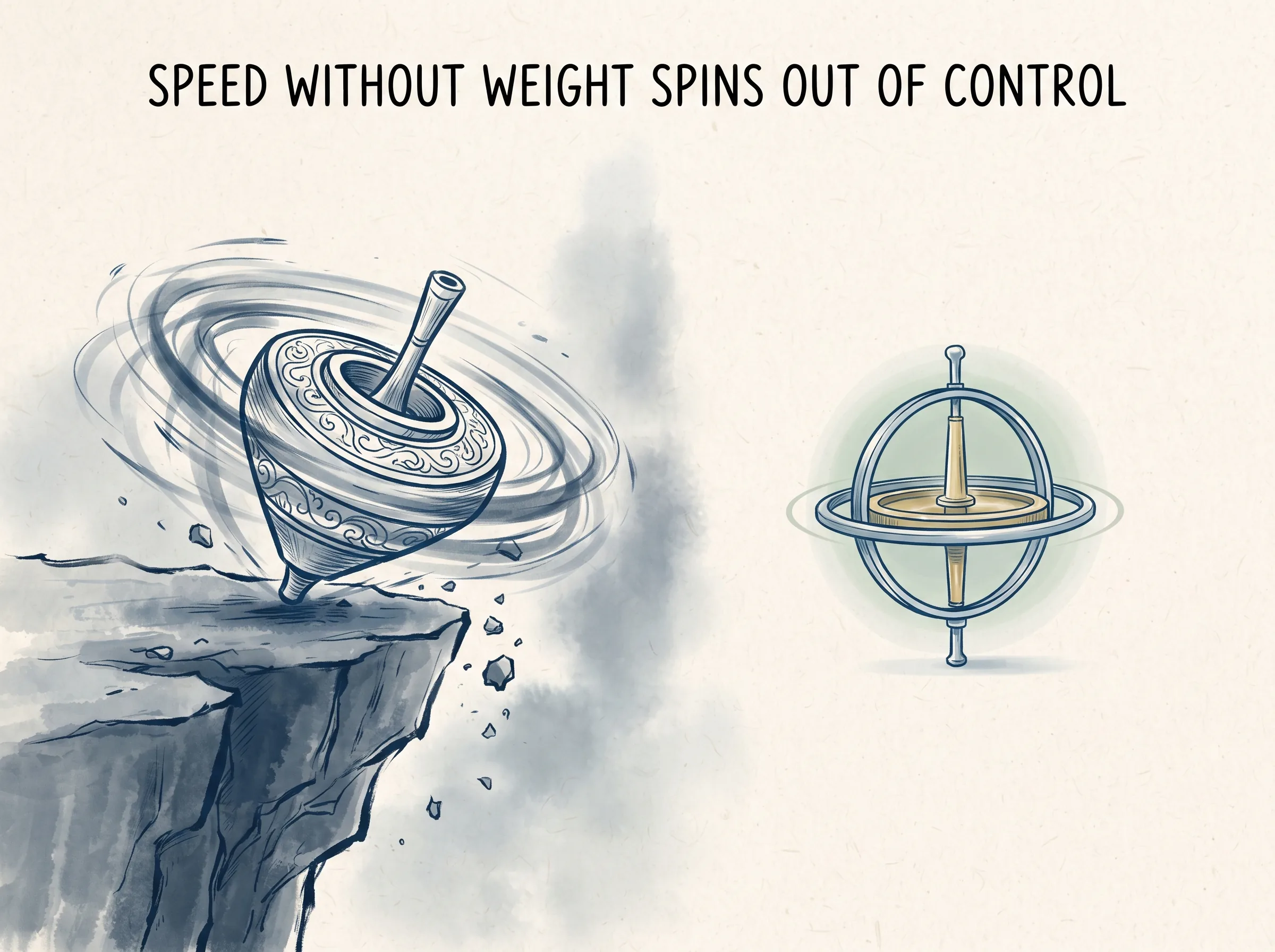
Laozi framed this not as a moral failing but as a matter of physical and psychological architecture. A tree can spread its branches in wind because its roots run deep. A boat moves freely on water because its hull has weight. Remove the weight, and what appears as liberation is actually vulnerability—the lightest vessel capsizes first.
Continue with the deeper interpretation and practical application.
ChiDestiny members get access to the full analysis, modern applications, and the growing Chinese Wisdom Library.
FAQ
Does Laozi oppose ambition or fast achievement? No. He does not counsel inaction or retreat. He warns against speed that outpaces the foundation sustaining it. The sage in the text travels all day and enters brilliance—movement and engagement are not forbidden. What is questioned is movement without root.
Is "stillness" the same as doing nothing or suppressing emotion? No. Stillness is internal sovereignty—the capacity to observe impulse without automatic obedience. It is not the absence of emotion but the presence of a governor. Research on emotional urgency supports the boundary that extreme affective states can impair deliberate decision-making, though emotion can also improve judgment under certain conditions [2]. Laozi's point is that action should be governed, not that governance requires emotional elimination.
Can this framework apply to leaders, not just individuals? Yes. The text explicitly addresses rulers and those with significant influence. Power amplifies both capability and risk. The internal weight required to carry authority is greater, not lesser, because personal instability at scale becomes structural harm.
How do I know whether my weight is structural or dead weight? Ask whether releasing it would free you or destabilize you. Dead weight lifts when shed. Structural weight sustains when carried. A helpful test: if removing something makes you faster in the short term but weaker in the long term, it is structural. If it makes you lighter and clearer, it is likely dead weight.
Conclusion
The chapter opens with weight and stillness and closes with the consequences of losing them. Between those poles lies a complete logic of how to move through a fast world without being consumed by it. The sage does not avoid action. He does not flee prosperity. He does not renounce influence. What he refuses is the illusion that speed alone is sufficient.
True maturity is not the absence of speed. It is the presence of a root deep enough to hold it. It is the capacity to enter the bustle of the world without letting it enter you. It is the discipline to keep your baggage cart intact even when the road ahead promises lighter travel.
You do not need to move faster. You need a foundation that lets you move fast without falling. Begin by identifying what structural weight you have already—and what you have carelessly discarded in the name of speed. Then protect it. That protection is not conservatism. It is the precondition for any speed worth sustaining, reflecting the enduring wisdom of Daodejing Chapter 26.
To explore these themes from another angle, read our related reflection on The Art of Not Proving: What Laozi Can Teach Us About Silence in the Age of Performance.
Deepen your understanding of these principles in our reflection on Should You Celebrate Victory? Laozi’s Radical Answer.
Sources & Further Reading
[1] The Project Gutenberg eBook of Dao De Jing, by Lao Zi — (Wang Bi version, ca. 240 CE, noted as standard text with known variant readings)
[2] Urgency Theory in the context of broader emotion theories — a conceptual review — (empirical discussion of emotional urgency and its relationship to rash decision-making)






