
There is a particular kind of exhaustion that has become almost invisible in its normalcy — the sense that you must always be performing, optimizing, proving. Your calendar is a series of commitments, your self-worth is measured in outputs, and rest is experienced as guilt disguised as recovery. The World Health Organization has formally recognized this pattern, classifying burn-out as "a syndrome conceptualized as resulting from chronic workplace stress that has not been successfully managed" [Burn-out an "occupational phenomenon": International Classification of Diseases]. But it is not just a workplace problem. It has become a cultural condition — one in which the pressure to appear effortlessly successful is itself exhausting.
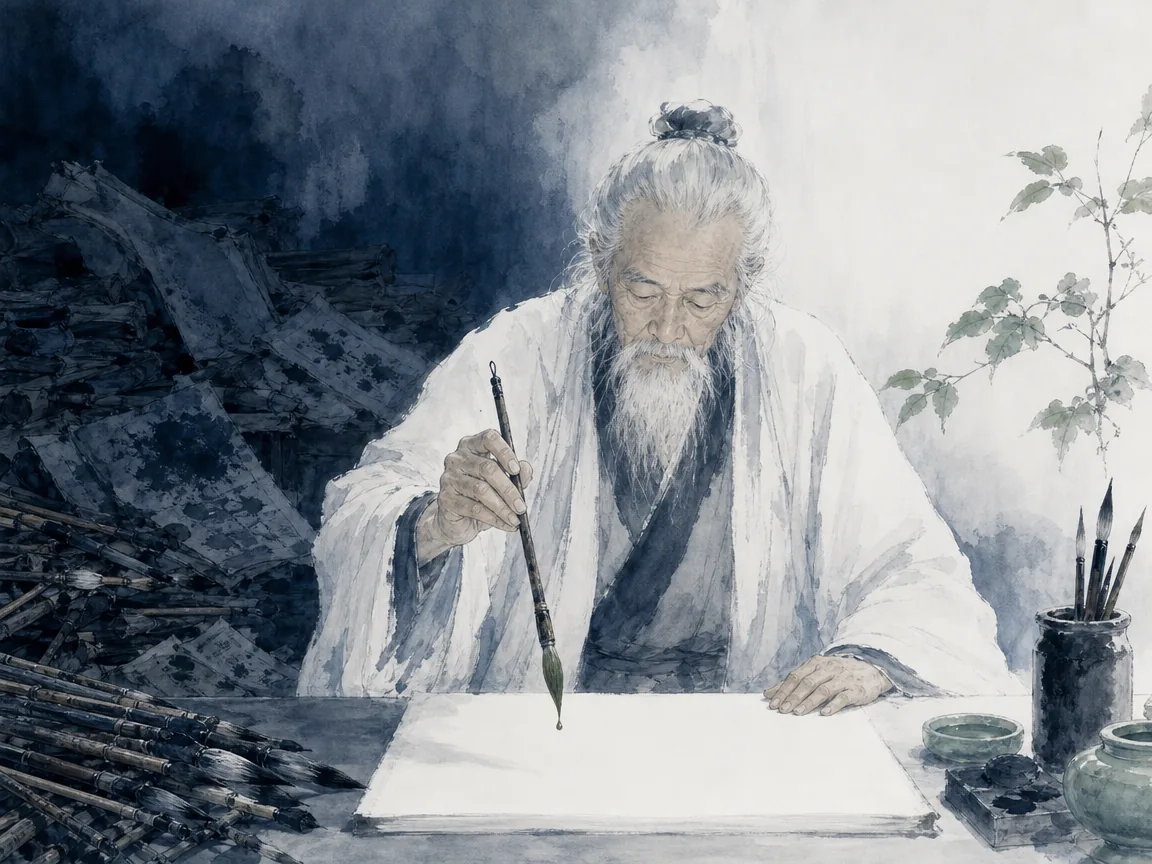
Chinese classical thought, across both Daoist and Confucian-adjacent traditions, offers a remarkably different answer. Rather than asking you to work harder, manage better, or reframe your mindset, it points toward something far more unsettling: perhaps the highest form of mastery does not look like mastery at all. The ancient Chinese aesthetic ideal of the transformative realm (huàjìng, the transformative realm (huàjìng, 化境)) describes a state in which skill becomes so deeply internalized that it disappears entirely. The best calligrapher writes with gestures that appear unthinking. The finest chef seasons without measuring. The most skilled practitioner moves without strain. This is not the absence of effort — it is effort so thoroughly integrated that it no longer announces itself—a foundational perspective explored in Mastery and Burnout Chinese Wisdom.
The question this raises is both practical and profound: if the pinnacle of human excellence looks like effortlessness, why do we spend so much of our lives performing effort? And more importantly, how might this ancient insight help modern readers move beyond the pressure to constantly prove themselves?
Mastery and Burnout Chinese Wisdom: What the Transformative Realm (Huà Jìng, the transformative realm (huàjìng, 化境)) Actually Means
The transformative realm (huàjìng, the transformative realm (huàjìng, 化境)) is not a widely discussed term in Western philosophy, which makes it important to approach it carefully. It belongs to a long tradition of Chinese aesthetic and contemplative thought in which the highest achievement is described not as accumulation but as dissolution — the gradual fading away of everything that is unnecessary, artificial, or performed for an audience.
At its core, huàjìng (the transformative realm (huàjìng, 化境)) refers to a condition in which technique has been so thoroughly absorbed that the boundary between the person and the act collapses. There is no gap between intention and execution. The performer is no longer present as a separate ego managing outcomes; instead, the action flows through them with a kind of quiet inevitability. This is why classical Chinese writing on painting, calligraphy, martial arts, and cooking consistently describes mastery in terms of invisibility rather than display.
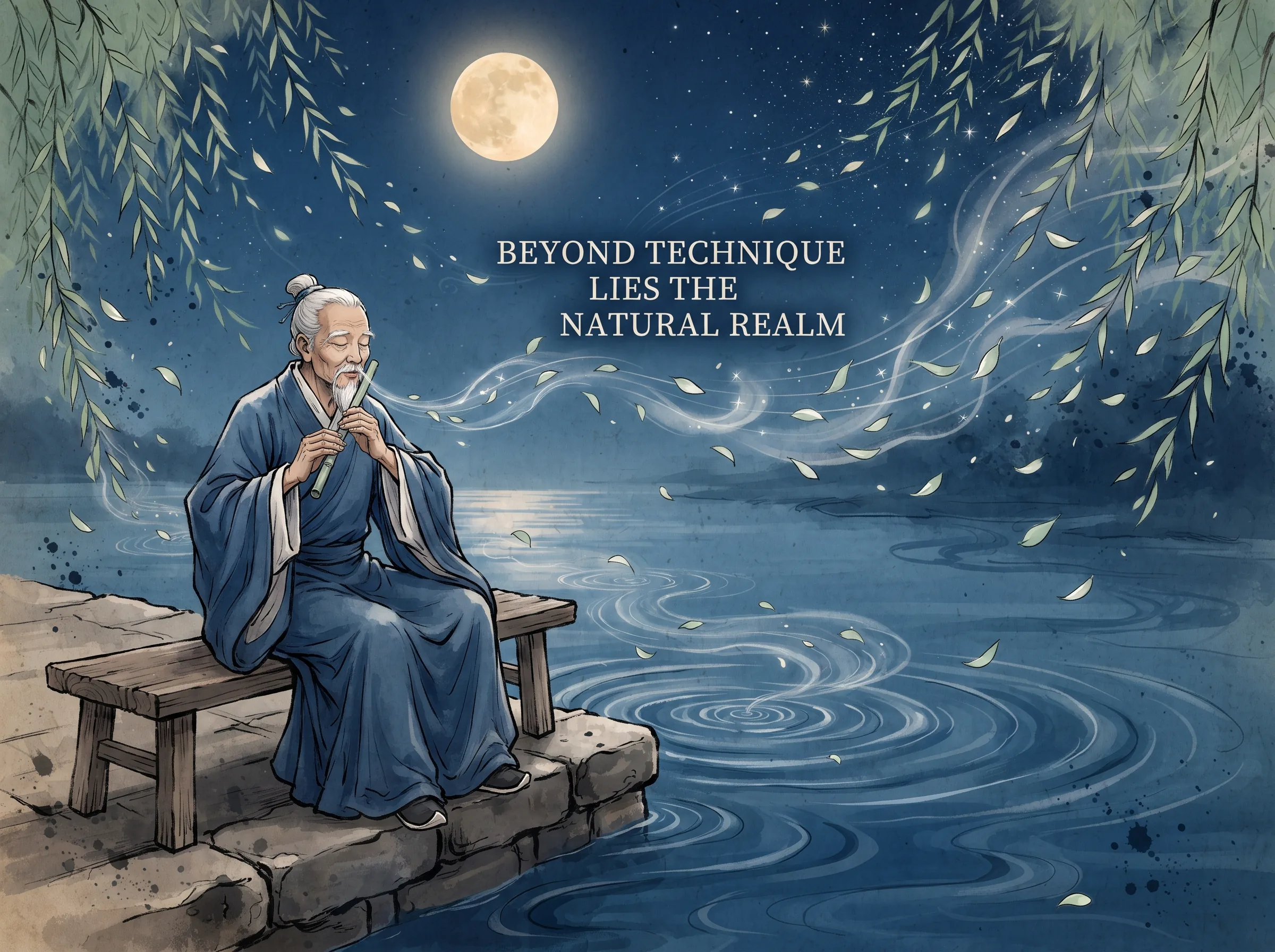
The reasoning behind this ideal is rooted in a deep observation about the nature of time and endurance. Chinese tradition has long noted that the sharpest things break, the brightest flames burn out quickly, and the most forceful structures attract resistance. In contrast, water — the softest substance — persists. Wind — invisible — reshapes mountains over centuries. This is not mere poetic fancy. It is an empirical observation about what lasts, repeated across centuries of Chinese philosophical reflection.
Why the Modern Drive for Visibility Is Exhausting
The contemporary obsession with visible achievement — personal branding, social media performance, the quantification of self-worth through metrics — stands in sharp contrast to the Chinese ideal. Where the transformative realm (huàjìng, the transformative realm (huàjìng, 化境)) teaches that the highest state should be imperceptible, modern culture rewards the opposite: you must be seen, measured, validated, and constantly displayed.
This is not simply a complaint about hustle culture. It touches something deeper about the relationship between selfhood and achievement. When your sense of worth depends on external confirmation, every task becomes a performance, every interaction becomes an audition, and every rest period feels like falling behind. You are not just working — you are working in public, even when no one is watching.
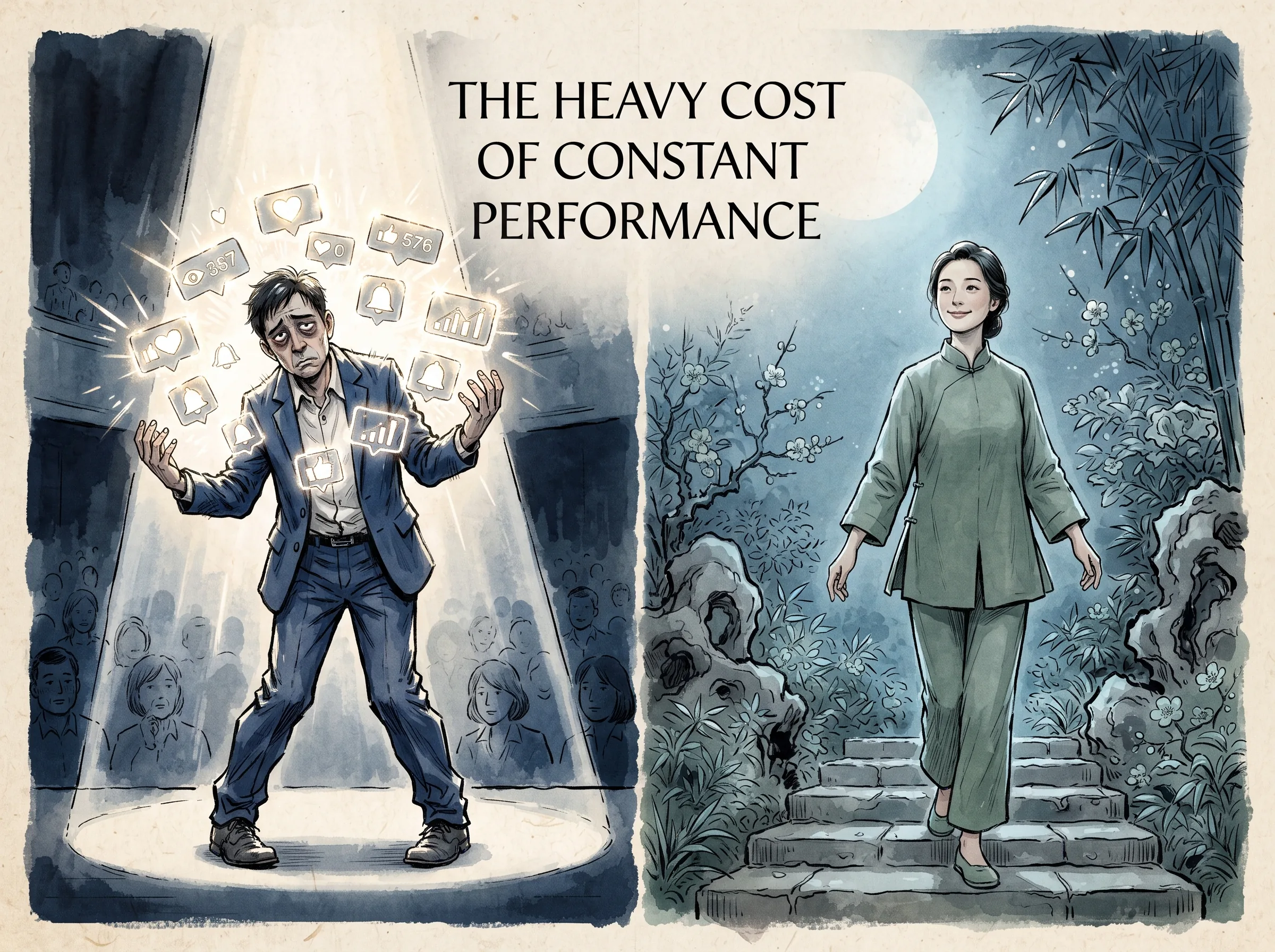
Burnout, as the WHO has noted, results from chronic workplace stress that has not been successfully managed [Burn-out an "occupational phenomenon": International Classification of Diseases]. But the Chinese insight suggests that much of what we call burnout may actually be over-management — not of our time or energy, but of our selves. We are managing an image, a reputation, a narrative of success, and the energy cost of maintaining that narrative is enormous.
The Three Inner Battles: A Path Toward the Transformative Realm (Huà Jìng, the transformative realm (huàjìng, 化境))
The path toward mastery as described in classical Chinese sources is not a single revelation but a sequence of inner transformations. While different traditions articulate these stages with varying emphasis, a recurring pattern appears across calligraphy theory, literary criticism, and philosophical reflection.
Entering the Realm (Rù Jìng, 入境): The Discipline Behind Effortlessness
True simplicity is not the default setting of an untrained person. It is the hard-won achievement of someone who has passed through extensive training and chosen, deliberately, to let it go. The Chinese tradition is clear on this point: the transformative realm (huàjìng, the transformative realm (huàjìng, 化境)) is not raw talent, and it is not the absence of discipline. It is discipline so thoroughly internalized that it no longer requires conscious enforcement.
Sun Guoting (孙过庭), a prominent Tang dynasty calligrapher and theorist, articulated a three-stage model of learning in his seminal work Shu Pu (《书谱》), which has been widely referenced in Chinese aesthetic thought: beginners seek basic correctness (初学分布,但求平正); intermediates pursue striking novelty and distinction (既知平正,务追险绝); masters return to simplicity, but a simplicity that is earned, not inherited (既能险绝,复归平正) [Sun Guoting Shu Pu in Chinese Calligraphy: A Guide]. This framework has been understood across generations not as a rule specific to calligraphy but as a description of how any serious human endeavor develops.
The modern challenge lies in the fact that most people stop at the first stage — or more precisely, they stop just short of it, at a point that suffices for external approval. The Chinese tradition identifies a particular trap: the belief that "good enough" is adequate. When your work is competent, when you receive consistent praise, when you can earn a living — that is often the moment when the deeper journey begins. And it is also the moment when most people stop, because the external incentives that drove them forward have been satisfied. Gain deeper perspective on weathering adversity through the poetic resilience explored in When Exile Becomes Awakening: Su Shi’s Blueprint for Finding Purpose in Hard Times.
Crossing from competence to depth requires a motivation that cannot be bought, promoted, or praised by others. It is a decision to continue into darkness, where the only evidence of progress is the subtle refinement of your own sensibility. This is the discipline behind effortlessness — and there is no shortcut around it.
Breaking Through Boundaries (Pò Jìng, 破境): Shattering the Performative Self
Once you have reached a high level of competence, a new obstacle appears: the self that has been built around that competence. This self is proud, defensive, and desperately in need of recognition. It is also, paradoxically, the greatest barrier to true mastery.
The Chinese tradition describes this stage using the language of shedding. The expert must let go of the identity that was constructed through achievement — the titles, the reputation, the need to be seen as capable. This is not humility in the conventional sense. It is something more radical: the willingness to encounter the work without the armor of a persona.
Zhuangzi (庄子) offered one of the most enduring explorations of this inner freedom in the chapter known as Carefree Wandering (Xiāoyáoyóu, 逍遥游). The figure of the perfected person (zhìrén, 至人) in Zhuangzi's text is described as one who has transcended the fixed boundaries of the ego — free not because they control everything, but because they have stopped clinging to a rigid self-concept [Zhuangzi: Enjoyment in Untroubled Ease]. This is not a call to inaction but a call to a different kind of action — one that is not animated by the need to prove, defend, or display.
In practical terms, breaking through boundaries (pòjìng, 破境) means recognizing when your relationship to your work has shifted from engagement to performance. It means noticing the moments when you are doing something not because it calls to you but because you need it to reflect well on you. This stage is painful precisely because it asks you to surrender something you have worked hard to build: an identity that has, until now, protected you.
Returning Home (Huán Xiāng, 还乡): Mastery as Ordinary Life
The final stage of the classical path is perhaps the most misunderstood. After entering the realm and breaking through the performative self, the highest state does not take you to some transcendent height. It returns you — transformed — to ordinary life.
In Chinese aesthetic thought, this return is described as returning to balance and simplicity (fù guī píngzhèng, 复归平正). But the simplicity of the master is qualitatively different from the simplicity of the beginner. The beginner's simplicity is born of ignorance; the master's simplicity is born of having seen everything and chosen, consciously, to live plainly. The surface looks the same. The depth is entirely different.
This principle appears across many forms of Chinese practice — in the tea master who treats every bowl with the same reverence, in the calligrapher whose later works appear deceptively simple, in the chef whose extraordinary skill is expressed through the most unremarkable dishes. The highest state is not extraordinary. It is ordinary, made ordinary by the fact that it has passed through extremity and emerged at peace with itself.
The Classical Reference: Su Shi and the Taste of Simple Joy
One of the most poignant illustrations of this arc comes from the life and work of Su Shi (苏轼, 1037–1101), the Song dynasty poet, calligrapher, and statesman whose trajectory mirrors the movement from youthful ambition to aged simplicity.
In his youth, Su Shi wrote lines of extraordinary grandeur and self-confidence. His famous poem beginning with "the great river flows east" (dàjiāng dōng qù, 大江东去) captured a sweeping historical vision and an ambition to etch his name into the record of time. This is the voice of someone still engaged in the pursuit of visibility and distinction.
Later, after enduring political persecution, exile to Huangzhou, and years of hardship, Su Shi's poetry changed. He wrote, in the poem commonly identified as Huanxisha (Sands of the Washing Stream, 浣溪沙), the line that has become one of the most quoted in the Chinese literary tradition: in human life the sweetest flavor is quiet joy (rénjiān yǒu wèi shì qīnghuān, 人间有味是清欢) — "What finds flavor in this world is quiet joy" [Su Shi: Huanxisha (浣溪沙) – Wikisource]. This is not the language of conquest. It is the language of someone who has stopped competing with life and has learned, instead, to taste it.
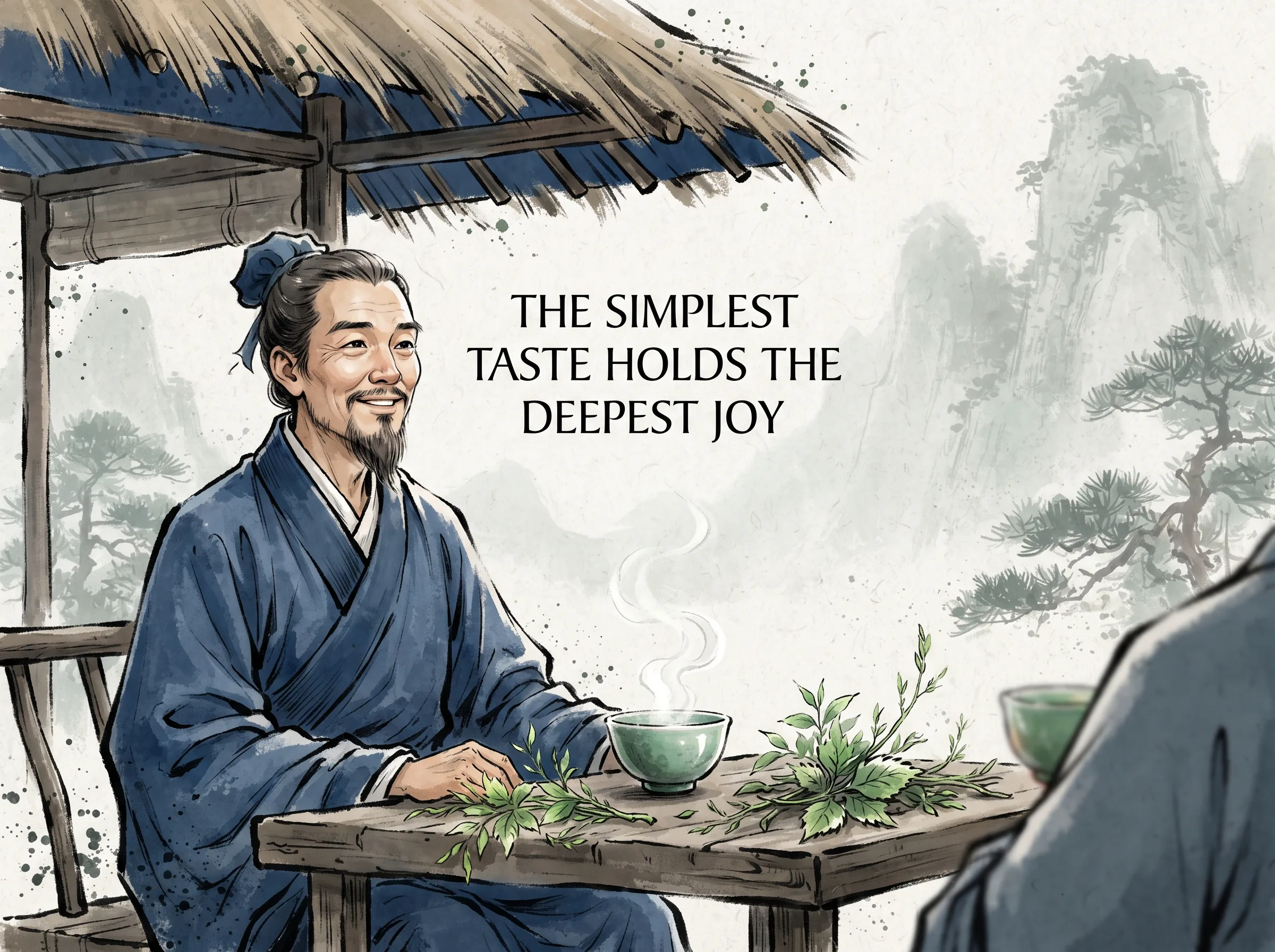
The transformation in Su Shi's work — from the bold, ambitious voice of youth to the restrained, deeply felt voice of maturity — is precisely the movement that the Chinese tradition describes as the path toward the transformative realm (huàjìng, the transformative realm (huàjìng, 化境)). It is not a rejection of achievement but a deepening of it, until achievement is no longer the point.
What Disappears and What Remains
A useful way to understand the transformative realm (huàjìng, the transformative realm (huàjìng, 化境)) is to ask a simple question: when mastery is complete, what has vanished, and what remains?
In the classical narratives, it is always the anxious, competitive, performance-driven self that disappears. What remains is not less — it is more aligned. The calligrapher's hand moves with the rhythm of centuries of practice embedded in muscle memory. The chef's palate has become so refined that judgment is instantaneous and unselfconscious. The practitioner's breath has become so natural that it requires no attention at all.
This is what Chinese aesthetics sometimes describe with the phrase "both person and work have matured together" (rén shū jù lǎo, 人书俱老). The word mature (lǎo, 老) here does not carry the negative connotation it sometimes carries in English. It does not mean decay or irrelevance. It means ripened, settled, at peace with its own limits. The wrinkles are where hardship has been metabolized into calm. The quiet is where the struggle has been resolved, not by victory but by release.
Practical Takeaways for the Modern Reader
The insights of the transformative realm (huàjìng, the transformative realm (huàjìng, 化境)) are not reserved for monks, artists, or ancient philosophers. They offer a framework for anyone who has ever felt exhausted by the pressure to perform, optimize, and prove.
Reframe mastery as an inner journey, not an external display. The question is not "How can I look more capable?" but "What would it feel like to do this without needing anyone to notice?" This shift changes everything — from the quality of your work to the texture of your days.
Notice where you are operating from "good enough." Ask yourself honestly: am I staying at a comfortable level of competence because it is sustainable, or because I am afraid of what deeper work might reveal about me? The difference matters. Sustainable contentment is wise. Fear-based avoidance is not.
Practice letting go of one need for external validation at a time. You do not need to dismantle your entire identity overnight. Start small: choose one task this week where you will do it purely for the quality of the doing, with no thought of how it will reflect on you. Notice what arises.
Find the transformative realm (huàjìng, the transformative realm (huàjìng, 化境)) in ordinary attention. The highest state is not found in exceptional circumstances but in the quality of presence you bring to ordinary tasks. Wash a dish and actually feel the water. Walk to work and actually notice the light. Cook a meal and attend to every movement. These are not distractions from serious work — they are the substance of it.
FAQ
Is burnout really just about work stress? The World Health Organization defines burn-out specifically as a syndrome resulting from chronic workplace stress that has not been successfully managed, and notes it is classified as an occupational phenomenon rather than a medical condition [Burn-out an "occupational phenomenon": International Classification of Diseases]. However, the pressure to perform and prove oneself extends far beyond the office. The Chinese tradition would suggest that much of what we experience as burnout shares a common root: the exhausting work of maintaining a performance of competence.
Does the idea of "effortless mastery" mean I should stop trying hard? No. The Chinese tradition is emphatic that the transformative realm (huàjìng, the transformative realm (huàjìng, 化境)) is not the absence of effort but the culmination of it. The appearance of effortlessness is earned through prolonged, disciplined practice. The tradition warns explicitly against confusing laziness or avoidance with simplicity. The key distinction is that disciplined practice is undertaken for its own sake, not for external validation.
Can someone who is not an artist or practitioner still benefit from this idea? Yes. The principle applies to any sustained activity — parenting, teaching, coding, gardening, managing a team. Wherever there is a skill to be developed and a self to be managed, the question of whether you are performing or participating becomes relevant. The Chinese tradition would argue that most professional and personal exhaustion stems from the former, not the latter.
How is this related to concepts like mindfulness or flow? There are meaningful parallels. The state of flow described by Mihaly Csikszentmihalyi — complete absorption in an activity with a loss of self-consciousness — shares structural similarities with the transformative realm (huàjìng, the transformative realm (huàjìng, 化境)). Mindfulness practices, which emphasize present-moment awareness without judgment, also resonate with the idea of returning to ordinary experience with full attention. The Chinese tradition offers a specific cultural vocabulary for experiences that are, in some form, recognizable across many contemplative traditions.
The Chinese classical tradition does not offer a quick fix for burnout. It offers something perhaps more useful: a reimagining of what it means to be excellent, to be skilled, to be alive. The highest mastery, according to this tradition, does not announce itself. It does not need to. It simply is — like water finding its way through stone, like wind shaping a mountain, like a perfectly seasoned dish that needs no explanation.
The next time you find yourself caught in the exhausting cycle of performing competence, consider this question: what would this look like if I were not trying to prove anything? The answer may surprise you. It may also set you free, reflecting the enduring wisdom of Mastery and Burnout Chinese Wisdom.
Connect these enduring values to the broader cultural heritage explored in The Art of Effortless Mastery: What Ancient Chinese Philosophy Teaches Us About Letting Go.
For a deeper comparative examination of these ideas, explore our related study on Song Dynasty Poets: Ancient Wisdom for Modern Uncertainty.
Sources & Further Reading
Further Reading
- The Columbia History of Chinese Literature — Victor Mair, ed. For broader context on Su Shi and Song dynasty literary culture.
- Calligraphy and Eastern Culture by Tsong-lin Lee — An accessible introduction to Chinese calligraphic theory, including Sun Guoting's framework.
- Zhuangzi: Basic Writings translated by Burton Watson — A reliable English translation of the core Zhuangzi texts, including the Xiaoyaoyou (逍遥游) chapter.
- Dao De Jing: A Dual Translation by Jan Yau — Both the original Chinese and an English translation of the Dao De Jing, useful for understanding Laozi's water metaphor in context.







[…] Examine this artistic principle further through the classical aesthetic philosophy of Beyond Effortlessness: What Chinese Classical Wisdom Says About Mastery, Burnout, and Letting Go. […]