
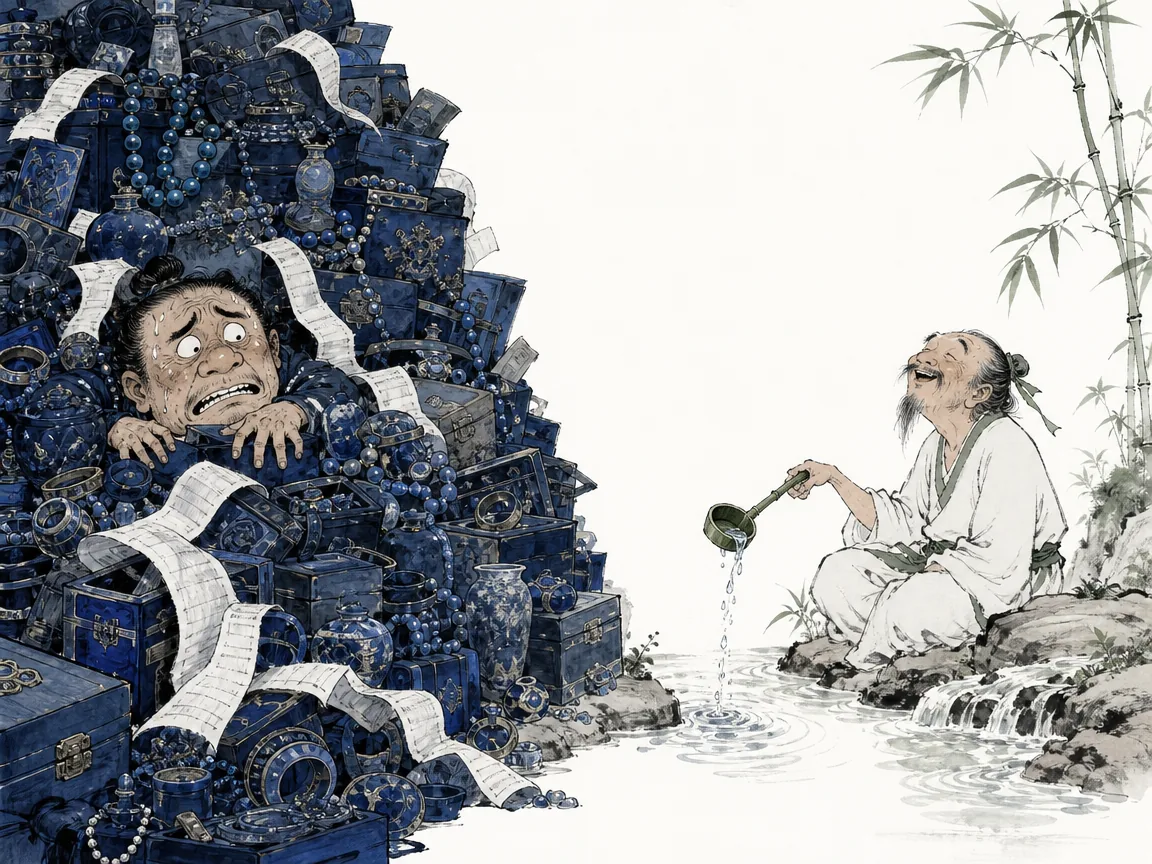
You have probably experienced this pattern: something new arrives and you feel a brief spark of satisfaction — a upgraded phone, a completed project, a purchase you told yourself you needed. But soon the feeling fades, replaced by a quiet sense that the next thing will be the one that finally makes everything feel complete. The chase continues. This is not a personal failing. It is a cultural condition. Modern consumer design is built to keep desire in motion, defining rituals and milestones through advertising rather than lived experience. Diamonds became a requirement for engagement, Valentine's roses a duty, travel destinations checked off like tasks. We are taught to want more without being given a vocabulary for when enough is enough.
Classical Chinese thought offers a different frame, not as a retreat from ambition but as a practice of intelligent attention. At the heart of this framework is a single Chinese concept: modest fulfillment (Xiǎo Mǎn, 小满). It describes a state of nearly full but not overflowing — a moment of balance that avoids both emptiness and excess. The idea appears in the naming of one of the traditional twenty-four solar terms used to track the agricultural year. Rather than celebrating absolute completion, this tradition encodes a preference for the space just before fullness, where there is still room to grow, still room to rest, still room to turn. Understanding how such a concept emerged does not require adopting any particular philosophy. It requires only noticing what the idea reveals about the relationship between desire, limitation, and attention—a foundational perspective explored in Contentment in Chinese Philosophy.
Contentment in Chinese Philosophy: The Psychology of the Never-Enough Loop
The feeling of never having enough is reinforced by a system that profits from dissatisfaction. Marketing does not simply sell products; it sells the idea that satisfaction is always one purchase, one milestone, or one upgrade away. This logic turns everyday life into a series of unfinished business. You finish one goal and immediately set another. You buy one item and notice what comes next. The loop feels urgent, but it is also deeply habitual.
Chinese observers of daily life have long noticed a similar pattern in how people relate to possessions and status. In the nineteenth-century novel Dream of the Red Chamber (Honglou Meng) by Cao Xueqin, the character Madam Jia serves a cup of tea and remarks on the water used to prepare it, while another character, the recluse-like nun Miaoyu, prepares a different tea in secret using water collected from plum blossoms and snow years earlier. The scene is striking not because it teaches us how to brew tea, but because it reveals how attention to small choices becomes a quiet practice of distinction. What matters is not the price of the water but whether someone notices it at all. The novel shows us a world where desire for more is constant, yet those who pay attention find a different kind of wealth.

The modern equivalent does not ask us to drink plum-blossom snow. It asks us to believe that buying the right things, occupying the right positions, and collecting the right experiences will eventually produce a lasting sense of ease. The problem is structural, not moral. When satisfaction is always deferred to the future, the present is treated as provisional. This is the engine of burnout, comparison, and chronic restlessness.
The Philosophy of Xiaoman: The Wisdom of “Just Enough”
Xiaoman, often translated as “Lesser Fullness,” is the second solar term of summer in the traditional Chinese calendar. It falls between Lixia (“Beginning of Summer”) and Mangzhong (“Grain in Ear”). The season it marks is characterized by increasing rainfall and the gradual filling of river systems. It is also a time when grain crops begin to plump but have not yet fully matured. The name captures this moment of approaching fullness without claiming completeness.
What makes Xiaoman philosophically suggestive is the absence of a corresponding solar term called Daman, or “Great Fullness.” The traditional calendar recognizes “Lesser Fullness,” but not its seemingly logical opposite.Why a tradition that tracks heavenly and earthly rhythms would omit such an obvious counterpart is a question scholars and cultural historians have discussed in various forms. One interpretation suggests the omission reflects a preference for measured growth over absolute saturation, an idea consistent with certain classical texts. Whether or not that reading is historically certain, the contrast is striking: a cultural calendar that names near-fullness yet stops short of fullness encodes a deliberate tension rather than a straightforward hierarchy.
This tension echoes a principle often associated with Daoist thought, the idea that extremes tend to reverse themselves. When something reaches its peak, change follows. Completeness is unstable. Partial fullness, by contrast, is flexible. It can grow, it can pause, it can receive without breaking. In practical terms, this means contentment is not a matter of settling for less. It is a matter of recognizing that less is sometimes more sustainable, and that holding lightly to what you have preserves more energy than constantly striving for what is next.
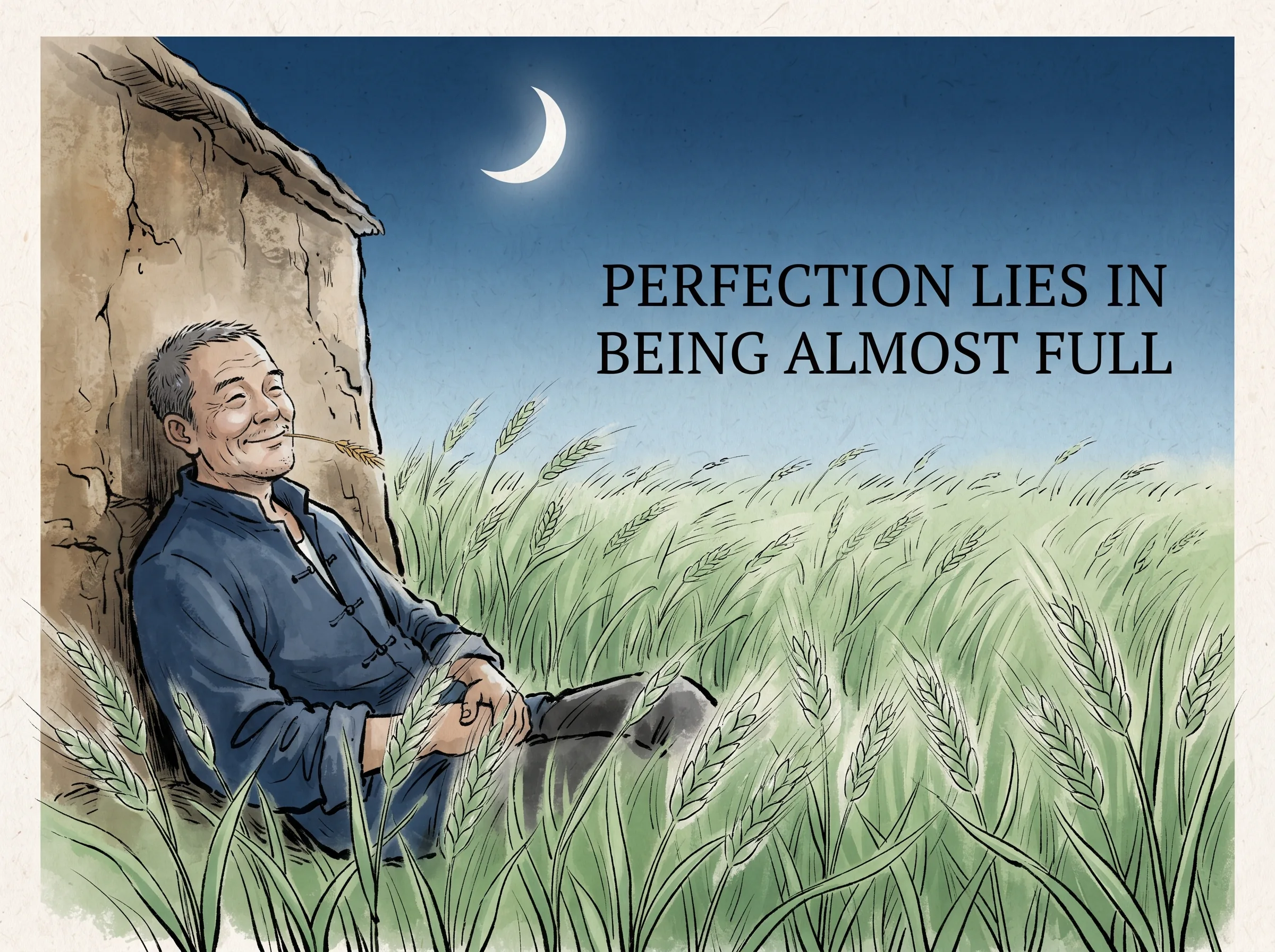
The sentiment has been expressed in various forms across Chinese literature. A phrase that circulates in discussions of this idea — "flowers not fully bloomed, moon not fully round" — is widely quoted as capturing this aesthetic of near-fullness. Depending on the edition or tradition, it has been attributed to different authors, and the exact wording varies across historical transmissions. What is clear across versions is that the image carries the same message: the most beautiful, most promising states are those still in motion, not those that have reached finality. This understanding of near-fullness as preferable to total fullness does not belong exclusively to one school of thought. It appears across literary and philosophical traditions that value equilibrium over extremity.
Eating with the Seasons as a Practice of Enough
One of the most practical ways to apply the philosophy of Xiaoman is through our relationship with food. A traditional Chinese principle associated with eating originally concerned when food should be consumed, rather than where its ingredients came from. Over centuries, the same phrase was also understood in a seasonal sense: eat what is currently available rather than consuming everything at all times. Either way, the core insight remains the same — limitation is not deprivation, it is structure.
In southern China, spring customs once involved eating the earliest greens of the season, treating them as valuable precisely because they were fleeting. In Nanjing and surrounding areas, spring buds from the Chinese toon tree were celebrated as especially precious during this period, a custom whose details have been documented in local cultural records. The belief that early spring sprouts could be worth their weight in gold speaks to a broader pattern: people noticed that seasonal food was inherently limited, and limitation created appreciation. This is the opposite of the modern supermarket model, where everything is available year-round and nothing feels urgent.
The same principle appears in customs associated with Lixia, or the “Beginning of Summer.” In parts of the Yangtze River Delta, including Suzhou and Wuxi, traditional observances included eating three kinds of fresh seasonal food. In Suzhou, these often included cherries, green plums, and young wheat — fruits and grains at their most tender and most temporary. In Wuxi, the custom expanded to include items from land, water, and trees. The variety of local versions is instructive. What connects them is not a single recipe but a practice: at a moment when summer heat can suppress appetite, people chose to mark the season with foods that could not be postponed. They ate what was there, not what was convenient. Examine this artistic principle further through the classical aesthetic philosophy of The Aesthetic Way: Ancient Chinese Wisdom for Living with Beauty.
This approach to food invites a simple shift. Instead of asking what you can buy whenever you want, ask what is available now and how you might make room for it. A seasonal vegetable at the farmers' market, a fruit that ripens only in July, a dish that takes longer because its ingredients are limited — these are small frictions against endless consumption. They create natural boundaries. They make appreciation easier.
Self-Authored Rituals for People Who Are Tired of Buying Meaning
Consumer culture offers rituals wrapped in receipts. A traditional culture offers rituals wrapped in attention. The difference is who defines them.
In parts of southern China, Lixia was also marked by a custom called chengren, or “weighing people.” At the beginning of summer, family members were weighed using a large traditional steelyard. The practice was not primarily about fitness tracking. It was about acknowledging that summer heat could be hard on the body, and marking that transition with a shared, almost playful observation. Some sources describe this as a folk custom rather than a formally recorded court ritual, which means its authority comes from everyday practice, not from elite tradition. Whether it was practiced widely or locally, the custom itself is evidence of a different relationship to discomfort: rather than avoiding the hardness of summer, people named it and made it bearable through humor and shared rhythm.
Similarly, among literati circles, the sixth day of the sixth lunar month became associated with sunning books — bringing volumes out into strong summer light to protect them from insects and damp. One poem about this custom describes the pleasure of carrying old books into a courtyard on a cool morning in the hottest season, treating the activity not as chore but as celebration of a lifelong bond with reading. The poem appears in collections tied to later imperial-era literary culture, though its precise date and authorship vary across versions. What matters is not whether every detail is historically certain but what the practice reveals: some people found ways to turn hardship into ceremony without spending money.
Even in the deepest winter, a similar spirit appears in folk songs counting the nine periods of cold after the winter solstice. Verses describing ice thick enough to walk on, or birds that freeze despite shelter, circulated among ordinary people as a way to make winter endurable. These were not creations of the elite. They were tools for surviving difficulty with humor. That kind of self-authored ritual — making meaning from what you have instead of waiting for what you do not — is a practical alternative to the cycle of chasing satisfaction through purchase.
Choosing Elegance in Ordinary Circumstances
A nineteenth-century scholar and poet named Kuang Zhouyi wrote about life choices in a collection of reflections on poetry. His most quoted observation distinguishes between two kinds of fate: the circumstances you are born into and the manner in which you live within them. According to his text, your conditions of poverty or prosperity are shaped by forces beyond your control and often cannot be changed [Source: Kuang Zhouyi: Huifeng Cihua (蕙風詞話) – Wikisource]. But whether you live elegantly or coarsely is a choice you make every day. The distinction is not between success and failure. It is between grace and habit.
This insight can feel remote when applied to grand decisions. It becomes actionable when applied to small ones. The choice is not always whether to buy or not buy. It is whether to notice the difference between a purchase that fills a need and one that feeds a habit. It is whether to drink tea prepared from stored rainwater because the process matters or because it signals taste. It is whether to hang a summer painting because the season suits it or because a feed rewards it.
Elegance in this sense is not about taste or wealth. It is about attention. When you choose deliberately, you slow down the impulse to consume. When you choose routinely, you speed it up. The difference between the two is not always visible in the moment. It shows up later, in how tired you feel and how full your space is.
Small Fulfillment as an Antidote to Burnout Culture
Contemporary self-help language often recommends optimization: maximize productivity, maximize output, maximize impact. The danger is that optimization leaves no room for rest. Modest fulfillment (Xiǎo Mǎn, 小满) offers a different logic. It suggests that the best state is not maximum but appropriate — enough to sustain effort, enough to leave space for the unexpected, enough to avoid collapse under your own weight.
This does not mean giving up. The contemporary Chinese expression tangping, or “lying flat,” refers to withdrawing from relentless competition. The philosophy of Xiaoman, by contrast, is not about surrender but about pursuing growth without sacrificing balance.It is the recognition that you can move through life with purpose while also pausing at moments when stopping is wiser than pushing. The related idea of relaxed ease (sōngchí gǎn, 松弛感) is sometimes misunderstood as laziness. In its stronger sense, it describes the ability to meet life's bumps without breaking. You can be serious about your work and light about your worries. You can aim high and accept enough.
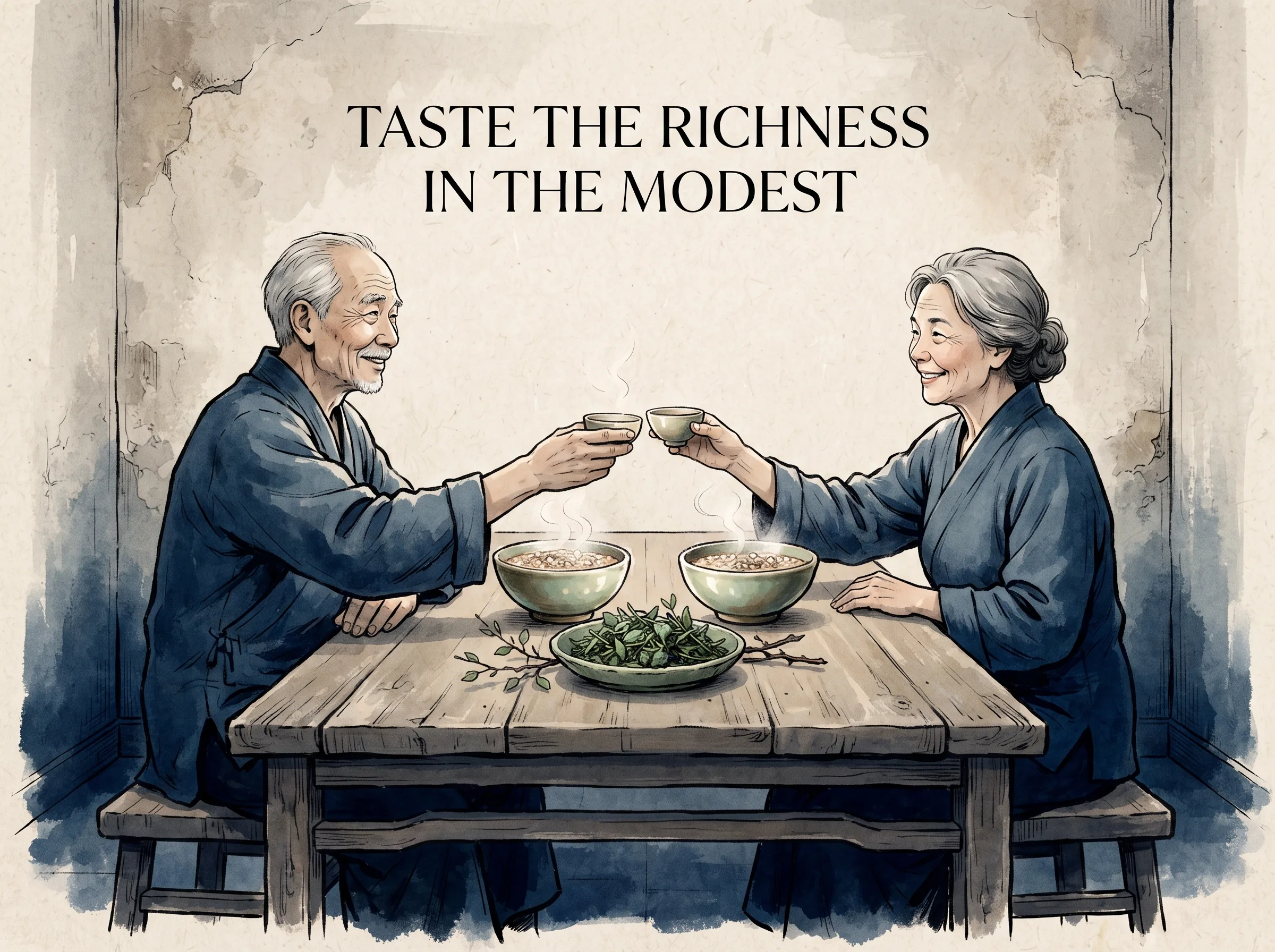
Applied to daily life, this looks like small boundaries: one project finished before starting another, one meal eaten without distraction, one ritual created instead of one more subscription purchased. None of these guarantee happiness. All of them make it more likely by reducing the noise that keeps desire running on empty.
Putting the Philosophy of Xiaoman into Practice
You do not need to study classical texts to apply this idea. A few small shifts can change how you relate to wanting.
First, try seasonal eating for one week. Choose at least three meals where the main ingredient is what is currently in season in your region. Notice how limitation changes the experience. If seasonal produce is hard to find, choose one ingredient you rarely buy and cook it simply.
Second, create a small ritual that does not cost anything. It could be weighing yourself on a traditional scale and noting the result, sunning books or papers on a sunny day, or collecting rainwater in a container outside after a storm. The point is not the object but the attention.
Third, distinguish surface choices from life choices. Ask yourself which decisions are about comfort and which are about meaning. Choosing what earrings to wear is fine. Choosing whether to live elegantly or reactively is heavier. Pay more attention to the latter.
Fourth, notice when you are chasing fullness. If you finish a goal and immediately seek the next one, pause. Ask whether you are moving toward something you want or away from the discomfort of stopping. A brief pause is not laziness. It is calibration.
Frequently Asked Questions
Is the philosophy of Xiaoman relevant only to people interested in Daoism or Chinese philosophy? No. It is a cultural concept that describes a practical attitude toward limits. You do not need to adopt any tradition to benefit from the observation that partial fullness can be more sustainable than total saturation. Many people use it simply as a lens for reflecting on desire and consumption.
How is the philosophy of Xiaoman different from settling or giving up? The philosophy of Xiaoman is not about lowering standards. It is about recognizing when you have enough and choosing to pause there. Settling implies resignation; Xiaoman reflects an intentional commitment to balance. You can continue pursuing growth while recognizing the value of the progress you have already made.
Can practicing seasonal eating really change how I feel about wanting more? It can, because it introduces friction into a system designed to remove friction. When you eat what is seasonal, you encounter natural limits. Limits remind you that not everything is available all the time. That reminder can weaken the habit of assuming more is always possible.
What if I live in a place where traditional solar terms do not match my climate? You can adapt the principle without copying the calendar. The underlying idea is simple: align your consumption with availability. If a fruit is out of season where you live, treat it as a rare luxury rather than a routine purchase. If certain items are always available, choose to skip some of them intentionally. The point is practice, not precision.
Closing Thoughts
The feeling of never having enough is not a character flaw. It is a pattern reinforced by culture, marketing, and habit. Classical Chinese thought offers a practical response not by urging you to want less but by showing you how to want differently. The philosophy of Xiaoman reminds us that stopping short of complete fullness is not a failure. It is a sustainable state that leaves room to grow, rest, and respond.
If you want to begin, start small. Choose one meal to eat seasonally. Create one ritual that has no price tag. Notice one moment today when you feel the urge to buy meaning and choose to pause instead. These are not grand acts. They are deliberate ones. Deliberate acts, repeated, become a life, reflecting the enduring wisdom of Contentment in Chinese Philosophy.
Examine this artistic principle further through the classical aesthetic philosophy of Reimagining Ritual: What Ancient China Can Teach Us About Meaningful Ceremony.
For a deeper comparative examination of these ideas, explore our related study on The Revolution of Heaven: Moving with the Changing Seasons.
Sources & Further Reading
[1] Dream of the Red Chamber, Chapter 41 — Tasting Tea with Plum Blossom Snow (红楼梦·第四十一回) – Guwen Island
[2] Kuang Zhouyi — Huifeng Cihua (蕙風詞話) – Wikisource
Further Reading
- Twenty-Four Solar Terms Cultural Knowledge System (二十四节气文化)
- National Center for Preservation of Ancient Books (国家古籍保护中心资源)
- Daodejing Classical Text Studies (道德经经典文本与注疏研究)
- Analects Commentary Literature Resources (论语注疏文献资源)






