
The Aesthetic Way in Chinese Wisdom: We Have Stopped Seeing
We live in an age that rewards speed above all else. Efficiency is the currency of modern life, and everything is measured by output: how fast we can work, how many tasks we can complete, how quickly we can consume. In this world, beauty has been quietly reassigned. It is treated as decoration — something to add after the "real" work is done, or as a luxury to purchase when we have surplus income and spare time.
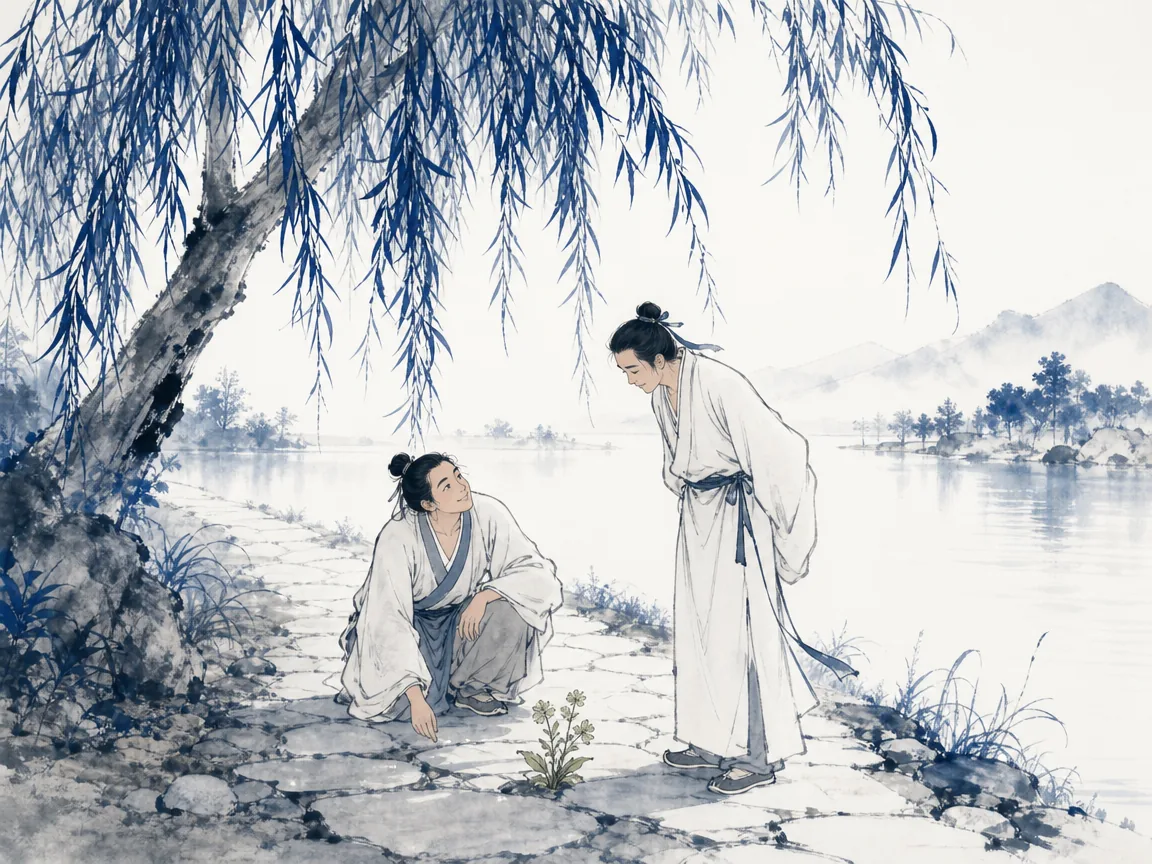
But there is another way of understanding beauty, one that has been present in Chinese thought for millennia. It is not about owning beautiful things or visiting museums. It is about developing a particular quality of attention — the ability to notice, to linger, to find depth in what is already present. This kind of aesthetic awareness is not a lifestyle upgrade. It is a form of self-cultivation, a practical wisdom for living more deeply in a world that constantly asks us to hurry.
What makes this approach different from generic advice about slowing down is its philosophical grounding. Classical Chinese thinkers diagnosed the same condition we experience today — a numbed perception, a life lived at the speed of function — and offered not quick fixes but enduring frameworks for recalibrating how we attend to the world. The following explores three such frameworks and what they might offer for ordinary daily life.
The Illusion of More
Before examining what Chinese philosophy offers, it is useful to understand why aesthetic awareness matters in the first place. Modern life presents a paradox: we have access to more goods, more images, more experiences than any previous generation, yet satisfaction does not increase proportionally. A meta-analysis of 56 studies covering the period from 1998 to 2022 found that materialistic values correlated with significantly lower subjective wellbeing among Chinese populations [1]. The pattern holds broadly across cultures: accumulating more does not automatically produce a more satisfying life.
One reason is that relentless consumption trains us to see the world instrumentally. Objects become functional items — clothing to wear, food to consume, spaces to pass through. Perception narrows to what is useful, and everything else fades from attention. Anxiety in such an environment is partly a symptom of this contracted perception, not merely a reaction to external pressures. When the mind is busy evaluating, acquiring, and optimizing, there is little room left for the kind of unhurried attention that aesthetic experience requires.
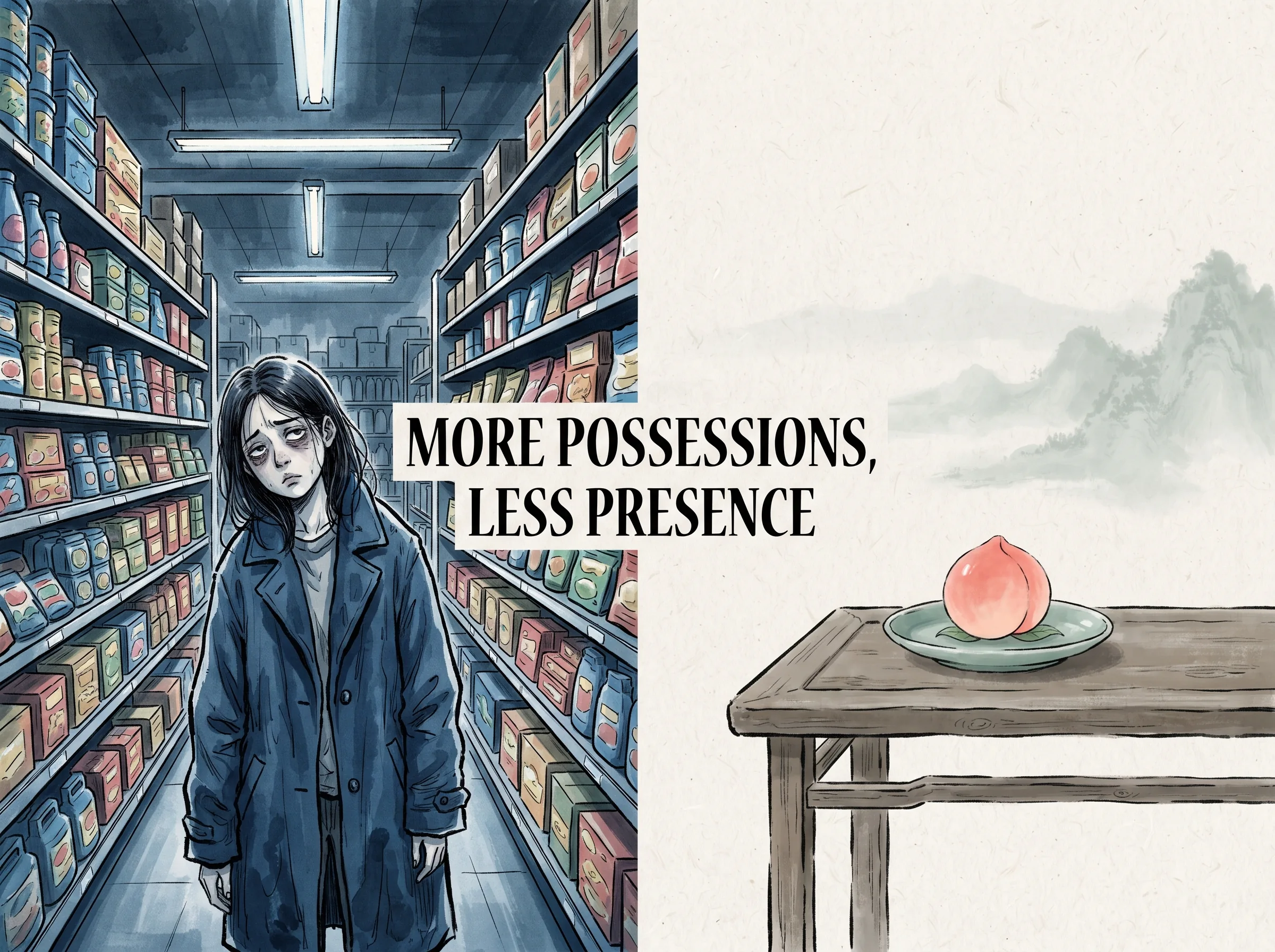
This is not a new observation. Chinese philosophers recognized centuries ago that a life driven purely by accumulation and utility tends to impoverish perception. Their response was not to advocate withdrawal from the world but to cultivate a different relationship to it — one based on seeing clearly, attending carefully, and finding richness in simplicity rather than in expansion.
Enough as a Practice of Attention
Among the most widely discussed ideas in the Dao De Jing is the principle of knowing when enough is enough, or "knowing contentment" (zhī zú, 知足). The Aesthetic Way in Chinese Wisdom of the text offers a direct critique of endless desire, noting that the greatest disaster lies in not knowing when one has had enough, and the greatest fault in always seeking more. It concludes that the sufficiency that comes from recognizing what is sufficient is perpetually sufficient. The point is not asceticism but reorientation: wealth and richness are not measured by what one acquires but by the capacity to perceive what is already present.
Applied to aesthetic awareness, this means that the first step is not to seek out more beautiful things but to train attention to notice what is already there. A sidewalk crack filled with moss, the angle of afternoon light on a wall, the sound of rain against a window — these do not require purchase or planning. They require a pause in the habit of scanning the world for utility and function. The discipline of enough is, in essence, a discipline of attention. It asks us to slow the rush of evaluation long enough for perception to return.
Simplicity, in this sense, is not deprivation. It is the removal of sensory noise so that the mind becomes sensitive again. Every object, every notification, every optimization demand competes for attention. Reducing the competition does not make life thinner; it makes perception sharper. This is a practical insight with real consequences: when the mind is not constantly chasing the next thing, it has room to receive the present moment in full.
The Useless Tree and the Freedom of Wandering Attention
If Laozi offers a framework for attention grounded in enoughness, Zhuangzi offers a framework for attention grounded in freedom. His most famous parable concerns a large tree — one whose trunk is gnarled and whose branches are twisted, conforming to neither the carpenter's ink line nor the compass and square (不合绳墨,不合规矩) and therefore useless by a carpenter's standards [3]. The tree is discarded, ignored, passed over. Yet precisely because it is useless to anyone, it is never cut down. It lives long, provides shade, and exists on its own terms. Zhuangzi uses this image to challenge the assumption that usefulness is the only measure of value.
The parable carries a deeper implication for aesthetic awareness. A person with developed aesthetic sensibility shares something with the useless tree: they resist the impulse to reduce everything to function. They notice the curl of a leaf not because it serves a purpose but because it is worth noticing. They find meaning in moments that efficiency-minded culture would discard as wasted time. This quality of unhurried, curious engagement with the world is what Zhuangzi describes through the figure of the free and easy wanderer — someone who moves through life without being trapped by the narrow categories of utility and productivity. Examine this artistic principle further through the classical aesthetic philosophy of Contentment in a Culture of More: Ancient Chinese Wisdom for the Never-Enough Trap.
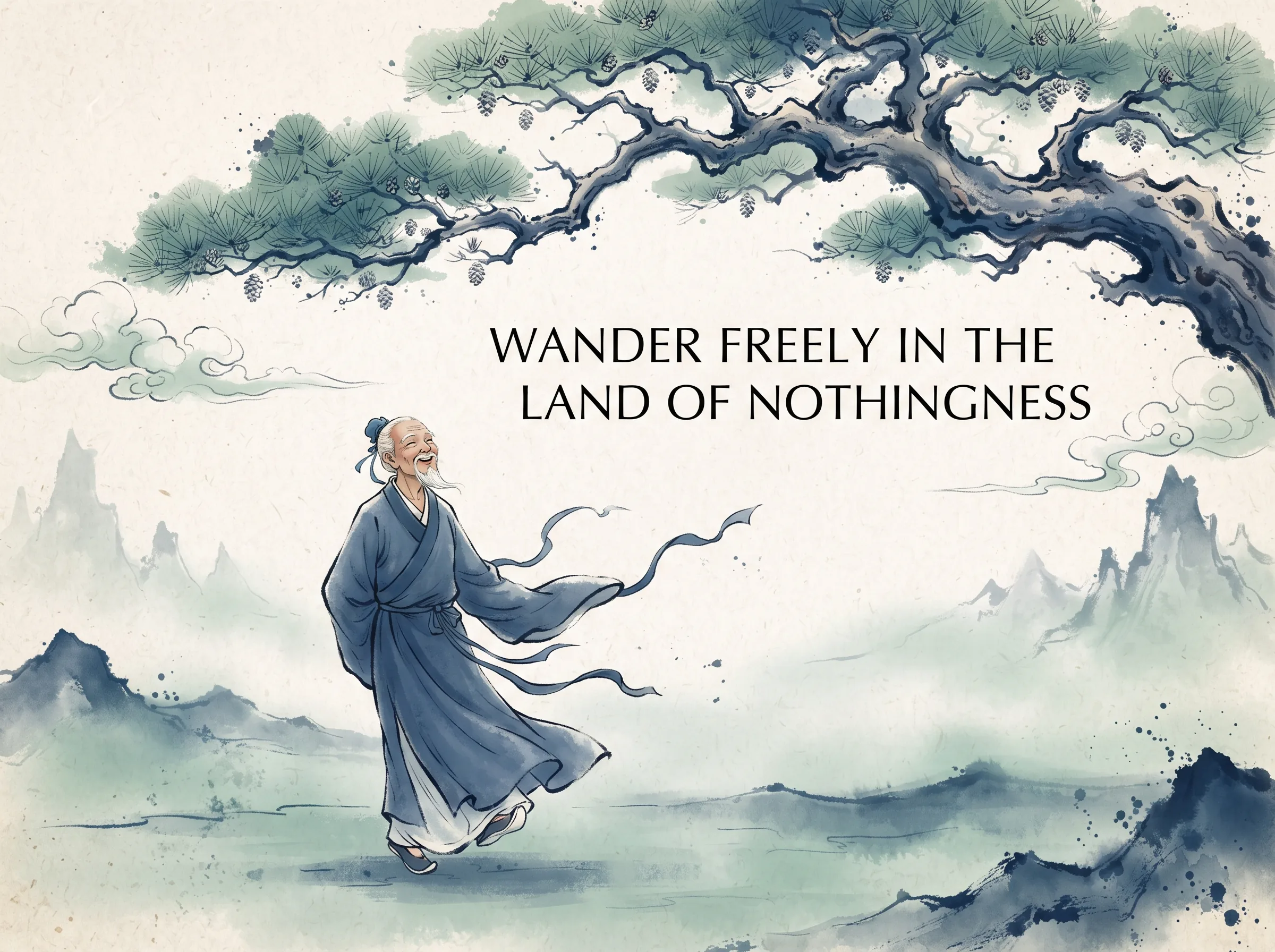
In practice, this means allowing attention to wander without demanding that it produce something. Walking without a destination. Watching without an agenda. Letting the mind rest on a texture, a sound, a play of shadow and light without immediately categorizing or using it. The resistance to pure functionalism is itself a form of aesthetic cultivation. It expands the range of what can be experienced as meaningful.
The Practice of Ritual and the Training of Perception
Chinese philosophy does not treat aesthetic awareness as something that arrives spontaneously. It is developed through practice, and traditional practices such as calligraphy, tea preparation, and garden design serve as disciplines for training perception. These are not merely artistic hobbies; they are forms of self-cultivation that sharpen attention and deepen appreciation for ordinary moments.
The Stanford Encyclopedia of Philosophy notes that in the Chinese tradition, artists and theorists did not separate aesthetic judgment from moral reflection. Evaluations of artistic works took into account not only formal qualities but also the character and moral disposition of the artist [2]. Art was understood as an expression of the whole person, not just a technical exercise. Through the repeated practice of brushwork, a calligrapher cultivates patience, presence, and sensitivity to subtle variations in pressure, speed, and rhythm. Each stroke becomes an opportunity to refine attention.
Similarly, the Chinese garden — whether expansive or no larger than a single pot — has been understood as an essential element of daily life [2]. It is not an escape from reality but a space designed to deepen engagement with it. The arrangement of stones, the flow of water, the framing of a view through a window — these are all exercises in perception. They teach the eye to notice relationships, contrasts, and harmonies that casual glance would miss.
The key insight here is that aesthetic perception is a muscle. It grows through repetition. The person who arranges flowers weekly develops a finer sensitivity to colour, form, and balance. The person who prepares tea with attention learns to notice temperature, aroma, and taste in ways that routine consumption never reveals. What appears as a simple daily act becomes, through sustained practice, a discipline of perception.
Cultivating Aesthetic Awareness: Practical Steps
The philosophical frameworks discussed above — knowing enough, wandering attention, practicing ritual — are not abstract theories. They translate into concrete daily practices that require no special equipment, no particular background, and no significant expense. The following steps are drawn from the principles outlined and are offered as practical starting points rather than rigid prescriptions.
Begin with one deliberate sensory observation each day. Choose a single moment — the steam rising from a cup, the texture of bark on a tree, the quality of light on a surface — and attend to it fully for one minute. Do not analyse or judge. Simply notice. This is the practice of knowing contentment (zhī zú, 知足) in action: finding richness in what is already present rather than seeking what is absent.
Slow down one routine act. Pick something you do automatically — drinking tea, walking to a meeting, washing dishes — and perform it with full attention. Notice the sensations, the sounds, the sequence of movements. This is the practical application of Zhuangzi's wandering attention: transforming a functional task into a moment of unhurried presence.
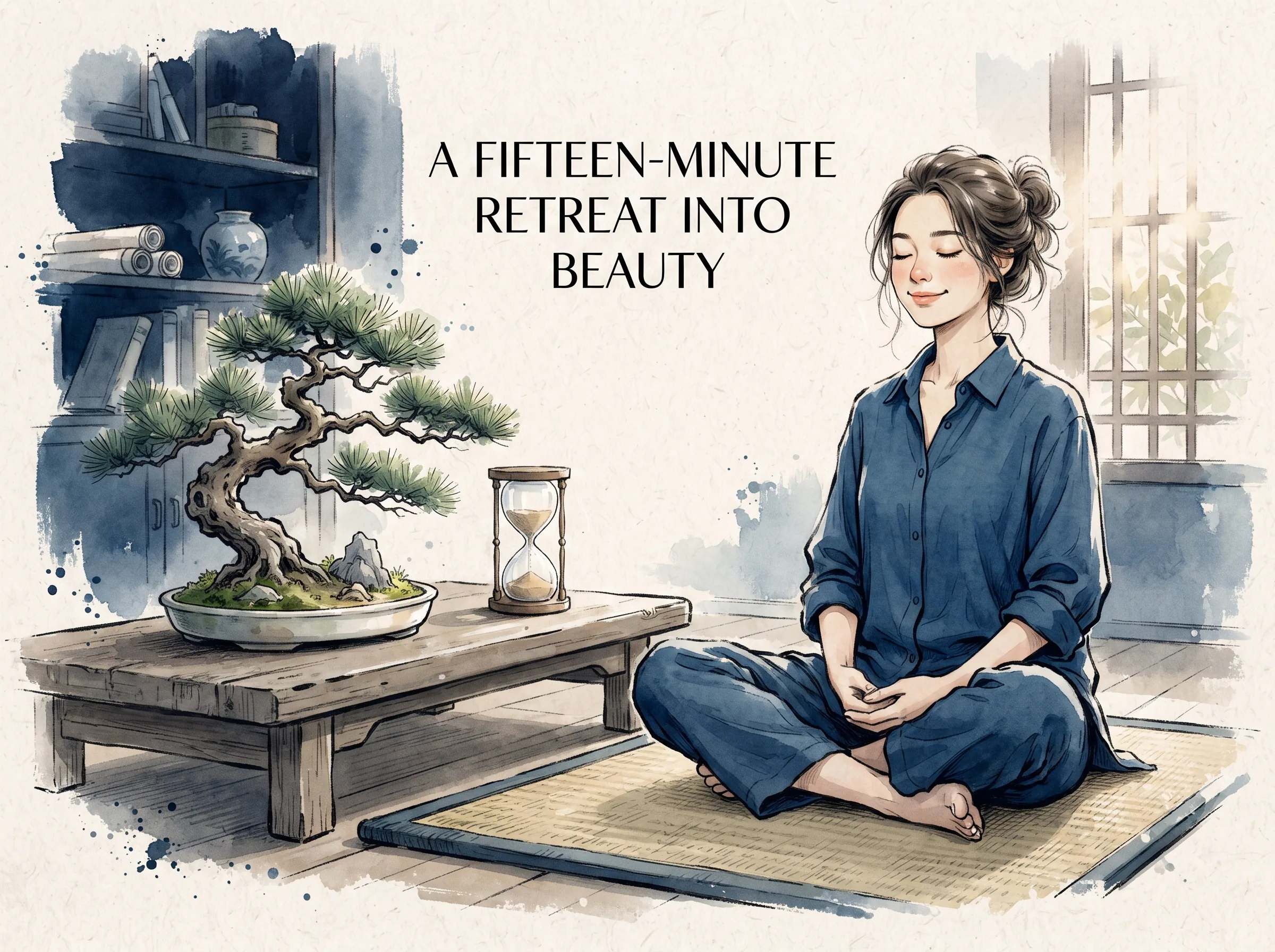
Create one small ritual of beauty each week. It could be arranging a branch in a vase, listening to a piece of music without multitasking, or writing a few lines by hand. The ritual need not be elaborate. Its purpose is to carve out a space in which aesthetic perception can develop through repeated, intentional practice.
Reduce one source of digital noise. Each notification, scrolling session, or background screen competes for attention and contracts the range of perceptual sensitivity. Removing one source — even temporarily — creates room for the kind of unhurried attention that aesthetic experience requires. This is not anti-technology but pro-perception.
These steps are best understood as forms of self-cultivation (xiū shēn, 修身), as classical Chinese thought calls it. They are not lifestyle upgrades or consumption choices. They are practices that develop a capacity: the capacity to see more deeply, to linger longer, to find meaning in the ordinary. Over time, this capacity reshapes the quality of daily life in ways that no amount of external accumulation can match.
Why This Matters Now
The conditions that classical Chinese philosophers observed — a life dominated by utility, a perception narrowed by constant demand, a dissatisfaction that accumulation fails to resolve — are more acute today than at any point in history. The modern world produces more stimuli, more options, more pressure to optimize than any previous era. The result is not greater satisfaction but a particular kind of exhaustion: the fatigue of a mind that is always scanning, always evaluating, never resting.
Aesthetic awareness, as understood through this tradition, offers a different path. It does not require leaving the world or renouncing its demands. It requires developing a counter-habit — the habit of noticing, of lingering, of finding depth in what is already at hand. It asks us to treat perception as a skill that can be cultivated, not merely a passive response to external beauty.
This is practical wisdom in the deepest sense: it addresses a real problem — the contraction of attention and the impoverishment of experience — with tools that are accessible, repeatable, and grounded in a tradition that has refined them over centuries. The goal is not to become an aesthete in the conventional sense but to live with a quality of attention that makes ordinary life richer, calmer, and more resilient.
FAQ
Q: Is aesthetic awareness the same as appreciating art or beauty products?
A: Not necessarily. While engagement with art can support aesthetic development, the Chinese philosophical tradition understands aesthetic awareness more broadly as a quality of attention — the ability to perceive depth, relationship, and meaning in ordinary moments. A cup of tea, a patch of light on the floor, or the sound of wind can be objects of aesthetic attention just as much as a painting.
Q: Do I need any special training or background to practice this?
A: No. The practices described here — deliberate observation, slowed routine, small rituals, reducing digital noise — require no prior knowledge, special equipment, or financial investment. They are accessible to anyone willing to devote a few minutes of attention to an ordinary moment.
Q: Isn't this just another form of self-improvement pressure?
A: That is a fair concern, and one the tradition would take seriously. The practices are not about achieving a better version of yourself according to external standards. They are about developing a capacity for perception that has been contracted by the demands of modern life. The aim is not optimization but restoration — restoring the mind's natural sensitivity to what is present.
Q: How is this different from mindfulness or meditation?
A: There is significant overlap, but the emphasis here is specifically on aesthetic perception — the cultivation of attention directed toward form, texture, colour, sound, and the relationships between things. While mindfulness often focuses on breath or bodily sensation as an anchor, aesthetic awareness extends that attentive quality outward to the full range of sensory experience, treating the world itself as a field of meaning and beauty.
Summary and Next Steps
Ancient Chinese philosophy offers a distinctive approach to aesthetic awareness: not as an optional luxury but as a practical wisdom for living more deeply. Through the principle of knowing enough, the freedom of wandering attention, and the discipline of ritual practice, it provides frameworks for reversing the contraction of perception that characterizes modern life. These are not abstract theories but cultivated practices — forms of self-cultivation that develop the capacity to see more, linger longer, and find richness in the ordinary.
The next step is not to read more but to practice. Choose one of the steps outlined above and begin. A single minute of deliberate observation each day is a beginning. From there, the practice can grow naturally, guided by attention rather than ambition.
Examine this artistic principle further through the classical aesthetic philosophy of Reimagining Ritual: What Ancient China Can Teach Us About Meaningful Ceremony.
For a deeper comparative examination of these ideas, explore our related study on Why Do We Keep Asking If Something Is Useful?.
Sources & Further Reading
[1] Associations between two conceptualizations of materialism and subjective wellbeing in China: A meta-analysis of studies from 1998 to 2022 — Meta-analysis of 56 studies on the relationship between materialistic values and subjective wellbeing in Chinese populations.
[2] Aesthetics in Chinese Philosophy: Painting and Calligraphy (Stanford Encyclopedia of Philosophy) — Scholarly overview of Chinese aesthetic theory, including the role of art in moral cultivation and the significance of gardens in daily life.
[3] Zhuangzi, “Free and Easy Wandering” (《莊子・逍遙遊》), Chinese Wikisource — Original Chinese text of the chapter, including the parable of the useless tree.
Further Reading
- Zhuangzi (《莊子》), Chinese Wikisource — Complete Chinese text for broader exploration of its philosophical themes.
- Ames, Roger T. and David L. Hall. Dao De Jing: A Philosophical Translation. Bellwether Books — English translation of the Dao De Jing with philosophical commentary.
- Cleary, Thomas. The Book of Zhuangzi. Columbia University Press — Translation and study of selected chapters from the Zhuangzi.






