
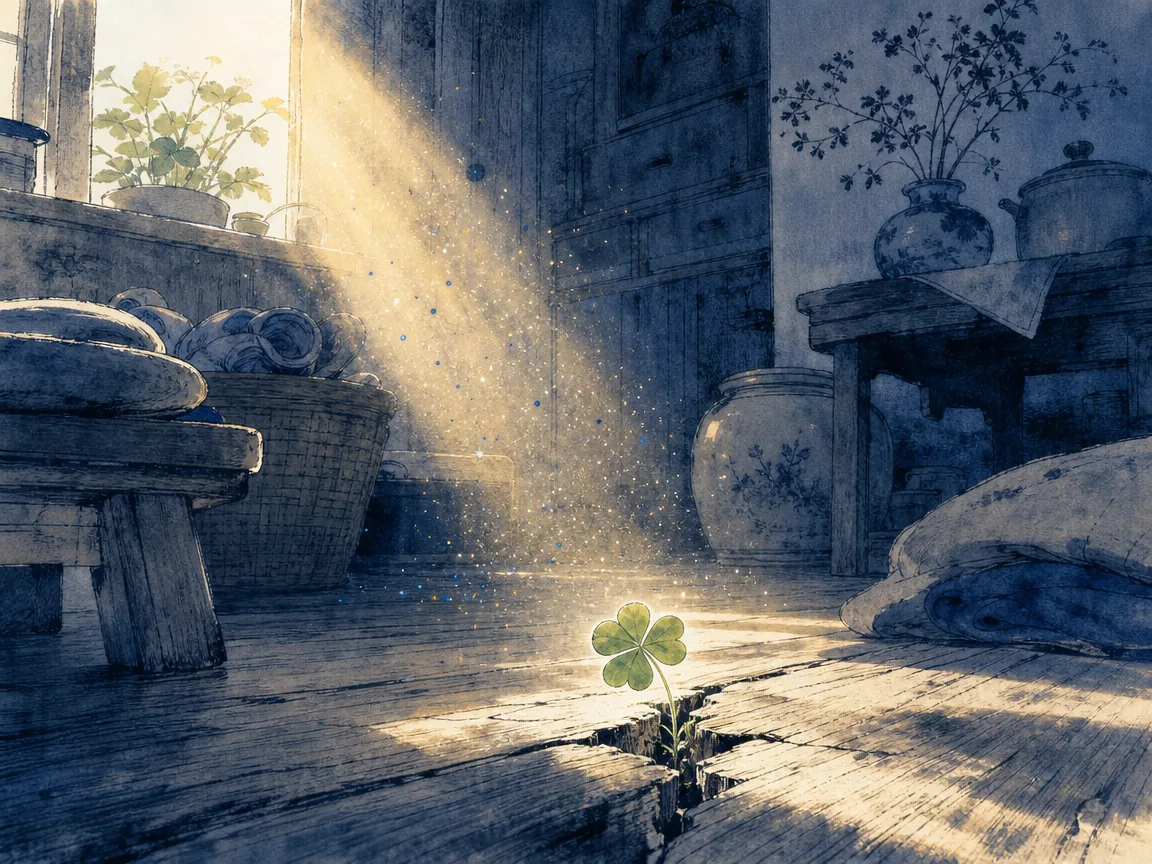
You walk past it every morning — the same crack in the sidewalk where a dandelion has found a foothold, the warm patch of afternoon light sliding across your kitchen floor, the steam rising from your cup in patterns that shift and dissolve before you can name them. Yet you keep walking. The commute rushes on. The screen blinks. The list of things to do grows longer. You are not blind. You are simply full.
A recent study found that when our working memory is occupied by other goals, we experience fewer aesthetic moments and savor them less [1]. The research tracked over fifteen thousand reports from more than a hundred students and revealed a clear pattern: the mind that is crowded with tasks has less room to notice. This is not a failure of character. It is a fact of cognition. But it carries a quiet implication — that the ability to see beauty is partly an ability to be present, and presence can be cultivated—a foundational perspective explored in Beauty in Everyday Life Chinese Wisdom.
There is a term sometimes used in contemporary writing that aesthetic awareness is one of the most valuable skills of modern life. What that phrase points toward is not expensive taste or art-historical knowledge. It is a mode of attention — a way of meeting the world that turns ordinary moments into occasions of meaning. Classical Chinese philosophy, particularly the traditions associated with Daoism and Confucianism, offers long-standing guidance on how to develop this skill. Not as decoration for the already-cultured, but as practical wisdom for anyone who wants to live more fully within the life they already have.
Beauty in Everyday Life Chinese Wisdom: The Attention Your Grandmother Already Knew
The granddaughter recalled her grandmother's small rural home — sparse furniture, earth floors, a courtyard where tall crimson flowers grew wild. There was never anything extravagant there. But the rooms were neat. The courtyard was tended. And when asked about it, the grandmother said something simple: the days are lived for yourself; if your eyes are comfortable, your heart follows. That is not philosophy as academic discipline. It is philosophy as a habit of attention, built into how a person moves through their own space.
Stories like this appear across cultures, but they carry a particular resonance in the Chinese tradition, where everyday life has long been regarded as the proper ground for reflection. The observation here is straightforward enough: people who notice beauty in ordinary surroundings tend to find ways to make themselves content without needing external conditions to change first. That is consistent with what some readers will recognize as a Daoist instinct — that satisfaction does not arrive once desire is fulfilled, but rather begins when desire is understood.
Modern life offers almost unlimited opportunities to satisfy appetite. It offers far fewer structured invitations to slow down and pay attention. The result is not necessarily dissatisfaction in the dramatic sense. It is a kind of numbness — a gradual blurring of the edges of experience until the days begin to look the same. Aesthetic awareness, in this context, is less about appreciating fine objects than about recovering the capacity to feel the texture of an ordinary moment.
When the Mind Is Full, Beauty Fades
A study published in 2021 examined aesthetic experience in real time rather than in a laboratory. Over two weeks, participants reported their moment-to-moment encounters with beauty while researchers tracked what else was happening in their minds. The finding was clear: higher cognitive load was associated with both fewer aesthetic experiences and a reduced ability to savor them once they occurred [3]. The researchers described focused attention as an important condition for aesthetic experience, noting that the capacity to concentrate on a stimulus supports richer perception, deeper engagement, and greater pleasure [1].
In plain terms, the research confirms what many people already suspect from their own lives: when you are mentally occupied, the world looks different. A sunset becomes background noise. A well-arranged table goes unnoticed. The coffee you drink tastes like caffeine delivery rather than something worth pausing for. This is not a moral failing. It is the psychology of limited attention.
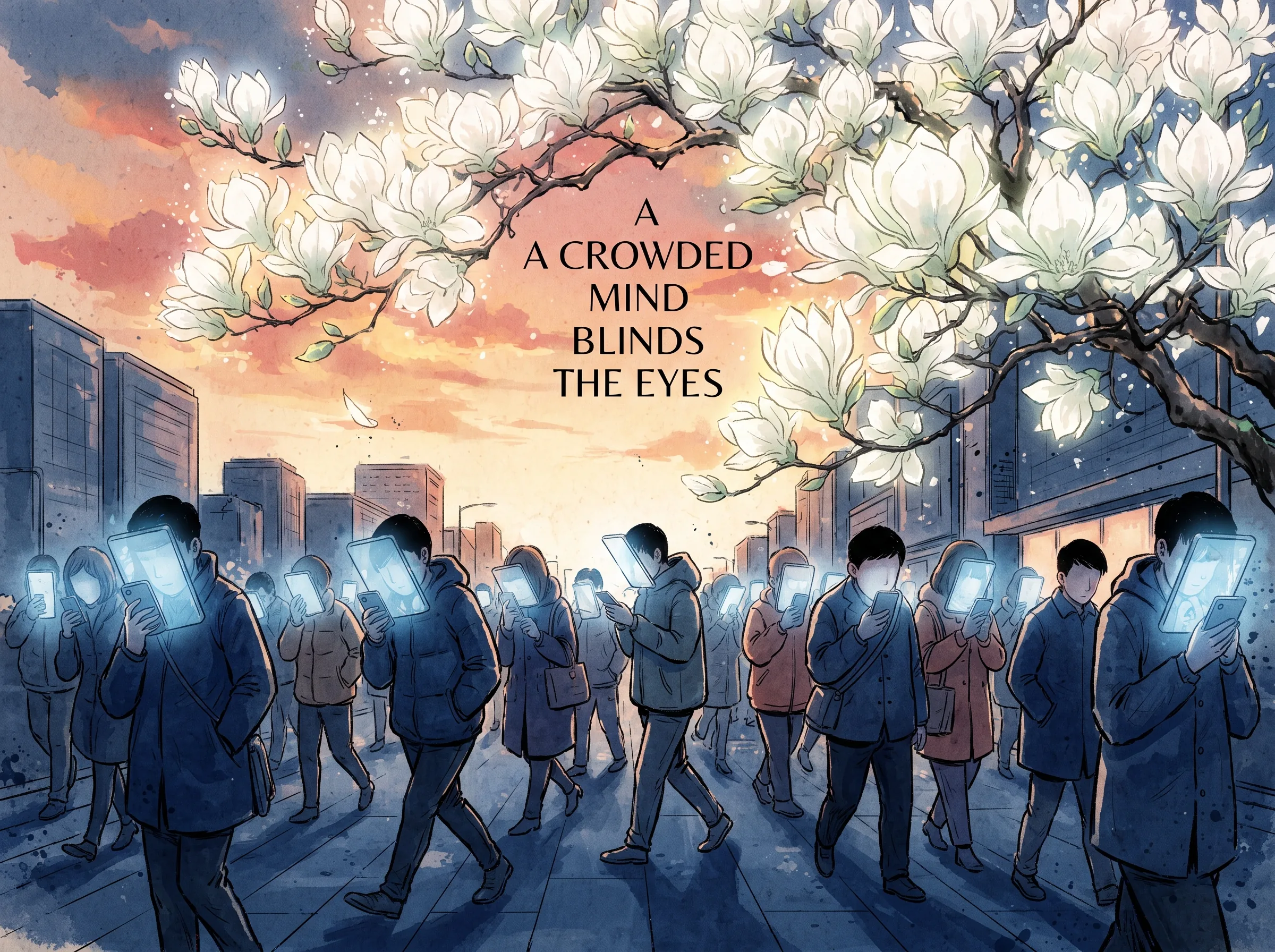
Classical Chinese thinkers would not have phrased it in terms of working memory, but they recognized the same phenomenon. The tradition associated with Laozi repeatedly warns against the clutter of desire and the distraction of endless striving. What gets called "contentment" in those texts is often misunderstood as resignation. In fact, it is closer to what the Danish philosopher Søren Kierkegaard once described as freedom from the tyranny of the next thing — the ability to receive what is already at hand rather than remaining perpetually oriented toward what is missing. Whether or not one accepts the philosophical packaging, the practical observation stands: a mind saturated with wants has less room for appreciation.
Zhuangzi and the Practice of Seeing Differently
The philosopher Zhuangzi, active in the Warring States period, is known for a style that favors story over argument. His text is filled with dialogues, dream sequences, and paradoxes designed to loosen the reader's habitual categories rather than to prove a point. One recurring theme concerns the limits of a single perspective. A common interpretation holds that Zhuangzi invites us to question our fixed viewpoints and consider that what seems obvious from one position may look entirely different from another [2].
The famous passage about dreaming he was a butterfly illustrates this move. Zhuangzi asks whether he is a man who dreamed he was a butterfly or a butterfly now dreaming he is a man. The point is not metaphysical speculation for its own sake. It is an exercise in perspective-taking — a reminder that the boundary between self and world, between observer and observed, is more flexible than daily habit suggests. When that boundary loosens, the world becomes less of a checklist and more of an encounter. To explore these themes from another angle, read our related reflection on When Tools Become Masters: What Zhuangzi’s Chapter 26 Teaches Us About Losing Our Inner Sovereignty.
This does not mean every object is equally beautiful. It means that beauty is not purely an objective property waiting to be discovered, nor is it purely subjective fantasy. It arises in the relation between a receptive mind and a world that offers more than we usually notice. People with a developed aesthetic sense often report exactly this: their world feels richer not because it has changed, but because their attention has. The sunset, the cracked cup, the sound of rain on a tin roof — these do not become beautiful because someone declared them so. They become visible as beautiful when someone learns to stop long enough to meet them.
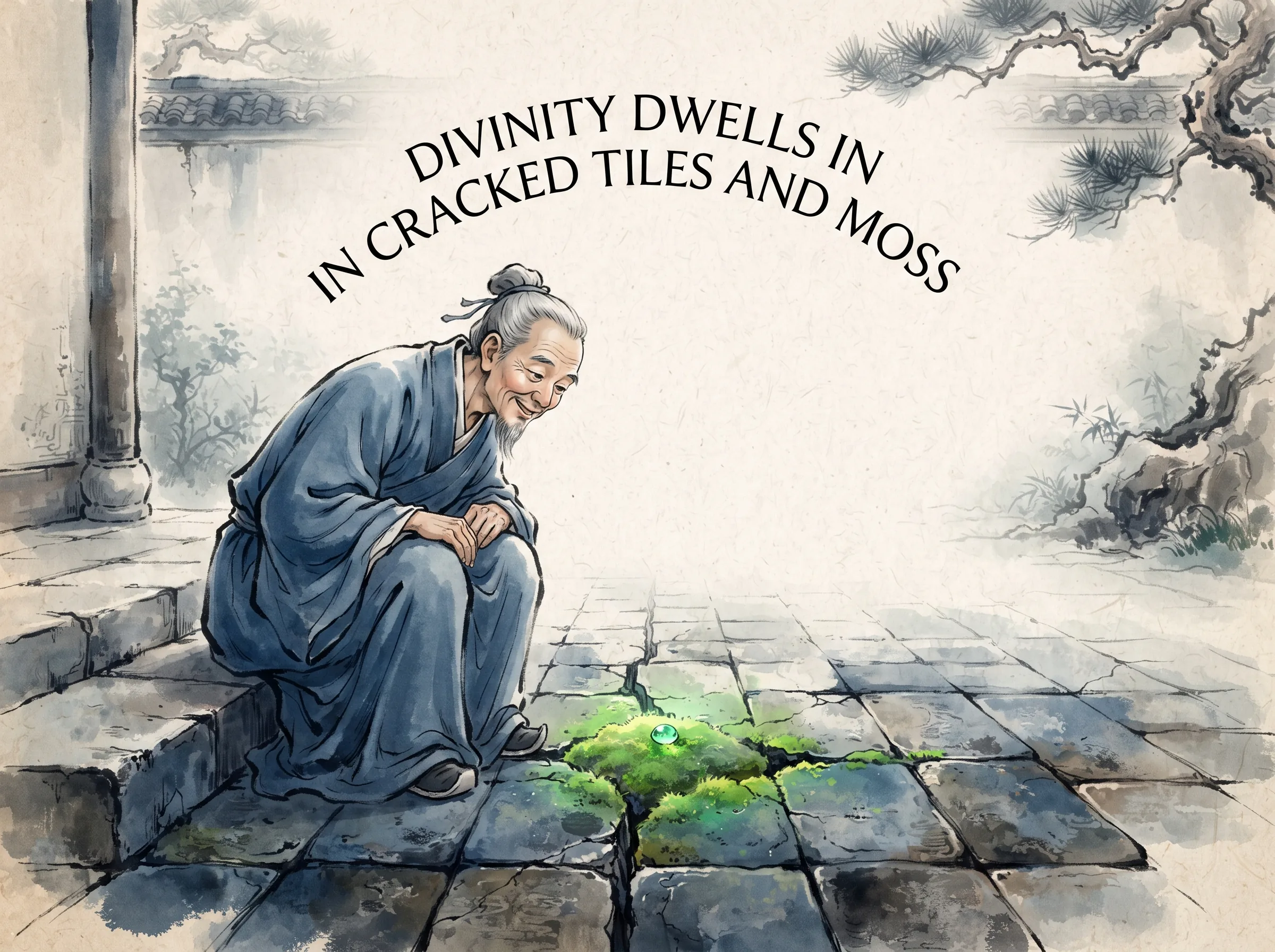
The practical move here is subtle. It is not "think positively." It is "look again." Zhuangzi's method is never about forcing a new opinion onto the world. It is about creating the conditions — stillness, humor, distance from rigid categories — under which the world can reveal itself differently.
Refinement as Character, Not Display
Confucius is often read as a teacher of rules. That reading is not wrong, but it is incomplete. He cared deeply about how people carried themselves, how they arranged their surroundings, and how they participated in shared practices such as music and ritual. One passage frequently discussed by scholars records him saying that one is aroused by poetry, established by ritual, and completed by music. The sequence matters: culture and practice are not ornaments added after character is formed. They are the very means by which character takes shape.
The underlying idea is that external order and internal order influence each other. A space that is treated carelessly reflects, and reinforces, a mind that is careless. A gesture of attention — setting a table neatly, choosing a vase for a single flower, arranging tools so they can be found without frustration — is simultaneously practical and ethical. It says something about how the person regards their own life.
This connection between aesthetics and character is not mystical. It is psychological. The way a person treats their environment reveals what they value, and what they value shapes how they act. Someone who cultivates attention to beauty is less likely, all else being equal, to treat people roughly or to consume without reflection. Not guaranteed — no single practice guarantees virtue — but inclined. The tradition calls this self-cultivation. The modern equivalent might be called integrity of attention.
It is worth noting that this line of thinking can be overstated. A messy room does not prove a bad person, and a tasteful apartment does not prove goodness. The classical claim is subtler: sustained engagement with refined practice tends to cultivate certain dispositions — patience, sensitivity, restraint — that make ethical life more natural. Whether one accepts that claim or not, the practical recommendation remains usable: treat your surroundings with attention, and observe what changes in your own responsiveness.
Three Practices for Developing Aesthetic Awareness
The philosophy is useful, but the question remains practical: how does a person actually train this capacity? The answer is not dramatic. It involves small, repeatable acts of attention.
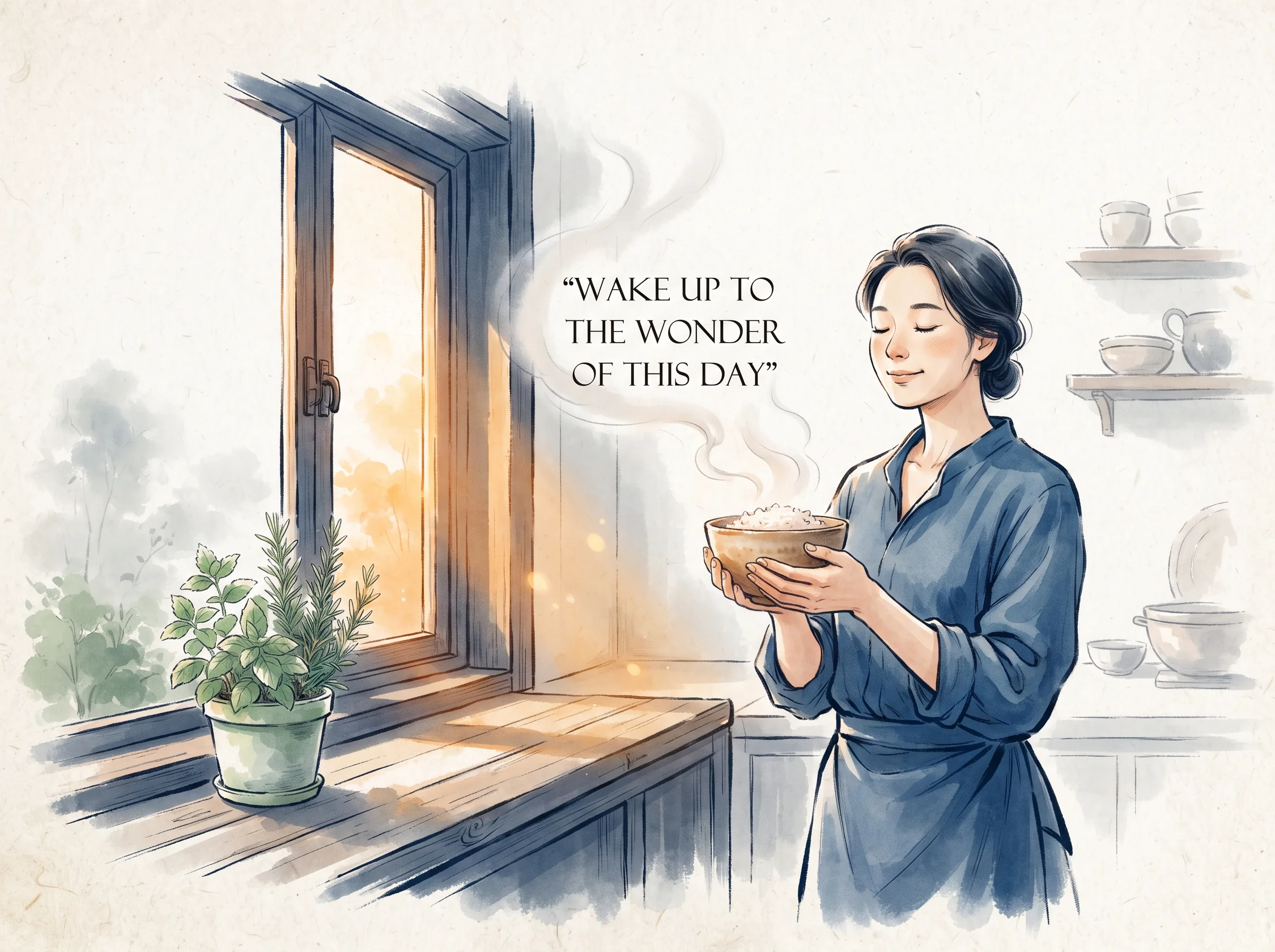
Choose one ordinary moment and attend to it fully each day. It might be the first sip of morning tea. It might be the sound of keys in the lock. It might be the way light falls through a window at a particular hour. The goal is not to achieve a mystical experience. It is to interrupt automatic pilot and give the mind one clear object to rest on. Psychological research supports the general principle that focused attention enhances aesthetic engagement [1]. The method is simply to create opportunities for that attention to occur.
Remove one unnecessary thing from your space and notice what appears. Laozi's emphasis on simplicity is often summarized as "do less." The practical version is more specific: subtract until the essential becomes visible. A cluttered desk does not merely look messy. It competes for attention. Clearing even a small area creates a field in which the eye can rest and notice what was previously hidden by noise. This is aesthetic work in the literal sense — it refines perception by reducing interference.
When something feels ugly or boring, ask what you might be missing. This is the Zhuangzi move applied to daily life. The question is not "how do I force myself to like this?" It is "what perspective am I not applying?" A cracked wall is ugliness until it is seen as a record of weather and time. A delayed train is an inconvenience until it is noticed as an uncheduled pause. The practice is modest but disciplined: refuse the first judgment and look one more time.
None of these methods guarantees lasting transformation. They are habits, not remedies. But habits accumulate. And in a culture that rewards speed and novelty, the deliberate choice to notice is itself a quiet act of resistance.
The Life Worth Living Is the Life Worth Seeing
There is a Chinese saying sometimes attributed to various sources that a person who understands beauty also understands how to live well. Whether or not the exact wording is verifiable, the intuition behind it is easy to recognize. People who cultivate aesthetic awareness tend to be less frantic. They tend to find satisfaction in conditions that do not require purchase or approval. They tend to treat their surroundings — and, by extension, the people in them — with more care.
This is not a promise that beauty will solve problems. It is an observation that beauty changes the conditions in which problems are faced. A difficult life seen with dull attention feels heavier than the same life seen with sharpened attention. The facts do not change. The quality of the encounter does.
The ancient sources offer different versions of the same insight. Laozi points toward simplicity and contentment. Zhuangzi points toward flexible perception and the humor of stepping outside one's own fixed view. Confucius points toward refinement as a path of self-cultivation. Together they form a toolkit rather than a doctrine — a set of perspectives that can be tested against one's own experience rather than accepted on authority.
Aesthetic awareness, then, is not a luxury reserved for artists or enthusiasts. It is a practical skill. It is the ability to meet the world with enough attention that the world can meet you back. The grandmother who kept her courtyard neat was practicing it. The student who paused to notice a patch of light on the wall is practicing it. The person who reads these words and decides to look more closely at something ordinary is practicing it.
The path is not wide. It is simply forward — into the next moment, with the eyes open.
FAQ
Is aesthetic awareness the same as having good taste? Not exactly. Good taste usually refers to judgments about objects — music, fashion, design. Aesthetic awareness is broader: it is the capacity to notice beauty in ordinary situations, not only in curated objects. A person with refined taste may still miss the beauty of a cracked cup on a kitchen counter. A person with aesthetic awareness may have little knowledge of art history yet still find moments of pleasure in daily life.
Can anyone develop this skill, or is it an innate gift? Evidence from psychological research suggests that attention — not taste — is the key variable, and attention is trainable. Studies have shown that mental overload reduces aesthetic experience, while focused attention supports it [1]. The implication is that practice, not inheritance, matters most.
Does this mean I should stop pursuing goals and just appreciate what I have? No. The classical sources do not recommend abandoning ambition. They recommend checking whether ambition is consuming the present. Zhuangzi's point about perspective is not "give up," but "do not mistake one angle for the whole picture." Contentment, in this tradition, is not passive resignation. It is the ability to be engaged without being exhausted by the next thing.
How is this different from positive thinking or gratitude journaling? Those practices focus on attitudes toward life events. Aesthetic awareness focuses on perception itself. Gratitude says "I am thankful for this." Aesthetic awareness asks "what am I not seeing here?" The former works on emotion. The latter works on attention. They are compatible, but they target different processes, reflecting the enduring wisdom of Beauty in Everyday Life Chinese Wisdom.
To explore these themes from another angle, read our related reflection on Why You’re Exhausted No Matter How Hard You Try (According to Zhuangzi).
Deepen your understanding of these principles in our reflection on The Aesthetic Way: Ancient Chinese Wisdom for Living with Beauty.
Sources & Further Reading
[1] Beauty and the busy mind — Occupied working memory resources impair aesthetic experiences in everyday life – PMC ()
[2] Zhuangzi (Stanford Encyclopedia of Philosophy) ()
Further Reading
- The Daodejing — foundational Daoist text often associated with Laozi, available in multiple translations
- The Analects — collected sayings and ideas associated with Confucius
- The Zhuangzi — philosophical text attributed to Zhuangzi and later followers, noted for its parabolic style and explorations of perspective






