
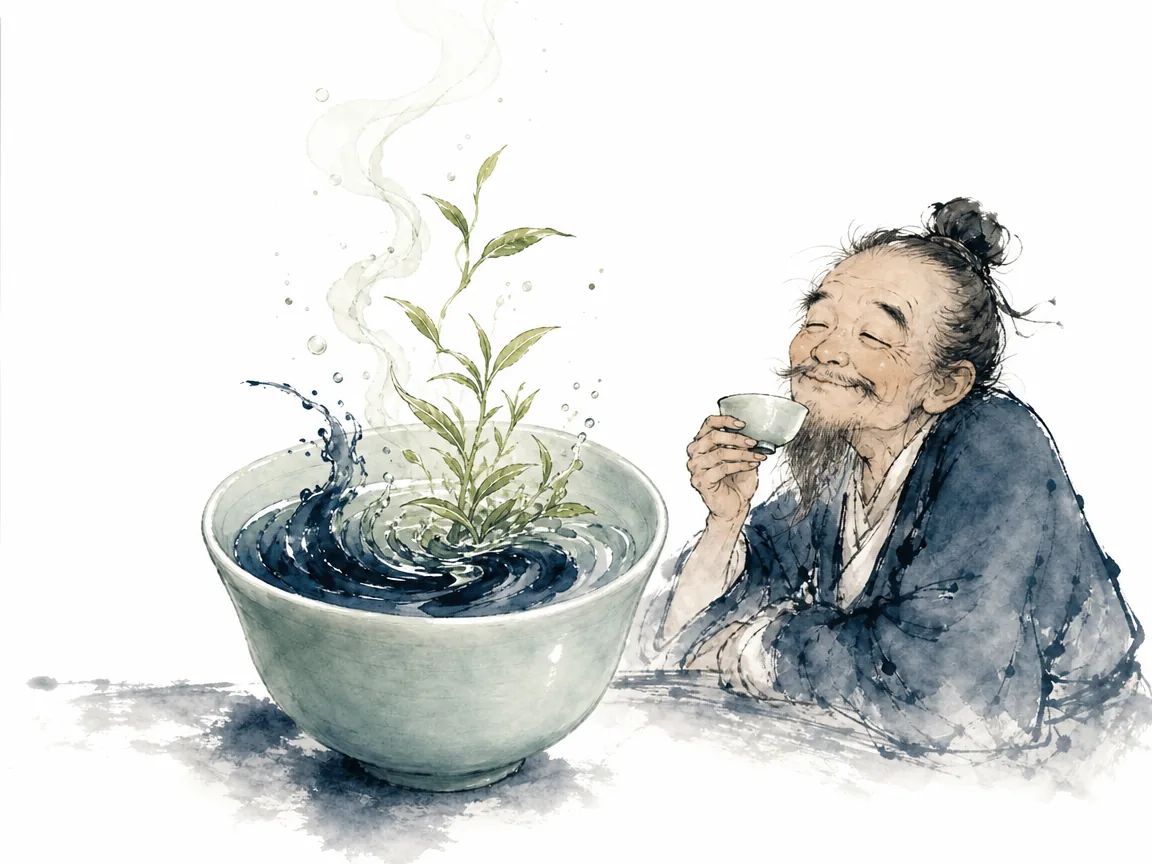
You probably know what impatience feels like. It is the third cup of coffee with sugar before the morning email is even answered. It is the quiet frustration of watching a problem remain unsolved while scrolling through another quick-fix tutorial. It is the assumption that if something worth having is worth pursuing, it should arrive without friction.
There is another way of thinking about struggle, one that has been quietly practiced in China for centuries. It does not ask you to embrace suffering or romanticize hardship. It asks only that you look more closely at how a cup of tea is made—and at how your own life unfolds. The ancient Chinese wisdom surrounding tea offers a different rhythm: bitterness is not a mistake to be avoided, patience is not wasted time, and sweetness that arrives later is often more enduring than anything served immediately—a foundational perspective explored in Be Like a Cup of Tea Chinese Wisdom.
A good cup of tea does not rush. Neither does a life well lived.
Be Like a Cup of Tea Chinese Wisdom: The Character for Tea Encodes a Way of Belonging
The Chinese character for tea is chá (茶). If you look at how it is constructed, it is composed of the radical for grass or plant (cǎo, 艹) at the top, the character for person (rén, 人) in the middle, and the character for tree or wood (mù, 木) below. Some teachers and writers point out that this visual structure places a human being between plant life and earth, suggesting that people belong in relationship with the natural world rather than apart from it.
In another strand of the same tradition, the character is sometimes broken down into components that add up to the number 108—traditionally regarded in Chinese culture as a symbol of longevity. People who reach the age of 108 are sometimes said to have attained “tea longevity” (chá shòu, 茶寿). Whether or not this reflects the formal etymology of the character, the story itself carries meaning. It treats tea not as a mere commodity but as something that holds a cultural memory about how human life connects to nature, time, and endurance.
This kind of symbolic reading of Chinese characters is common across East Asian literary and philosophical traditions. The point is not necessarily that the character was invented to encode a philosophical proposition. It is that over centuries, people noticed patterns, formed interpretations, and found those interpretations useful for thinking about how to live. Language itself can become a vessel for wisdom when a community keeps returning to it.
The Life of a Tea Leaf as a Metaphor for Human Experience
A raw tea leaf does not taste like the liquor in your cup. Before it becomes something you would want to drink slowly, it goes through a process that some would call harsh.
Scientific research on tea processing provides a measured account of what happens during this transformation. Studies of green tea manufacturing, such as research on the Enshi Yulu variety, show that key processing steps—fixation through high heat, rolling, shaping, and drying—produce significant, measurable changes in the chemical compounds that contribute to bitterness, astringency, and mellowness. The initial high-heat fixation reduces the sharp green notes. Rolling then concentrates certain compounds and can intensify bitterness and astringency. Controlled shaping and subsequent drying reduce those harsh qualities again, allowing umami and rounded mellowness to become more prominent in the final product.
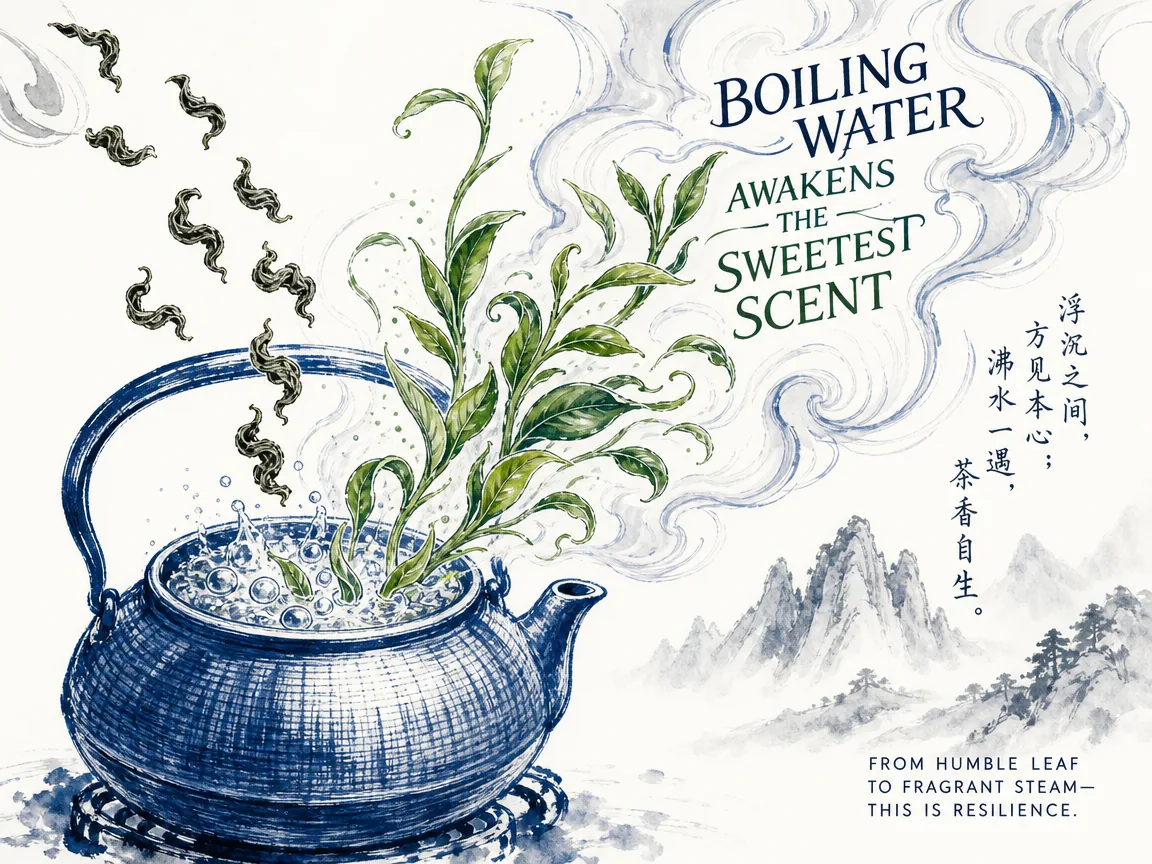
In plain terms: the leaf must be pressed, heated, and reshaped before it reaches its final form. If you picked a fresh leaf straight from the bush and brewed it immediately, it would taste very different—and most people would find it less pleasant. The processing is not a punishment inflicted on the leaf. It is the process by which the leaf becomes itself.
This observation has served as a powerful metaphor in Chinese literary and philosophical culture. The boiling water that awakens the leaf can be read as a figure for the pressures that awaken character. Not every pressure produces depth—but without pressure, there is no release. A person who has never been challenged rarely discovers what they are capable of holding.
This view echoes a Daoist understanding of transformation, often expressed through the concept of transformation (huà, 化). Adversity is not always an interruption of the good life. Sometimes it is the very condition through which a good life becomes possible.
Three Philosophical Lenses on Tea
Chinese culture has long drawn tea into conversation with several major traditions. Each tradition reads the tea experience differently, and each reading offers a distinct lens through which modern readers can understand their own struggles.
Daoism finds in tea a model of returning to one’s original simplicity (fǎn pú guī zhēn, 返璞归真). A meal of plain tea and simple food (cū chá dàn fàn, 粗茶淡饭) is not a sign of lack. It is a deliberate choice to strip away excess and attend to what is essential. The Daoist notion of non-forcing (wú wéi, 无为) is often misunderstood as passivity, but in the context of tea it suggests something subtler: action that does not force, a patience that does not resist the natural timing of things. Tea cannot be rushed. No amount of impatience will make a leaf release its flavor faster. The practice of tea teaches a kind of non-forcing—showing up, preparing the water, and waiting.
Confucianism hears in tea a lesson from the Doctrine of the Mean (Zhōngyōng, 中庸). Tea should not be too strong nor too weak. It should not be drunk in haste nor in rigid ceremony. Balance is the aim. This principle applies beyond the teapot. In relationships, work, and personal ambition, the Confucian insight is that extremes tend to collapse under their own weight, while moderation preserves sustainability. A life lived at maximum intensity without pause is difficult to maintain. A life that leaves room for reflection and recalibration is more likely to endure. Examine this artistic principle further through the classical aesthetic philosophy of From Dust to Light: How Ancient Chinese Wisdom Teaches Us to See Beauty in Everyday Life.
Buddhist traditions in China have long associated tea with meditation. The phrase “Chan and tea are of one flavor” (chán chá yí wèi, 禅茶一味) reflects a cultural understanding, developed over centuries, that the stillness required for meditation and the attentiveness required for brewing tea share the same quality of presence. Drinking tea mindfully becomes a practice in itself. The ritual of heating water, measuring leaves, pouring, and sipping draws attention to the present moment and away from the noise of past regrets and future anxieties.
These three lenses are not competing answers. They are different tools for the same question: how do I live well in a world that rarely slows down?
Writers Who Drank Through Hardship
Chinese literary history is filled with poets and thinkers who turned to tea during difficult periods. The tradition of drinking through hardship is not a metaphor they invented—it is a pattern that appears repeatedly across centuries.
One of the best-known figures is Lu Yu (陆羽), who lived during the Tang Dynasty and authored what is considered the first systematic work on tea, The Classic of Tea (Chá Jīng, 《茶经》). His famous opening line, “Tea is a fine tree of the south” (茶者,南方之嘉木也), established a tone of reverence that has shaped Chinese tea culture ever since. Biographers note that Lu Yu experienced personal hardship in his early years and dedicated his life to understanding tea, turning difficulty into devotion rather than resentment.
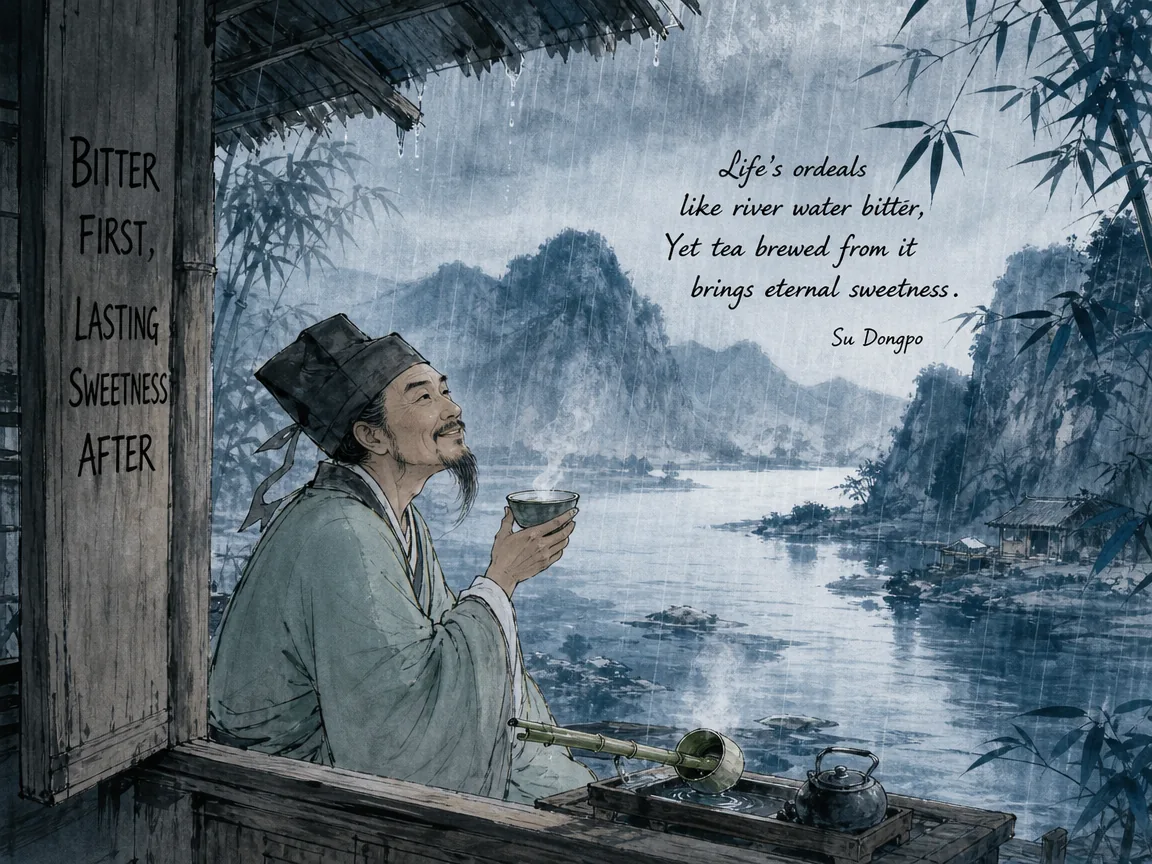
Another important voice is the poet Lu Tong (卢仝), also from the Tang Dynasty. His well-known poem, Writing in Thanks to Imperial Censor Meng for His Gift of Fresh Tea (《走笔谢孟谏议寄新茶》), contains the famous “Seven Bowls of Tea” passage, which traces a spiritual and physical journey from the first bowl, which moistens the lips and throat, to the seventh, which apparently makes the drinker feel as though a gentle wind is rising beneath their arms, carrying them toward transcendence. Whether read literally or figuratively, the poem maps a trajectory from bodily sensation to inner expansion—a map that many readers have found useful when navigating their own transitions.
Su Shi (苏轼), one of the most celebrated figures in Chinese literary history, wrote under difficult political circumstances. His line “Fine tea has always been like a beautiful woman” (从来佳茗似佳人) appears in the poem Matching Cao Fu’s Rhymes: A New Tea from Heyuan, Freshly Roasted (《次韵曹辅寄壑源试焙新茶》) and suggests that tea can serve as a steady presence when other relationships grow uncertain. Su Shi experienced repeated demotions throughout his career, and his writing about tea often carries the weight of someone who learned to find comfort in simple, reliable things.
The point of citing these figures is not to suggest that drinking tea solves political exile or personal tragedy. It is to show that generations of thoughtful people have used tea as a companion during hard times—not as an escape, but as a practice that helped them stay present, reflective, and grounded.
What the Ancient Wisdom Says to the Modern Reader
Modern life rewards speed. It is designed to make everything feel urgent: instant messaging, fast food, same-day delivery, five-minute summaries of complex books. There is nothing inherently wrong with efficiency. But when speed becomes the default assumption about every meaningful thing, people tend to lose their capacity to endure the necessary stages of growth.
Tea culture offers a corrective without rejecting modernity entirely. It does not ask you to abandon technology, productivity, or ambition. It asks you to remember that some of the most valuable things in life—character, understanding, resilience, wisdom—cannot be manufactured quickly. They require time, heat, pressure, and stillness in proportions that no shortcut can replicate.
The concept of a returning sweetness (huí gān, 回甘)—the sweet aftertaste that follows bitterness—is central to this way of thinking. Sweetness in tea is not something added during processing. It is something that emerges after the bitter and astringent phases have passed. The aftertaste is earned, not supplied. This distinction matters. A life built on externally provided rewards—likes, purchases, status symbols—tends to require constant replenishment. A life that cultivates internal sweetness, developed through challenge and reflection, becomes more self-sustaining.
This is not a call to romanticize suffering. Hardship is not inherently valuable. Abuse, neglect, and trauma do not produce wisdom simply by existing. But ordinary difficulties—the stress of a demanding job, the frustration of a stalled project, the ache of a long-distance relationship—are part of the human condition. The tea metaphor invites readers to ask a different question: not "how can I avoid this?" but "what can this reveal about me, and what can it help me become?"
The practical implication is simple but not easy. When pressure arrives, do not immediately reach for the nearest distraction or quick fix. Sit with the discomfort for a moment. Ask what it is trying to shape. Many people discover, often surprisingly, that the struggles they expected to break them were the very processes that refined them.
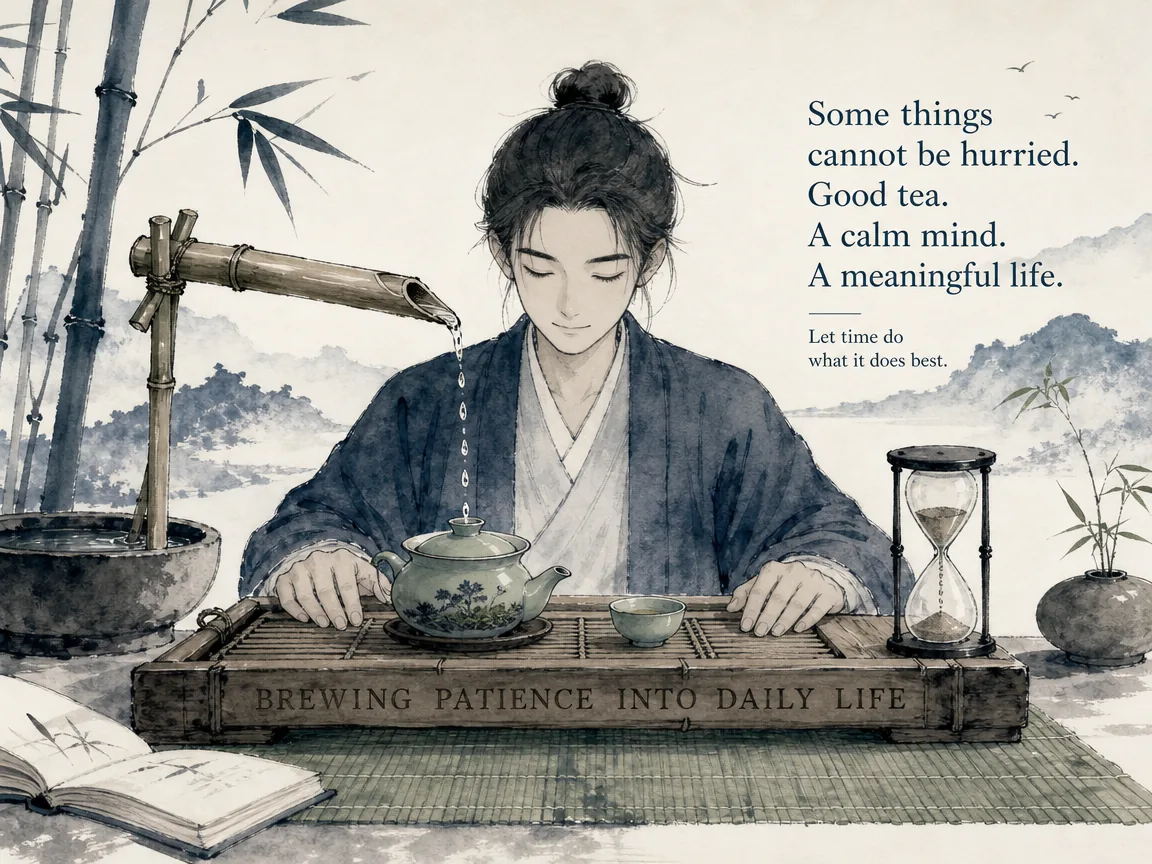
Practice: Brewing Patience Into Daily Life
Applying the tea metaphor does not require adopting a new religion or purchasing expensive equipment. It requires one shift in perspective: treating pressure as part of a process rather than an obstacle to it. Here are three small practices that embody that shift.
First, slow the first sip. When you make tea—or even when you brew coffee—resist the impulse to drink immediately. Wait two or three minutes. Notice the temperature, the aroma, the color. This small delay trains the nervous system to tolerate a brief pause between stimulus and response. In moments of stress, that pause is where choice lives.
Second, name the bitterness. When something difficult arises—a criticism, a rejection, a failure—do not rush to reframe it as "everything happens for a reason" or to distract yourself with busyness. Acknowledge the bitter phase honestly. Write it down. Name it. Most people skip this step, and skipping it is what makes pressure feel chaotic rather than formative.
Third, track the aftertaste. At the end of each week, spend five minutes reflecting on something challenging that occurred and what emerged from it. This does not mean forcing gratitude onto pain. It means looking for evidence that the difficulty revealed something about your capacity, your priorities, or your boundaries. Over time, this practice builds a personal record of returning sweetness (huí gān, 回甘)—proof that pressure has, in fact, produced substance.
Frequently Asked Questions
Is the tea metaphor just a poetic way of avoiding real problems? No. The metaphor is a lens, not a solution. It does not replace practical action—seeking medical help, changing a toxic job, ending a harmful relationship. It reframes what to do when no immediate escape exists. When the pressure cannot be removed instantly, the tea model asks what can be cultivated inside it.
Do I need to drink tea to benefit from this perspective? No. The principle applies to any activity that requires patience and transformation—learning a skill, healing from loss, building a career, raising children. Tea is used here because it carries centuries of cultural reflection on exactly these themes, making it a concentrated example rather than a requirement.
What if I have been through trauma and bitterness has not led to sweetness? That is an important and honest question. Trauma is not ordinary difficulty, and the tea metaphor was never intended to minimize its impact. The concept of returning sweetness (huí gān, 回甘) describes a pattern observed in many people's experiences of manageable challenge, not a universal law that guarantees positive outcomes from every hardship. If you have experienced severe trauma, professional support is often more helpful than philosophical reframing.
Can this approach coexist with ambition and drive? Yes. The tea tradition is not anti-achievement. It is anti-rush. Many of the historical figures who wrote about tea were deeply ambitious—Lu Yu devoted his life to mastering a subject, Su Shi held important governmental posts, Lu Tong sought spiritual elevation. The distinction is between striving with patience and striving with desperation. One builds endurance; the other burns it out.
Conclusion
A good cup of tea does not apologize for its bitterness. It does not pretend the processing was easy. It simply completes the process and offers what it can offer—depth, complexity, and a sweetness that could not have arrived any other way.
The ancient Chinese wisdom surrounding tea does not promise that life will be easier if you follow it. It promises something more useful: that life will be more meaningful if you understand the role that pressure plays in shaping it. The boiling water is not your enemy. The waiting is not wasted. The bitterness is not a sign that something has gone wrong.
When the next wave of modern pressure arrives—the deadline, the disappointment, the uncertainty—consider this question: what is this pressure revealing about what I am made of? You may not have the answer immediately. But if you keep brewing, the answer will come in its own time, reflecting the enduring wisdom of Be Like a Cup of Tea Chinese Wisdom.
Examine this artistic principle further through the classical aesthetic philosophy of Can Ancient Chinese Life Aesthetics Teach Us How to Live Beautifully Today?.
Deepen your understanding of these principles in our reflection on Why Chinese Painting Let Go of “Accuracy” — A Daoist Perspective.
Sources & Further Reading
[1] Food Chemistry — “Formation mechanisms of bitterness and astringency during Enshi Yulu green-tea processing” (《基于代谢组学与感官组学的恩施玉露绿茶加工过程中苦味与涩味形成机制分析》)
[2] Lu Tong’s “Seven Bowls of Tea” (Qī Wǎn Chá, 《七碗茶》), with original text, translation, and commentary
[3] Su Shi’s *Matching Cao Fu’s Rhymes — A New Tea from Heyuan, Freshly Roasted* (《次韵曹辅寄壑源试焙新茶》), with original text, translation, and commentary
Further Reading
- The Classic of Tea (Chá Jīng, 《茶经》) by Lu Yu (陆羽) — a foundational text on Chinese tea culture and theory
- Lu Tong’s Writing in Thanks to Imperial Censor Meng for His Gift of Fresh Tea (《走笔谢孟谏议寄新茶》) — Tang Dynasty verse containing the “Seven Bowls of Tea” passage
- Su Shi’s Matching Cao Fu’s Rhymes: A New Tea from Heyuan, Freshly Roasted (《次韵曹辅寄壑源试焙新茶》) — a Song Dynasty reflection on tea
- Research on sensory and metabolic changes during green-tea processing — current food-science literature on how processing affects taste compounds






