
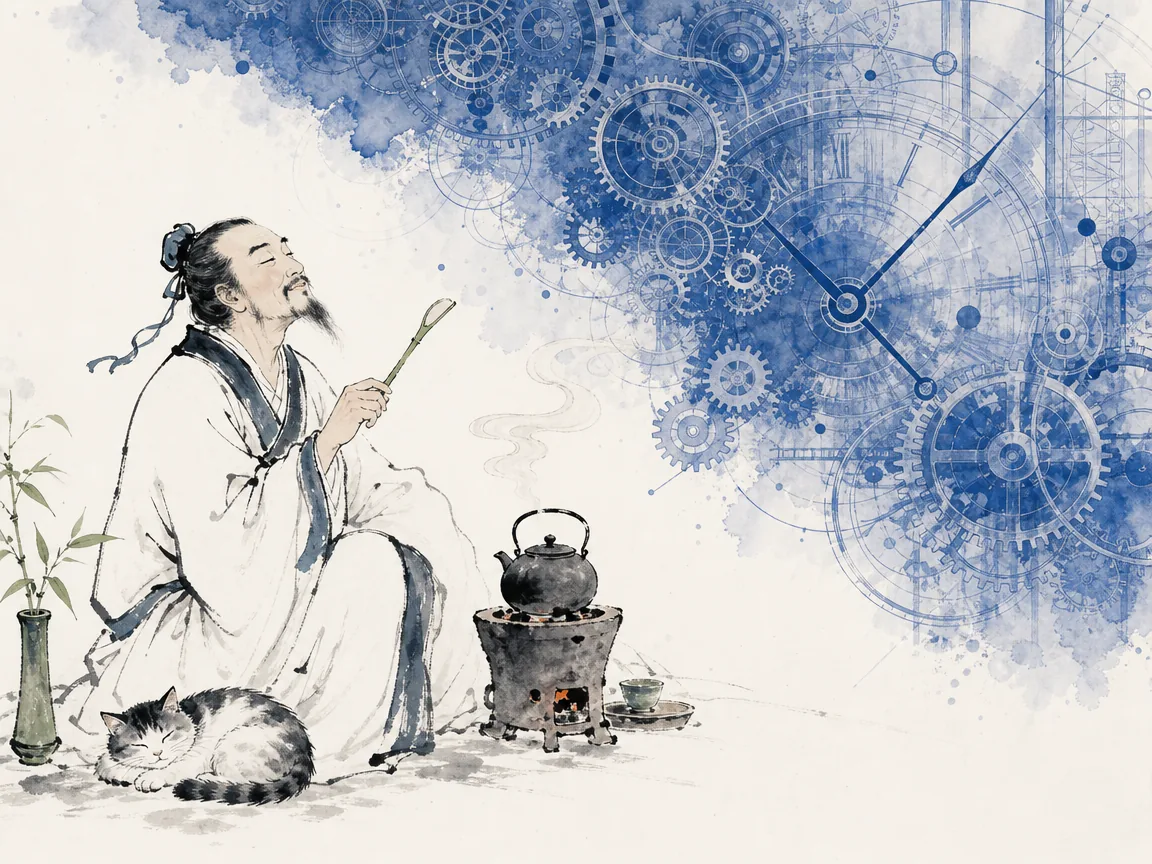
We live in an age that worships speed. Every minute not squeezed into measurable output feels like a failure. We optimise our mornings, track our steps, stack our calendars, and measure our worth in productivity metrics. And yet, for all our efficiency, we feel busier, more anxious, and more exhausted than ever. What if the answer to modern overwhelm is not doing more with less—but doing less, with more presence? What if the most important human rituals are precisely those that refuse to be efficient?
In Tang-dynasty China, a man named Lu Yu (陆羽, Lù Yǔ) understood something our culture has largely forgotten. He wrote The Classic of Tea (《茶经》, Chá Jīng), a treatise of roughly seven thousand Chinese characters that spends more time describing how to boil water than almost anything else. No wonder: he devoted his life to a practice that serves no urgent purpose, in a world that needed no further proof of human resilience—a foundational perspective explored in Human Need for Uselessness Daoism.
Human Need for Uselessness Daoism: The Orphan Who Became a Sage
Lu Yu’s beginnings were not dignified. The New Book of Tang (《新唐书》, Xīn Táng Shū) records simply: “Lu Yu, courtesy name Hongjian (鸿渐), also known as Ji (疾), courtesy name Jici (季疵), was from Jingling in Fuzhou. His parentage is unknown.” [12] Some accounts say a monk found him by a river and raised him. Whatever the details, one fact is consistent: he was abandoned, unwanted, and given a courtesy name drawn from the image of a wild goose gradually advancing onto land—almost as if fate were promising that he would eventually find his footing.
He grew up to be short, plain-looking, and prone to stuttering—traits that in another life might have condemned him to obscurity. Instead, he ran away from the monastery where he was raised, joined a travelling comedy troupe, and wrote thousands of words of wit and satire. [12] He was, by every conventional measure, failing upward. And yet this same man—physically unremarkable, socially marginalised, temperamentally intense—would become the figure China’s tea tradition reveres above all others.
His life teaches something quietly radical: a person’s worth is not determined by the convenience they offer the world. Lu Yu did not optimise himself for success. He chose a path with no obvious return on investment, and in doing so, left a mark that outlasted empires.
What Made Tea Worth Writing About
Before Lu Yu, tea in China was not always the refined infusion we associate with it today. It could be boiled with green onion, ginger, dates, orange peel, and other ingredients into something closer to a vegetable broth. The Classic of Tea dismisses poorly prepared versions of this mixture as little better than “ditch water” (沟渠之水, gōu qú zhī shuǐ). [1]
Lu Yu did not reject these methods simply because he was pretentious. He believed they turned tea into a vehicle for other flavours instead of a drink that invited attention to its own nature. His alternative—the decoction method (煎茶, jiān chá)—was painstaking: roast the tea cake, grind it into powder, watch the water reach precise stages of boiling, add only a pinch of salt, and serve immediately. He described twenty-four specialised utensils—not merely for display, but because each tool supported a process that demanded full attention.
The point was never complexity for its own sake. It was what the complexity created inside the person performing it: focus, stillness, and reverence for the present moment. Long before “mindfulness” entered the global vocabulary, Lu Yu had built a contemplative practice into the act of making tea. Examine this artistic principle further through the classical aesthetic philosophy of From Dust to Light: How Ancient Chinese Wisdom Teaches Us to See Beauty in Everyday Life.
The Four Characters That Hold Everything
At the heart of The Classic of Tea lies a four-character ideal: “refined conduct and frugal virtue” (精行俭德, jīng xíng jiǎn dé). [13] Lu Yu wrote that tea is cooling in nature and therefore especially suited to people of disciplined conduct and modest habits.
On the surface, this seems like a minor observation about a beverage. On a deeper level, it offers a philosophy of living. The ritual of tea is elaborate not because elaboration is valuable in itself, but because it makes us slow down. When you must toast the cake, grind the leaves, monitor the water, and pour at the right moment, it becomes harder to remain trapped in yesterday’s argument or tomorrow’s deadline. You are here—now—with the water, the leaves, and the fire.
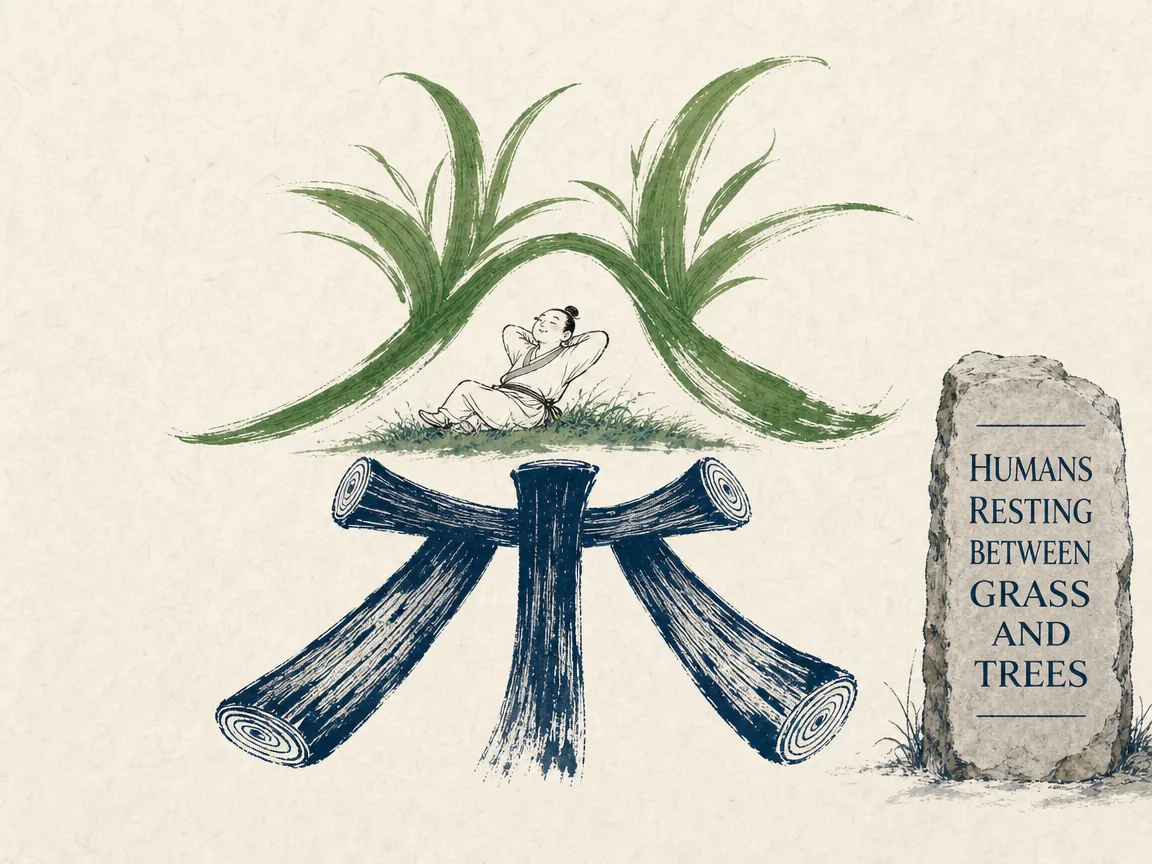
The paradox is that ceremony serves simplicity. The forty minutes spent producing a single cup are not wasted; they are the point. In a world that treats attention as a scarce resource to be sold, Lu Yu’s tea is an act of reclamation.
Tea as Sanctuary in Chaotic Times
Lu Yu lived through one of the most violent periods in Chinese history. The An Lushan Rebellion (安史之乱, Ān Shǐ zhī Luàn, 755–763 CE) devastated the Tang Empire. Cities burned. Millions were displaced or died. Scholars fled. The world Lu Yu knew was collapsing.
And yet—or perhaps precisely because of this—he sat by a fire and wrote about how to boil water.
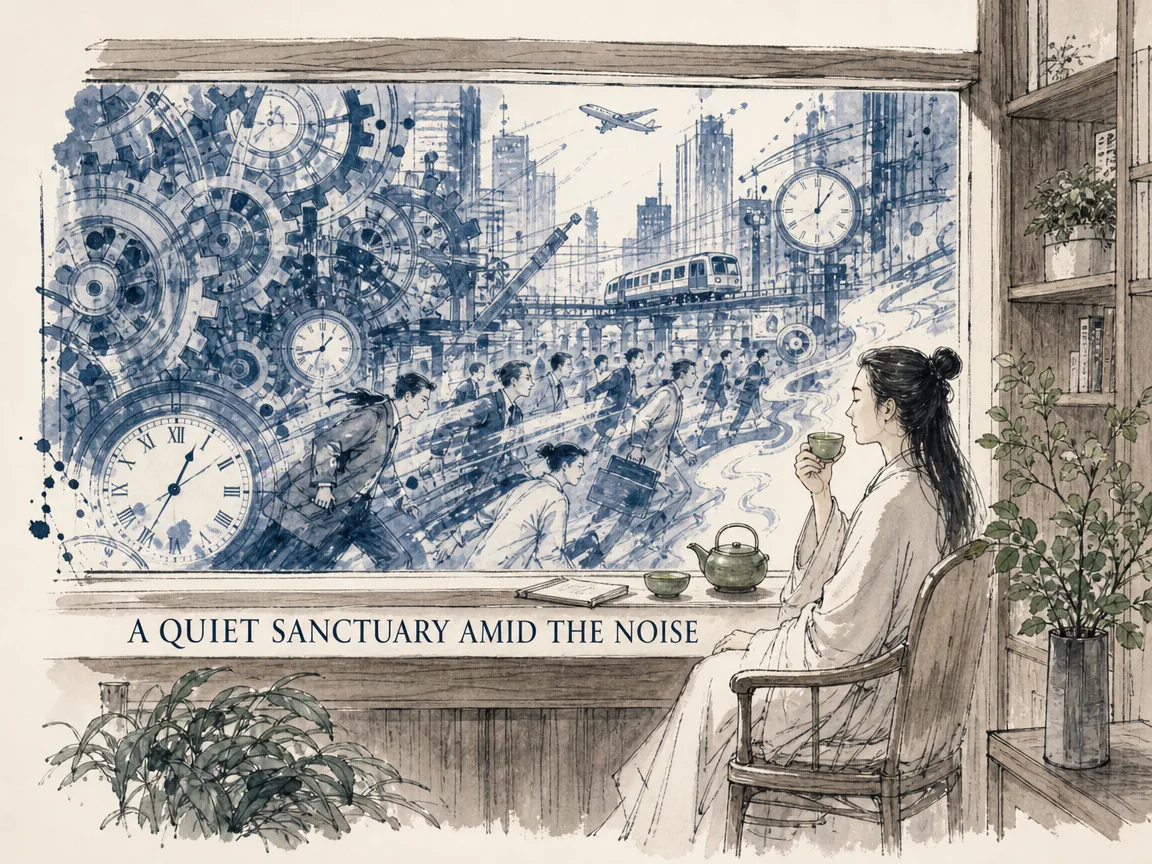
This is not escapism. It is a philosophical stance. When the larger world is beyond your control, you choose what you can govern: the temperature of your water, the quality of your attention, and the integrity of your daily practice. Read this way, The Classic of Tea becomes a manual for preserving inner order amid outer chaos. The idea resonates with both Daoist and Confucian thought, in which naturalness (自然, zìrán) and self-cultivation (修身, xiūshēn) are not luxuries but necessities.
The image is almost unbearable in its quietness: while armies march and palaces fall, a man in a borrowed robe watches steam rise from a clay pot and records what he sees. That act of attention is itself a form of courage.
Machines Need Efficiency. Humans Need the “Useless”
A famous passage in The Zhuangzi (《庄子》, Zhuāngzǐ) cuts to the heart of the matter: “People understand the usefulness of what is useful, but not the usefulness of what appears useless” (人皆知有用之用,而莫知无用之用也). [2] The idea of “the usefulness of the useless” (无用之用, wú yòng zhī yòng) describes precisely what we experience when we make tea and do nothing else.
A machine exists to produce output. A human being exists to do far more than produce output. The difference matters, because treating every moment as an efficiency problem gradually erases parts of us. Scrolling without intention, eating without tasting, and walking without looking are not neutral habits. They are small surrenders of presence.
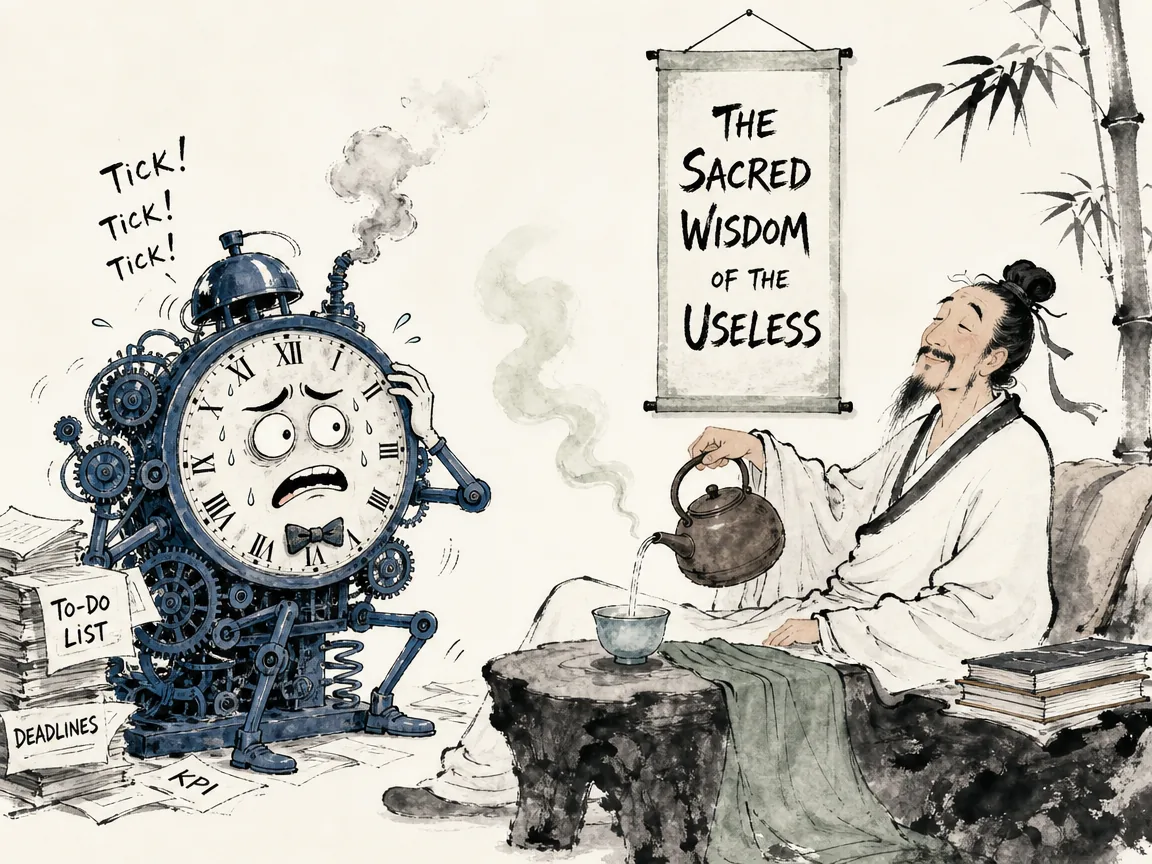
Tea refuses this logic. You cannot hurry a proper cup without losing something essential. The water must reach the right temperature. The leaves must open. The flavour must develop in its own time. In these three to five uninterrupted minutes, you are not optimising. You are simply being.
Your phone has a hundred apps designed to save you time. Your teacup has one thing that saves you: yourself.
What You Can Actually Do Today
You do not need twenty-four utensils. You do not need a trip to a mountain spring. You do not need to master Tang-style tea decoction (煎茶, jiān chá) or memorise the tea-growing regions Lu Yu described. [13] All you need is a cup, hot water, and whatever tea you have available—a tea bag, loose leaves, anything.
The ritual is simple:
- Heat the water—not to a perfect number, just enough to release what the leaves can give.
- Watch the leaves unfold. Really watch them.
- Breathe.
- Taste slowly.
That is it. Three minutes. In those three minutes, you are not an employee, a consumer, a parent, a debtor, or a member of any social category that demands performance. You are a person holding a warm cup, tasting something made from a plant that grew through soil, rain, and sunlight. That is not trivial. It is part of the foundation of a life.
When the world feels overwhelming—and it will, because it always does—make tea anyway. Not as an escape, but as an anchor, reflecting the enduring wisdom of Human Need for Uselessness Daoism.
Examine this artistic principle further through the classical aesthetic philosophy of The Teapot That Is Raised, Not Used.
For a deeper comparative examination of these ideas, explore our related study on How to Be Like a Good Cup of Tea: Ancient Chinese Wisdom for Modern Life.
Sources & Further Reading
[1] The Classic of Tea (《茶经》, Lu Yu) – Wikisource — Lu Yu's foundational treatise on tea cultivation, preparation, and aesthetic philosophy.
[2] The Zhuangzi: In the Human World (《庄子·人间世》) – Wikisource — Classical source for "the usefulness of the useless" (wú yòng zhī yòng, 无用之用).
Further Reading
- The An Lushan Rebellion (安史之乱, 755–763 CE) historical background to Lu Yu's life.
- Modern scholarship on Chinese tea culture tracing Tang decocted tea (jiān chá), Song whisked tea (diǎn chá), and Ming loose-leaf brewing.







[…] This challenges a basic assumption of modern design: that beauty is something to be delivered complete, at the moment of purchase. In the teapot's case, beauty is unfinished at the start. It is co-created across time. The object does not merely serve the user; it changes alongside the user. A clean mug is valued because it is hygienic. A patinated teapot is valued because it is alive with memory. Cultivate quiet mindfulness in everyday living through the meditative tea ritual in Why Do Machines Need Efficiency, But Humans Need “Uselessness”?. […]