
Restraint and Release in Chinese Art: The Weight of Too Much
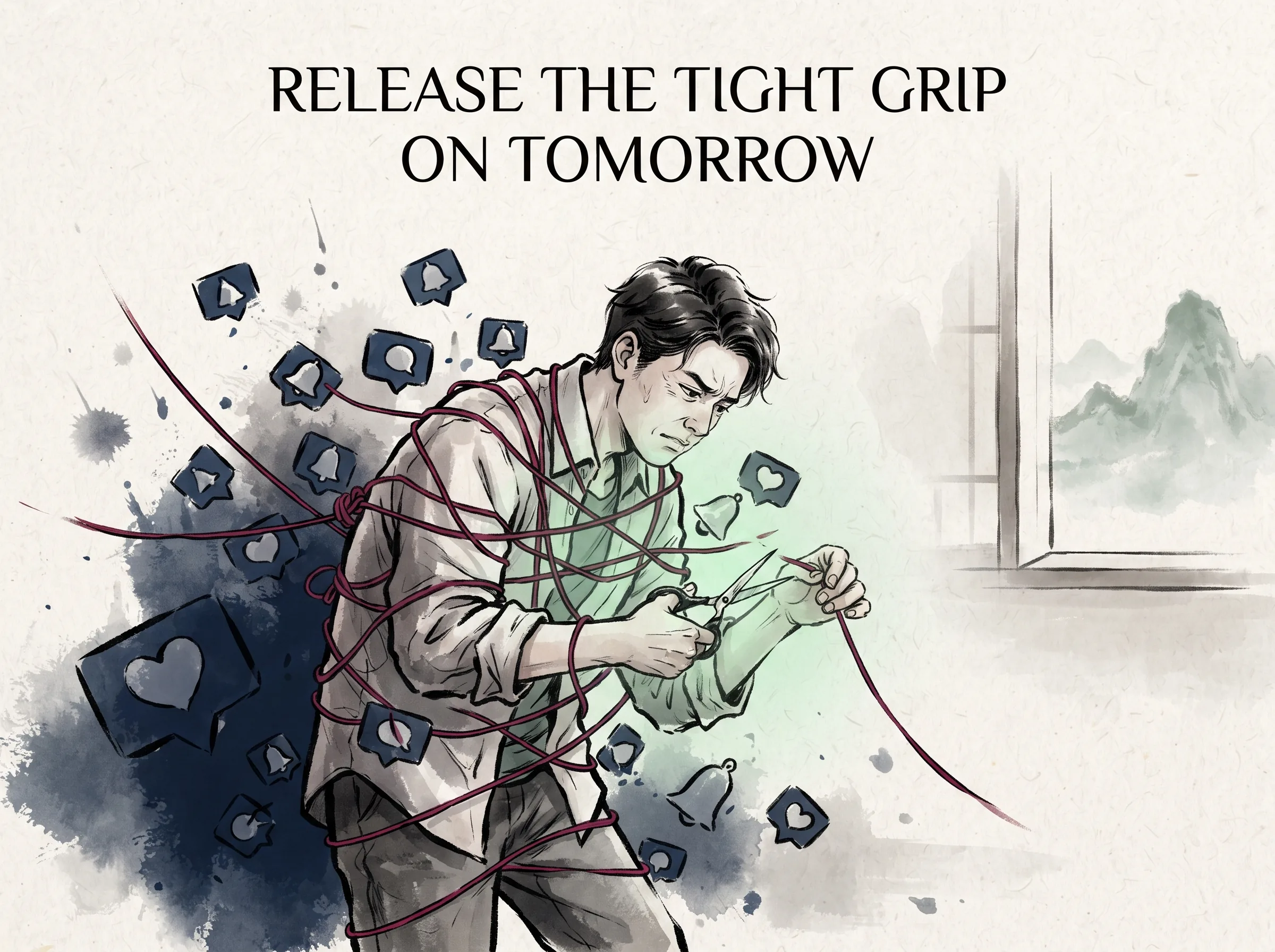
Modern life has a peculiar exhaustion. It is not always physical fatigue but something closer to spiritual crowding — the sense that every moment is occupied by expectation, every identity is a performance, and every success leaves you more bound to it than before. We pursue achievement hoping it will bring freedom, only to find the pursuit itself has become a kind of captivity.
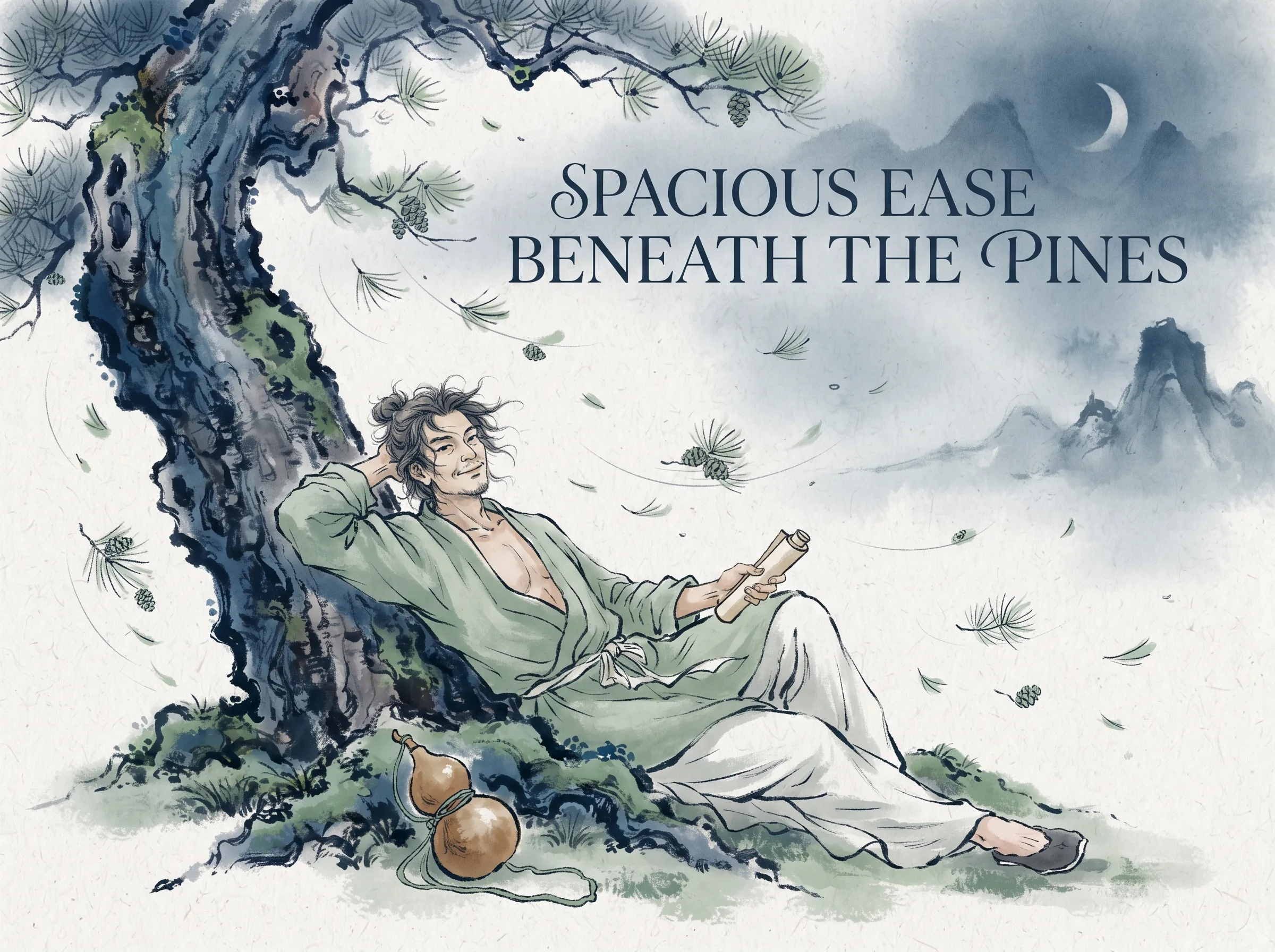
There is an old Chinese aesthetic response to this problem, though the word for it is often lost in translation. The idea of spacious ease (萧散, xiāosàn) is difficult to pin down; it can also suggest graceful detachment or an unoccupied spirit. At its core, it is the cultivated ability to move through worldly demands without letting them occupy the center of who you are. It is not withdrawal. It is not laziness dressed in the language of enlightenment. It is the discipline of keeping something inside you free, even while the world asks you to give it everything.
Chinese writers and painters understood this long before burnout became a cultural diagnosis. They developed a philosophy of leaving room — in art, in speech, in life — and applied it to the question of how to live without being consumed by the life you live. The figures below, from different corners of Chinese history, each embody a different facet of this spirit. Their stories offer not a doctrine but a temperamental compass, pointing toward a way of being that remains possible even under pressure.
What “Spacious Ease” Means
The first character (萧, xiāo) carries a sense of clarity and spaciousness — like autumn wind moving through pines, or mist thinning off a mountain. It is not barren; it is uncluttered. The second character (散, sàn) suggests looseness, freedom from clinging, and the capacity not to be trapped in one fixed shape. Together, they point toward a quality of mind that is clear rather than cold, relaxed rather than slack, anchored rather than rigid.
One thing spacious ease (萧散) is not: it is not the excuse of someone who has not tried, dressed up as wisdom. A person who has never carried weight cannot practice release; they can only pretend weight does not exist. True spaciousness requires that you have first felt the pressure — of ambition, of responsibility, of expectation — and then chosen, consciously, where to hold on and where to let go.
What it is, instead, can be glimpsed in the lives of four figures from Chinese history. Their stories do not constitute a systematic theory of spacious ease (萧散), but together they illustrate the spirit the term aims to capture.
Xie An at the Bridge of Fate
In 383 AD, the Jin dynasty faced its greatest military threat. The Former Qin army, numbering perhaps a quarter million, was marching south. The survival of the dynasty hung in the balance. Xie An, the chief strategist and civil official responsible for organizing the defense, received news of a decisive victory at the Battle of Fei River while he was still playing a game of Weiqi with a guest [1].
He read the letter, set it down on the bed, and continued playing as though nothing extraordinary had happened. When his guest asked, he replied simply, "The young men have already defeated the barbarians." Only later, when alone, did his composure break — he crossed the threshold so excitedly that he snapped the wooden teeth of his clogs without noticing [1].
The story is often told as an illustration of emotional control. But control alone does not capture it. Xie An was not numb. He felt the enormity of what had just happened — the empire had been saved — and yet he refused to perform his reaction for an audience. His spirit remained unoccupied by the very success that defined him. He could carry the weight of an empire and still sit quietly at a board game. That is closer to spacious ease (萧散) than any theory of stoicism.
Ji Kang on the Execution Ground
Decades earlier, the writer and musician Ji Kang stood on the execution ground in Luoyang, accused of subversion. Three thousand students had petitioned for him to be spared. He refused their plea. Before his death, he asked for his guqin and played one final composition [2]. When he finished, he said, "The Guangling San is lost to us now" [2].
He did not beg. He did not preach. His last act was not a political statement but an act of beauty — the preservation of a piece of music that would otherwise die with him. A man facing death chose to spend his final moments not on survival or justification but on art. That is a particular kind of freedom: the freedom to define your own relationship to the moment, regardless of what the moment demands from you.
Tao Yuanming and the Unstrung Zither
Tao Yuanming is perhaps the most recognizable name in this tradition. When a provincial inspector visited his county, his staff advised him to dress formally and greet the visitor with proper ceremony. Tao responded with a remark that has echoed through Chinese literary history: "I will not bend my waist for five bushels of rice" [3]. He removed his seal of office and wrote the "Return" essay, describing his decision to leave official life behind [3]. Examine this artistic principle further through the classical aesthetic philosophy of Why Great Skill Looks Clumsy: Laozi’s Antidote to Modern Perfectionism.
He kept a plain, unstrung zither — a guitar-like instrument with no strings and no tuning marks — and would pluck at it during gatherings with friends, saying, "I only need to understand the interest of the zither. Why should I trouble myself with sounds on strings?" [3]. The gesture is almost absurd. A zither without strings produces no music anyone else can hear. And yet Tao preferred it precisely because it did not require the appearance of music. The value was internal, not performative.
His retreat was not simple escapism. It was the recognition that certain pursuits, however prestigious, shrink the soul. The unstrung zither becomes a symbol of that recognition — beauty that does not need external proof of its existence.
Wang Wei Walking to Where the Water Ends
Wang Wei, the Tang dynasty poet and painter, wrote:
I walk to where the water ends, and sit and watch the clouds rise.
(行到水穷处,坐看云起时。)
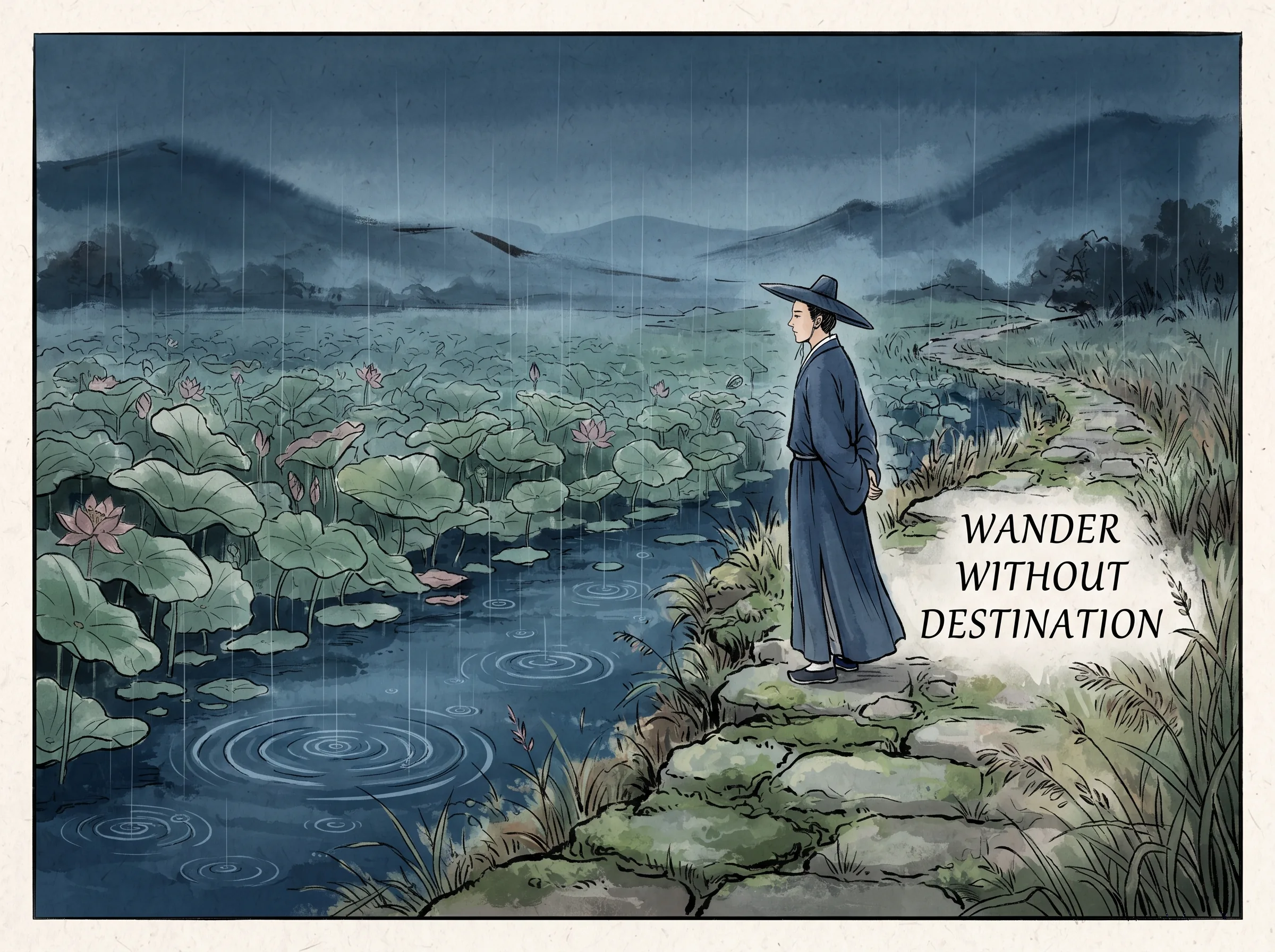
These lines come from a poem titled "Parting from My Country Residence on Zhongnan Mountain" [4]. The image is deceptively simple. A traveler follows a stream until it disappears — the path literally ends. Most people would feel trapped, turn back, or grow anxious. Wang Wei simply sits down and watches clouds form above him.
This is not passivity. It is a particular way of being present with limitation. The water does not end because something has failed; it ends because that is where the path happens to go. And from that stopping point, something new becomes visible — clouds rising, sky opening. The poem captures a spirit of spacious ease (萧散) that is neither resigned nor ambitious but quietly adaptable.
The Aesthetic of Leaving Space
These four figures share something in common, though they lived in different eras and faced different circumstances. Each of them preserved an inner margin — a space that the world could not fill, coordinate, or claim.
This principle has a name in Chinese aesthetics: leaving blank space (留白, liúbái). In Chinese landscape painting, vast areas of the canvas are left empty — not because the painter lacked skill, but because emptiness itself becomes part of the composition [5]. Mountains hover in mist. Water is suggested rather than drawn. The viewer's imagination completes what the brush does not.
The same logic applies to poetry, where suggestion is preferred to declaration, and to life itself. An existence with no interior margin becomes claustrophobic — every moment filled, every identity confirmed by others, every emotion performed for an audience. The Chinese tradition calls this condition fullness (满, mǎn), and regards it as the enemy of elegance [5].
What leaving blank space (留白) teaches is that emptiness is not absence. It is the condition that makes presence possible. A room full of furniture cannot be entered. A conversation that never pauses cannot be heard. A life without silence has no place for anything to resonate.
Why This Matters Now
The conditions that make spacious ease (萧散) relevant today are not especially new, but their intensity is. Digital platforms demand constant self-presentation. Career identity has replaced community identity as the primary source of self-worth. Busyness is worn as a badge of significance. The result is a particular form of spiritual suffocation — not from having too little, but from having too many roles to play simultaneously, none of which feel entirely chosen.
Spacious ease (萧散) offers a third option between engagement and withdrawal. You can participate fully in the world — work, relationships, ambition — without letting those participations become the totality of your identity. The question is not whether to engage but how to engage without being possessed.
How to Cultivate Spaciousness
The practice of spacious ease (萧散) is not dramatic. It does not require retirement, meditation retreats, or renunciation. It can begin with small, ordinary gestures of reclaiming interior space.
Distinguish what you choose from what chose you
Most commitments we carry were not chosen in the moment they seemed necessary. A career path, a relationship status, a social obligation — many of these accumulate through a series of small decisions that felt like the only reasonable option at the time. Pausing to ask, "Did I choose this, or did it choose me?" can reveal opportunities for intentional release. Not everything you carry needs to be carried.
Build spaces between stimulus and reaction
The Buddhist tradition speaks of the gap between stimulus and response as the space where freedom lives. Spacious ease (萧散) operates similarly. When pressure arrives — a demanding email, an unexpected criticism, a deadline that multiplies — the practiced response is not to react immediately but to notice the reaction forming and choose, consciously, how to meet it. This does not require silence or isolation. It can be as simple as taking three breaths before responding to a message that provokes urgency.
Cultivate an inner reference point
External validation is inevitable in social life. What spacious ease (萧散) suggests is that your primary evaluation system should not be external, even when you participate fully in external achievement. There is a difference between using recognition as information and using it as your entire sense of worth. An inner reference point might take many forms — private writing, contemplative practice, time in nature, or simply the discipline of asking at the end of each day whether you acted from conviction or from compulsion.
Recognize restraint as discipline, not suppression
Spacious ease (萧散) is not about suppressing desire or ambition. It is about not letting every desire have the final word. Restraint, in this sense, is a form of respect for your own wholeness. It is the understanding that some urges, if acted on immediately, will narrow your options rather than expand them. The practice is to let desire pass through without necessarily obeying it — to create distance between impulse and action.
What “Spacious Ease” Does Not Promise
It is important to be clear about what this tradition does not offer. Spacious ease (萧散) is not a remedy for clinical anxiety or depression. It is not a substitute for professional help. The figures described above lived in societies with far fewer structural pressures than modern life, but they also faced war, exile, poverty, and political danger. Their composure was not the absence of suffering but a particular way of meeting it.
Spacious ease (萧散) does not promise that life will become easier. It suggests that ease can be found in a particular quality of attention — one that refuses to let external circumstances completely determine inner space. This is not always possible, and it is not always appropriate. But when it is possible, it is a distinctive contribution to the question of how to live well.
Conclusion
Spacious ease (萧散) is not a destination you arrive at but a practice you return to, again and again. It asks a single, recurring question: Am I using this, or is it using me? The roles we play, the identities we accumulate, the achievements we pursue — none of these are inherently bad. They become problematic when they cease to be things we choose and become things that choose us.
The highest form of engagement, in this view, is one that leaves the self unbittered and unoccupied. Not empty — occupied is fine. Unoccupied means there is still room inside you for something the world has not named, for a silence that no achievement can fill, for the quiet possibility that the best part of a life may be the part that no one sees.
FAQ
Is “spacious ease” the same as stoicism or detachment?
Spacious ease (萧散) shares surface similarities with both but diverges in important ways. Stoicism emphasizes rational control of emotion and acceptance of external events. Detachment, in the ascetic sense, often implies withdrawal from worldly engagement. Spacious ease, as illustrated through these historical figures, is neither purely rational control nor withdrawal. It is a form of engagement that preserves inner spaciousness while fully participating in the world. Xie An did not suppress his emotion — he simply refused to perform it. Ji Kang did not detach from life — he chose his final act of engagement. Tao Yuanming did not escape reality — he redefined what counted as real. Wang Wei did not deny the dead end — he sat with it and watched what came next.
Can “spacious ease” be practiced by someone with significant responsibilities?
Yes. None of the figures described above lived lives of leisure. Xie An was a top minister during a crisis. Ji Kang held official position before his fall. Tao Yuanming served as a county administrator. Wang Wei was a civil servant and poet. Their spaciousness was not the luxury of the unburdened but the discipline of the occupied. Spacious ease (萧散) does not require fewer responsibilities — it requires a different relationship to them.
Why is this concept less known in the West?
Spacious ease (萧散) has not been widely translated or taught in Western contexts partly because it is not a formal doctrine but an aesthetic-temperamental ideal. It does not appear as a single term in classical philosophical treatises with systematic definitions. Rather, it emerges from literary criticism, artistic theory, and biographical accounts of individual lives. It is a quality observed in practice rather than a proposition argued in text. This makes it harder to catalog but arguably closer to lived experience.
How is “spacious ease” related to “leaving blank space”?
Leaving blank space (留白, liúbái) is the aesthetic expression of the same principle that spacious ease (萧散) describes in human conduct. Both reject fullness as the ideal. In painting, leaving blank space creates room for imagination. In life, spacious ease creates room for the self. The Chinese tradition consistently treats fullness (满, mǎn) as the enemy of depth and elegance [5]. A life without interior margin, like a painting without empty space, becomes claustrophobic — everything defined, nothing allowed to resonate, reflecting the enduring wisdom of Restraint and Release in Chinese Art.
Examine this artistic principle further through the classical aesthetic philosophy of Why We Call Ancient Chinese Art “Ugly” — And What Aesthetic Humility Can Teach Us.
Sources & Further Reading
Further Reading
- A New Account of the Tales of the World (世说新语) — Traditional source for anecdotes about Wei-Jin period figures
- Su Shi (苏轼), various essays on painting and poetry — The phrase “spacious, simple, and far-reaching” (萧散简远) is associated with Su Shi's literary criticism, though its exact textual origin requires further verification
- Zong Baihua (宗白华), The Art of the Chinese Painter — Explores leaving blank space (留白) and spatial concepts in Chinese aesthetics






