
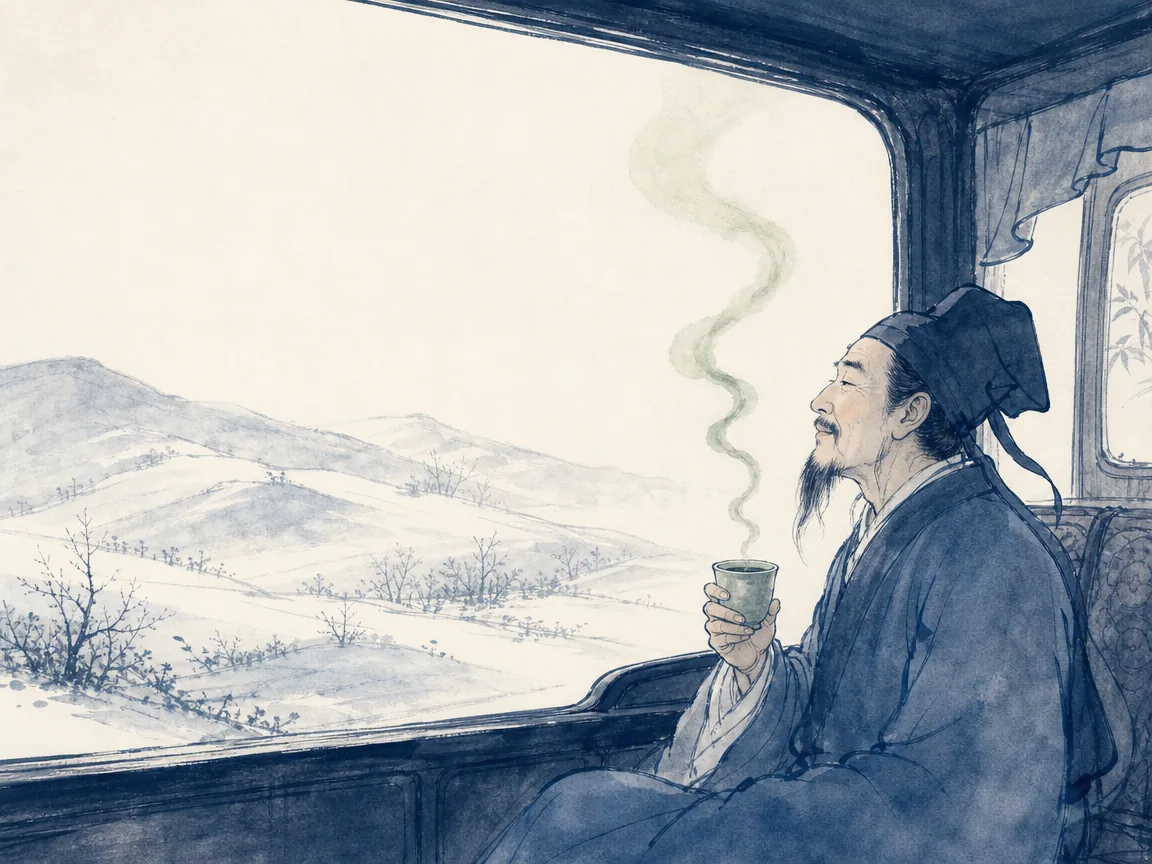
Why do two people standing before the same misty mountains walk away with entirely different experiences? One feels a quiet thrill; the other sees nothing special at all. The world has not changed. Only their inner capacity to receive it has.
This gap between observers is not a mystery reserved for art historians or philosophers. It shows up everywhere — at a museum where one visitor is moved and another checks their phone, on a train ride where one person finds the passing countryside mesmerizing and another finds it tedious. The question itself is an invitation: if the external world is identical, what explains the difference inside? This principle is central to Cultivating Aesthetic Appreciation.
Classical Chinese thinkers understood this long before contemporary psychology began studying it. They did not treat aesthetic sensitivity as a fixed gift handed out at birth. Rather, they treated it as something cultivated — built through knowledge, embodied practice, and deliberate choice. What follows is not a prescription for becoming refined, but a practical look at how ordinary seeing can become extraordinary.
Cultivating Aesthetic Appreciation: The Invisible Gap Between Two Observers
There is a well-known passage from the writer Yang Jiang describing a train journey with the historian Qian Mu. As the train slowed at each station along the route from Wuxi to Beijing, Yang Jiang looked out at bare trees and steep slopes and saw little worth noticing. Qian Mu, however, saw layers of history unfolding across the same landscape. He pointed out where battles had been fought, where armies had marched, and breathed life into places that otherwise appeared plain. To Yang Jiang, the scenery was unremarkable. To Qian Mu, it was rich with meaning
This story captures something essential about how perception works. The mountains do not argue with us. The light does not change its intensity depending on whether we appreciate it. What changes is what we bring to the encounter. Knowledge, memory, cultural literacy, and attentiveness all shape what the eye can register and what the mind can cherish.
Modern research supports this intuition in a remarkably direct way. A study involving sixty participants — forty art novices and twenty art experts — asked people to rate abstract artworks and portraits for beauty and preference [5]. The results were clear: art experts consistently rated the works higher on aesthetic dimensions such as beauty and wanting compared with novices [5]. In other words, trained perception produced a measurably richer experience. A shorter session of art-historical training given to half of the novices also produced a small but measurable shift in preference ratings [5]. The takeaway is not that experts are born different, but that expertise changes what people can feel.
Aesthetic Sense as Cultural Stamina
The Chinese essayist Li Xiaoyu has described aesthetic perception (shěnměi, 审美) not as passive taste but as cultural stamina (文化体力). This is a useful phrase because it captures something we often miss: aesthetic response is earned through accumulation, not granted through genetics.
Think of it like physical fitness. No one runs a marathon without building up to it. You start with a kilometer, then three, then ten, gradually strengthening your body until the distance that once seemed impossible becomes manageable. Aesthetic stamina works similarly. The ability to feel moved by a landscape, a poem, or a painting is not a flash of inspiration; it is the result of repeated exposure, patient observation, and growing familiarity.
What makes this framing especially useful is that it removes the gatekeeping language around "culture." When we speak of taste, we often imply that some people simply have it and others do not. That implication can feel discouraging, even exclusionary. But stamina is different. Stamina belongs to anyone willing to train. It is accumulated through time, curiosity, and attention — qualities that everyone can cultivate.
Laozi captured a related insight when he wrote about the disciplined mind. In the Daodejing, Cultivating Aesthetic Appreciation, he describes the practice of attaining deep emptiness and maintaining steadfast stillness (zhì xū jí, shǒu jìng dǔ, 致虚极,守静笃) The idea is that clear perception requires a quiet inner space. When the mind is restless, cluttered, and distracted, it cannot receive the subtle signals that beauty sends. When it is calm, it becomes capable of noticing what was always there.
Whether we call this emptying the mind or building cultural stamina, the practical implication is the same: aesthetic appreciation is a skill that improves with steady, patient practice.
Zhuangzi on Mastery Through Practice
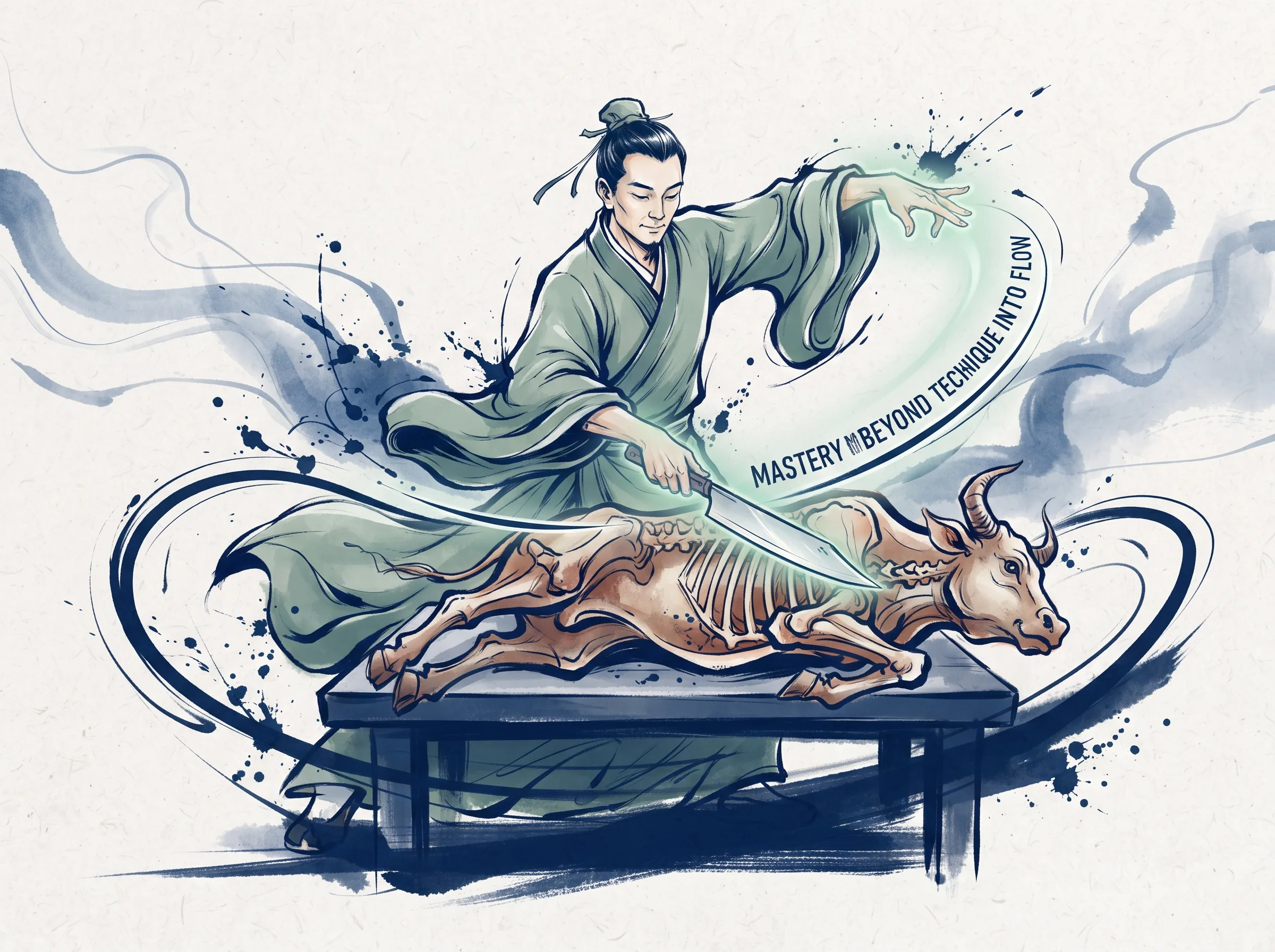
The story of the wheel-maker in Zhuangzi's "The Way of Heaven" chapter illustrates this point through narrative rather than theory [1]. A craftsman named Lun Bian explains to Duke Huan that his skill cannot be passed down through words alone. He describes years of devoted practice, of feeling the wood, of understanding the relationship between tool and material. What he knows resides in his hands and his attention, not in any treatise [1].
This is exactly how aesthetic perception works. You cannot read your way into a deeper visual experience any more than the wheel-maker could learn by listening to someone else describe the craft. Knowledge provides a map, but the territory is covered through direct, repeated engagement. The more you look, the more you notice. The more you notice, the more you feel. And the more you feel, the more the world opens up.
The art-experiment study reinforces this cycle in empirical form. Novices who received a brief introduction to stylistic and art-historical concepts showed a measurable improvement in how they rated artworks [5]. They did not become experts overnight, but the training opened a door. A single exposure to new ways of seeing can change what is visible. To explore these themes from another angle, read our related reflection on Why Do You Keep Chasing Goals That Don’t Make You Feel Free?.
Elegance as Skillful Choice
If cultural stamina is about accumulation, then elegance is about selection. The Qing dynasty writer Kuang Zhoui offered a concise formulation that remains striking: how far you go in life is determined by heaven, and nothing can be done about that; but whether you live elegantly or vulgarly is a matter of your own choice
The English word elegance carries the same insight. It derives from the Latin eligere, meaning "to choose carefully." Elegance is not abundance — it is not having the most expensive clothes, the largest house, or the loudest display. It is the disciplined act of choosing well among what is available.
Li Yu made this point vividly in his writings on daily living. He distinguished between two culinary modes: pairing (bìngyòng, 并用) and solo standing (gūxíng, 孤行) [2]. Some ingredients, like taro, have no flavor on their own and must be cooked alongside other foods to become worthwhile [2]. Others, like Chinese yam, are versatile — they can stand alone and still be delicious, or they can complement other ingredients without losing their character [2]. The same logic applies to clothing, meals, and even the way we arrange our attention.
Consider a simple example: choosing what to wear. An outfit is not beautiful because a single item is expensive or fashionable. It becomes coherent when the pieces relate to each other, to the wearer's complexion, to the occasion, and to the overall impression the person wishes to make. The young women who describe their outfit of the day on social media are practicing an everyday form of aesthetic judgment — weighing choices and seeking harmony.
Li Yu himself offered a practical rule: if your complexion looks tired and your hair appears dull, a touch of jewelry can brighten your presence. But if you have rested well and your natural glow is already strong, heavy adornment will overwhelm you instead of enhancing you The principle is not about rules; it is about attention. It asks you to look carefully at what you have and choose accordingly.
This same principle extends beyond fashion. It appears in how we pair food, how we arrange a room, how we structure a conversation, and how we decide what to pay attention to on an ordinary walk. Every act of selection is a small exercise in aesthetic intelligence.
What You Carry Inside Changes What You See Outside
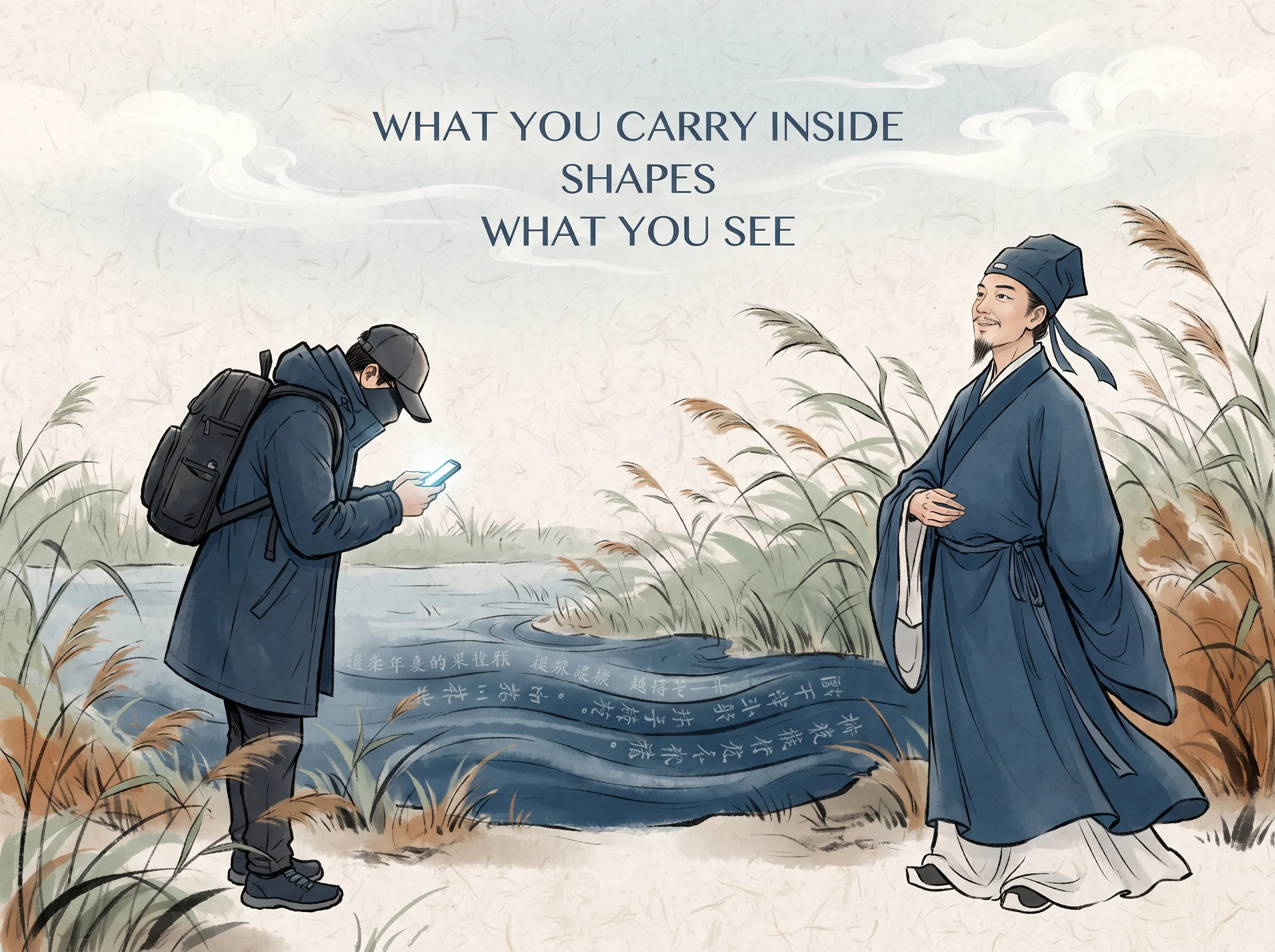
The connection between inner knowledge and outer perception is perhaps most powerful when it comes to landscape. The writer Yang Jiang recalled a trip to Tianmu Lake in Liyang, where after a rainstorm she looked out a hotel window and saw mist rolling over distant hills. Instead of seeing raw nature, she suddenly perceived the layered mountain scrolls of Huang Gongwang's Dwelling in the Fuchun Mountains overlaid on the real terrain. Her body responded differently — the excitement was sharper, the pleasure deeper — because her mind had brought something extra to the view.
Huang Gongwang spent several years between 1347 and 1350 creating that masterpiece, painting the scenery of the Fuchun region for a fellow monk named Wuyongshi [4]. The painting and the land mutually illuminate each other. Knowing something about the painting does not replace the experience of standing in front of the hills, but it enriches it. The landscape becomes a conversation between what is there and what you have absorbed.
Similarly, when the writer stood before the hills around West Lake after rain, she heard a line from the Song dynasty poet Jiang Kui: "Several peaks, cold and forlorn, deliberating on the evening rain" The poem — actually from Jiang Kui's Point Blanket Lip (点绛唇·丁未冬过吴松作) — did not invent the mountains, but it gave them a tone that plain observation had not revealed [3]. The same hills would not have carried that particular emotional weight for someone unfamiliar with the verse.
This is what the tradition calls "poetry within painting, painting within poetry" (shī zhōng yǒu huà, huà zhōng yǒu shī, 诗中有画,画中有诗) — the interplay between poetry and painting, where image and word deepen each other Wang Wei's work is often celebrated for this quality, though the phrase itself comes from the later critic Su Shi's commentary rather than from Wang Wei Whether or not we trace the exact lineage, the phenomenon is unmistakable: looking at a landscape through the lens of art, literature, or history transforms ordinary sight into something alive.
The research study supports this in its own language. Novices who received even a brief grounding in art-historical concepts rated artworks more favorably than those who did not [5]. Training expands the range of what can be felt.
Three Practices for Building Aesthetic Stamina
The preceding sections describe a capacity rather than a doctrine. Translating that capacity into daily life requires only modest, repeatable actions. Here are three practices that align with the principles above.
Practice One: Observe Deliberately
Speed is the enemy of aesthetic perception. When we move quickly through a place — scrolling through a phone, rushing to the next appointment, scanning for highlights — we train our attention to skim rather than to sink in. The antidote is to slow down enough to let the senses register more than the surface.
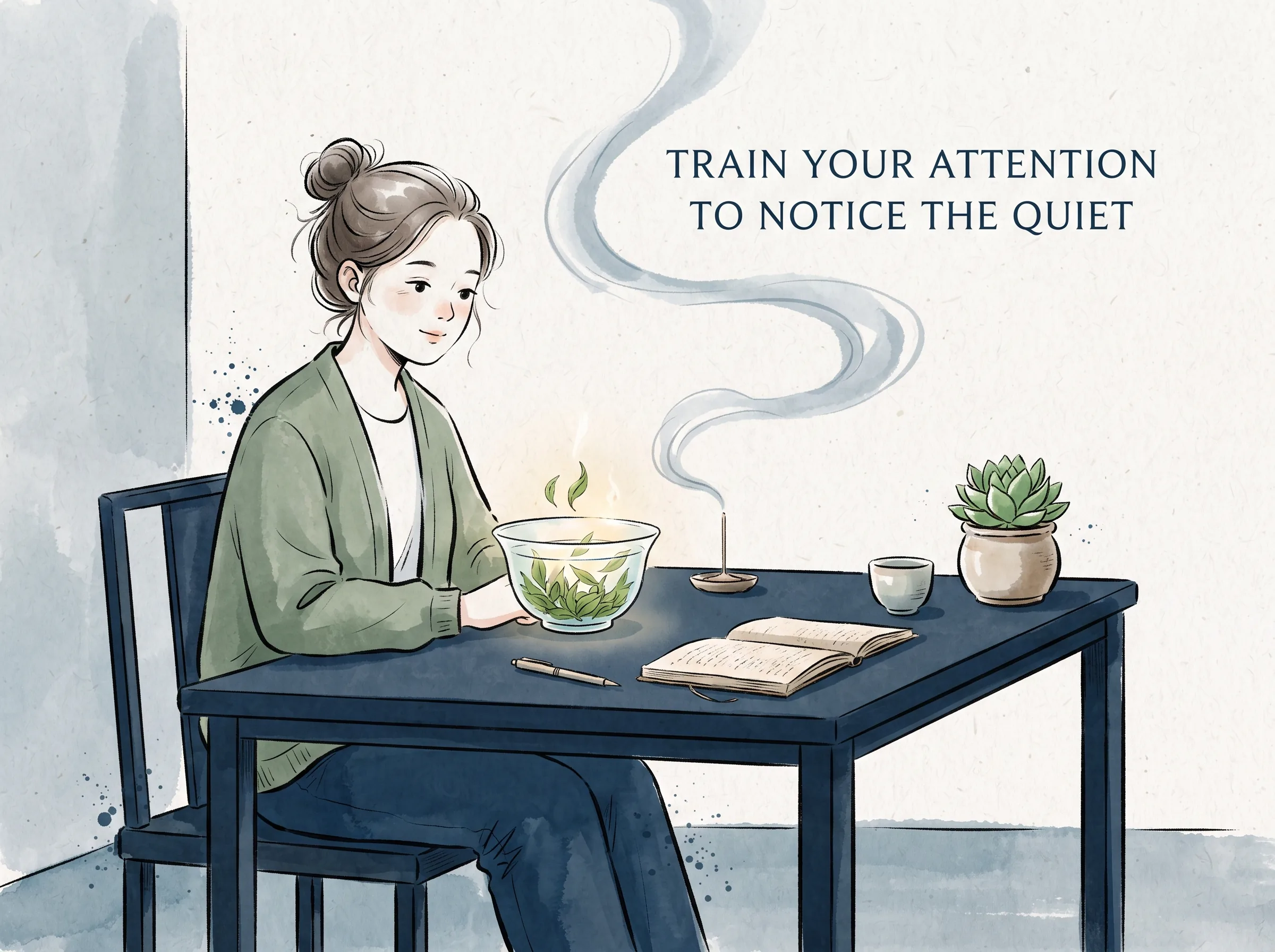
Stand still for a few minutes. Notice not only what is there but how light falls on it, how textures vary, how sounds layer on top of each other. Resist the immediate urge to label or judge. Let the scene speak before you decide whether it is beautiful. This kind of attention is precisely what Laozi described when he spoke of stillness — not emptiness as absence, but stillness as readiness
Practice Two: Build Your Inner Archive
Aesthetic stamina grows through exposure. Read poetry. Visit galleries. Study the history of art, even informally. Watch films that linger on landscape. Listen to music without multitasking. Each encounter deposits something into your inner archive — a reservoir of images, tones, rhythms, and moods that you draw upon when you encounter the world outside.
You do not need formal credentials for this. The art-study research shows that even a short session of stylistic and historical guidance can shift how people respond to visual art [5]. The goal is not accumulation for its own sake but the gradual enrichment of perception. Over time, a poem you memorized, a painting you studied, or a melody you loved will surface when you least expect it — often at the moment when an ordinary landscape suddenly reveals a depth you had previously missed.
Practice Three: Choose with Care
Elegance lives in the details of selection. Apply the principles of pairing (bìngyòng, 并用) and solo standing (gūxíng, 孤行) to everyday decisions. When dressing, ask yourself not whether a single item is striking but whether the whole look works. When preparing a meal, consider which flavors support each other and which can stand alone. When choosing a book, a film, or a route for a walk, let intention guide you rather than habit.
Li Yu's guidance about adornment illustrates the principle well: if your natural appearance is already strong, resist the urge to add more; if it is dimmed by fatigue, a small addition can restore balance The same logic applies to conversation, to workspace organization, to the books on your shelf, to the way you frame your day. Every small choice is a rehearsal for larger ones.
A final reflection is worth carrying: the goal is not to see more but to see deeper. A long life with shallow perception is less rich than a shorter one attended to fully. The finite span of our existence is compensated by the infinite depth that careful seeing can reveal.
Frequently Asked Questions
Can aesthetic appreciation really be trained, or is it mostly innate?
Research suggests both factors play a role, but training matters more than many people assume. A study of sixty participants found that art experts rated artworks higher on beauty and preference than novices, and even a brief session of art-historical training produced a measurable improvement in novices' ratings [5]. This indicates that aesthetic sensitivity is not fixed at birth; it responds to exposure and learning.
What does the Zhuangzi story of the wheel-maker have to do with seeing beauty?
The story in the "Way of Heaven" chapter illustrates that mastery cannot be transmitted through words alone — it must be developed through sustained practice [1]. The same principle applies to aesthetic perception. Reading about beauty is helpful, but the real training happens through repeated, attentive engagement with the world. Knowledge opens the door; practice walks you through it.
How do I know if I am building cultural stamina or just accumulating facts?
The difference lies in bodily response. If your encounter with a landscape, a painting, or a piece of music leaves you feeling genuinely moved — if your attention sharpens and your emotions respond — then the knowledge is being integrated into perception rather than sitting passively in your mind. Facts become stamina when they change how you experience.
Is there a risk of becoming snobbish about aesthetic taste?
The risk exists whenever any form of cultivation is mistaken for superiority. The point of building aesthetic stamina is not to look down on those who have not yet developed it but to recognize that the capacity is available to anyone willing to invest time and attention. The Chinese concept of elegance as careful choice, rather than expensive display, keeps the practice grounded and accessible.
Closing Thought
The difference between those who see beauty in ordinary landscapes and those who do not is not a difference in the eyes but a difference in what the eyes have been taught to receive. Classical Chinese wisdom — from Laozi's call to inner stillness to Zhuangzi's emphasis on practiced mastery to Li Yu's attention to skillful choice — converges on the same insight: aesthetic sense is cultivated, not inherited.
You do not need to travel far or acquire expensive credentials to begin. Start by standing still long enough to notice. Read a poem that lingers in your mind. Choose deliberately in the small decisions of your day. Over time, the world will reveal itself in shades you did not know were there.
Cultivate quiet mindfulness in everyday living through the meditative tea ritual in What a Leaf Can Teach You: Ancient Chinese Wisdom in the Art of Tea.
Deepen your understanding of these principles in our reflection on Why Chinese Aesthetics Chooses Stillness: How Daoist Simplicity Can Help Modern Readers Find Peace.
Sources & Further Reading
[1] Empirical research on aesthetic perception — A controlled study demonstrating that art experts rate artworks higher on beauty and preference than novices, and that brief training produces measurable shifts in novice ratings.
[2] Classical Chinese philosophy and aesthetics — Contains the story of the wheel-maker Lun Bian, illustrating that mastery is gained through practice rather than words. Li Yu, Xianqing Ouji — Vegetarian Food, Chapter 1 — Discusses the principles of culinary pairing (bìngyòng, 并用) and standalone preparation (gūxíng, 孤行), using taro and Chinese yam as examples. Jiang Kui, Dian Jiang Chun — Passing Wu Song in the Winter of Dingwei — Source confirming the attribution of the line "several solitary peaks stand austere, deliberating the evening rain" (shù fēng qīngkǔ, shānglüè huánghūn yǔ, 数峰清苦,商略黄昏雨) to this specific ci poem. Huang Gongwang, Dwelling in the Fuchun Mountains (Wuyongshi Scroll) — National Palace Museum entry documenting the creation of the painting between 1347 and 1350.
[3] Extended reading (not cited as direct evidence in the article) — Broader collection of Zhuangzi texts for further exploration.






