
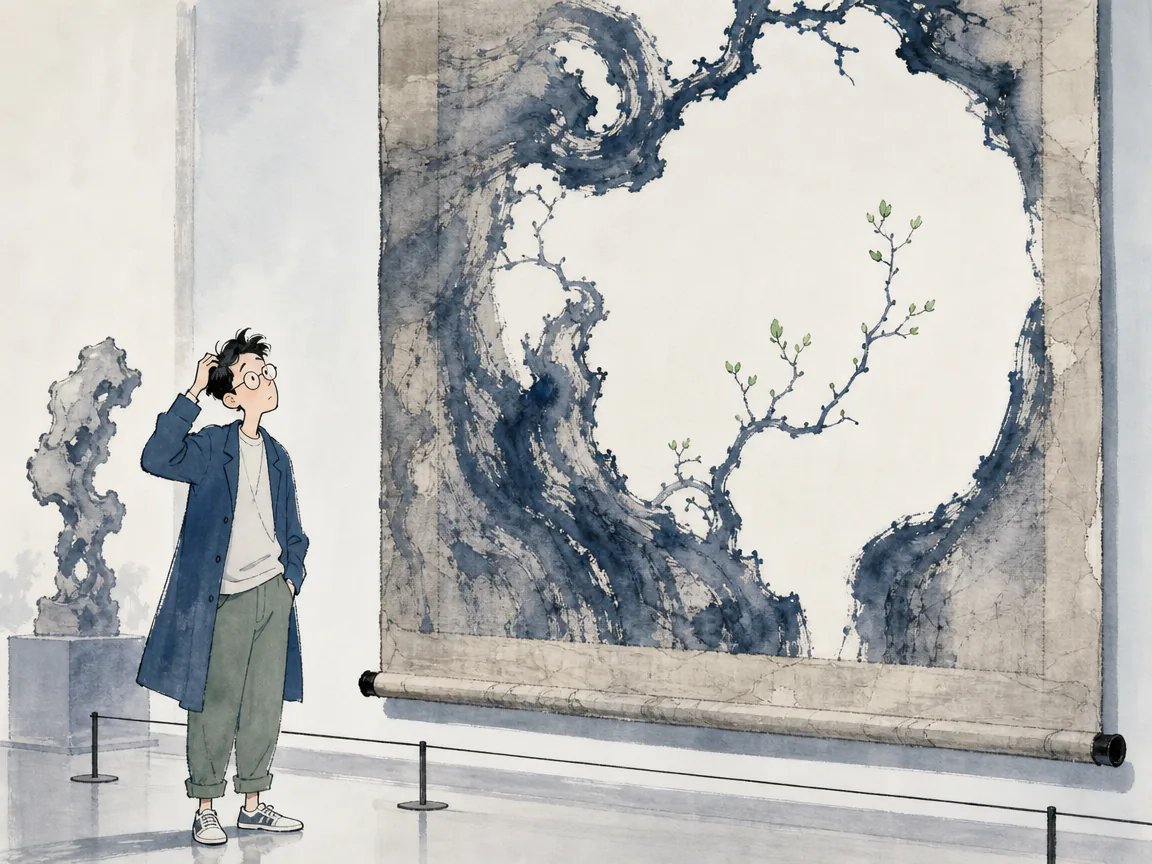
Walk into any major museum's Chinese art gallery and you'll hear a familiar murmur from visitors. Paintings that seem to flatten mountains into ghostly outlines. Calligraphy that looks like abstract squiggles rather than legible writing. Portraits where figures sit with stiff, doll-like stillness instead of naturalistic posture. Many Western visitors walk away confused, sometimes even frustrated. A common complaint surfaces: this doesn't look realistic. Or more bluntly, why does it feel so awkward?
What if the problem isn't the art? What if it's the lens we bring to it? This principle is central to Chinese Art Aesthetics.
Chinese aesthetics operates on principles that developed over millennia inside a completely different philosophical ecosystem. To read a Song dynasty ink landscape the way we might read a Renaissance oil painting is to misunderstand what it's trying to do. This isn't about skill, primitivism, or aesthetic decline. It's about a different theory of beauty itself — one that most modern viewers simply weren't taught to see. Learning to read Chinese art on its own terms requires what we might call aesthetic humility: the willingness to suspend our inherited reflexes and discover a new grammar of seeing.
Chinese Art Aesthetics: It Is Summoned
The Tang Dynasty writer Liu Zongyuan captured this insight in a single sentence that has echoed through Chinese aesthetic thought for over a thousand years: beauty does not manifest of itself, but is illuminated by human perception (měi bù zì měi, yīn rén ér zhāng, 美不自美,因人而彰) — "Beauty does not beautify itself; it is illuminated through human perception" [2]. The world does not arrive pre-packaged with beauty. We summon it. We call it forth through the act of attention, interpretation, and feeling.
This is not a uniquely Chinese intuition. Michelangelo famously described sculpture as the act of freeing the figure already trapped inside the stone. The difference lies in emphasis. Western classical tradition often positioned beauty as something to be discovered in nature — hidden forms waiting for the artist's chisel to reveal them. The Chinese formulation goes further: beauty does not even pre-exist as a latent form. It emerges only in the meeting between object and perceiver. Without a perceiver capable of summoning it, the landscape remains merely a landscape. The rock remains merely a rock.
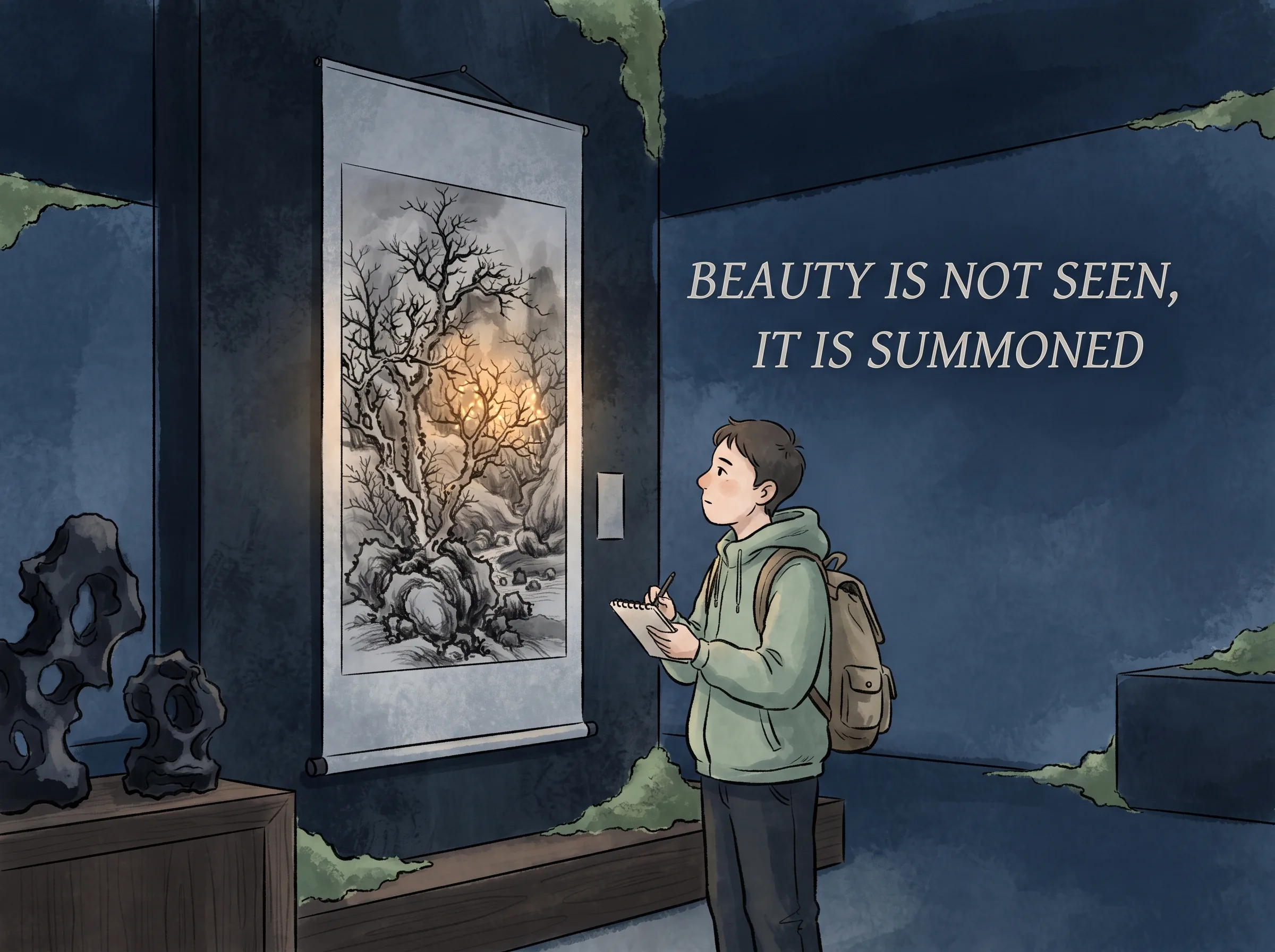
This has a practical implication for anyone standing before a Chinese masterpiece in a museum: aesthetic understanding is not a passive reception. It is an active participation. You don't simply absorb beauty — you co-create it. The brushstroke only becomes meaningful when your training, your patience, and your willingness to enter the cultural soil that grew it allow it to speak.
Three Reasons Our Aesthetic Instincts Fail Us
Beauty Varies by Person
What counts as beautiful shifts depending on who is looking and what they bring to the act of looking. This may sound obvious, yet we rarely apply it when confronted with unfamiliar art.
The Chinese character for beauty (měi, 美) is traditionally analyzed as a combination of sheep (yáng, 羊) and large (dà, 大) The reasoning behind this folk etymology is intriguing: in certain ancient pastoral contexts, a large, well-fed sheep would have represented wealth, nourishment, and visual fullness. But this meaning doesn't travel universally. A person who finds lamb unpalatable wouldn't spontaneously read beauty (měi, 美) as beautiful when seeing that character. The cultural valence embedded in the strokes is invisible without shared context.
What one culture prizes, another may disregard entirely. This isn't about superiority or deficiency. It's about cultural wiring.
Beauty Varies by Era
Every generation carries invisible criteria for what counts as beautiful, and we rarely notice them until we encounter a different era's standards.
The Venus of Willendorf, a small limestone figurine carved roughly twenty-nine thousand years ago, is one of the most famous prehistoric artifacts in the world [3]. Discovered in Austria in 1908, it depicts a female figure with exaggerated breasts, abdomen, and hips [3]. By contemporary fitness-magazine standards, this body would barely qualify as "acceptable." Yet the figure was clearly crafted with care and displayed prominence. Scholars caution that we cannot know precisely what these images meant to their makers [3]. Whatever the case, it would be a mistake to assume the people who created it were celebrating a modern notion of physical beauty. Different eras carry different logics.
In China, the character for peace and composure (ān, 安) — meaning quiet, at rest, composed — contains within its structure a picture of a woman beneath a roof. For generations, this image of stillness and domestic containment was read as an ideal of feminine beauty. Today, most Chinese women (and many men) would find that ideal deeply insufficient. Professional ambition, public presence, and physical vitality carry their own forms of beauty now. The standard hasn't disappeared; it has been supplemented and reshaped.
Even something as seemingly universal as skin tone shifts across time and place. Pale skin was long celebrated in China as a marker of privilege — the ability to avoid outdoor labor meant you belonged to a class that didn't need to work in the fields. Tanning, by contrast, signaled peasant hardship. Today, that hierarchy has inverted in many contexts: a tan can indicate leisure, vacation, and disposable income. The same bodily feature carries opposite social meanings depending on the era.
Every period judges beauty by its own hidden rules. Recognizing this is the first step toward recognizing that our rules are not universal rules.
Beauty Varies by Place
Geography shapes aesthetics just as powerfully as time shapes them. Consider the Byzantine religious paintings that fill the galleries of many European museums. To eyes trained on Renaissance naturalism, they often appear flat, unnatural, even crude. Gold backgrounds replace landscape. Figures float without perspective. Expressions are solemn rather than tender. Cultivate quiet mindfulness in everyday living through the meditative tea ritual in How to Be Like a Good Cup of Tea: Ancient Chinese Wisdom for Modern Life.
These works weren't made by artists who couldn't draw. They were made by artists working under a different theological logic. The flatness was intentional — it signaled that the scene belonged not to earthly time but to divine eternity. The gold background wasn't a failure of technique; it was a declaration of meaning. Only when viewed through that framework do these paintings begin to communicate what they were designed to communicate.
A thought experiment from cultural anthropology illustrates the principle sharply. Imagine a woman presenting freshly painted fingernails to a classroom. The students respond politely. She then places the same nails — freshly clipped, removed from the hand — on a tray and asks the same question. Suddenly, the image evokes discomfort rather than beauty. The object hasn't changed. Its context has. What is beautiful inside a living cultural body can appear grotesque outside it.
Chinese calligraphy and ink painting face a similar fate when removed from their cultural mother-body. The strokes, the spacing, the relationship between emptiness and mark — all of it grows from a soil that most Western viewers never learned to read.
What Makes Chinese Art Hard to Read — Specifically
Calligraphy as Pure Aesthetic Object
In most Western traditions, writing serves a functional purpose. A letter, a contract, a novel — the content matters, the calligraphy is invisible. Chinese calligraphy flips this relationship. The act of writing itself becomes the artwork. A poem is not merely transmitted through beautiful characters; the characters are the aesthetic experience.
When a Western viewer encounters a scroll of cursive script, the first impulse is often frustration: I can't read it. But reading was never the point of the display. The museum wall transforms a functional text into a visual field of rhythm, pressure, balance, and movement. The energy of the brush entering the paper, the variation between thick and thin strokes, the calculated use of empty space — these are the language.
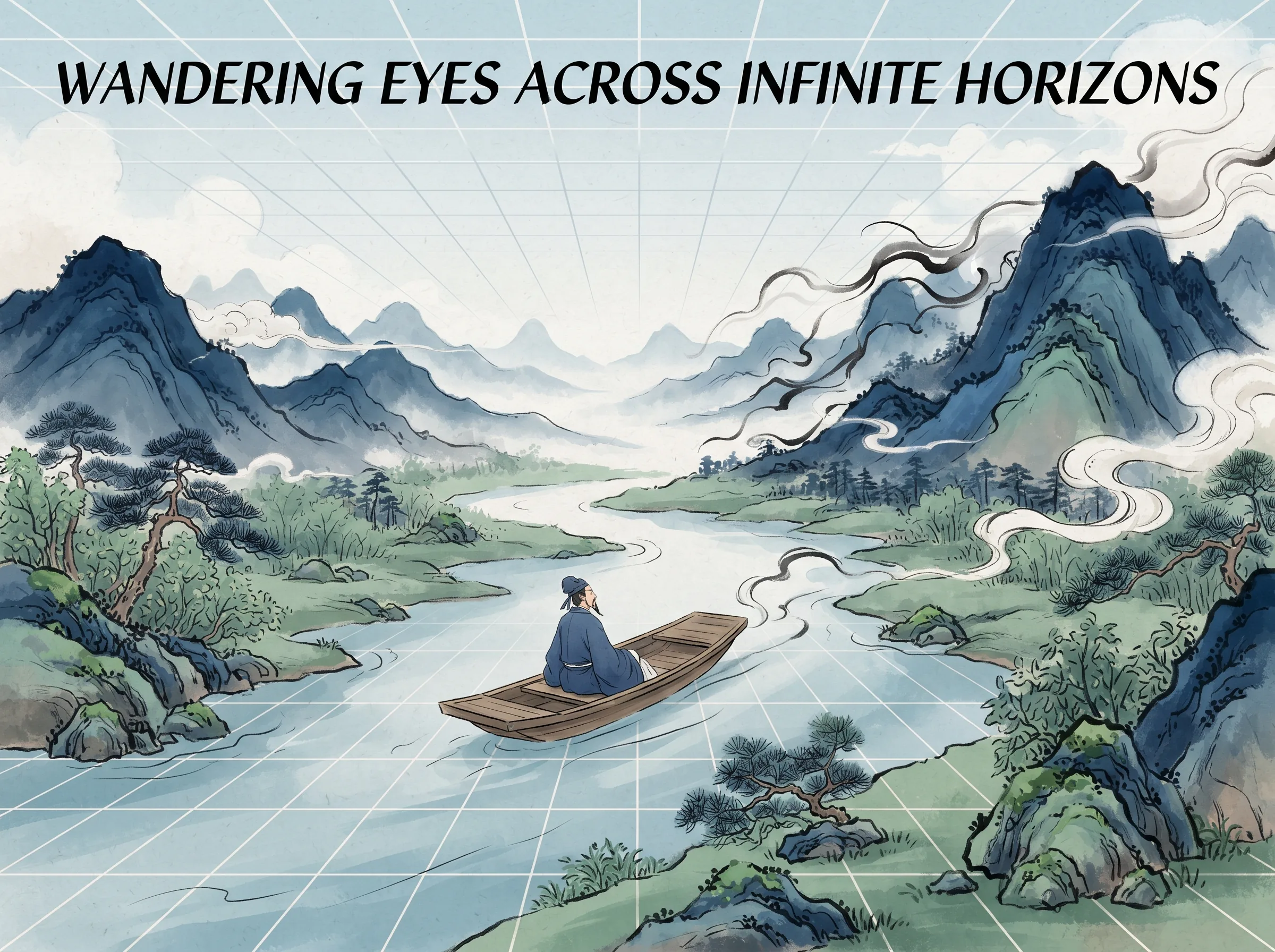
The character for composure (ān, 安) offers a microcosm of this visual-literary habit. Inside the strokes of a single Chinese character, a Western reader sees abstraction. A culturally trained eye sees a house, a figure, a mood of contained stillness. This is not a trick of the imagination. It is a centuries-old tradition of reading characters as compressed images.
Shared Brush Technique: shared origin of calligraphy and painting (shū huà tóng yuán, 书画同源)
Chinese painting and Chinese calligraphy share the same tools and the same disciplinary roots. The brush, the inkstone, the rice paper — these belong equally to the scribe and the painter. This principle, known as shared origin of calligraphy and painting (shū huà tóng yuán, 书画同源), or "calligraphy and painting share the same origin," means that the techniques of writing are the techniques of painting.
Traditional painting theory developed a vocabulary for this shared language. Brushstrokes that in calligraphy were labeled flying-white dry brushwork (fēibái, 飞白) (flying white), seal script (zhòu, 籀), and texture strokes (cūn, 皴) were applied to the depiction of natural forms. A rock might be painted with the same dry-brush technique used for a particular style of running script. A tree trunk might carry the coiled, tension-filled lines of seal script. These terms were systematized by artists and theorists across the centuries, most famously articulated by the Yuan Dynasty painter Zhao Mengfu, who argued explicitly for the unity of calligraphy and painting
Without knowing this vocabulary, the brushwork of a Chinese landscape remains visually opaque. With it, every stroke becomes legible — a record of the artist's hand moving through time, carrying the discipline of the written word into the world of the pictorial.
Expression Over Replication
It is often assumed that Chinese artists avoided realism because they couldn't achieve it. This is backwards.
By the Song Dynasty, Chinese painters had already reached extraordinary levels of naturalistic precision. Emperor Huizong's bird-and-flower paintings, with their meticulous observation of feather structure, insect anatomy, and botanical detail, demonstrate a commitment to visual accuracy that rivals anything produced in the medieval or Renaissance West The technical capacity was there. The choice was elsewhere.
Literati painters — scholar-officials who painted as an expression of cultivated identity rather than professional commission — deliberately turned away from replication. Their goal was not to copy the external world but to express the inner world. The term freehand literati sketch (xiěyì, 写意), often translated as "writing ideas" or "freehand expression," captures this orientation. The brush becomes a medium for temperament, for moral stance, for philosophical disposition. A bent pine is not a botanical record; it is an expression of resilience. Empty space on the page is not unfinished canvas; it is an invitation to contemplation.
This is not amateurism. It is a philosophical choice made after technical mastery was already achieved. The artist knew exactly how to paint a realistic bird. The artist chose not to, because realism was not the aim.
The Practice of Aesthetic Humility
Aesthetic humility is the practice of suspending your own aesthetic reflexes long enough to understand another culture's artwork on its own terms. It does not require you to like everything you encounter. It requires only that you seek understanding before passing judgment.
How do you practice it? The simplest method is to ask, before dismissing, what values this artwork is trying to express. What was important to the culture that produced it? What questions was it answering? The brushwork of a Chinese landscape only begins to speak when you understand that the landscape was never merely a landscape — it was a meditation on the relationship between humanity and the cosmos. The stiffness of a Buddhist statue only registers as emptiness when you recognize that the goal was not to depict a living body but to manifest a transcendent presence.
This practice applies far beyond Chinese art. The Byzantine icons that once puzzled museum visitors become comprehensible when placed back inside the theological framework that shaped them. African masks lose their "primitive" stigma when understood as vessels of ancestral presence rather than decorative objects. Japanese ukiyo-e prints reveal their radical compositions when read against the conventions of Edo-period woodblock printing rather than the expectations of linear perspective.
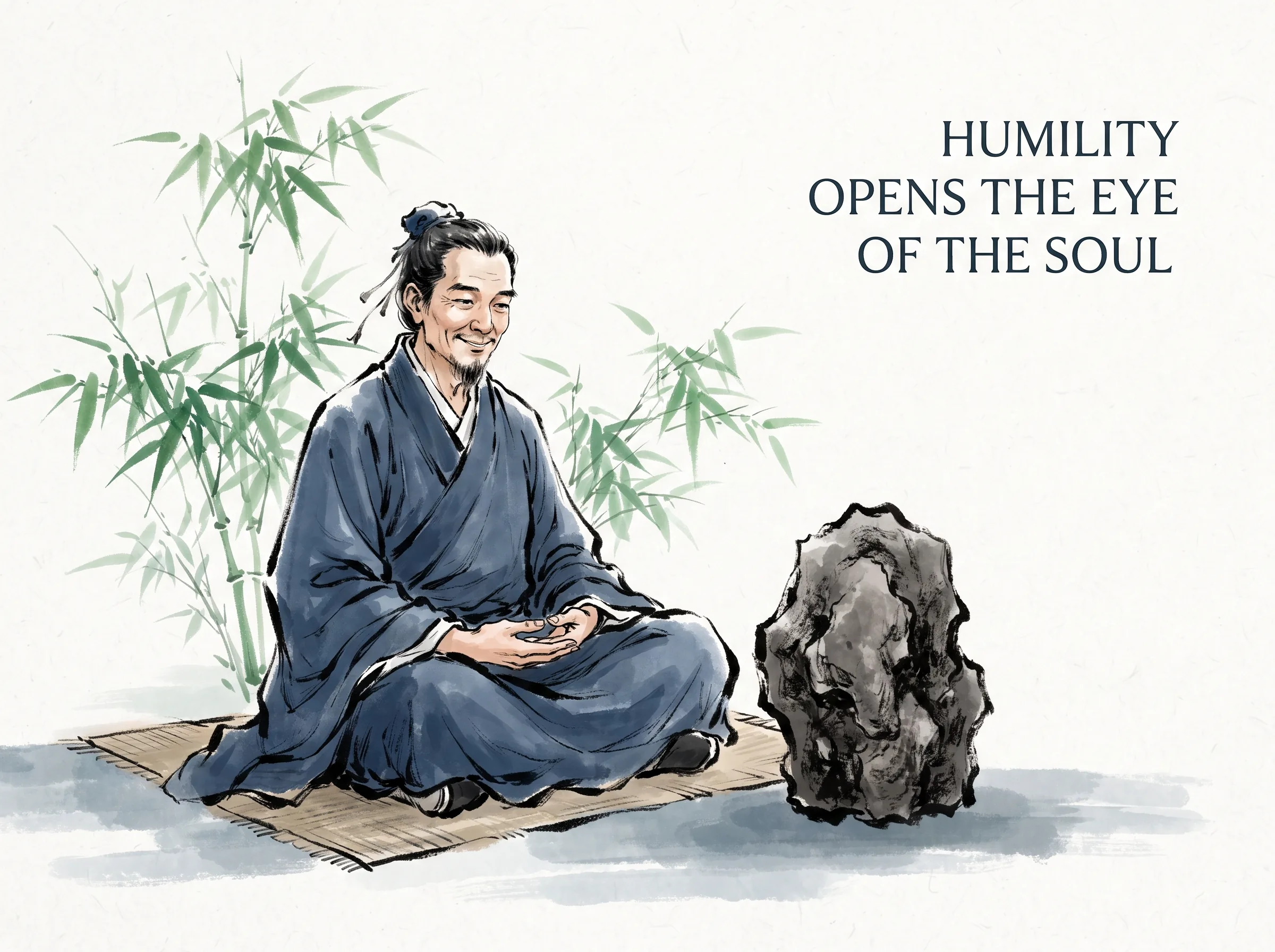
The sociologist Fei Xiaotong distilled this philosophy into sixteen characters that have become one of the most widely cited formulations of cultural coexistence in modern Chinese thought: "Each appreciates their own beauty, appreciates others' beauty, beauties blend in shared harmony, and the world arrives at grand unity" (gè měi qí měi, měi rén zhī měi, měiměi yǔ gòng, tiānxià dàtóng, each cherishes their own beauty, respects others' beauty, beauties blend in shared harmony, and the world arrives at unity (gè měi qí měi…, 各美其美…)) [4]. Each culture treasures its own beauty. Each culture learns to appreciate the beauty of others. When both movements are practiced, harmony emerges. This is not a call for relativistic indifference — it is a call for active, informed engagement across cultural difference.
Practical Takeaways for Modern Readers
If you visit a museum next week and encounter Chinese art that confuses or disappoints you, here are three concrete steps you can take:
Step one: pause before judging. The impulse to declare something ugly is immediate and powerful. Train yourself to interrupt that impulse with a single question: what is this artwork trying to express? This shifts your brain from evaluative mode to interpretive mode — and the latter is where understanding lives.
Step two: learn a few key terms. You don't need a degree in art history. But knowing what expressive sketching (xiěyì, freehand literati sketch (xiěyì, 写意)) means, what the shared origin of calligraphy and painting (shū huà tóng yuán, shared origin of calligraphy and painting (shū huà tóng yuán, 书画同源)) implies, what flying-white dry brushwork (fēibái, flying-white dry brushwork (fēibái, 飞白)) describes — these are keys, not trivia. A handful of well-learned terms unlocks an entire visual language. Treat them like vocabulary for a new dialect.
Step three: return the object to its cultural context. Before you decide whether a calligraphy scroll is beautiful, ask: what function did it serve? Who made it? For whom? What philosophical tradition shaped it? An artwork stripped of its cultural soil feels alien. Placed back inside that soil, it breathes.
The goal is not to force yourself to love every tradition you encounter. The goal is to understand before you evaluate. Judgment without comprehension is merely prejudice dressed in aesthetic language.
Frequently Asked Questions
Is Chinese art really less realistic than Western art?
No. By the Song Dynasty, Chinese painters had achieved extraordinary naturalistic precision, as seen in the meticulously observed bird-and-flower paintings associated with Emperor Huizong. What changed was not ability but intention. Literati painters chose to prioritize inner expression over external replication, making a deliberate philosophical decision rather than responding to a technical limitation.
Why do Chinese calligraphy and painting use the same brush?
Because Chinese aesthetic theory has long held that calligraphy and painting share the same origin — shū huà tóng yuán (shared origin of calligraphy and painting (shū huà tóng yuán, 书画同源), calligraphy and painting share the same source). Both practices share the same tools and techniques: brush, ink, rice paper, and disciplined hand movements. This means that the stroke quality that makes a character beautiful also makes a landscape beautiful; they are expressions of the same bodily discipline.
Can I learn to appreciate Chinese art without studying it for years?
You don't need years of study, but you do need a willingness to learn the right questions. Start with a handful of core concepts — xiěyì (freehand literati sketch (xiěyì, 写意)), shū huà tóng yuán (shared origin of calligraphy and painting (shū huà tóng yuán, 书画同源)), aesthetic humility — and practice applying them the next time you stand before a work that confuses you. Understanding precedes appreciation, but the gap between them is smaller than it feels.
Does aesthetic humility mean I have to like art I don't naturally enjoy?
Not at all. Aesthetic humility asks only that you seek to understand before you pass judgment. You can understand why a tradition values something deeply and still prefer something else entirely. The alternative — dismissing what you don't understand — closes the door before you've even opened it.
Conclusion
The uncomfortable museum visit is not a failure of the art. It is a failure of the lens. Chinese art often appears strange, stiff, or abstract to modern Western viewers because we bring a set of aesthetic expectations forged in a completely different tradition — one that prized linear perspective, anatomical accuracy, and the illusion of three-dimensional space. Chinese art, developed inside the philosophical ecosystems of Daoism and Confucianism, answers to different questions: How does the brush record the movement of qi? How does empty space become part of the composition? How does a single stroke carry moral character?
Liu Zongyuan's insight from over a thousand years ago remains urgently relevant: beauty is not an objective property waiting to be found. It is called forth by the perceiver [2]. When we approach Chinese art with aesthetic humility — the readiness to learn its grammar before pronouncing it defective — we don't just become better viewers of Chinese art. We become better viewers of all art, across all cultures.
The next time you encounter something unfamiliar in a museum, resist the easy verdict. Ask instead: what is this trying to say? The answer may change what you thought you knew about beauty itself, reflecting the enduring wisdom of Chinese Art Aesthetics.
Cultivate quiet mindfulness in everyday living through the meditative tea ritual in Stop Solving. Just Drink Tea..
Deepen your understanding of these principles in our reflection on Beyond the Surface: The Chinese Art of Cultivating Invisible Presence.
Sources & Further Reading
[1] Verified Sources
[2] [Record of the Thatched Pavilion at Matui Mountain (邕州柳中丞作馬退山茅亭記) – Wikisource (維基文庫)] — Liu Zongyuan's Tang Dynasty essay containing the phrase "beauty does not manifest of itself, but is illuminated by human perception" (měi bù zì měi, yīn rén ér zhāng, 美不自美,因人而彰)
[3] Naturhistorisches Museum Wien – Venus-Forschung — Documentation on the Venus of Willendorf, including its dating to approximately 29,500 years ago and scholarly cautions about interpreting its meaning
[4] Fei Xiaotong's Sixteen-Character Maxim (费孝通十六字箴言) – Tsinghua University History Museum — Fei Xiaotong's formulation on cultural beauty and coexistence
Further Reading
- Liu Zongyuan, Record of the Thatched Pavilion at Mount Matui (邕州柳中丞作马退山茅亭记) — primary textual source for the concept of beauty being summoned by the perceiver
- Fei Xiaotong, reflections on cultural pluralism and the path toward global harmony articulated in the sixteen-character principle
- Standard art history survey texts on Song Dynasty painting, literati aesthetics, and the development of xiěyì (freehand literati sketch (xiěyì, 写意), freehand literati expression) theory
- Comparative aesthetic studies on Byzantine iconography and the function of flatness in religious art







[…] Examine this artistic principle further through the classical aesthetic philosophy of Why We Call Ancient Chinese Art “Ugly” — And What Aesthetic Humility Can Teach Us. […]