
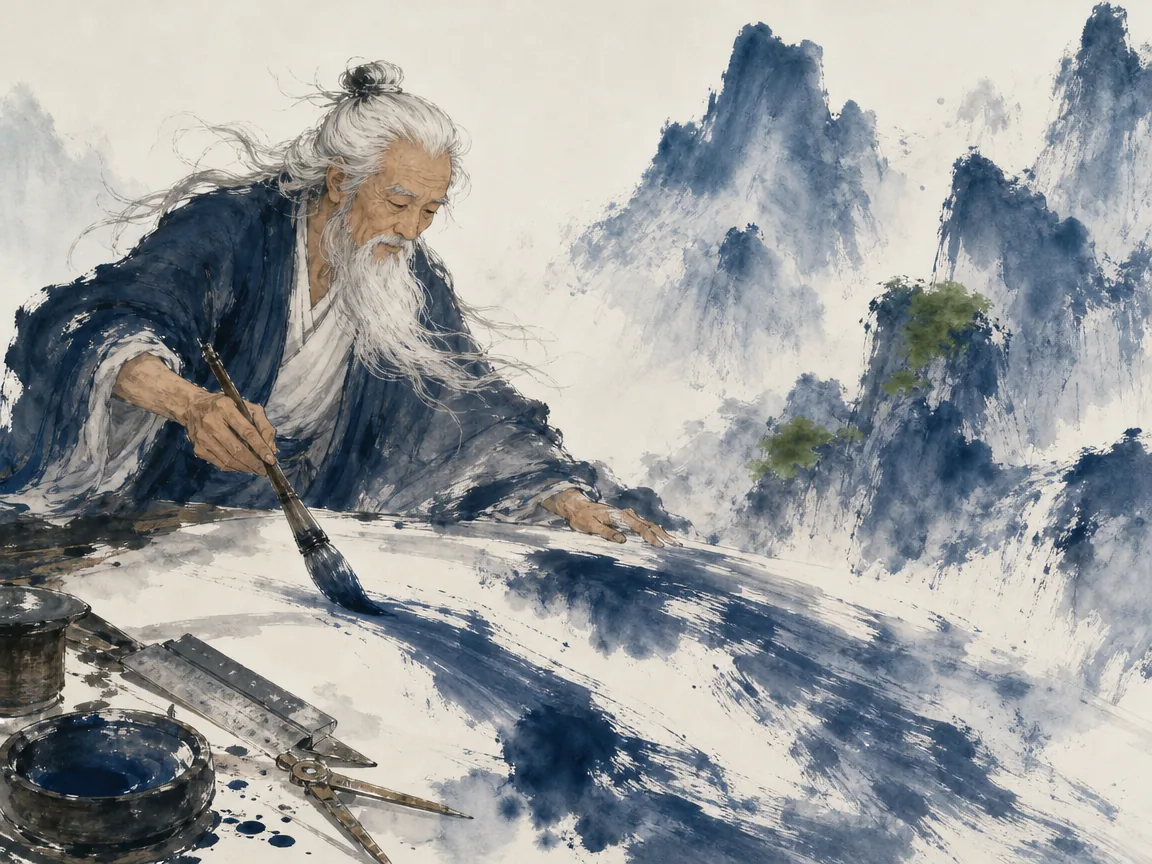
By the 15th century, a strange divergence was unfolding between two great artistic civilizations. In Europe, painters had just invented mathematical perspective — a system that could render the three-dimensional world on a flat surface with startling precision. In China, artists and scholars were explicitly arguing that realism was not the goal of painting, and that those who judged art solely by how closely it resembled its subject were missing the point entirely.
This was not a failure of technique. Chinese painters were perfectly capable of rendering the world with remarkable accuracy. The choice to move away from strict visual fidelity was philosophical — rooted in Daoist and Chan Buddhist ideas about how reality is experienced, perceived, and understood. It raises a question that feels urgently modern: What does it mean to truly "see" the world? And what might we lose — or gain — by adopting different ways of looking? This principle is central to Daoist Perspective on Chinese Painting.
In this article, we explore how ancient Chinese philosophy shaped an artistic tradition that valued spiritual resonance over geometric accuracy. We'll look at the history of perspective, the wisdom behind the Chinese approach, and what it might teach us about the narrow, fixed ways of seeing that dominate modern life.
Daoist Perspective on Chinese Painting: The Choice Between Spirit and Form
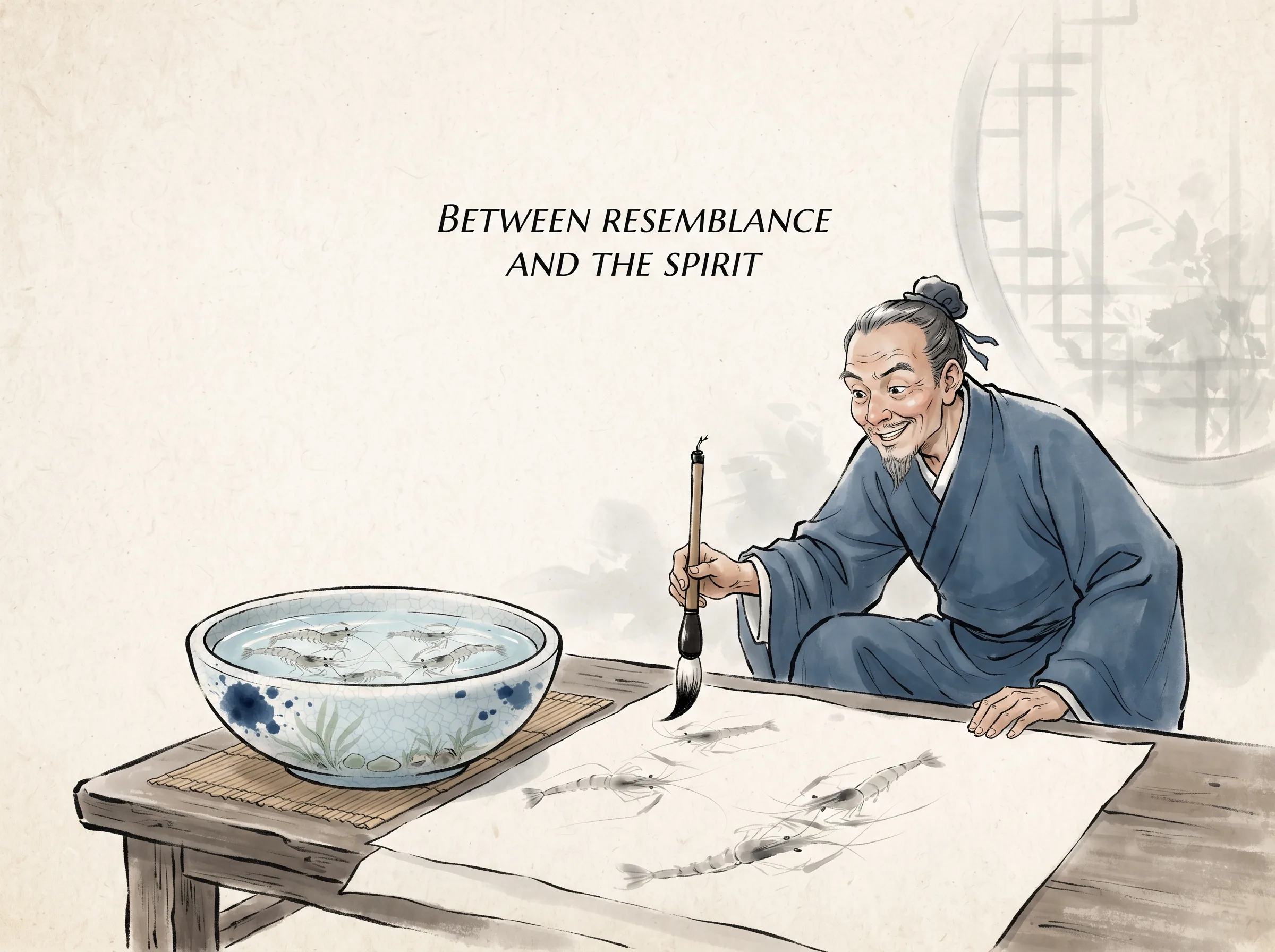
Chinese painting's decision to prioritize spiritual essence (神似,shensi) over visual exactness (形似,xingsi) was not a technical shortfall — it was a deliberate philosophical position about the nature of reality and perception. While Western art, particularly from the Renaissance onward, pursued the illusion of depth through single-point perspective, Chinese landscape painting developed a different framework entirely.
The Western pursuit of single-point perspective mirrors a worldview in which the observer occupies a fixed, authoritative position — the world is measured, framed, and rendered from one controlling vantage point. The Chinese scattered perspective, by contrast, reflects a worldview of movement, harmony, and participatory observation. The viewer is not meant to stand still and measure; the viewer is meant to enter the painting and wander through it.
Both traditions carry wisdom. But the Chinese model offers a quietly radical alternative to the modern obsession with precision, optimization, and seeing the world from one dominant angle.
The Moment China Turned Away from the Eye
During the Song and Yuan dynasties, Chinese painters deliberately moved away from mimicking visual reality. The literati — scholar-officials who painted as a form of self-cultivation rather than professional commission — championed an aesthetic that valued inner rhythm over surface accuracy.
Su Shi (苏轼,1037–1101), one of the most important literary figures in Chinese history, famously wrote: "On painting, if one judges by resemblance to form, one is but a child" (论画以形似,见与儿童邻). The implication was clear: a mature understanding of art goes beyond the mechanics of visual replication. The goal was not to copy the surface world but to express the inner vitality — the qi yun (气韵) — of the subject.
This attitude was deeply connected to Daoist thought. In the Zhuangzi, the story of "sitting and forgetting" (坐忘,zuo wang) describes a state in which the self is dissolved, the body is released, and the mind is freed from conventional categories. True perception, in this view, requires going beyond the mechanical function of the eye. The artist who clings to accuracy is trapped in a limited way of seeing; the artist who lets go may perceive something deeper.
Reader takeaway: Sometimes releasing the need to "get it right" visually opens a door to a richer, more integrative way of understanding.
Scattered Perspective as a Way of Being
One of the most striking features of Chinese landscape painting is its handling of space. Chinese paintings often incorporate "shifting perspective," which presents a point of view that moves up and down, near and far [source: Chinese Landscape Painting during the Song Dynasty | Asian Art at the Princeton University Art Museum]. These multiple viewpoints encourage the viewer's eyes to wander through the scene. We look across at the distant areas, and we look down at the paths that humans travel. Examine this artistic principle further through the classical aesthetic philosophy of Why Can’t You Buy That X Factor? The Chinese Art of Cultivating Spirit Resonance (*Qì Yùn*, spirit resonance (*qì yùn*, 气韵)).
This is fundamentally different from the fixed, single-point perspective that dominated Western art from the Renaissance onward. In a Western painting, the viewer occupies one privileged position — the world is arranged around a single vanishing point. In a Chinese scroll, the viewer's eye is invited to move. There is no command center. No single angle holds authority over all others.
The Daoist parallel is striking. The opening line of the Dao De Jing — "The Tao that can be spoken is not the eternal Tao" (道可道,非常道) — suggests that reality cannot be captured from one fixed position. Zhuangzi's essay on "the equality of things" (齐物论) similarly explores how perspectives shift depending on where one stands. From different vantage points, what appears large or small, near or far, changes. No single viewpoint is complete.
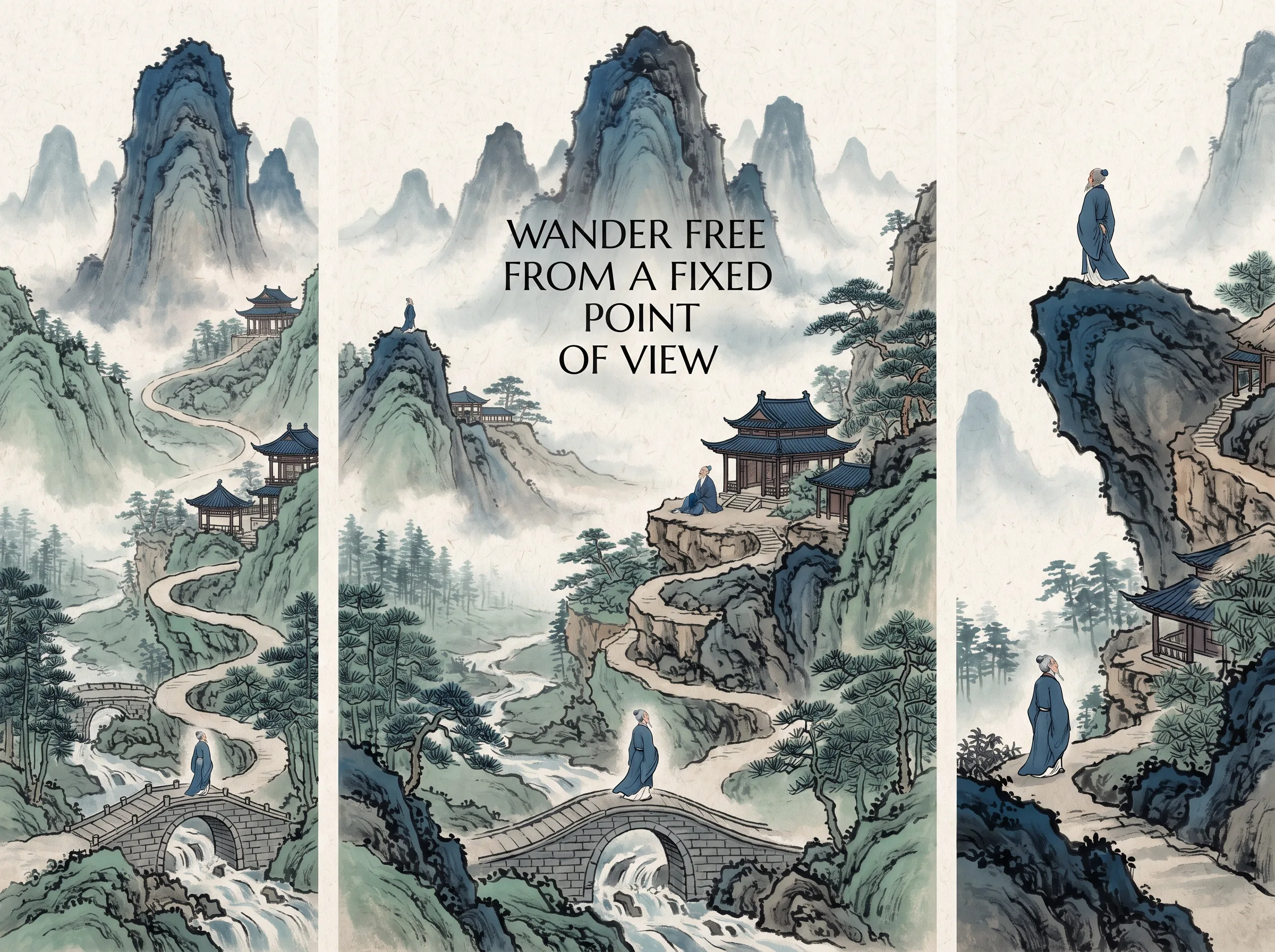
Scattered perspective, then, is not merely an artistic technique. It is an embodied philosophy — a way of being in the world that favors openness, movement, and non-fixation over control and finality.
Observing Without Possessing
The Song dynasty was also a period of extraordinary natural observation in Chinese painting. The Confucian project of investigating things to extend knowledge (géwù zhìzhī, 格物致知), sometimes translated as "investigating things to extend understanding," encouraged deep attention to the natural world. Song painters studied bird behavior, plant growth, and rock formations with remarkable care. A painter might observe how a peacock walks or how a wild goose stretches its neck — details rendered with precision that rivals anything from the European Renaissance.
But the goal was different. The Song painters' aim was moral and spiritual cultivation, not technical domination Their observation was an act of engagement with the world, not an attempt to possess or control it.
Consider the contrast with Leonardo da Vinci, whose anatomical studies were equally meticulous — but driven by a desire to master representation and, ultimately, the world itself. Both cultures valued deep observation. But the Chinese tradition, informed by Daoist ideas of wu wei (无为) — action through non-forcing — approached observation differently. The painter observes without the urge to capture, fix, or own the subject.
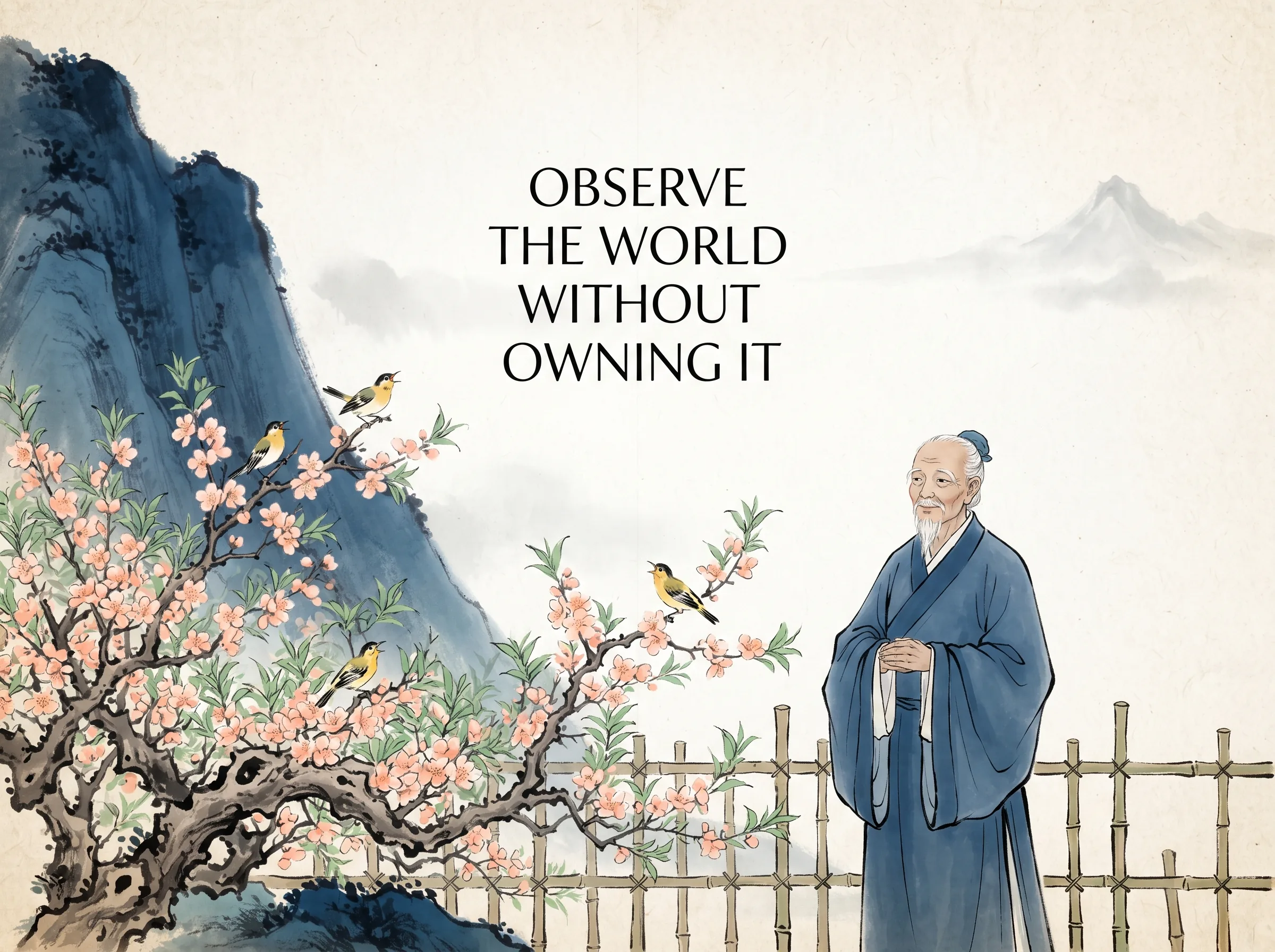
How we observe matters as much as what we observe. Observation without the compulsion to control is itself a form of wisdom.
When Did "Better" Become the Goal?
The Western invention of single-point perspective — credited to the architect Filippo Brunelleschi around 1415–1420, and later systematized by Leon Battista Alberti in his De Pictura (1435) — was indeed a technological leap with enormous consequences. It transformed not only painting but architecture, engineering, cartography, and eventually the scientific revolution. The ability to represent space accurately on a flat surface became synonymous with progress.
But from a Daoist perspective, one might ask: Is technical progress always spiritual progress?
Modern life is saturated with single-point thinking. We optimize. We measure. We chase KPIs and standardized metrics. We have become extraordinarily good at seeing the world from one dominant angle — and we have largely lost the ability to see from multiple angles simultaneously. The algorithmic echo chambers of the digital age are, in a sense, the ultimate expression of single-point perspective: one viewpoint, reinforced endlessly, presented as the whole picture.
There is an ancient Chinese saying, often attributed to Wang Wei, that describes this differently: "Distant people have no eyes, distant trees have no branches, distant mountains have no stones". The point is not a failure of detail — it is a recognition that truth often lies not in accumulation but in essence. A painting that captures the spirit of a mountain is not less truthful for omitting its individual rocks.
In a culture obsessed with seeing more clearly, there may be wisdom in learning to see differently.
What We Can Apply Today
The philosophical choices behind Chinese painting are not confined to art history. They offer practical wisdom for navigating modern life.
Reframe the problem by shifting your perspective. When stuck on a difficult decision or challenge, ask yourself: Am I viewing this from one fixed vanishing point? What would the situation look like from another angle? The Chinese tradition of scattered perspective reminds us that no single viewpoint contains the whole truth.
Prioritize spirit over technical perfection in creative work. Whether you are writing, designing, leading a team, or building something new, ask: Am I chasing surface accuracy, or am I expressing what matters? The Chinese concept of shensi — capturing the spirit of a subject — and the Japanese idea of wabi-sabi both point in the same direction: meaning often lives beneath the surface of precision.
Cultivate scattered awareness. Instead of freezing on one interpretation of a situation, practice moving your attention through it. Let your gaze wander — across the details, across the distances, across your own assumptions. The habit of flexible attention is itself a form of inner cultivation.
These practices connect to real challenges in modern life. Information overload, algorithmic filtering, and the cultural pressure to optimize every decision are all expressions of single-point thinking. Stepping back from the compulsion to fixate, measure, and control — even briefly — can restore a sense of depth and balance.
The ancient Chinese painters did not abandon realism because they were primitive. They chose depth over display. That is a choice we can still make.
FAQ
Did Chinese painters simply lack the technical skill to paint realistically? No. Chinese painters were fully capable of producing highly detailed, realistic work — particularly in the Song dynasty, when artists studied nature with extraordinary attention. The choice to move away from strict realism was philosophical, not technical. They deliberately prioritized spiritual resonance over visual exactness.
Is Western single-point perspective "better" than Chinese scattered perspective? Not necessarily — they serve different purposes and reflect different worldviews. Single-point perspective is powerful for creating the illusion of depth from a fixed viewpoint. Scattered perspective creates an immersive, participatory experience. Neither is inherently superior; they emerge from different cultural and philosophical assumptions about the nature of reality and perception.
What does "spirit over form" actually mean in practice? It means that the inner quality, energy, or essence of a subject is considered more important than its outward appearance. A bamboo painting might not depict every leaf with botanical accuracy, but it should convey the resilience, flexibility, and vitality of bamboo. The viewer is invited to feel the subject's character, not just recognize its shape.
How is this connected to Daoism specifically? Daoist ideas — particularly the emphasis on simplicity, non-action (wu wei), and the limits of fixed perspectives — deeply influenced Chinese aesthetic theory. The belief that reality cannot be captured from a single angle (echoing the Dao De Jing) and the practice of perceiving beyond the mechanical eye (as in Zhuangzi's "sitting and forgetting") both encouraged artists to seek what lies beneath surface appearance, reflecting the enduring wisdom of Daoist Perspective on Chinese Painting.
For broader philosophical context, consult our related exploration on Why “Heaven and Humanity as One” Still Matters: What Ancient Chinese Aesthetics Can Teach Modern Life.
Sources & Further Reading
[2] Sun. (2025). *History of Chinese Painting — How Did the Ming Dynasty Enable Literati Painting to Shape 300 Years of Art?* (中国绘画史:明代文人画) [Video]. Bilibili.
Further Reading
- Edgerton, S. Y., Jr. (1991). The Heritage of Giotto's Geometry: Art and Science on the Eve of the Scientific Revolution. Cornell University Press.
- Bartlett, K. R. (2005). The Italian Renaissance: Course Guidebook. The Teaching Company.
- Zhuangzi. Inner Chapters (especially "The Great and Honoured Master" and "Among the Matters of the World"). Various translations available.
- Dao De Jing (Laozi). Classic text on the nature of the Tao.
- The Great Learning (Daxue), one of the Four Books of Confucianism — source of the concept of investigating things to extend knowledge (géwù zhìzhī, 格物致知).







[…] Centuries later, the Ming dynasty theorist Dong Qichang pushed back against this determinism. While the precise original phrasing of his arguments requires careful textual verification, his position is well known in Chinese aesthetic tradition: spirit resonance (qì yùn, spirit resonance (qì yùn, 气韵)) can indeed be cultivated, and the method is encapsulated in the famous maxim — reading ten thousand scrolls and travelling ten thousand miles (dú wàn juǎn shū, xíng wàn lǐ lù, 读万卷书,行万里路) [3]. The accumulated effect of this cultivation, Dong suggested, is a clearing of the mind's worldly turbidity, allowing an inner landscape to emerge naturally (xiōng zhōng tuō qù chénzhuó, zìrán qiūhè nèi yíng, 胸中脱去尘浊,自然丘壑内营) [3]. In this view, capturing technical likeness is strictly secondary to channeling the vital cosmic flow; explore this radical aesthetic tradition in our reflection on Why Chinese Painting Let Go of “Accuracy” — A Daoist Perspective. […]