
The West often defines beauty as a kind of fire—blazing, complete, impossible to ignore. Greek statues gleam with every flexed muscle; Renaissance paintings flood the eye with gold, crimson, and divine light. Beauty here is abundance, declaration, an overflowing presence that demands your attention.
Chinese aesthetics, however, has long favored ice over fire. Its highest form of beauty is not what fills the frame but what remains when everything else recedes—like a tide pulling back to reveal the smooth stones beneath, like silence after the last note of a guqin string has faded. This quiet, restrained beauty, sometimes described as “clear stillness” (qingji, 清寂), does not shout. It invites—a foundational perspective explored in Daoist Simplicity and Inner Stillness.
What happens when a tradition that values emptiness meets a world that cannot stop producing? For modern readers living under constant notifications, packed schedules, and endless consumption, Chinese aesthetic philosophy may offer something increasingly rare: permission to subtract rather than accumulate.
Daoist Simplicity and Inner Stillness: Two Different Visions of Beauty
The contrast between Western and Chinese approaches to beauty is not merely stylistic—it reflects a deeper difference in how each tradition understands presence and absence, fullness and potential.
In the Western classical tradition, beauty has often been associated with maximal expression. The Baroque era pushed this to its limit, filling every surface with ornamental detail, dramatic gesture, and emotional intensity. The viewer is told exactly what to feel, what to see, what matters. Nothing is left to imagination; completeness is the goal.
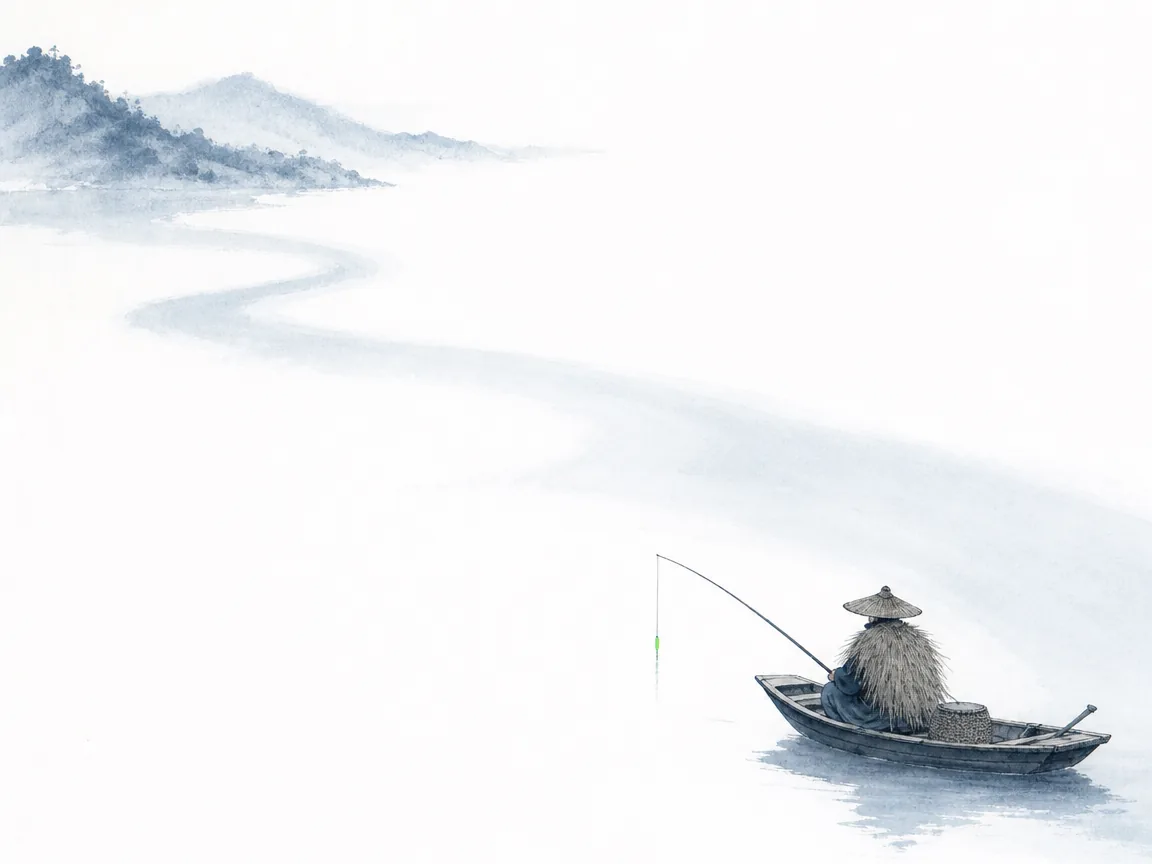
Chinese painting and poetry operated from a different premise. In ink-wash landscape painting, the most important element on the page is often the empty space—the unpainted mountain, the unseen river, the fog that separates one peak from another. This is the practice of “leaving blank space” (liubai, 留白): an artistic and philosophical choice to leave parts of the composition deliberately unfilled. The white is not an absence to be regretted; it is a space where the viewer's own breath, thought, and feeling can enter.
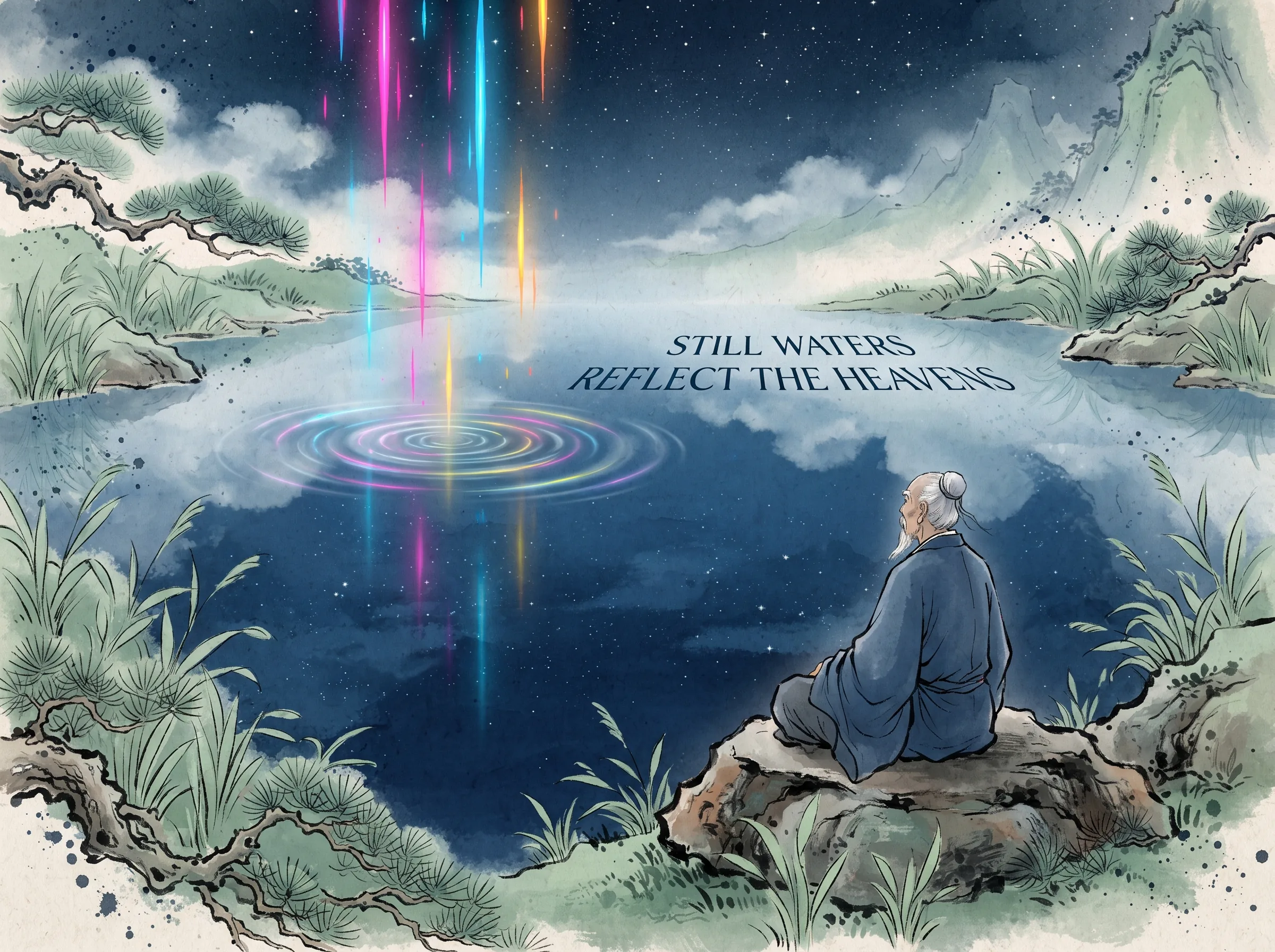
The metaphor of a receding tide captures this well. Western beauty is the wave cresting—loud, bright, unforgettable in its moment. Chinese beauty is what the water leaves behind: damp sand, scattered shells, the slow breathing of the shore. Both are real. Neither cancels the other. But only one teaches restraint.
The Daoist Roots of Subtraction
At the heart of this aesthetic lies a philosophical tradition that has shaped Chinese thought for over two thousand years: Daoism.
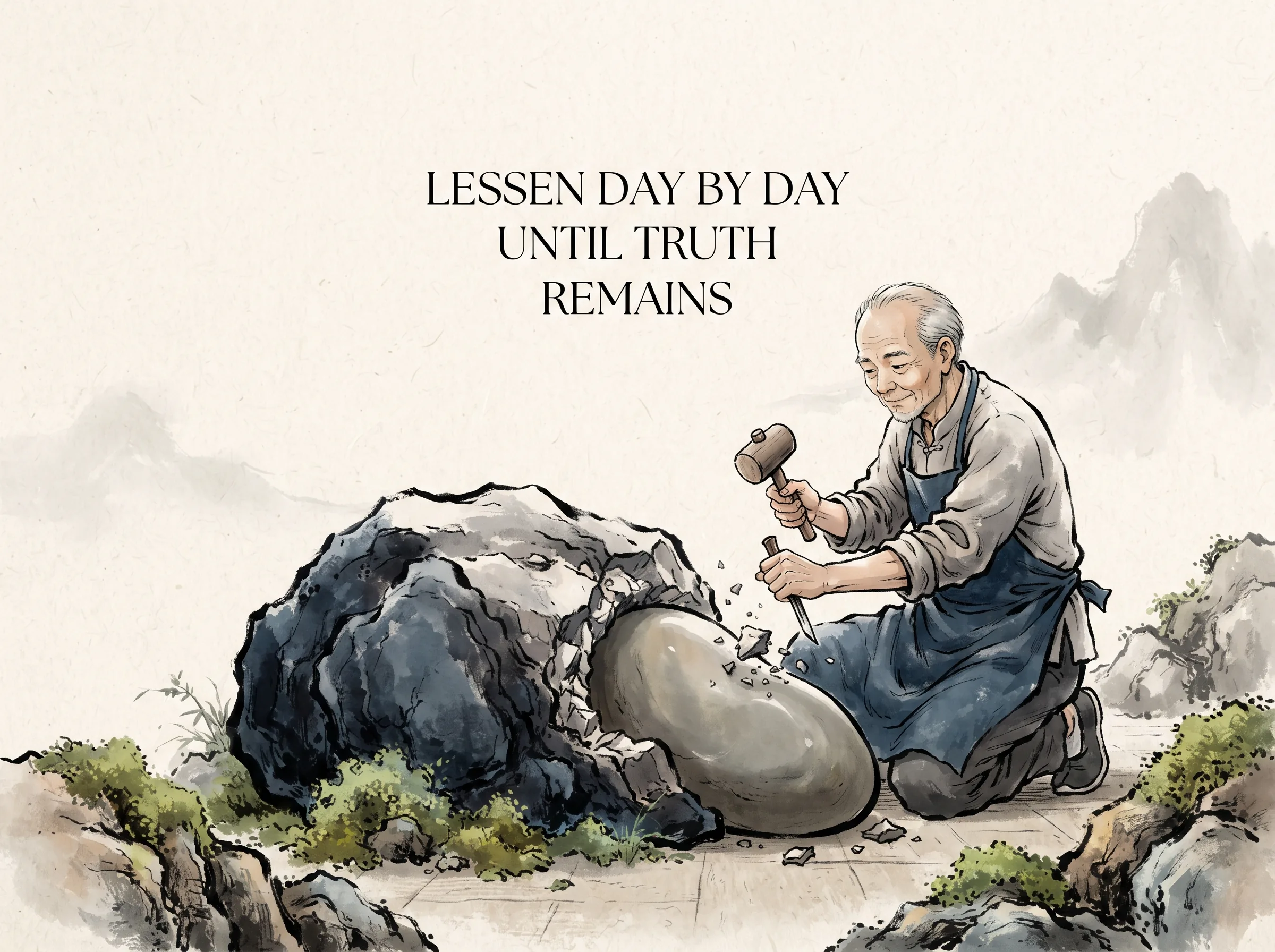
Daoist philosophy, traditionally attributed to Laozi (老子), offers one of the most radical critiques of accumulation in human intellectual history. The Daodejing—a text whose chapter divisions vary across ancient manuscripts—contains one of its most famous formulations in a passage that runs roughly: “In learning, one adds day by day; in the Dao, one subtracts day by day. Subtract and again subtract, until non-action is reached” [1]. Another well-known line, often cited from the sixteenth chapter of the same text, speaks of attaining “utmost emptiness” and maintaining “deep stillness” as a way of aligning with the underlying rhythm of the world [1].
These ideas are not calls to nihilism or withdrawal from life. They are arguments about where genuine power and perception reside. The Daoist claim is that what we normally call “more”—more knowledge, more possessions, more stimulation—often obscures what matters. The uncarved block, a recurring metaphor in the text, represents potential precisely because it has not yet been shaped into something fixed and limited.
This stands in sharp contrast to the accumulation-based logic that dominates modern life. Our economy rewards growth, our screens reward engagement, and our social lives reward visibility. Daoism asks a simpler, harder question: what if the path to clarity runs in the opposite direction?
Art as Philosophical Practice
Daoist ideas did not stay in philosophical texts. They moved into ink, paper, brushstrokes, and blank space. The result is an artistic tradition where the philosophy and the craft are inseparable.
Consider the Southern Song dynasty painter Ma Yuan (马远, active circa 1190–1224), who served as an academy painter in the imperial court [2]. His landscapes are famous for a compositional choice that seems almost audacious: mountains and trees crowd into one corner of the scroll, while the rest of the picture plane dissolves into mist or empty paper. He became so associated with this approach that later critics dubbed him “Ma of One Corner” (Ma Yijiao, 马一角) [2]. Examine this artistic principle further through the classical aesthetic philosophy of Can You Learn to See More Beautifully? Ancient Chinese Wisdom on Cultivating Aesthetic Sense.
A viewer standing before such a painting is not being denied a subject. They are being invited to complete it. The empty space is not waiting to be filled by the artist's future brushwork; it is asking the viewer to supply their own atmosphere, their own sense of scale, their own meditation. The painting succeeds not by giving everything away but by withholding strategically.
Poetry works similarly. Wang Wei's (王维) famous four-line poem Deer Enclosure (Luzhai, 鹿柴) demonstrates the technique in miniature:
Empty mountain—no one in sight,
Only the echo of human voices.
Late sunlight enters the deep forest,
And shines once more on the green moss.
(空山不见人,但闻人语响。返景入深林,复照青苔上。)
The poem's power lies in what it does not say [3]. We are never told why the speaker is there, what he feels, or whether he is alone or simply unseen. The emptiness of the mountain becomes a mirror for the reader's own quiet. The final image—a thin blade of light returning to moss—holds both transience and persistence, cold and warmth, in a single stroke.
Temperate Beauty—Cold Shell, Warm Heart
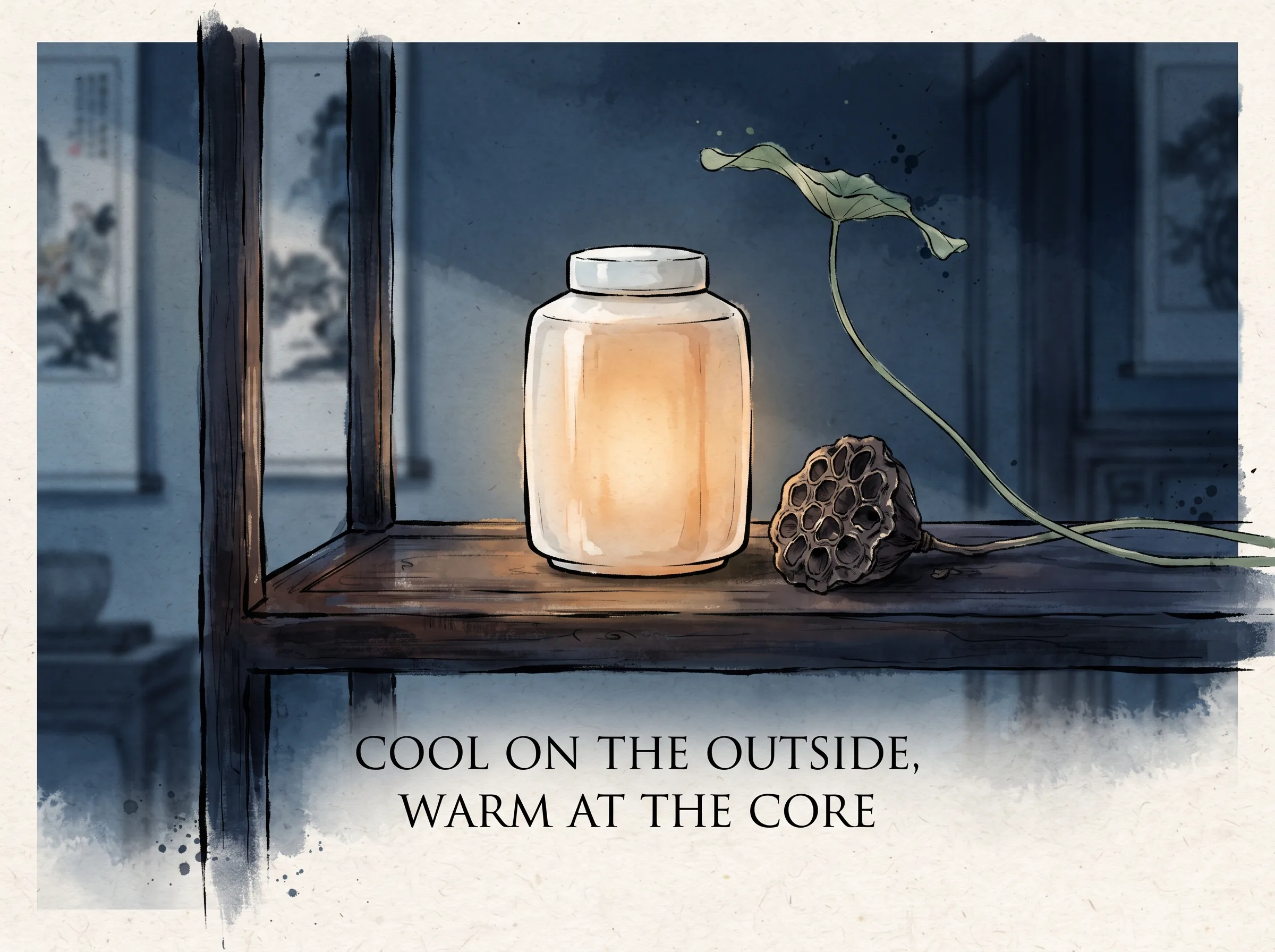
One of the most misunderstood aspects of Chinese aesthetics is its relationship to emotion. The surface of much Chinese art is cool, distant, restrained. But that coolness is not the absence of feeling. It is the container for feeling that would be too overwhelming if expressed directly.
Su Shi's (苏轼) Former Ode on the Red Cliff (Qian Chibi Fu, 前赤壁赋), written in 1082 during a period of exile, is a masterpiece of this principle [1]. The essay opens with an image that seems almost understated:
A clear breeze comes gently;
The water stirs not at all.
(清风徐来,水波不兴。)
This is not a scene of drama or revelation. It is wind moving over still water. And yet, within this calm frame, Su Shi builds one of the most profound meditations in Chinese literature—on change, impermanence, the relationship between the eternal and the momentary, and the possibility of inner peace even when external circumstances have stripped a person of power and status.
The coldness here is a vessel. The warmth underneath is what makes the whole composition endure.
This pattern repeats across Chinese literary and artistic tradition. The most emotionally charged moments are often expressed through landscapes, seasons, and objects rather than through direct declarations of feeling. A lone moon, a broken bridge, a half-finished letter—these become carriers of emotion precisely because they do not name it.
For modern readers accustomed to emotional directness, this approach may seem indirect. But indirection has its own honesty. It acknowledges that some feelings are too complex, too layered, too vulnerable to be captured in a single statement. The space around them—the silence, the blank paper, the unpainted cloud—is what allows the emotion to breathe.
Practical Wisdom for Modern Life
The question for contemporary readers is not whether they should become painters or poets. It is whether the principles behind Chinese aesthetics can offer any practical relief in an age defined by overload.
A few approaches, drawn from the tradition, may help.
Practice daily subtraction. Chinese aesthetics does not demand a complete life overhaul. It begins with a single, manageable act of removal. Each day, identify one unnecessary thing and let it go—one unnecessary subscription, one habit of checking your phone out of reflex, one conversation you agree to because of obligation rather than interest. The point is not asceticism but clarity. Every subtraction creates a small space where attention can return to what actually matters.
Train slow perception. Contemporary research suggests the average viewer spends roughly seventeen seconds looking at an image in a gallery—enough time to judge, photograph, and move on, but not enough to be transformed [2]. Slow perception is the practice of staying with one thing—a flower, a line of poetry, a cup of tea—for longer than the initial impulse demands. Not analyzing it. Not performing appreciation. Simply allowing it to register. Over time, this practice sharpens the capacity to notice subtlety, which is the foundation of the aesthetic sensibility the Chinese tradition cultivates.
Reserve your own “one corner.” Ma Yuan's compositional daring—leaving most of the canvas empty and trusting the viewer—has a personal parallel. Every person benefits from an uncompromised space: a morning routine without screens, a walk without destination, a room without decoration, a conversation without an agenda. This is not indulgence. It is the personal equivalent of “leaving blank space” (liubai, 留白)—the blank area where your own presence can enter without competition.
Make peace with incompleteness. The Preface to the Poems Collected from the Orchid Pavilion (Lantingji Xu, 兰亭集序) is valued partly because its corrections and revisions reveal a living mind at work. Chinese aesthetics often treats unfinished work not simply as failure but as invitation. The lesson is not that perfection is impossible but that completion is not always necessary for meaning. An imperfect relationship, an unresolved conversation, a project abandoned halfway—these are not always signs of defeat. Sometimes they are simply spaces where life continues to move.
FAQ
Is “clear stillness” (qingji, 清寂) the same as Japanese wabi-sabi (侘寂)?
While the two concepts share an appreciation for simplicity, imperfection, and transience, they emerge from different cultural and philosophical lineages. Wabi-sabi developed within Japanese Buddhist aesthetics, particularly Zen, and emphasizes the beauty of asymmetry, weathering, and modest materials. Qingji, rooted in Chinese Daoist and literati traditions, emphasizes stillness, restraint, and the productive power of emptiness. Both value what is left unsaid, but they approach it from different historical and philosophical directions.
How can someone without an interest in art apply Daoist aesthetics to daily life?
The principles do not require expertise in painting or poetry. Subtraction, slow perception, and reserved personal space are everyday practices. The aesthetic tradition simply provides a vocabulary and a set of examples that make these practices feel intentional rather than arbitrary. Reading a poem slowly, taking a walk without a destination, or declining an obligation are all applications of the same logic—that less noise allows more signal.
Does Daoist subtraction mean rejecting modern technology or progress?
Not at all. Daoist thought is not anti-civilization; it is anti-uncritical accumulation. The Daodejing warns against excess, not innovation. Many contemporary readers find that a Daoist lens helps them evaluate which technologies and habits serve their actual life and which merely fill time. The question shifts from “Can I have this?” to “Does this create space or consume it?”
Where can I read more about Chinese aesthetics and Daoist philosophy?
Primary sources such as the Daodejing and Zhuangzi, available in many English translations, offer direct access to the philosophical foundation. Art historical surveys of Chinese landscape painting and poetry can provide visual and literary examples of the principles discussed here. Several scholarly works explore the intersections of Daoism, Buddhism, and Chinese aesthetic theory in greater depth.
Summary and Next Steps
Chinese aesthetics chose stillness not out of indifference but out of a deep conviction that the most important things cannot be forced into view. The tradition teaches that emptiness is not the opposite of richness—it is the condition that makes richness possible. A painting without blank space leaves nowhere for the viewer to enter. A life without subtraction leaves no room for attention to settle. A heart without restraint has no vessel for its deepest feelings.
For modern readers, the lesson is practical rather than decorative. You do not need to live in a mountain retreat or master ink painting to benefit from this tradition. You need only recognize that subtraction is a form of cultivation, that silence is a form of speech, and that the space you protect is the space where your life actually happens.
The next step is not to add another habit to your routine but to identify one thing you can reliably remove—one notification, one obligation, one minute of aimless scrolling—and let it go. Start small. Let the blank space grow from there, reflecting the enduring wisdom of Daoist Simplicity and Inner Stillness.
Examine this artistic principle further through the classical aesthetic philosophy of Why Empty Space Feels Most Expensive: The Chinese Art of Leaving Room.
Deepen your understanding of these principles in our reflection on Beyond the Aloof Genius: How Chinese Art Blends Beauty and Practical Wisdom.
Sources & Further Reading
[1] Primary sources referenced
[2] Former Ode on the Red Cliff (前赤壁赋) — Wikisource — Su Shi's 1082 prose-poem, containing the line “A clear breeze comes gently; the water stirs not at all” (清风徐来,水波不兴).
[3] Deer Enclosure (鹿柴) by Wang Wei — Wikisource — Wang Wei's poem beginning “Empty mountain—no one in sight” (空山不见人,但闻人语响).
[4] Song Dynasty painting: Viewing Plum Blossoms in Snow — National Palace Museum — Museum record on Ma Yuan, his role as a Southern Song court painter, and the origin of the “Ma of One Corner” designation (马一角).
[5] Further reading (not cited in body)
[6] Lawrence Cunningham, Dao De Jing: A New Translation of the Tao Te Ching — an accessible English translation with commentary
[7] James Cahill, The Dry Wind: A Study of Ma Yuan — an art-historical study of Ma Yuan's one-corner compositions
[8] Victor Mair, The Columbia Anthology of Traditional Chinese Literature — a broad selection of classical Chinese poetry and prose in English translation
[9] Craig Clunas, Art in China — a general survey contextualizing aesthetic principles within broader cultural history






