
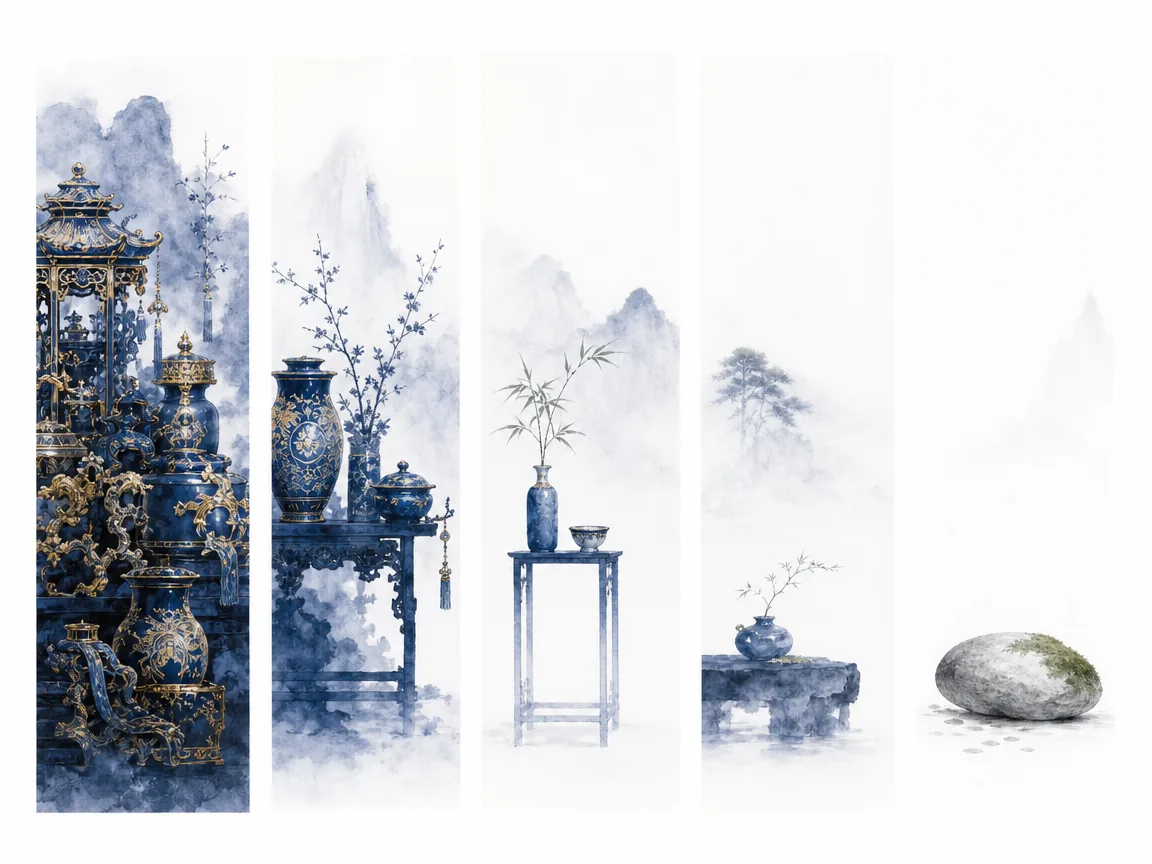
In recent years, a framework describing five levels of aesthetic sensibility—poverty of taste (贫), showy wealth (富), refined nobility (贵), cultural elegance (雅), and pure simplicity (素)— has circulated widely in Chinese-language media. It is not a classification found in classical texts, but rather a contemporary interpretation that draws on traditional ideas about refinement, restraint, and spiritual cultivation. What makes it compelling is not its antiquity, but its diagnostic power: it offers a language for understanding why material prosperity alone does not produce beauty, and why the pursuit of elegance often stalls at the level of display.
At the heart of this framework lies a quiet Daoist insight — that true simplicity is not the absence of decoration, but the presence of clarity. The Zhuangzi describes simplicity and uncarved potential (朴素) as something so fundamental that "the world cannot compete with it in beauty" [1]. This is not a call to own less for its own sake; it is an invitation to recover a deeper relationship with what matters. In an age saturated with logos, filters, and algorithmic trends, the question the five levels raise is urgent: are we consuming beauty, or merely performing it? This principle is central to Five Levels of Chinese Aesthetics.
This article explores each level not as a ladder to climb, but as a mirror. Where you find yourself may reveal more about your culture's relationship with desire, education, and meaning than you might expect. And where Daoist simplicity enters the picture is precisely here — as a corrective to the assumption that more is always better.
Five Levels of Chinese Aesthetics: A Framework for Thinking About Taste
Before examining each level individually, it is worth clarifying what this framework does and does not claim. The five-tier model—poverty (贫), wealth (富), nobility (贵), elegance (雅), and simplicity (素)— appears in contemporary Chinese commentary rather than in classical philosophical texts. It is a modern synthesis, one that connects observable patterns in consumer behaviour, urban design, and cultural production to older ideas about aesthetic refinement found in Confucian and Daoist thought. Treating it as a lens rather than a doctrine keeps it honest.
Each level represents a different relationship between the individual and the objects, spaces, and practices that surround them. Moving upward is not simply a matter of spending more money or acquiring more cultural knowledge. It is a shift in orientation — from external validation toward internal coherence, from accumulation toward discernment.
The levels are not fixed categories either. A person might display the aesthetics of refined nobility (贵) in one domain of life and fall back into habits of showy wealth (富) in another. Civilization as a whole may excel in one level while lagging in another. The framework is descriptive, not prescriptive — and that is precisely why it remains useful.
The Aesthetic Deficit (贫)
The first level, poverty of taste (贫), denotes not poverty of wealth but poverty of aesthetic perception. It is the stage where beauty is neither anticipated nor valued, and where utility occupies the entire field of vision. Economic constraint is one cause; educational neglect is another. When schools treat art and music as peripheral subjects and public spaces are designed without attention to proportion, colour, or human experience, the result is not merely visual dullness — it is a kind of sensory atrophy.
In many Chinese cities, the consequences are visible on commercial streets where signage competes for attention through size and saturation rather than harmony or legibility. Advertising often prioritises shock value over clarity. Public interiors and exteriors alike tend toward a generic efficiency that asks nothing of the eye or the mind. The term sometimes used for this phenomenon — visual pollution — is not hyperbole. It describes an environment in which the aesthetic sense has never been trained, only ignored.
This is not unique to China. Many societies pass through phases where rapid urbanisation and commercial expansion outpace aesthetic consideration. What distinguishes the poverty stage (贫) is the absence of any institutional or cultural counterweight — no tradition of civic design, no expectation that public spaces should cultivate dignity rather than merely accommodate function.
The remedy, in this framework, begins with education: not specialized art training, but a general cultivation of attention. Learning to notice proportion, to feel the weight of a colour, to sense when a space feels open or claustrophobic — these are skills that can be developed at any age. The first step out of aesthetic poverty (贫) is simply to look more carefully.
Showy Consumption and the Performance of Taste (富)
The second level, showy wealth (富), marks the transition from scarcity to surplus — and, problematically, from need to display. Here, aesthetic choice is replaced by brand recognition. Luxury logos become the primary language of taste, and wealth is communicated through visibility rather than through discernment. The objective is not beauty but distinction: the desire to be seen as someone who can afford what others cannot.
This stage is recognisable everywhere luxury markets have expanded rapidly. Gold-toned interiors, overly branded garments, and conspicuous vehicles serve as social signalling rather than aesthetic expression. The underlying logic is transactional — taste is assumed to be interchangeable with price. What is absent is the question of whether an object, a space, or a style actually cultivates pleasure or meaning, or whether it merely announces its cost.
Comparisons with other cultures are instructive but should be handled carefully. Italian design is frequently cited for its emphasis on craft and material quality, while Japanese aesthetics — exemplified by brands like Muji — are noted for their commitment to understated functionality. These traditions share a tendency to locate value in what is restrained rather than what is announced. That is not to claim they are superior, only that they model a different relationship between wealth and expression.
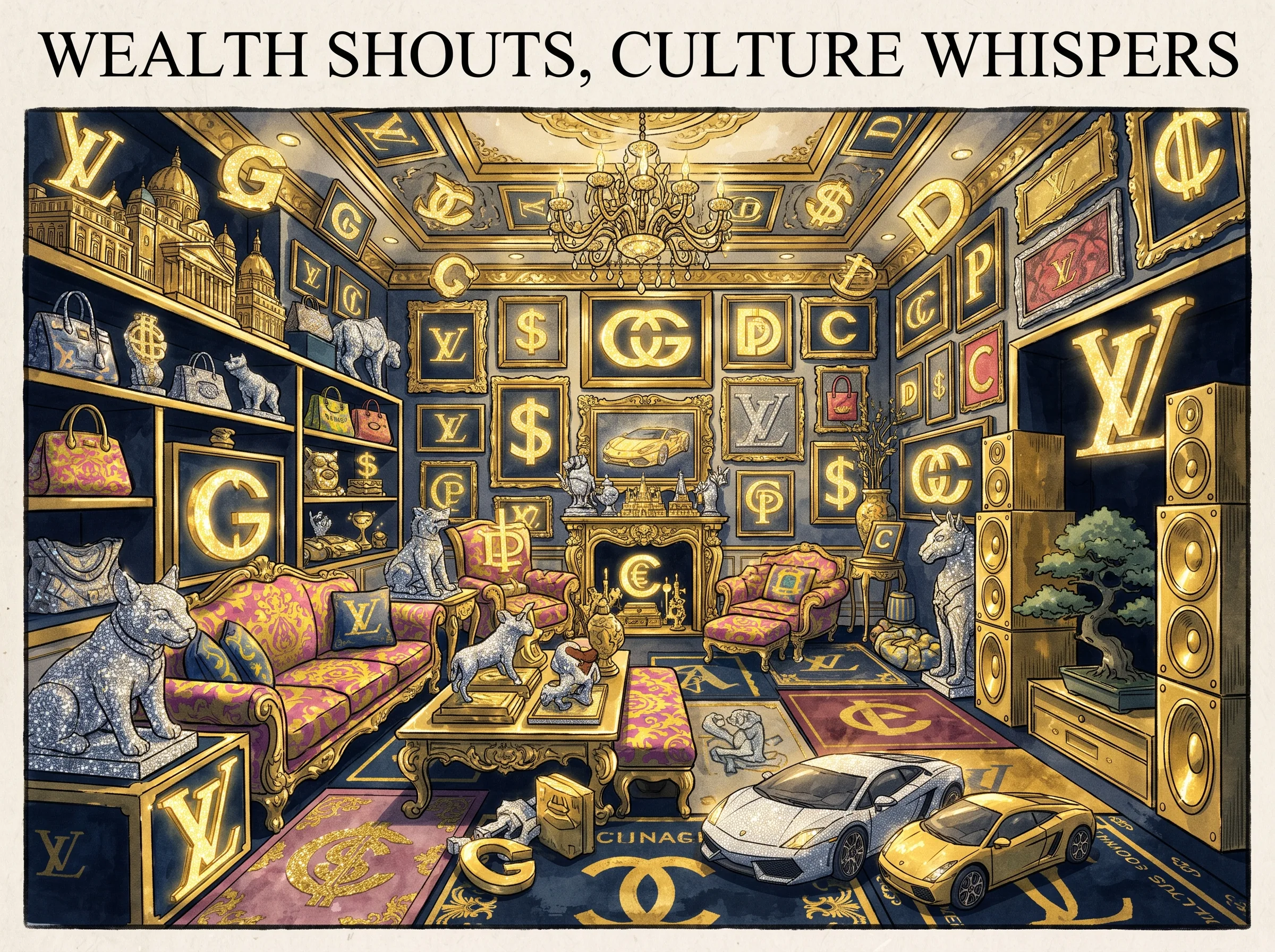
The danger of the showy-wealth stage (富) is that it confuses confidence with conspicuousness. A person who fills their environment with status symbols may feel secure, but that security is externally sustained — it depends on others recognising the signals. When the symbols lose their cultural cache, the sense of self-worth they propped up tends to collapse with them.
Refined Elegance and Cultural Depth (贵)
The third level, refined nobility (贵), represents a qualitative shift. Taste is no longer performed; it is cultivated. Objects are chosen not for their recognisability but for their relationships — to history, to craft, to the particular context in which they exist. Elegance here is quiet, earned through exposure rather than expenditure. Examine this artistic principle further through the classical aesthetic philosophy of Why We Call Ancient Chinese Art “Ugly” — And What Aesthetic Humility Can Teach Us.
European aristocratic traditions offer one reference point. British manor aesthetics, French courtly refinement, and the Italian appreciation of proportion and line all reflect centuries of accumulated practice. These are not merely styles; they are systems of attention shaped by ritual, education, and social expectation. A well-trained eye in these traditions can discern the difference between a reproduction and an original, between mass-produced furniture and piece-made craft, without needing a price tag to guide the judgment.
Japan provides another model, one that has influenced global design thinking considerably. The tea ceremony, the arrangement of flowers, the wearing of kimono — these are practices in which beauty is inseparable from discipline, seasonality, and respect for material. The aesthetic is not decorative; it is dimensional. Each gesture carries meaning, and meaning is refined through repetition.
China's own historical traditions of refinement — Song dynasty ceramic minimalism, Ming furniture design, literati painting — once embodied this level of sensibility. But centuries of political disruption, ideological campaigns, and rapid modernisation fragmented the transmission of these practices. For many contemporary Chinese people, the refined-nobility level (贵) feels like something learned from museums or period dramas rather than from lived inheritance. The result is a generation that admires classical beauty without having absorbed its underlying grammar.
Recovering refined nobility (贵), then, requires more than acquiring antiques or visiting galleries. It demands sustained engagement with the traditions that produced them — reading, studying craft, understanding the cultural contexts that gave objects their resonance. Taste at this level is not inherited; it is built.
The Integration of Art and Self-Cultivation (雅)
The fourth level, cultural elegance (雅), moves beyond refinement into integration. At this stage, aesthetic practice is not something one appreciates occasionally; it is something one lives. Beauty is woven into daily routine rather than reserved for special occasions.
In traditional Chinese culture, the literati ideal of proficiency in the zither, Go, calligraphy, and painting (琴棋书画) exemplified this principle. These arts were not hobbies for the wealthy; they were disciplines for self-cultivation. The practice of calligraphy, for instance, was simultaneously an exercise in breath control, patience, moral reflection, and technical mastery. The goal was never to produce a beautiful object for display; it was to become a more cultivated person through the act of creating.
This tradition understood art as a path, not a product. The same holds true for other practices across East Asian cultures — the Japanese tea ceremony as spiritual discipline, Zen garden meditation as physical contemplation, Korean buncheo (scholarly gatherings) as communal aesthetic refinement. In each case, the boundary between art and life dissolves.
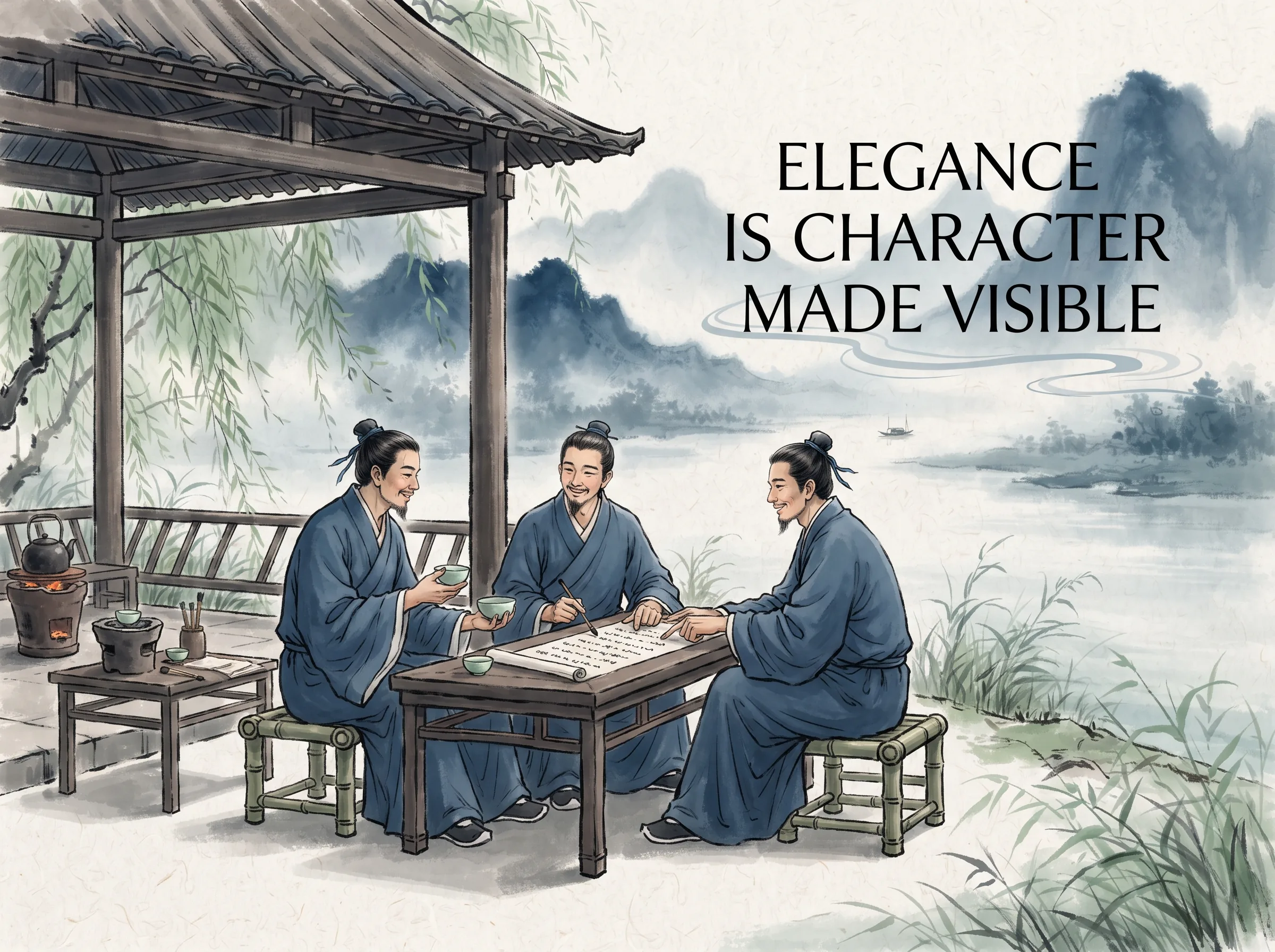
Contemporary distortions of cultural elegance (雅) are widespread. The recent surge in hanfu photography, for example, has produced striking images but often lacks the depth of engagement that characterises genuine aesthetic practice. Wearing traditional clothing for social media posts is not inherently wrong, but when it becomes a performance without understanding — when the cultural, historical, and philosophical dimensions are ignored — it risks becoming another form of showy wealth (富) dressed in historical costume. Similarly, playing Guqin music in the background of a café interior without understanding its meditative purpose reduces a spiritual practice to ambient decoration.
The difference between authentic cultural elegance (雅) and its superficial imitation is intention. Authentic aesthetic practice asks what the practitioner becomes through the practice. Superficial imitation asks only how the practice makes the practitioner appear.
Simplicity as the Highest Form of Beauty (素)
The fifth and final level, pure simplicity (素), is where Daoist philosophy offers its most direct contribution. Pure simplicity (素) denotes purity, unadorned simplicity, and a return to the essential nature of things. It is not minimalism as a design trend — which can itself become a status marker — but simplicity as a way of being.
The Zhuangzi articulates this most clearly in the chapter on the Heavenly Dao (天道): "Stillness makes one sage, movement makes one king; without action one is honoured. Simplicity and unadorned authenticity — the world cannot compete with it in beauty" [1]. The passage links simplicity (朴素) directly to the Daoist ideals of emptiness and stillness (虚静) and non-action (无为). Beauty at this level is not achieved through addition but through subtraction — the removal of what obscures rather than what reveals.
This is distinct from Buddhist concepts of impermanence or wabi-sabi, though they share surface similarities. Wabi-sabi finds beauty in asymmetry and decay as expressions of transience; Daoist simplicity (素) finds beauty in clarity and undifferentiated potential as expressions of the uncarved block (朴). Both reject pretension, but they root that rejection in different philosophical foundations.
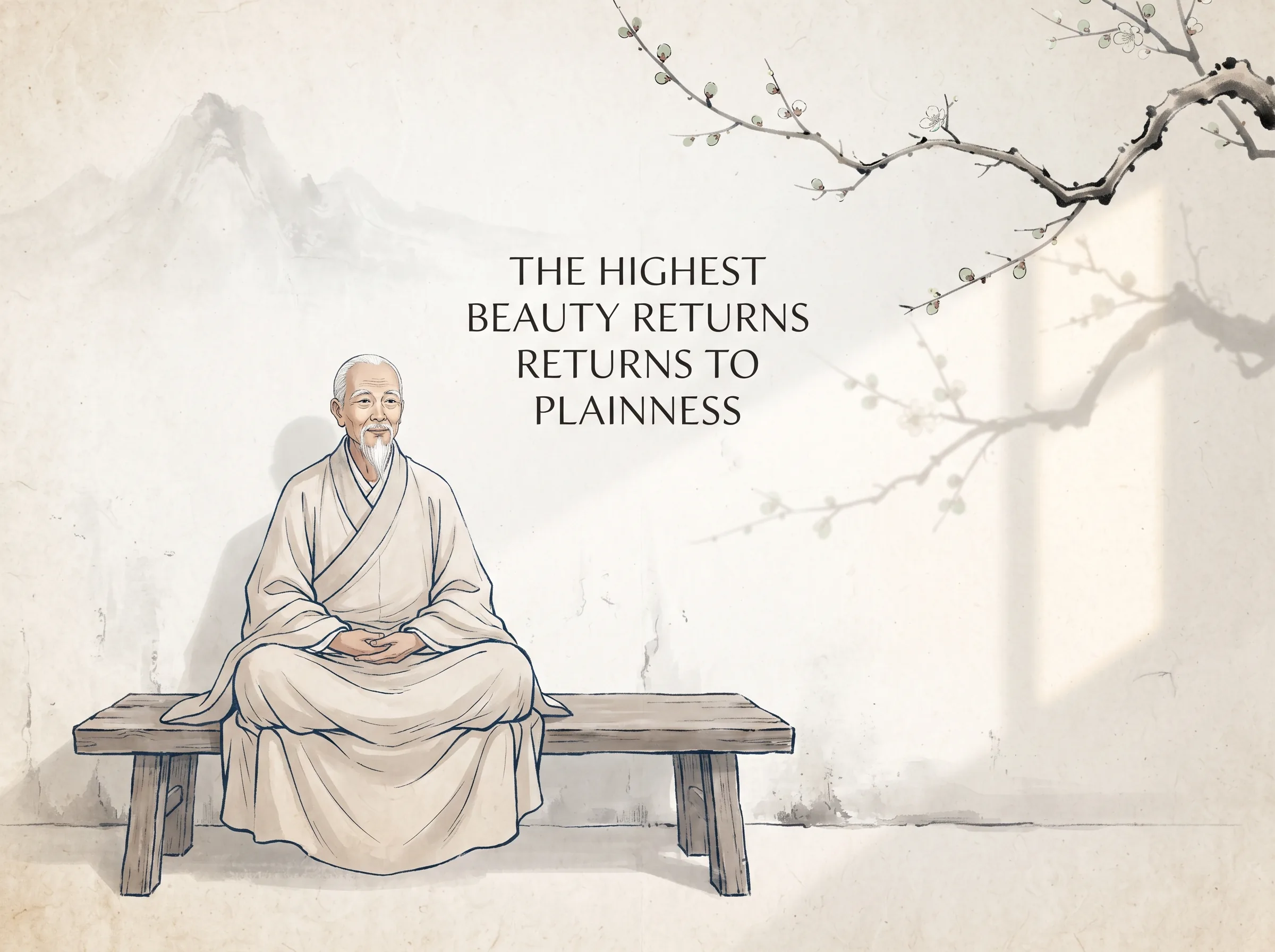
Scandinavian minimalism, with its emphasis on light, function, and material honesty, offers a useful cross-cultural parallel. Like Daoist simplicity, it suggests that less can be more — not because austerity is virtuous, but because clarity serves human wellbeing. The difference is that Scandinavian design typically frames simplicity as a practical solution, while Daoist simplicity frames it as a spiritual one.
What makes pure simplicity (素) particularly relevant today is its implicit critique of consumer culture. Every product, every notification, every curated image in the digital economy is designed to add — to add desire, to add content, to add complexity. Pure simplicity (素) invites the opposite movement: to subtract until what remains is not empty but essential.
Practical Steps Toward Simpler Aesthetic Living
Moving from theory to practice requires small, intentional actions rather than dramatic lifestyle overhauls. The following suggestions are grounded in the principle that aesthetic growth is cumulative — each step builds on the last.
Audit your environment. Spend one evening observing your living and working spaces without judging them. Note what draws your attention and what repels it. Ask: does this object serve a purpose, or does it serve primarily to fill space? Remove or relocate anything that fails both tests.
Choose one practice to deepen. Rather than attempting to master multiple aesthetic disciplines, select one — calligraphy, tea preparation, plant care, or even mindful walking — and commit to it for three months. Depth of engagement with a single practice teaches more than superficial exposure to many.
Study before you acquire. Before purchasing an object, read about its history, its materials, and the traditions that shaped its design. This slows the impulse to buy and builds the habit of selection over accumulation.
Create digital silence. Designate periods — an hour each evening, for example — when screens are off and visual input is minimised. Cluttered screens train cluttered attention; quiet screens allow attention to recover.
Seek out spaces that practise restraint. Visit galleries, gardens, or interiors where silence and simplicity are the dominant features. Notice how your body responds — does your breathing slow? Does your mind settle? These bodily responses are data, not nostalgia.
Reflect on desire rather than indulging it. When you feel the urge to acquire something new, ask: what am I trying to communicate? To whom? Is this desire mine, or has it been shaped by advertising, social comparison, or cultural expectation? The question itself is a form of cultivation.
FAQ
Is the five-level aesthetic framework found in classical Chinese texts?
No. The framework of poverty (贫), wealth (富), nobility (贵), elegance (雅), and simplicity (素) as a progressive scale appears in contemporary Chinese commentary rather than in ancient philosophical or literary sources. It is a modern synthesis that draws selectively on Daoist, Confucian, and broader East Asian aesthetic ideas. Its value lies in its diagnostic usefulness, not in its classical authority.
How does Daoist simplicity differ from Japanese wabi-sabi or Scandinavian minimalism?
All three traditions value restraint, but they root that value differently. Daoist simplicity (素) emerges from the concept of the uncarved block (朴) and the idea that beauty resides in what is essential and unadorned — it is ontological in orientation. Japanese wabi-sabi finds beauty in imperfection, asymmetry, and the evidence of time — it is rooted in Buddhist understandings of impermanence. Scandinavian minimalism emphasises functional clarity, natural materials, and humane design — it is pragmatic in orientation. None is superior; each addresses a different dimension of the human relationship with material culture.
Can someone practice Daoist-inspired simplicity without adopting Daoism as a religion or philosophy?
Yes. The aesthetic and ethical dimensions of Daoist simplicity — attention to what is essential, resistance to excessive accumulation, cultivation of inner clarity — can be approached as practical wisdom without requiring theological commitment. Many people engage with Daoist ideas precisely because they offer a language for questioning consumer culture without demanding belief.
Why does this framework matter for ordinary people, not just collectors or designers?
Because aesthetics is not confined to museums and galleries. The objects we choose, the spaces we inhabit, the images we consume, and the pace at which we live all carry aesthetic weight. Understanding the difference between display and discernment is relevant to anyone who shops, decorates, communicates digitally, or navigates a city. The five levels offer a vocabulary for asking better questions about the life we are building.
Where to Go From Here
The five levels of Chinese aesthetics are not a ranking system designed to make anyone feel inadequate. They are a map — one that shows where we have been, where we tend to stall, and where we might go next. The Daoist tradition, with its insistence that simplicity is not deprivation but clarity, offers a compass for navigating the gap between what we consume and what sustains us.
If this framework resonated with you, the next step is not to purchase fewer things but to understand more deeply why you purchase at all. Read about the history of Chinese literati aesthetics. Observe the design choices in your own environment with fresh attention. Try a practice — any practice — that requires patience rather than speed. These are small gestures, but they are gestures in the right direction.
Aesthetic maturity is not a destination. It is a continuous recalibration of attention, desire, and meaning. The fact that you are asking where you stand on this framework is already a sign that you have moved beyond aesthetic poverty (贫).
Examine this artistic principle further through the classical aesthetic philosophy of Can You Learn to See More Beautifully? Ancient Chinese Wisdom on Cultivating Aesthetic Sense.
Sources & Further Reading
[1] Zhuangzi, “The Way of Heaven” (《庄子·天道》) — Wikisource — Primary classical source for the concept of simplicity (朴素) as irreducible beauty
[2] Daoism (Stanford Encyclopedia of Philosophy) — Academic overview of Daoist philosophical concepts including non-action (无为) and their relationship to aesthetic and ethical thought
[3] Zhuangzi (《庄子》) — Wikisource — Collection text confirming the structure and chapter numbering of the Zhuangzi
Further Reading
- The Daodejing, Chapter 19, on embracing simplicity and uncarved potential (见素抱朴) and reducing self-interest and desire (少私寡欲)
- Waley, Arthur. The Way and Its Power: A Study of the Tao Te Ching and Its Place in Chinese Thought — accessible translation and commentary on Daoist aesthetics
- Sun, Xiaomeng. Chinese Aesthetic Tradition — survey of classical Chinese aesthetic thought from Confucian and Daoist perspectives
- Nakamura, Hajime. Wabi-Sabi: The Japanese Art of Imperfection — exploration of Japanese aesthetic principles and their philosophical roots






