

Confucius once flew into a rare public rage. The ruler of a major state had arrived with his entire household to witness a dance performance — sixty-four dancers moving in perfect formation. Confucius watched in silence. When it was over, he could contain himself no longer. A minister, he said, should not be allowed such spectacle. What would a ruler dare do next if such transgressions were tolerated?
His anger is recorded in the Analects, one of the most studied texts in East Asian history. But what exactly was he angry about? Was Confucius simply defending rigid class boundaries — insisting that people stay in their assigned places and know nothing more? Or was he protecting something more subtle: the idea that certain forms belong to certain contexts, and that blurring those boundaries corrupts the whole system of meaning? This principle is central to Confucian Concept of Li.
This question matters today. We live in an age that tends to read ritual propriety (lǐ, 礼, often translated as "ritual" or "propriety") through a single lens: hierarchy, control, obedience. We hear the word and think of kneeling, deference, and the suppression of individual freedom. But this reading flattens a rich tradition. At its philosophical core, ritual propriety (lǐ, 礼) is about appropriateness — knowing what fits, where, and when. It is not merely a code of domination; it is a framework for living thoughtfully within a shared world.
Confucian Concept of Li: What Lǐ (礼) Actually Means
The Chinese character for ritual propriety (lǐ, 礼) carries multiple layers of meaning. It can refer to formal ritual, to manners and etiquette, to the complete (zhěngtào, 整套) system of social norms that order human relationships, and — at its deepest level — to a sense of what is fitting and right in any given situation. The modern English word "propriety" captures part of this, but not all of it.
Confucius did not invent ritual propriety (lǐ, 礼). The practices he described as ritual propriety (lǐ, 礼) predated him by centuries — ancestral sacrifices, court ceremonies, ways of greeting and dining, garments worn for specific occasions. What Confucius did was to give these practices a philosophical foundation. He argued that ritual was not empty formality but the very medium through which human beings become fully human. To perform ritual propriety (lǐ, 礼) correctly is to cultivate both oneself and one's relationships with others.
This point is central to understanding the tradition. Confucius believed that raw human nature, left unchecked, tends toward chaos — not because people are inherently bad, but because without shared forms of interaction, we lack the tools to coordinate our lives. Ritual provides those tools. It teaches us how to express respect, how to mourn, how to celebrate, how to disagree, and how to occupy our roles in families, communities, and larger societies.
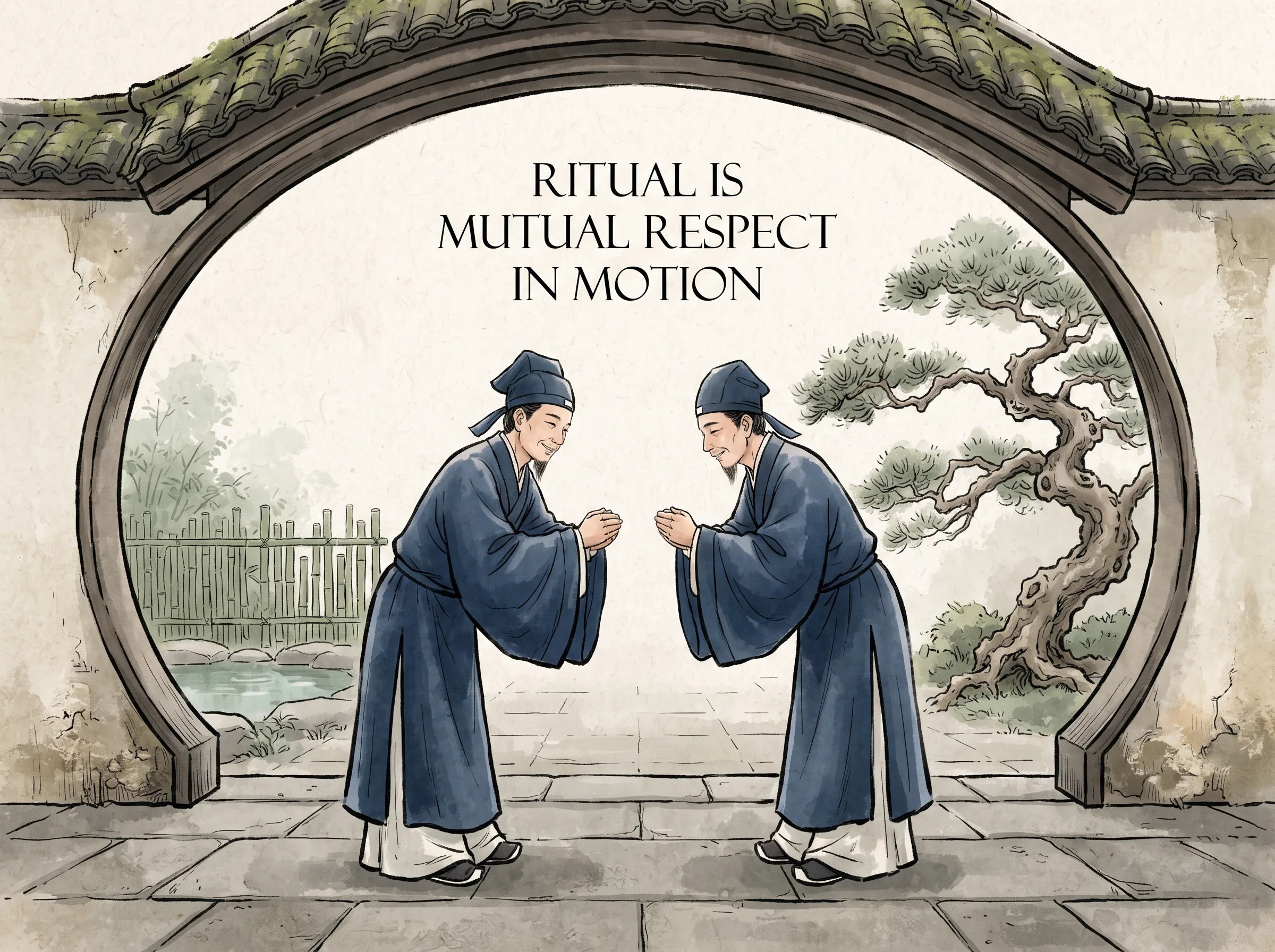
The Book of Rites (Liji, Classic of Rites (礼记)), a collection of texts compiled centuries after Confucius but preserving his school's teachings, offers a famous pairing that illuminates this idea: music brings people together, while ritual creates appropriate distinctions. In this view, ritual propriety (lǐ, 礼) and music (yuè, 乐, music/harmony) work in tandem — one establishing difference and structure, the other creating unity and emotional resonance. Neither alone is sufficient. Together, they compose a complete vision of social life.
How Hierarchy Looked — and What It Signaled
One reason modern readers recoil from ritual propriety (lǐ, 礼) is that it was historically entangled with systems of power. In imperial China, ritual codes were indeed used to justify social inequality, patriarchal authority, and obedience to the state. This is not a matter of interpretation — it is documented fact. The Confucian tradition provided the ideological backbone for a civil service examination system, for filial piety laws, and for elaborate court protocols that reinforced the emperor's divine mandate.
But examining how ritual propriety (lǐ, 礼) operated in practice also reveals something surprising: the system was far more nuanced than simple oppression suggests. Visual culture offers clear evidence.
Take the Forbidden City. The number of figurines lining the roofs of its buildings was not decorative — it was a precise marker of rank. The Hall of Supreme Harmony (Taihe Dian), where the emperor held court, bore the highest count of roof figures, ten in total, a number unique among surviving ancient Chinese buildings. Other palaces carried fewer, their owners' status visibly encoded in the architecture itself. This was not arbitrary ornamentation; it was a language of social order written in stone and glazed tile.
Similarly, the buzi — the embroidered square patches worn on the robes of Ming and Qing officials — functioned as an instantly legible system of rank. Civil officials wore bird emblems; military officials wore beast emblems. A first-rank civil official displayed a crane; a ninth-rank official, the lowest tier, wore a quail. When two officials met, they could determine each other's status in seconds by glancing at the chest and back of the opponent's robe. The system was practical as well as symbolic.
Even domestic architecture carried this logic. The stone drum-shaped bases flanking traditional courtyard house entrances — known as mendang — were said to indicate the occupation of the family within: round bases for military households, square ones for civil officials. While the precise historical origins of this convention are debated among architectural historians, the folk tradition consistently linked shape to function, embedding social information into everyday built environments. Connect these enduring values to the broader cultural heritage explored in How Could a 5,000-Year-Old Civilization Stay United?.
In all these cases, ritual propriety (lǐ, 礼) operated as a system of visual and material communication. It told people how to relate to one another, where to stand, what to wear, how to behave. Whether one views this as elegant social choreography or coercive control depends largely on one's position within the hierarchy.
The Critique Is Not Wrong
It is important to say plainly: the oppressive uses of institutional ritual (lǐ, 礼) were real. For centuries, the Confucian ritual system was deployed to enforce class hierarchy, restrict women's autonomy, demand blind obedience to authority, and punish deviation as moral failure. Confucianism itself was weaponized by dynastic states and later by political movements to justify social engineering and personal suppression. No honest engagement with this tradition can ignore this history.
Confucius himself, however, was not blind to the dangers of ritual hollowed out into empty performance. In the Analects, he warned that ritual without inner virtue is worthless — that a ceremony performed without genuine feeling is merely theater. The "Eight Rows of Dancers" (Bā Yì, 八佾) episode, in which Confucius raged at a minister's unauthorized use of royal dance protocols (guīgé, 规格), is often read as a defense of elite privilege. But it can also be read as a warning: when the forms of authority are misused, the entire moral ecosystem deteriorates. Confucius was angry not because a minister dared to dance, but because the dance represented a breakdown in the relationship between form and legitimacy.
This tension — between ritual propriety (lǐ, 礼) as a guide to living and as a tool of social control — is not a bug in the Confucian tradition. It is a feature. The tradition contains the resources for its own critique. Later Confucian thinkers, from Mencius to Wang Yangming, developed sophisticated arguments about the inner moral source of ritual, insisting that external forms must always be grounded in genuine virtue.
The Core Insight: Appropriateness
Stripped of its historical baggage and abstracted to its philosophical core, what remains of ritual propriety (lǐ, 礼)? One word captures it well: appropriateness (shìdàng, 适当 / héshì, 合适) — suitability, fittingness. suitability, fittingness.
Consider a simple example. Wearing a bikini to a podcast recording studio is inappropriate. Wearing a bikini on a beach in Hainan is perfectly appropriate. The garment has not changed. The context has. What separates the two situations is not a universal moral rule but a sensitivity to setting — to who is present, what is expected, what the occasion calls for.
This is the everyday wisdom of propriety (lǐ, 礼). It asks not "What is the rule?" but "What fits here?" The answer depends on role, relationship, place, time, and intention. A greeting between friends differs from a greeting between strangers. A funeral requires different conduct than a wedding. Speaking directly to a senior colleague carries different implications than speaking to a junior one. None of these distinctions are inherently oppressive — they are the basic infrastructure of social coordination.
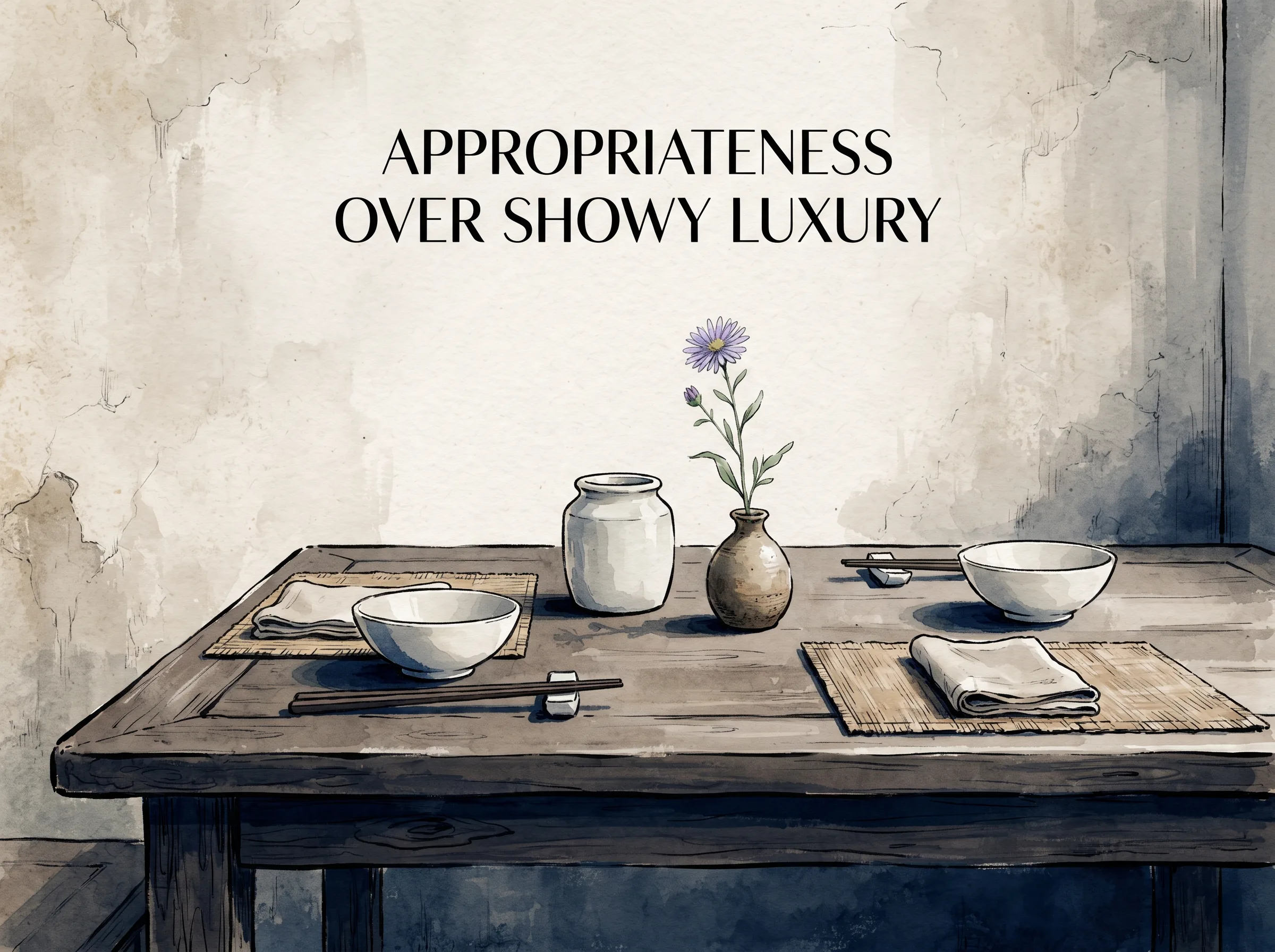
Confucius understood this intuitively. He advised his students to consider not only what they want to do but what is fitting to do in each situation. The Analects is filled with such guidance: how to speak to different types of people, when to act and when to wait, how to balance sincerity with tact, how to honor tradition without being trapped by it.
The modern parallel is everywhere. Professional dress codes exist because context matters — wearing the same clothes to a job interview as to a gym session signals a failure to read the situation. Social media presence requires the same sensitivity: the post appropriate for a close friend differs from the post appropriate for a professional network. Cross-cultural communication is perhaps the richest domain, where what is polite in one context may be deeply offensive in another. Propriety (lǐ, 礼), properly understood, is simply the practice of paying attention to these differences.
Three Takeaways for Modern Readers
Engaging with ritual propriety (lǐ, 礼) today does not require adopting ancient rituals or revering hierarchical systems. But it does invite a particular kind of attention — one that can enrich how we move through the world.
First: context matters more than costume. The specific forms of ritual propriety (lǐ, 礼) — the kowtow, the silk robes, the jade pendants — are products of their time. They carry historical weight that we may not wish to inherit. But the underlying instinct — that what we do should fit where and when we do it — is timeless. A modern equivalent might be the question professionals ask before sending an email: who is this for, what is the tone, is this the right channel? This is ritual propriety (lǐ, 礼) in miniature.
Second: appropriateness is not conformity. Recognizing that something fits in a given context does not mean accepting every hierarchy that claims to demand that fit. A person can understand that wearing formal attire to a courtroom is appropriate without believing that courtrooms should exist to enforce class inequality. Sensitivity to context is a skill, not an ideology. It can be used to navigate oppressive systems — or to resist them. The key is maintaining the ability to ask, critically, whether a given norm should be followed.

Third: life as an aesthetic project. Chinese philosophy, especially the Confucian tradition, treats living well as a kind of art. Just as a painter composes a landscape with attention to balance, proportion, and meaning, so a person composes their daily life through choices about how to dress, speak, gesture, and relate. Ritual propriety (lǐ, 礼) provides the palette — not a fixed set of instructions, but a set of sensibilities for attending to context, relationship, and expression. The result is not rigid conformity but cultivated sensitivity.
This aesthetic dimension is where ritual propriety (lǐ, 礼) connects most naturally to contemporary concerns. We live in an era saturated with images of how to present ourselves — on screens, at work, in public spaces. The question is no longer whether we will perform identity but how thoughtfully we will do so. Ritual propriety (lǐ, 礼) offers a tradition of reflection on exactly this question.
Closing Thought
The question with which we began — What if Confucian ritual isn't about oppression but about finding the right thing, in the right context, at the right time? — does not have a simple answer. Ritual propriety (lǐ, 礼) has been used both as a tool of liberation and as an instrument of control. It has been invoked to cultivate moral refinement and to enforce social hierarchy. The tradition contains both possibilities simultaneously.
What it offers today, stripped of dogma and read critically, is a vocabulary for thinking about fit — about how our actions, appearances, and words land in specific situations with specific people. It asks us to pay attention. Not blindly. Not submissively. But attentively.
In a world that often rewards speed over sensitivity, impulsivity over deliberation, and authenticity over awareness, the Confucian question — Is this appropriate? Does this fit? — may be more relevant than ever.
FAQ
Is ritual propriety (lǐ, 礼) the same as "ritual" in the religious sense? No. While ritual propriety (lǐ, 礼) can include ceremonial practices, it is broader than religious ritual. It encompasses manners, social norms, professional etiquette, and the general principle of contextual appropriateness. Think of it less as worship and more as the grammar of social life.
Does Confucianism support hierarchy and inequality? Historically, ritual propriety (lǐ, 礼) was embedded in hierarchical social structures, and Confucian institutions did reinforce class and gender distinctions. However, the philosophical core of ritual propriety (lǐ, 礼) — appropriateness to context — is separable from any particular hierarchy. Many contemporary scholars argue that the tradition contains resources for critiquing its own oppressive applications.
Can the concept of ritual propriety (lǐ, 礼) be applied outside of East Asian cultures? Yes. The underlying question — what fits this situation, this relationship, this moment? — is universal. Every culture has norms about appropriate behavior in different contexts. Ritual propriety (lǐ, 礼) provides a particularly systematic and philosophically rich framework for thinking about these norms, but the instinct it describes is cross-cultural.
How do I know when a social norm is appropriate versus oppressive? This is precisely the critical judgment that ritual propriety (lǐ, 礼) demands. Appropriateness is not automatic; it requires reflection on whether a norm serves human flourishing, respects the dignity of those involved, and can be questioned when it causes harm. The tradition itself insists that ritual without virtue is empty — a principle that invites ongoing ethical scrutiny, reflecting the enduring wisdom of Confucian Concept of Li.
Gain deeper perspective on weathering adversity through the poetic resilience explored in When the Path Is Blocked: What Classical Chinese Wisdom Teaches About Frustrated Ambition.
For a deeper comparative examination of these ideas, explore our related study on Reimagining Ritual: What Ancient China Can Teach Us About Meaningful Ceremony.
Sources & Further Reading
[1] Classical Source (精彩選件:郭熙〈早春圖〉) — National Palace Museum Southern Branch (国立故宫博物院南部院区)
[2] BV19g4y1k7jp — Bilibili Li Xiaoyu: Ritual and Music Tradition and Chinese Art (礼乐传统与中国艺术)
Further Reading (延伸阅读)
- Analects: Ba Yi (论语·八佾, 3.1) — Classical passage on Confucius criticizing usurpation of imperial ritual
- Classic of Rites: Record of Music (礼记·乐记) — Systematic Confucian discourse on ritual and music
- Guo Xi: Linquan Gaozhi (林泉高致集) — Northern Song landscape theory on political cosmological symbolism






